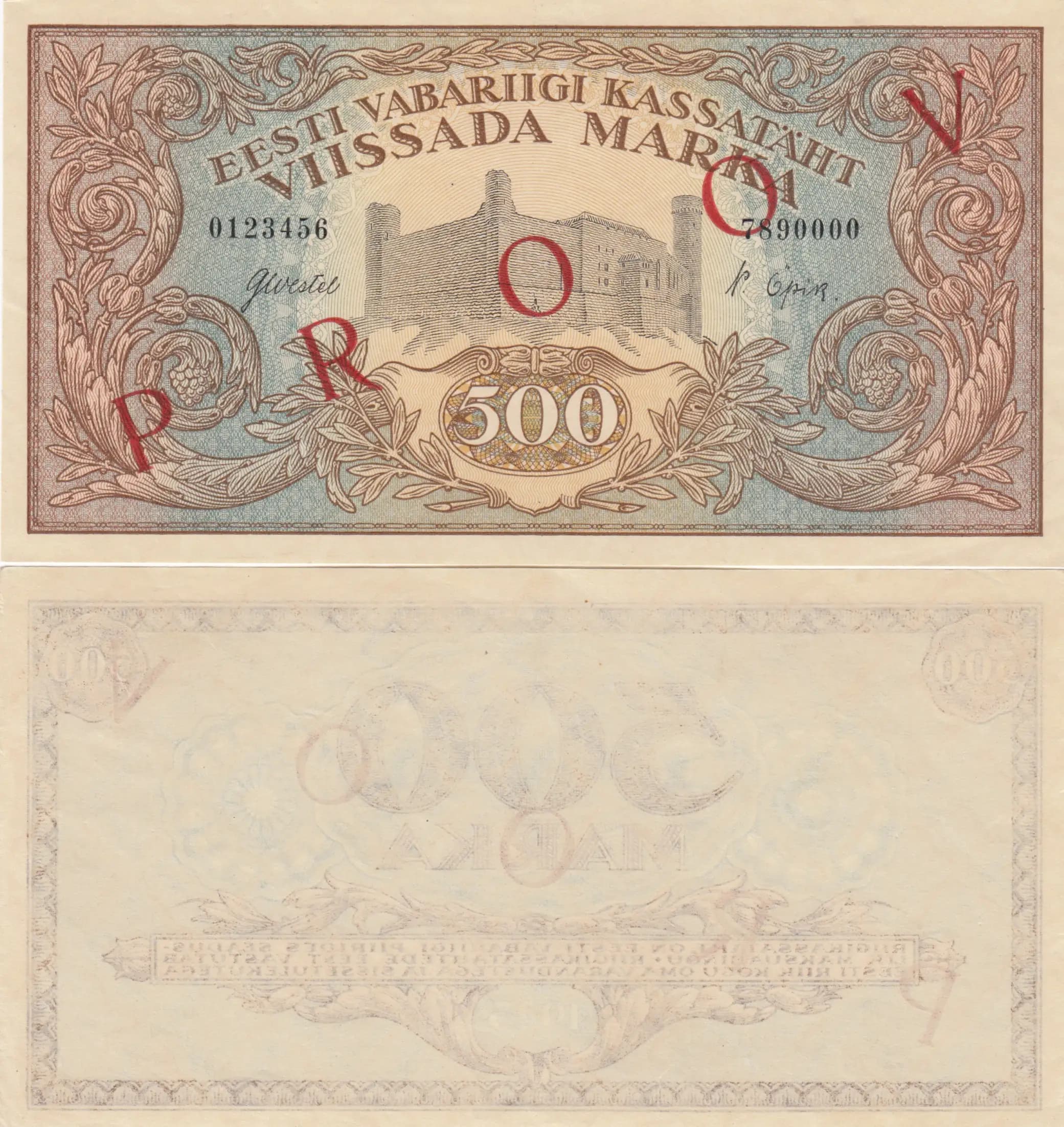
500 marka 1923
Market Prices
About This Note
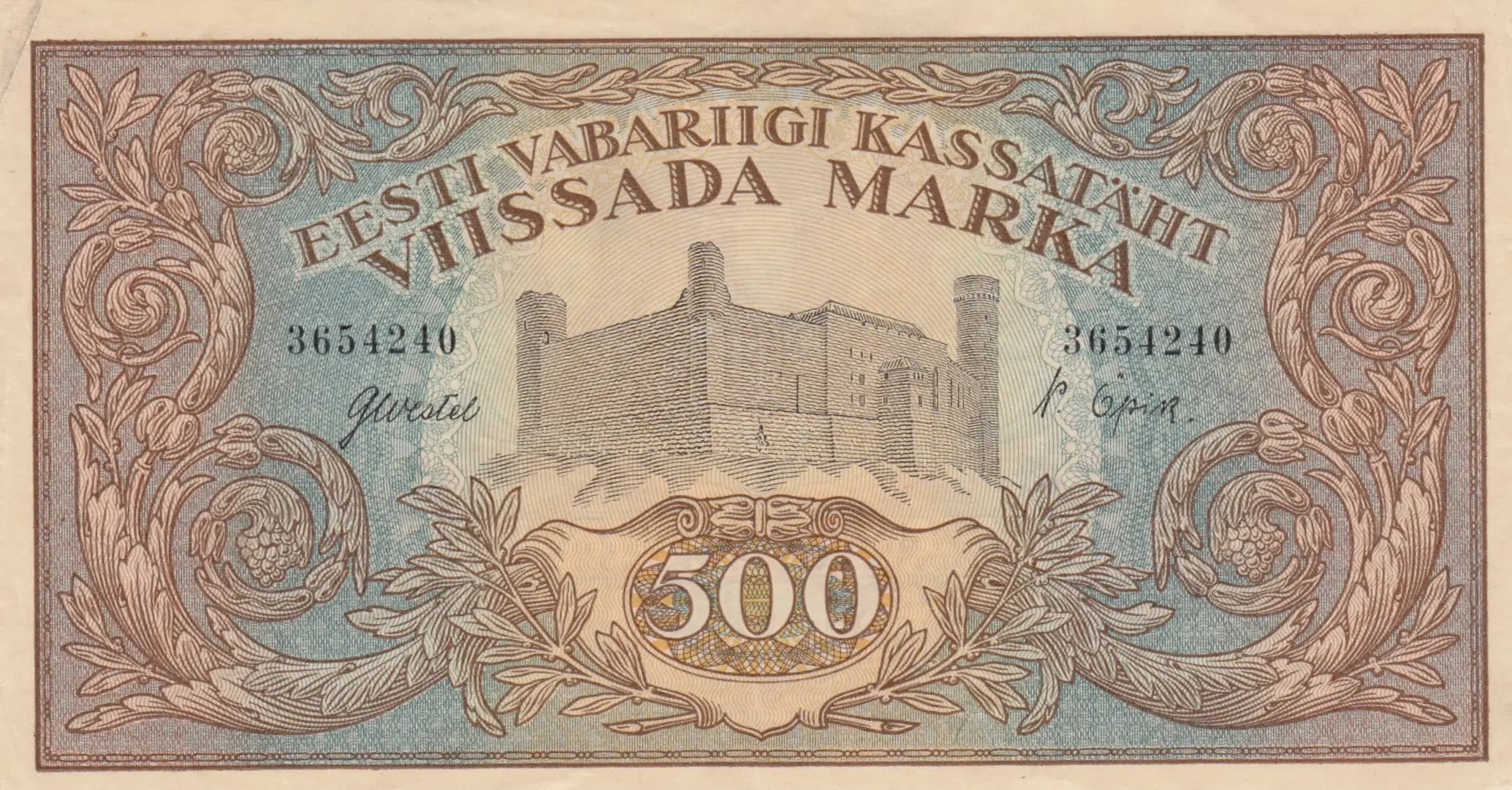
This 500 Marka note from Estonia's 1923 Treasury issue represents a striking example of early Estonian monetary sovereignty, rendered in fine brown and teal engraving. The note exhibits AU condition with sharp, crisp printing throughout and no visible wear, creases, or damage—the hallmark of a carefully preserved or uncirculated specimen. The central feature of Toompea Castle (Domberg), Tallinn's iconic fortress, combined with intricate guilloché patterns and ornate Art Deco-influenced borders, makes this an aesthetically significant piece of Estonian numismatic history.
Common. The eBay market data shows this note regularly trading in the $35–$180 range depending on condition, with AU-range specimens commanding $100–$150. Regular sales at these price points indicate adequate supply in the collector market. While Estonian currency from the early independence period (1918–1928) has collector interest, the 500 Marka denomination was part of the standard circulating issue with no evidence of extreme scarcity. The 2016 catalog valuation of $1,000 for UNC specimens appears aspirational compared to actual realized sales.
The 500 Marka denomination was issued by the Treasury of the newly independent Estonian Republic during its first years of sovereignty following independence from Russia in 1918. The prominence of Toompea Castle on the obverse—one of Estonia's most recognizable medieval landmarks—served both practical and symbolic purposes: establishing national identity through iconic architecture while providing anti-counterfeiting through detailed engraving. This 1923 issue represents a critical period when Estonia was establishing its own currency systems independent of Russian and German influences.
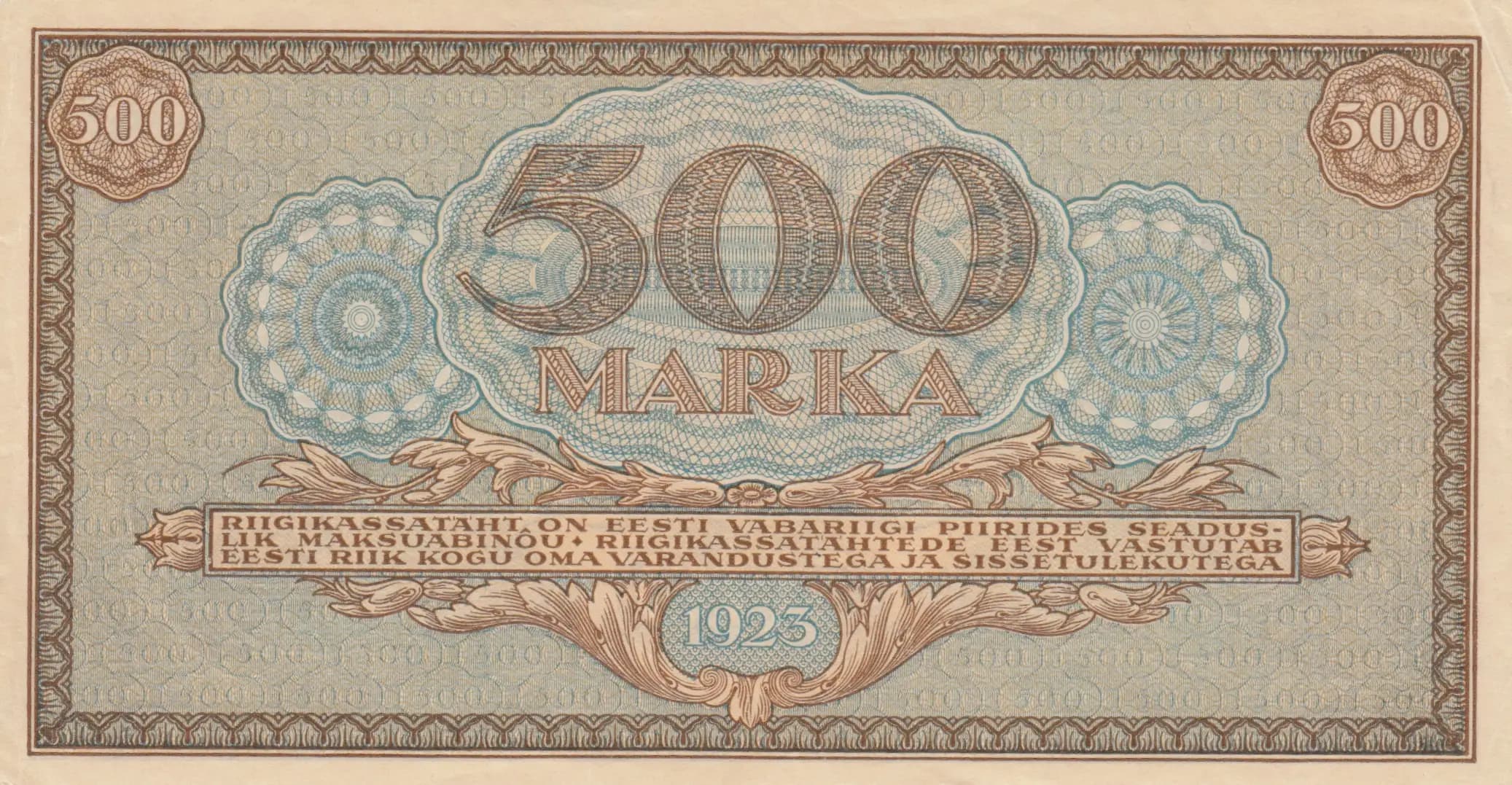
The obverse features Toompea Castle (Castrum Danorum), Tallinn's dominant medieval fortress with multiple towers and crenellated walls, rendered in fine engraving as the central vignette. The castle is surrounded by ornate Art Nouveau/Art Deco-style scrollwork borders in brown and teal, with the denomination '500' displayed prominently in an elaborate cartouche below the fortress. Serial numbers appear in mirror positions on left and right margins. The reverse maintains the same ornamental border scheme with large denomination numerals in decorative frames, corner rosette patterns, and extensive legal text in a panel format centered on the note. The color scheme of brown, teal/blue-green, and cream creates strong visual contrast while the fine-line engraving and extensive cross-hatching throughout provide sophisticated anti-counterfeiting measures typical of early 20th-century European currency production.
FRONT SIDE: 'EESTI VABARIIGI KASSATIHT' (Estonian Republic Treasury Note); 'VIISSADA MARKA' (Five Hundred Marks); '500' (denomination); Serial number '3654240' (appears left and right); 'Petselt' (signature/authorization mark). BACK SIDE: '500' and 'MARKA' (denomination); 'RIIGIKASSATÄHT, ON EESTI VABARIIGI PIIRIDES SEADUSLIK MAKSUMIDEL. RIIGIKASSATAHTE HÄVITAMINE ON EESTI RIIK KOGU OMA VARANDUSEGA JA SISSETULEKUTEGA' (This is a State Treasury Note, legal tender within the borders of the Estonian Republic. Destruction of State Treasury Notes [is the liability of] the Estonian State with all its property and income); '1923' (year of issue); corner denominations '500'.
Intaglio engraving (recess printing), evidenced by the fine line work, detailed cross-hatching on numerals, and ornate guilloché security patterns visible throughout both sides. The sharp impressions and precise detail suggest production by a skilled security printer, likely the State Printing Office or a contracted European security printer. No overprints or secondary printing techniques are evident on this specimen.
This specimen corresponds to Pick P-52, the standard 1923 issue. The PMG Population Report indicates two cataloged variants exist: P-52a and P-52s (likely representing standard and specimen notes). The signature mark 'Petselt' and serial number '3654240' visible on this note are consistent with the regular issue. No overprints, date variations, or anomalous printing characteristics suggesting a sub-variety are evident from the visual analysis.