25 kopeek in silver 1830's
About This Note
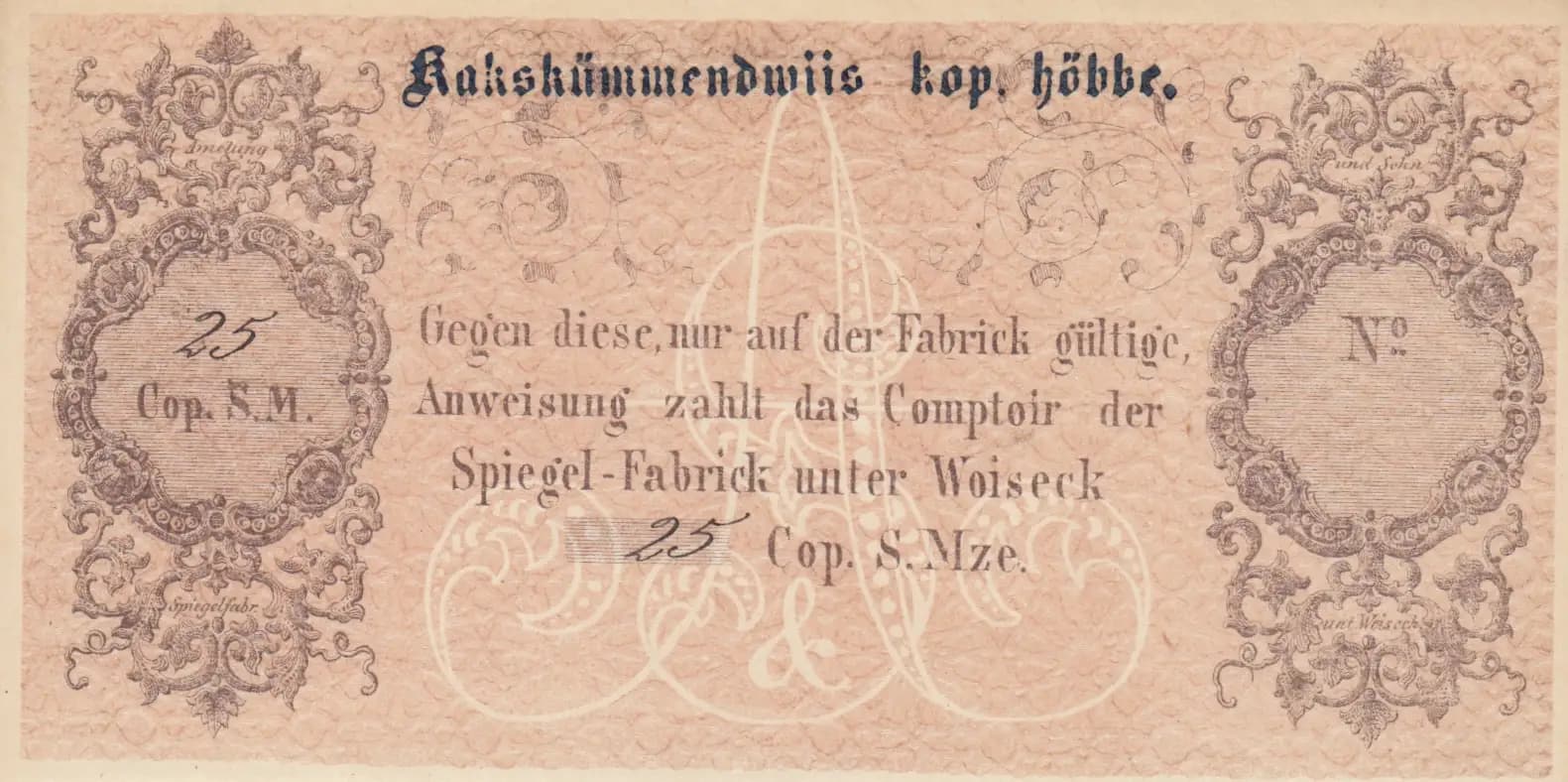
A fascinating 1830s factory scrip note denominated in 25 kopecks silver, issued by the Võisiku Glass and Mirror Factory in Estonia. The note features ornate baroque-style decorative borders in brown/sepia tones with a cream-colored aged paper base, displaying a central crown or heraldic watermark. Despite its UNC catalog grade, the note shows authentic aging characteristics including foxing, a prominent vertical crease, and tan patina consistent with nearly two centuries of storage, making it a historically significant example of early Estonian industrial scrip currency.
Scarce. This note is cataloged as unlisted in major Pick references, indicating limited documentation and presumably a restricted print run limited to the factory's operational period. Factory scrip from 19th-century Estonian enterprises survives in small quantities, as most were withdrawn from circulation or destroyed when factories closed. The specific issuer (Võisiku Glass and Mirror Factory) and the 1830s date further limit surviving examples.
This note represents a unique episode in Estonian economic history during the Russian Imperial period, when the Võisiku Glass and Mirror Factory operated under the dominion of the Tsarist Empire. The bilingual German-Estonian inscriptions and references to 'S.M.' (His Majesty) reflect the multilingual administrative environment of 19th-century Estonia under Russian rule. Factory scrip such as this were common mechanisms for paying workers and conducting internal commerce at industrial enterprises, often circulating only within the factory premises and serving as an early form of corporate currency.
The obverse features a symmetrical composition with elaborate baroque-style decorative scrollwork and floral motifs forming border frames on both the left and right margins in brown and sepia tones. The central design area contains a stylized crown or heraldic emblem serving as both a prominent visual focal point and likely a watermark security feature. The layout is typographically oriented with German-language instructions positioned in the center, denomination numerals flanking the central crown symbol, and administrative text. The note employs a single-color printing scheme in brown/sepia on cream-colored paper, typical of factory scrip currency of the era.
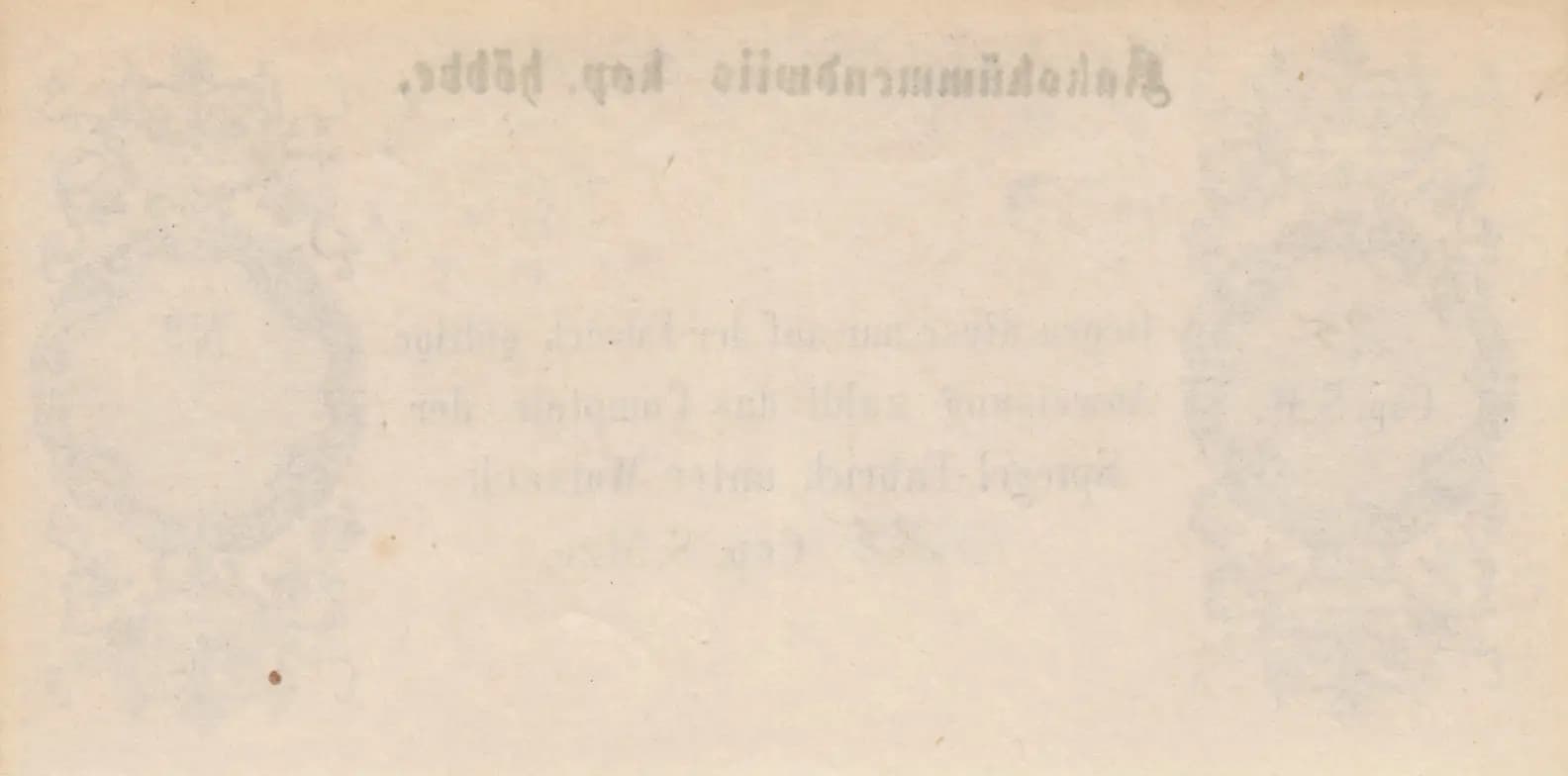
Front side: The central inscription in German reads 'Gegen diese, nur auf der Fabrick gültige, Anweisung zählt das Comptoir der Spiegel-Fabrick unter Woiseck' (Against this instruction, valid only at the factory, the office of the mirror factory under Woiseck pays). The denomination appears as '25 Cop. S.M.' and '25 Cop. S.Mze.' indicating 25 kopecks, His Majesty. An Estonian or Baltic inscription 'Raksktimmendwits kop. höbbe.' is present but remains difficult to definitively translate. A serial number designation 'N°' is noted. Back side: Text present but illegible in the visual analysis provided.
Letterpress or typography printing with hand-colored or tinted security elements, characteristic of 1830s industrial scrip production. The decorative borders show the crisp lines typical of engraved border designs, while the central heraldic crown design appears to have been produced through combination printing techniques. No security printer is identified in the catalog data for this unlisted Pick number, suggesting production occurred at or was commissioned directly by the Võisiku factory itself.
This note is unlisted in standard Pick catalogs, suggesting it may be a regional or factory-specific variety not yet fully documented in major numismatic references. Serial number designation 'N°' is present but the actual serial number itself is not clearly legible in the visual analysis. No signature varieties or dated variants are noted in the visual observations. The presence of both German and Estonian inscriptions on a single note is characteristic of this specific issuer during this period.