20 kopikat 1860
About This Note
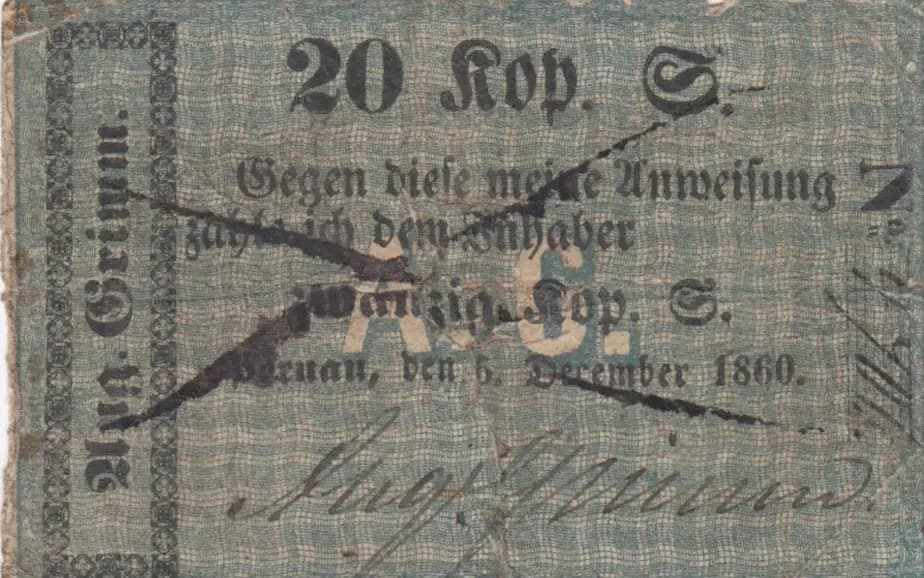
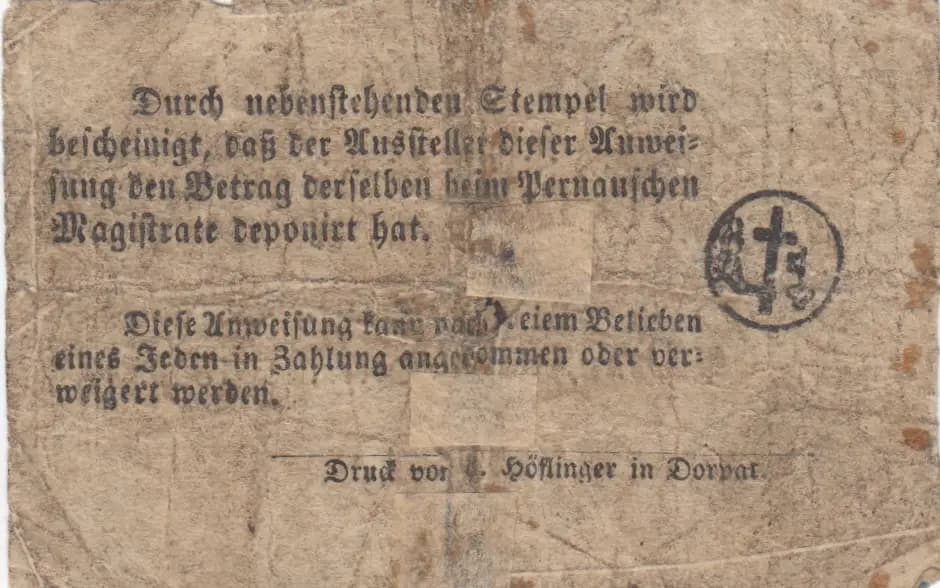
This is a rare private banknote issued by A. Grimm of Pärnu, Estonia in 1860, denominated at 20 kopeks. The note displays a greenish-blue tinted front with ornamental decorative patterns and German-language text, while the reverse shows a tan/beige aged background with legal authorization text and a circular seal featuring a cross motif. In Fair condition, the note exhibits significant aging with multiple creases, dark stains, worn edges, and ink transfer throughout, making it a compelling artifact of 19th-century Estonian-German commerce.
Rare. This is a Pick-unlisted private promissory note from a specific merchant issuer (A. Grimm) in a provincial Estonian city, issued during a very limited period. Private credit notes from small merchants typically had very restricted circulation, were often redeemed and destroyed, and rarely survived in collectible condition. The absence from major catalogs (Pick unlisted) combined with the specific issuer attribution indicates limited documentation and few surviving examples in the numismatic market.
This private promissory note reflects the complex financial landscape of 1860s Estonia, when the region was under Russian Imperial rule yet maintained German cultural and commercial institutions. Issued from Dorpat (modern-day Tartu) and signed at Pärnu by merchant A. Grimm, the note demonstrates the reliance on private credit instruments in provincial commerce before modern banking infrastructure. The German language and legal terminology indicate the dominance of Baltic German merchant networks in regional trade, with the circular seal and cross motif suggesting both commercial authority and the cultural-religious context of the period.
The note is a private promissory note (Anweisung) rather than government-issued currency. The obverse features a greenish-blue tinted security background with ornamental decorative border patterns concentrated on the left side, framing the denomination and issuer information. A prominent cross or religious symbol appears on the right side, reflecting both security and cultural elements typical of Baltic German commercial documents. The reverse presents legal text on a naturally aged tan/beige paper stock, with a circular seal featuring a cross motif positioned center-right, serving as the issuer's authentication mark. The overall design is characteristic of 19th-century private bank drafts and credit instruments circulating in Russian Imperial territories with significant German merchant communities.
FRONT: '20 Kop.' (20 Kopeks) — the denomination in mixed German/Russian notation. 'Gegen viele mehr Anweisung' (Against much more instruction/authorization) and 'tag, d. Verwandter' (day, of the Verwandter/custodian) appear as partial legal clauses. 'Dorpat, den 6. December 1860.' (Dorpat, the 6th of December 1860) — date and place of issue. BACK: 'Durch nebenstehenden Stempel wird bescheinigt, daß der Aussteller dieser Anweisung den Betrag derselben keine Verpflichtung...' (By means of the stamp shown beside, it is certified that the issuer of this authorization has no obligation...). 'Diese Anweisung kann nach jedem Belieben eines jeden in Zahlung angenommen oder verweigert werden.' (This authorization can be accepted or refused in payment at the discretion of anyone). 'Druck von C. Höflinger in Dorpat.' (Printed by C. Höflinger in Dorpat).
Letterpress printing, as evidenced by the crisp black text impression and the mechanical reproduction of ornamental borders visible in the visual analysis. The note was printed by C. Höflinger in Dorpat, a local print shop that specialized in commercial documents. The uniform color application and border patterns suggest multiple passes or careful registration of type blocks, consistent with professional commercial printing of the 1860s.
This particular specimen is dated 6 December 1860 and issued by A. Grimm from Pärnu, with printing by C. Höflinger in Dorpat. The signature visible at the bottom of the obverse represents the issuer's authorization. As a private mercantile note, varieties would typically include different issue dates, issuer signatures, and potentially different denominations from the same printer. No serial numbers are evident, which is typical for private promissory notes of this era.