30 kopikat 1860
About This Note
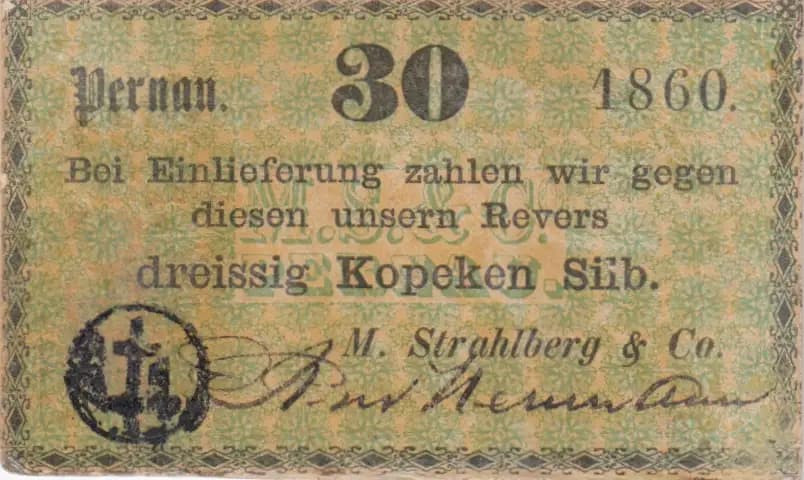
This is a scarce private banknote issued by M. Strahlberg & Co of Pärnu, Estonia in 1860, denominated in 30 kopeks. The note displays characteristic period printing with greenish-tan coloring, ornamental borders, and German-language redemption text. In AU condition, it exhibits the expected patina and foxing of a 163-year-old document while retaining strong visual clarity of its design elements, including the prominent circular seal and handwritten signature.
Uncommon to Scarce. This is an unlisted Pick number, indicating it falls outside the standard international banknote catalogs that typically focus on government-issued currency. Private redemption notes from mid-19th century Estonia, particularly from specific merchant houses like Strahlberg & Co, were produced in limited quantities and most have not survived. The AU condition grade further enhances its rarity, as most surviving examples would typically show heavier wear. The lack of catalog listing combined with the specialized nature of private merchant notes suggests limited collector availability.
This private promissory note reflects Estonia's complex mid-19th century history when the region was under Russian Imperial rule but maintained German-speaking merchant communities conducting local commerce. M. Strahlberg & Co, operating from Pärnu (Permau in German), issued this note as a private credit instrument redeemable for Russian kopeks, demonstrating how local merchants facilitated transactions in a territory where formal banking infrastructure was limited. The use of German language and formatting underscores the Baltic German merchant class's commercial dominance in Estonian towns during this period.
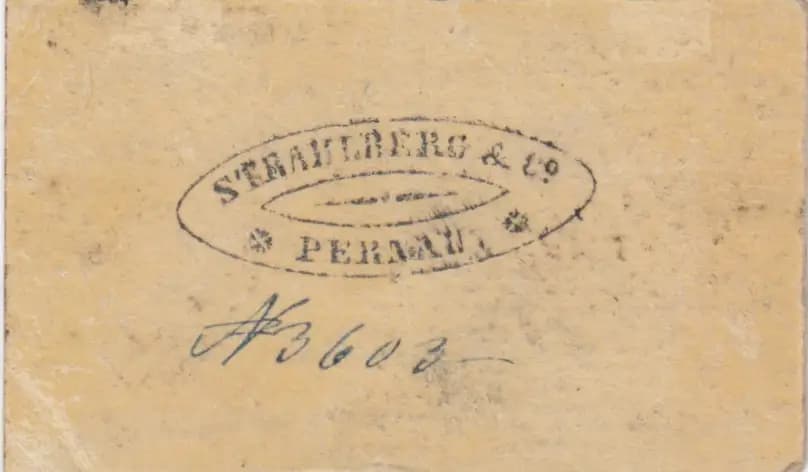
This is a private redemption note (Revers) issued by a merchant banking house rather than a government central bank. The front features a simple but elegant design with a greenish-tan background and decorative ornamental border pattern in brown/dark gray. The denomination '30' is prominently displayed at the top center with '1860' to its right. A circular seal or stamp on the left side likely bears the merchant's mark or a cross symbol typical of Germanic commercial seals. The redemption promise in German occupies the central text area, and an authorized signature appears on the right. The reverse is largely blank aged paper with an oval company stamp reading 'STRAHLBERG & Co PERMAU' centered in the upper portion, accompanied by what appears to be an archival reference number in handwriting. No portraits or historical landmarks are depicted; this is a utilitarian financial instrument.
FRONT: '30' (denomination); '1860' (year of issue); 'Vernan.' (location reference); 'Bei Einlieferung zählen wir gegen diesen unsern Revers dreissig Kopeken Sth.' (German: 'Upon presentation, we will pay against this our reverse thirty kopeks Sth.' - indicating this is a redemption note for thirty kopeks); 'M. Strahlberg & Co' (issuer name); handwritten signature (illegible but present as authentication). BACK: 'STRAHLBERG & Co PERMAU' (issuer name and location in German; Permau = Pärnu); handwritten notation (appears to be archival reference 'A 603' or similar).
Letterpress or typographic printing for the main text and denomination, combined with either engraved or lithographed ornamental border elements. The circular seal on the front and oval stamp on the reverse appear to be impressed stamps, likely applied by hand or stamp press after initial printing. The handwritten signatures and notations are manuscript additions for individual authentication and archival tracking. This reflects typical 19th-century private banking practice where stock-printed blanks were customized with signatures and stamps.
This specific note is distinguishable by: (1) the dated year 1860 in the upper right; (2) the handwritten signature visible on the front (individual to this particular note or batch); (3) the back-side archival notation that appears to be 'A 603' or similar, suggesting this was a cataloged or stored item from a collection; (4) the oval seal stamp on the reverse reading 'STRAHLBERG & Co PERMAU'. As a private merchant note rather than government issue, signature varieties and printing variations across batches would be expected. No standard varieties are documented in major catalogs due to the Pick unlisted status, but individual notes would vary by signature, date, and any handwritten notations present.