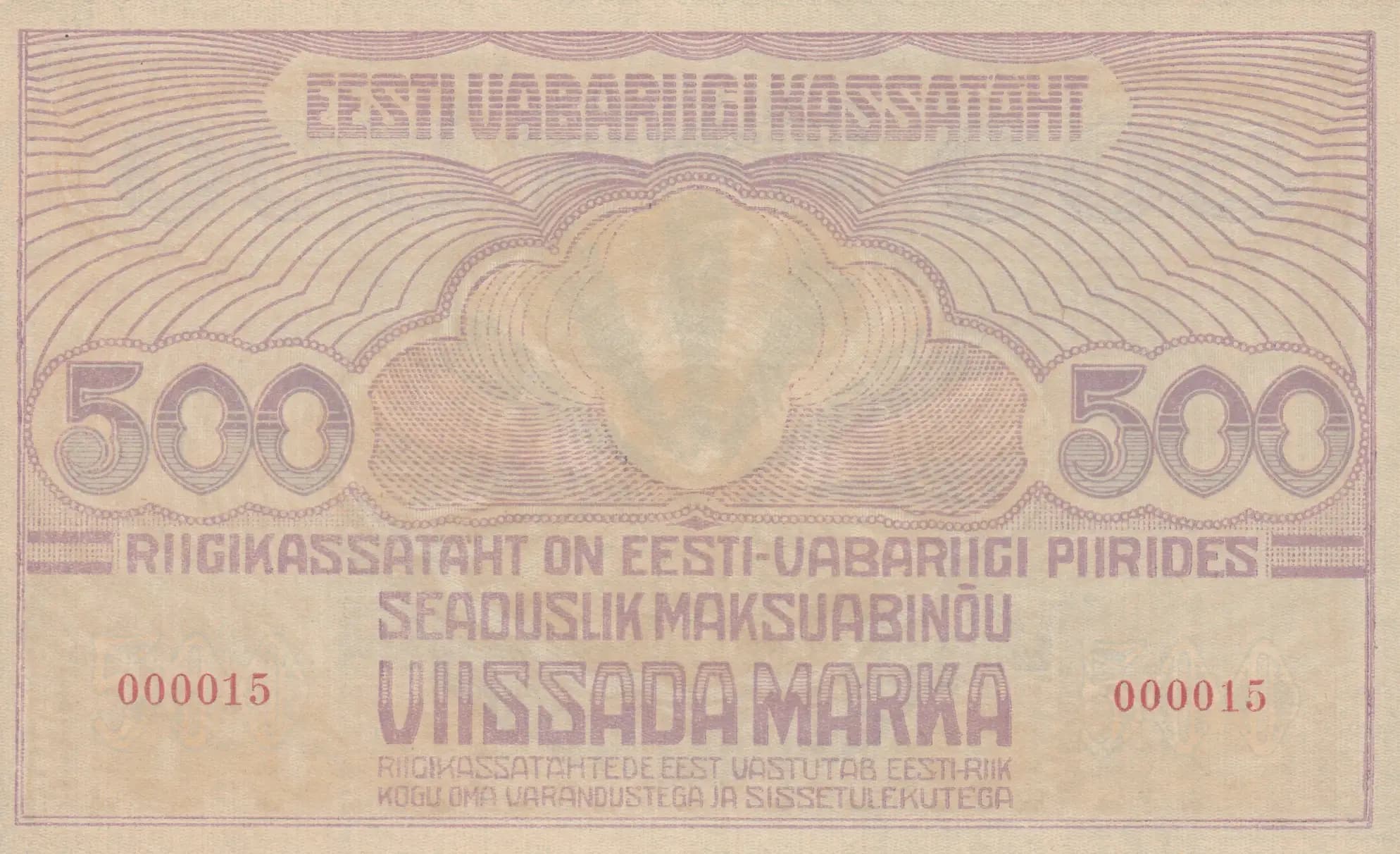
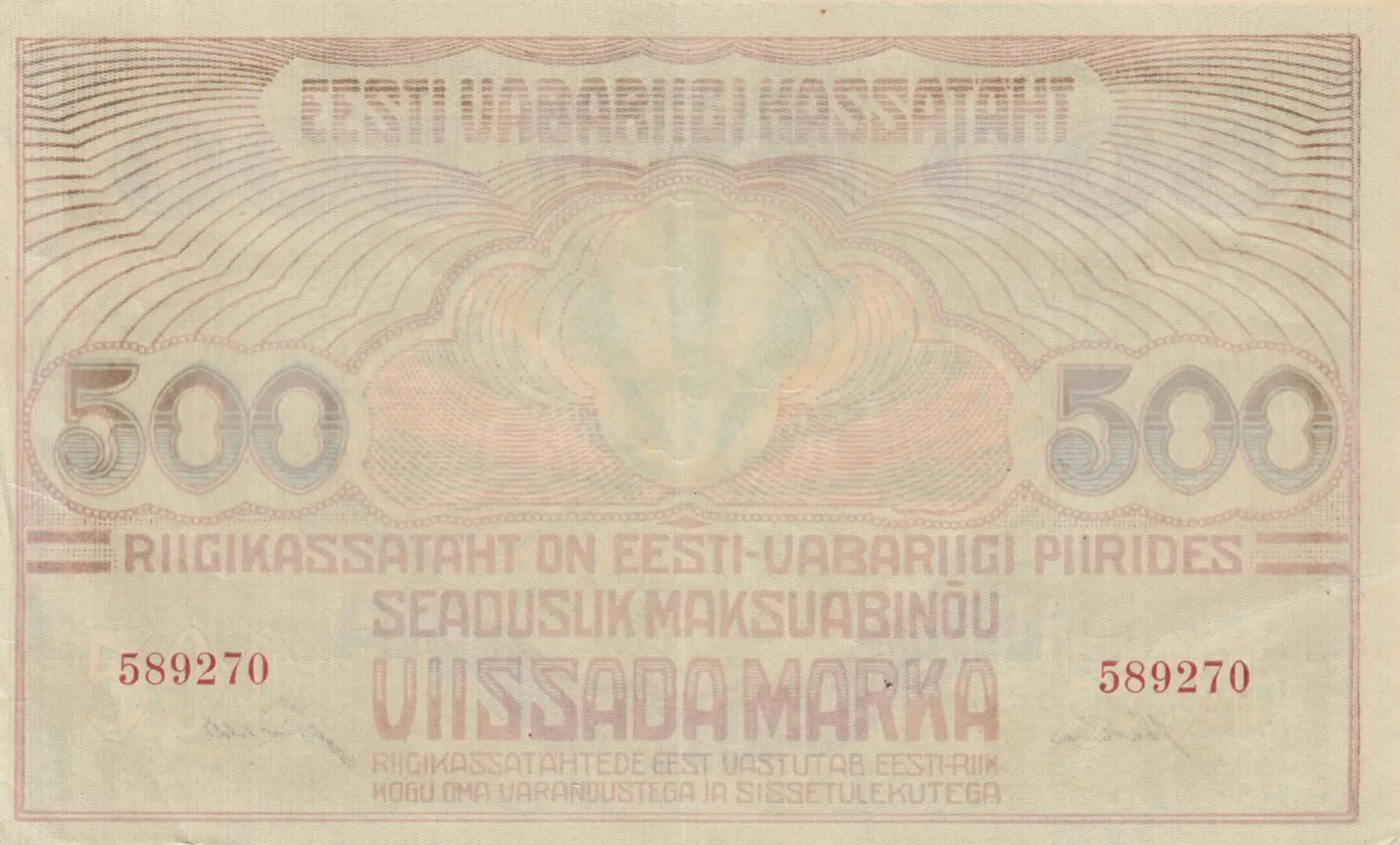
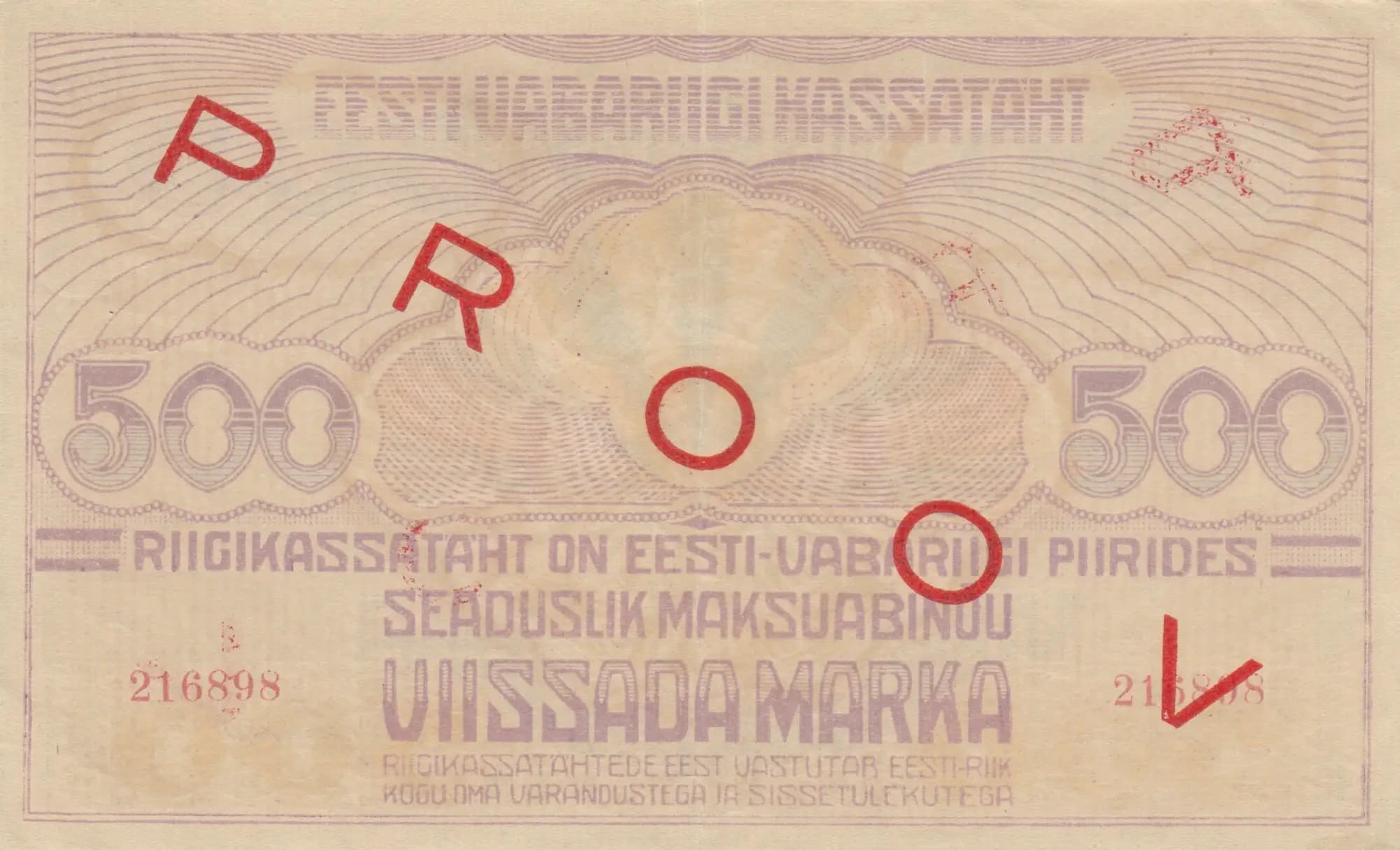
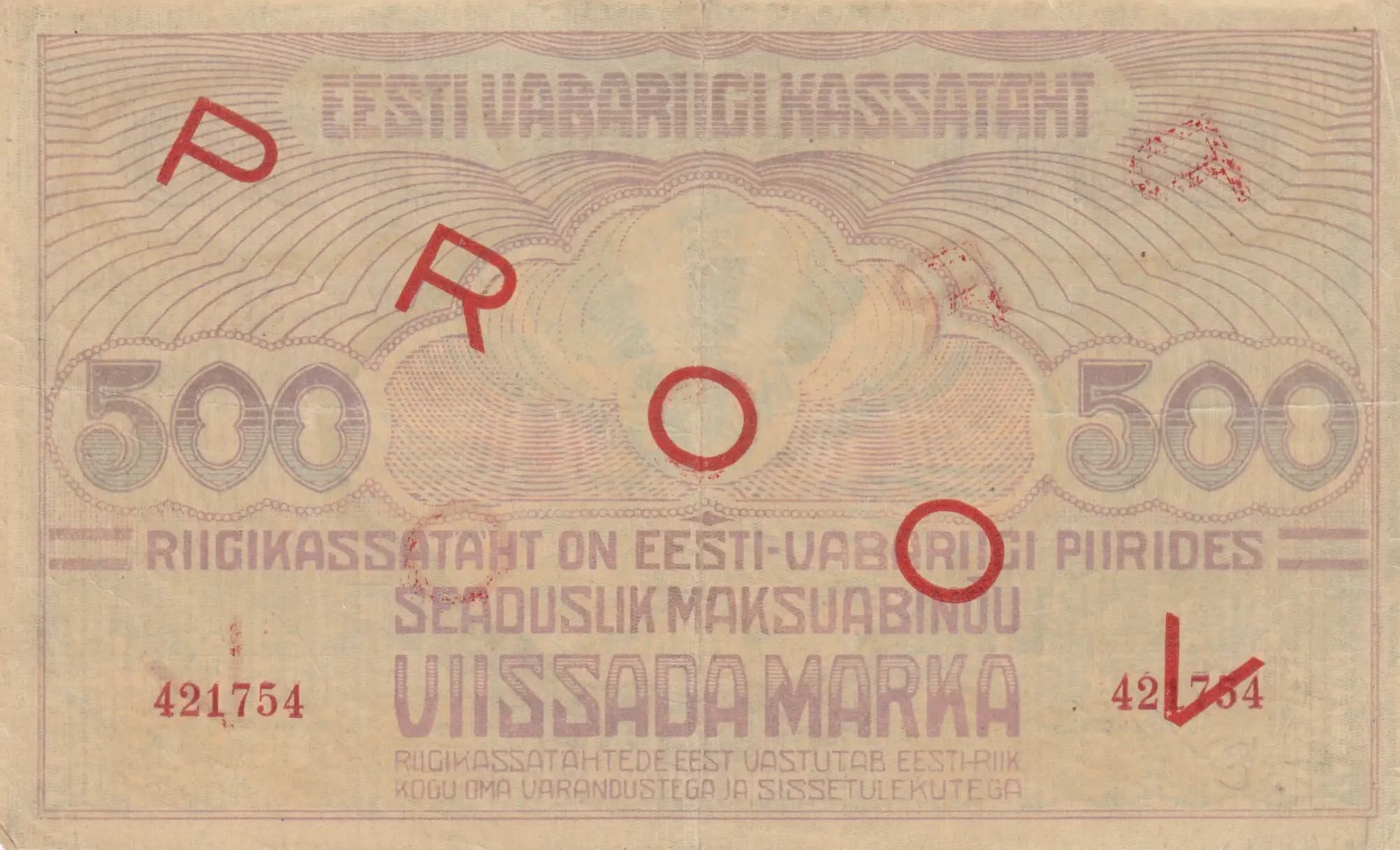
500 marka 1920
“# 000006”
Market Prices
About This Note
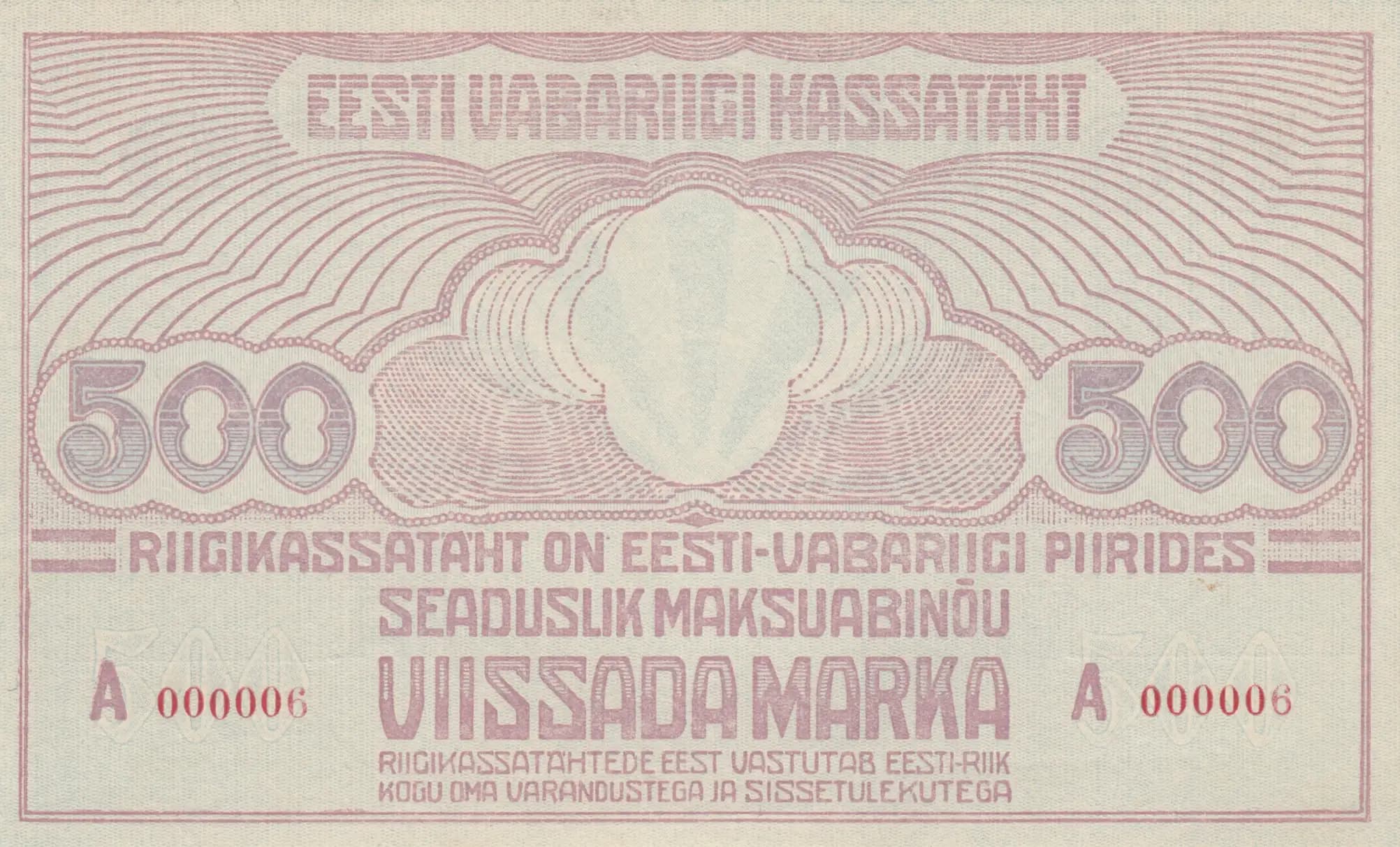
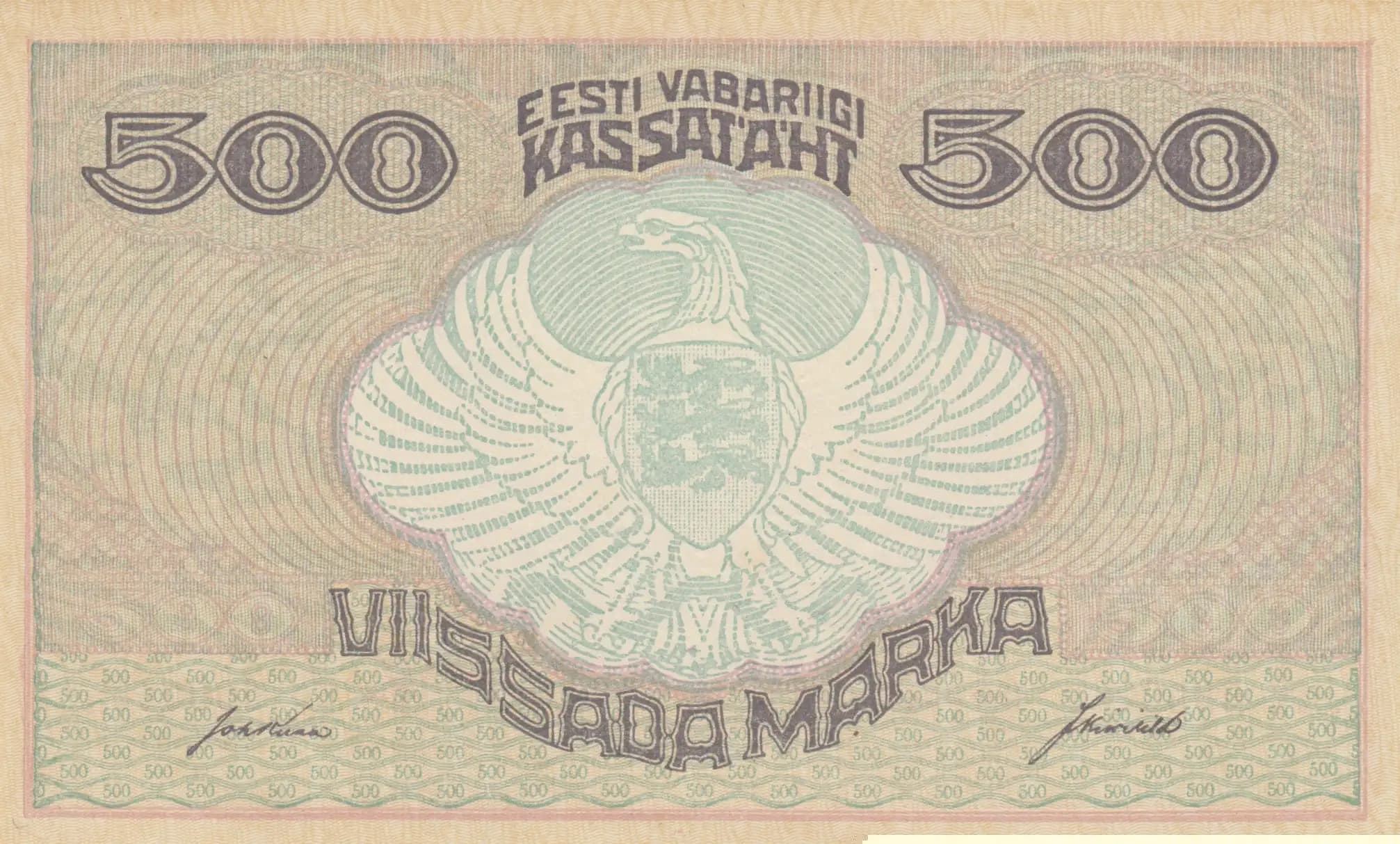
This is an exceptional example of Estonia's 500 Marka Treasury Note from 1920, graded UNC with serial number A 000006. The note displays pristine condition with vibrant mauve and green coloration, intricate ornamental wave patterns, and a distinctive quatrefoil central cartouche on the obverse. The reverse features Estonia's heraldic coat of arms with a winged emblem, exemplifying the nation's early independence period currency and representing a scarce denomination from the brief Estonian marka era.
Common. While this is an early Estonian currency issue and represents a specific historical period, the eBay pricing data provided shows UNC examples trading in the $114–$150 range with multiple listings available. The 2016 catalog value of $300 for UNC appears to represent aspirational collector pricing rather than market reality. The existence of multiple PMG-graded variants and the straightforward nature of the design suggest this was issued in sufficient quantities to satisfy circulation needs. The serial number A 000006 indicates this is from the earliest production run, which may have slightly elevated collector interest, but does not approach rarity threshold. The common availability of this denomination in international numismatic markets confirms common status.
Issued by the Treasury of Estonia (Eesti Vabariigi Kassataht) in 1920, this note commemorates the newly independent Estonian Republic's first years following independence from Russia in 1918. The heraldic imagery and the explicit legal tender declaration emphasize state sovereignty, while the 500 Marka denomination reflects the hyperinflationary period of post-WWI Eastern Europe. The Estonian state explicitly guaranteed the note's value through all its assets and revenues, a necessity for establishing confidence in new national currency during a turbulent economic period.
The obverse features a formal layout dominated by pale cream and mauve coloring, with the denomination '500' prominently displayed in large numerals flanking a central ornamental cartouche of quatrefoil (four-lobed) design. Concentric wave patterns provide sophisticated anti-counterfeiting ornamentation throughout. The reverse displays Estonia's state coat of arms: a heraldic emblem featuring a crowned or winged design with a central head or profile, rendered in green and teal tones with brown accents. The reverse background employs repeated '500' numerals as a security feature, with fine line engraving patterns covering the entire surface. Two signature lines appear at the bottom in cursive script, representing Treasury officials' authorization. The color palette shifts between front (mauve/cream) and reverse (green/teal/brown), a deliberate security measure typical of the era.
FRONT SIDE: 'EESTI VABARIIGI KASSATAHT' (Estonian Republic Treasury Note) | '500' (denomination in numerals) | 'RIIGIKASSATAHT ON EESTI-VABARIIGI PIIRIDES SEADUSLIK MAKSUABINU' (State Treasury Note is legal tender within the borders of the Estonian Republic) | 'VIISSADA MARKA' (Five Hundred Marks) | 'RIIGIKASSATAHTE EEST VASTUTAB EESTI-RIIK KOGU OMA VARANDUSTEGA JA SISSETULEKUTEGA' (The Estonian State is liable for this Treasury Note with all its assets and revenues) | 'A 000006' (Serial number). BACK SIDE: 'EESTI VABARIIGI KASSATAHT' (Estonian Republic Treasury Note) | 'VIISSADA MARKA' (Five Hundred Marks) | '500' (denomination repeated in background pattern).
Intaglio engraving with multicolor offset printing. The note exhibits the characteristic fine line work and intricate detail typical of early 20th-century European currency production. The precision of the wave patterns, heraldic emblem rendering, and background security motifs indicate work by a skilled security printer, likely one of the major European currency printers engaged by the Estonian Treasury. The multiple color application and clean impression quality visible in both the front and reverse designs are consistent with professional banknote manufacturing standards of 1920.
This note is identified as Pick P-49d, part of a series with at least two documented PMG variants (P-49b and P-49es). The watermark 'EV' (Eesti Vabariigi) is confirmed as present on this type. Serial number A 000006 places this note in the first production sequence (SEERIA A per realbanknotes.com), which is a noted variety characteristic. The mauve/purple-pink coloration on cream background is consistent with the standard 1920 printing specification for this Pick number. No overprints or special markings are visible, indicating this is a regular-issue note of the standard 1920-1921 printing period rather than a later or special variant.