50 penni 1919
About This Note
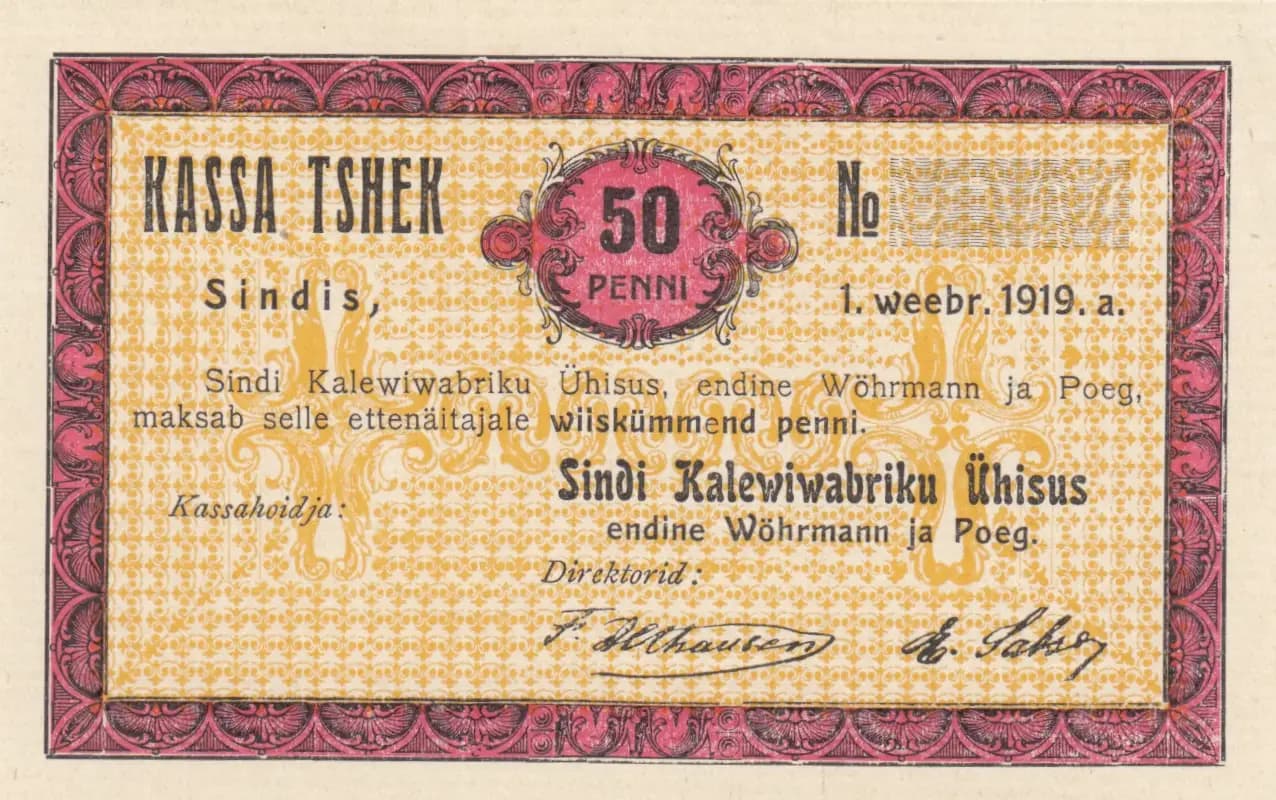
A scarce 1919 Estonian emergency currency note issued by the Sindi Kaleviwabriku Society during the early period of Estonian independence. This 50 penni denomination features an elegant Art Nouveau design with ornate red/pink decorative borders and a cream field, displaying period-appropriate typography and signatures of F. Mühling and Ch. Ialin. The note is presented in uncirculated condition with age-appropriate patina, representing an important artifact of Estonia's transitional monetary period.
Scarce. This is a private emergency note (Kassa Tshek) issued by a single Estonian factory in very limited quantity during a specific two-week or short-term emergency period in early 1919. Private emergency notes from this period survive in small numbers, and this particular 50 penni denomination from the Sindi Kaleviwabriku Society represents a narrow print run specific to one location and date. The Pick catalog lists it as 'unlisted,' indicating limited numismatic documentation and circulation. Uncirculated examples are particularly scarce as most emergency notes were redeemed and destroyed.
Issued on February 1, 1919, shortly after Estonia declared independence from the Russian Empire, this private emergency note reflects the chaotic currency situation during the early months of Estonian statehood. The Sindi Kaleviwabriku Society (formerly Wöhrmann and Son, a textile factory) issued cash checks as a practical necessity when official Estonian currency was scarce. The bilingual inscription "Sindi Kalewiwabriku Ühisus" demonstrates the linguistic transition from German to Estonian dominance in the newly independent nation.
A single-sided printed emergency note featuring a distinctly Art Nouveau aesthetic typical of early 20th-century Estonian commercial documents. The front displays a prominent oval cartouche in red/pink at the center containing the denomination '50 PENNI' in bold type. The note is framed by repeating semi-circular ornamental border patterns in red/pink against a cream/yellow field with a fine dotted security texture. The design incorporates both Estonian and German-language text reflecting the bilingual administrative practice of the period. The reverse is blank, typical of contemporary emergency notes. The overall composition emphasizes clarity of denomination and issuer authority through prominent typography and decorative framing rather than figurative imagery.
FRONT SIDE: 'KASSA TSHEK' (Cash Check); '50 PENNI' (denomination); 'No' (serial number designation); 'Sindis, 1. weebr. 1919. a.' (Sindis, 1st February 1919); 'Sindi Kalewiwabriku Ühisus, endine Wöhrmann ja Poeg, maksab selle ettenäitajale wiiskümmend penni.' (Sindi Kalewiwabriku Society, formerly Wöhrmann and Son, pays to the bearer of this fifty penni); 'Kassahoiaja:' (Cashier); 'Direktorid:' (Directors); signatures of 'F. Mühling' and 'Ch. Ialin'. BACK SIDE: Blank/minimal content.
Typographic (letterpress) printing with chromatic separation. The red/pink ornamental borders and denomination cartouche were printed separately from the black text elements, as evidenced by the distinct color registration and the fine dotted background pattern visible in the yellow/cream field. The dotted texture pattern suggests the use of benday or similar mechanical screening technique for security purposes. No security printer attribution is documented for this private emergency issue.
Identified variety includes specific date of issue (1. weebr. 1919 / 1st February 1919) and signatures of cashier F. Mühling and director Ch. Ialin. The note references the former ownership 'endine Wöhrmann ja Poeg' (formerly Wöhrmann and Son), indicating this represents the post-acquisition identity of the facility. Serial number field is present but specific number not legible from description. Variations may exist in serial numbering or minor typography differences across the limited print run, though no cataloged varieties are documented.