50 penni 1919
Market Prices
20 salesAbout This Note
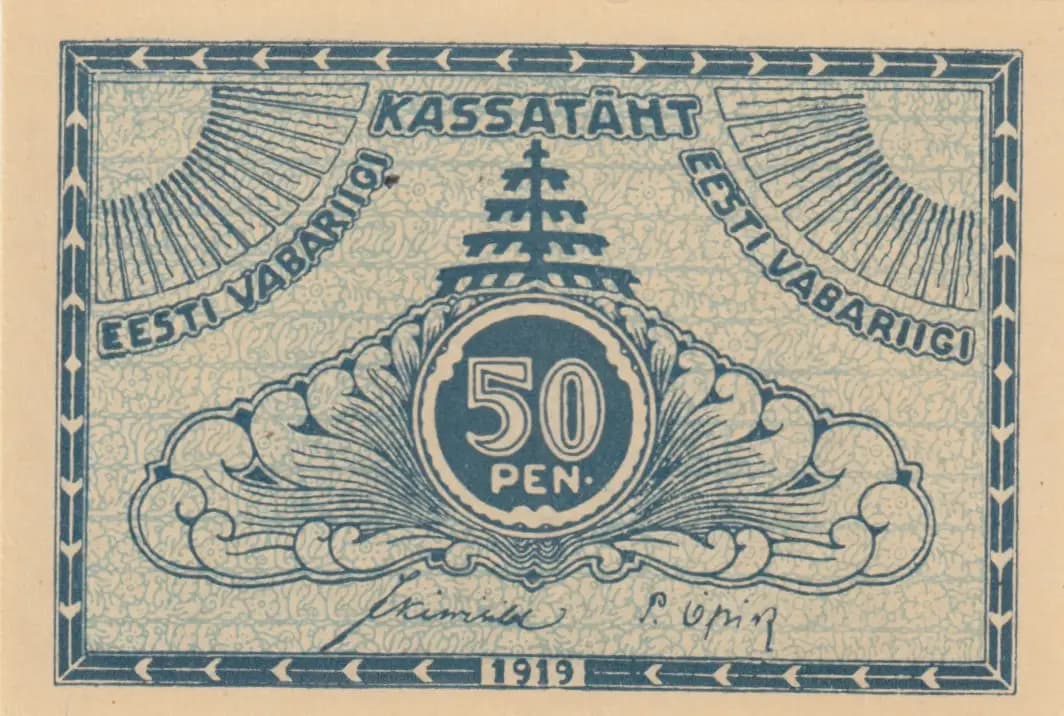
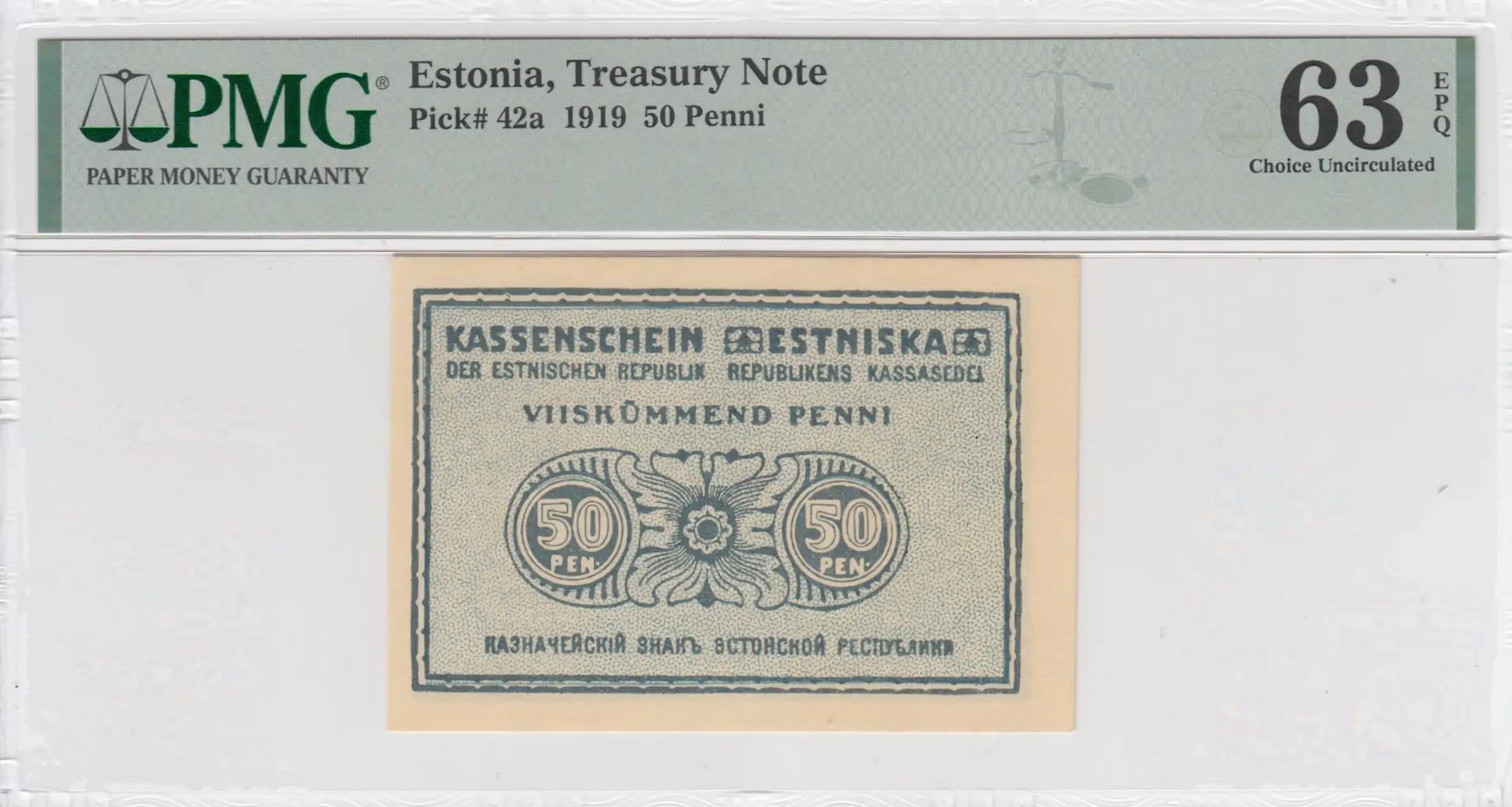
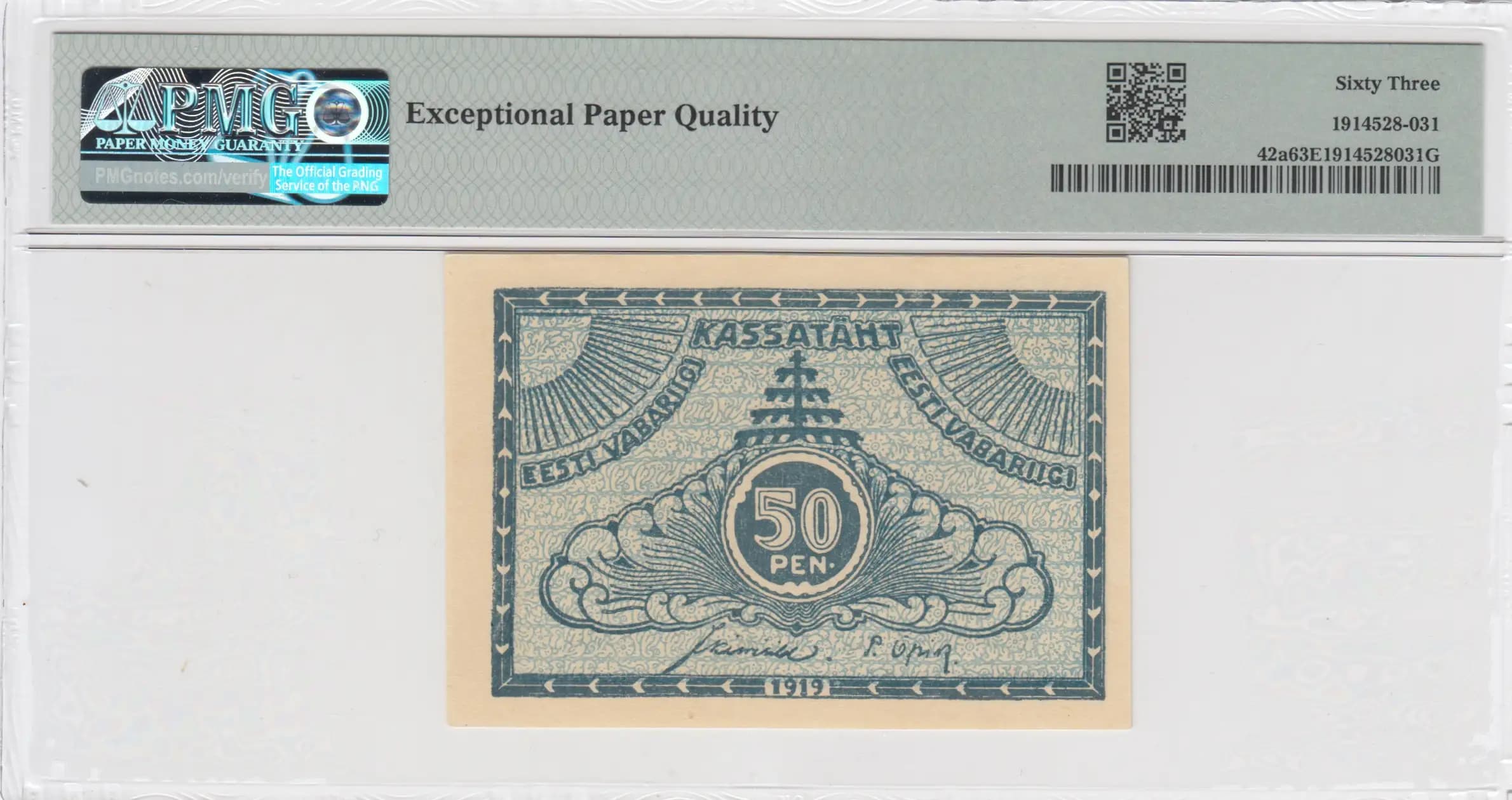
This is an exceptional example of Estonia's first independent currency issue, a 50 Penni Treasury Note from 1919 graded PMG 63 Choice Uncirculated with EPQ (Exceptional Paper Quality). The note displays crisp, sharp printing with excellent paper quality and exhibits the distinctive cream-beige coloring with dark blue-green intaglio work characteristic of early Estonian currency. The symmetrical design featuring the central winged coat of arms medallions and denomination markers remains virtually pristine, making this a desirable example for collectors of early Baltic state currency.
Common. This is a regular issue from 1919 produced in substantial quantities for general circulation during the early years of Estonian independence. Market data from realbanknotes.com shows consistent eBay sales ranging from under $1 to approximately $12.50 across various condition grades over the past decade, with typical Fine specimens selling in the $3-5 range and VF examples around $6-7. The PMG 63 grade represents an above-average example, but the denomination itself remains readily available in numismatic markets. No print run restrictions or recall issues are known for this Pick number.
The 1919 Estonian Treasury Note represents the fledgling Estonian Republic's first monetary assertion following independence from the Russian Empire in 1918. The trilingual inscriptions in German, Estonian, and Russian reflect the complex linguistic and political landscape of the newly independent nation, while the central winged emblem serves as the coat of arms symbolizing national sovereignty. These early issues were produced in limited quantities to establish Estonia's monetary authority during the chaotic post-WWI transition period before the adoption of the Krona in 1928.
The note presents a classical Art Nouveau-influenced design typical of early 20th-century European currency. The front features a symmetrical composition with two circular medallions flanking a central winged coat of arms emblem—the heraldic symbol of Estonia—rendered in fine line work. The denomination '50' and 'PENI' are integrated into ornamental cartouches on either side. The reverse side maintains the symmetrical aesthetic with a prominent central circular medallion displaying '50 PEN.' surrounded by radiating decorative scrollwork and flourishes. Fine line work and intricate border patterns throughout serve both aesthetic and security purposes. The overall design reflects the European banking traditions of the era while incorporating distinctly Estonian national symbolism.
FRONT SIDE: 'KASSENSCHEIN' (German: Treasury Note) / 'ESTNISKA' (Estonian: Estonian) / 'DER ESTNISCHEN REPUBLIK' (German: Of the Estonian Republic) / 'REPUBLIKENS KASSASEDEL' (Estonian: Republic's Treasury Note) / 'VIISKÜMMEND PENNI' (Estonian: Fifty Penni) / '50 PENI' (Estonian: 50 Penni) / 'РАZНAЧЕЙСКИЙ ЗНАК ЭСТОНСКОЙ РЕСПУБЛИКИ' (Russian: Monetary sign of the Estonian Republic). BACK SIDE: 'KASSATAHHT' (Estonian: Treasury Note) / 'EESTI VABARIIGI' (Estonian: Estonian Republic) / '50' (numeric denomination) / 'PEN.' (abbreviation for Penni) / '1919' (year of issue).
Intaglio (steel engraved) printing, evidenced by the fine line work, sharp detail definition, crisp denomination markers, and the embossed quality visible in the medallions and decorative elements. The uniform color saturation and precise registration of the dark blue-green ink on cream-beige paper are characteristic of high-quality intaglio work. The note was likely produced by a specialized European security printer; Estonian early currency was frequently contracted to established firms such as those based in Germany or other Central European locations.
This specific note is cataloged as Pick P-42 and represents the standard 1919 issue of the 50 Penni denomination. No significant varieties (such as signature variants, date differences, or serial number prefix variations) are apparent from the visual analysis. The note conforms to the standard design for this issue with trilingual inscriptions (German/Estonian/Russian) and the central Estonian coat of arms emblem typical of this series.