50 penni 1919
Market Prices
20 salesAbout This Note
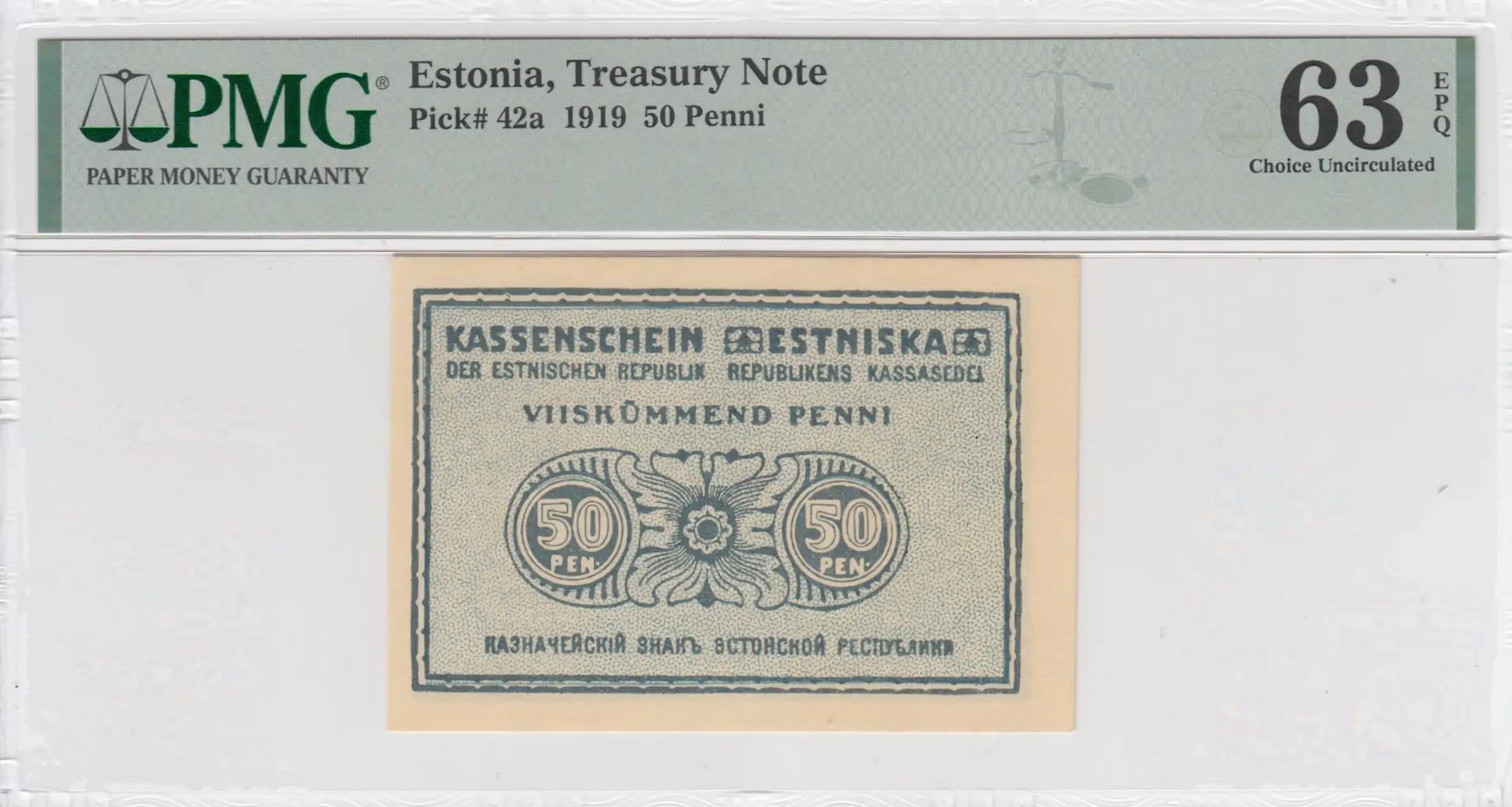
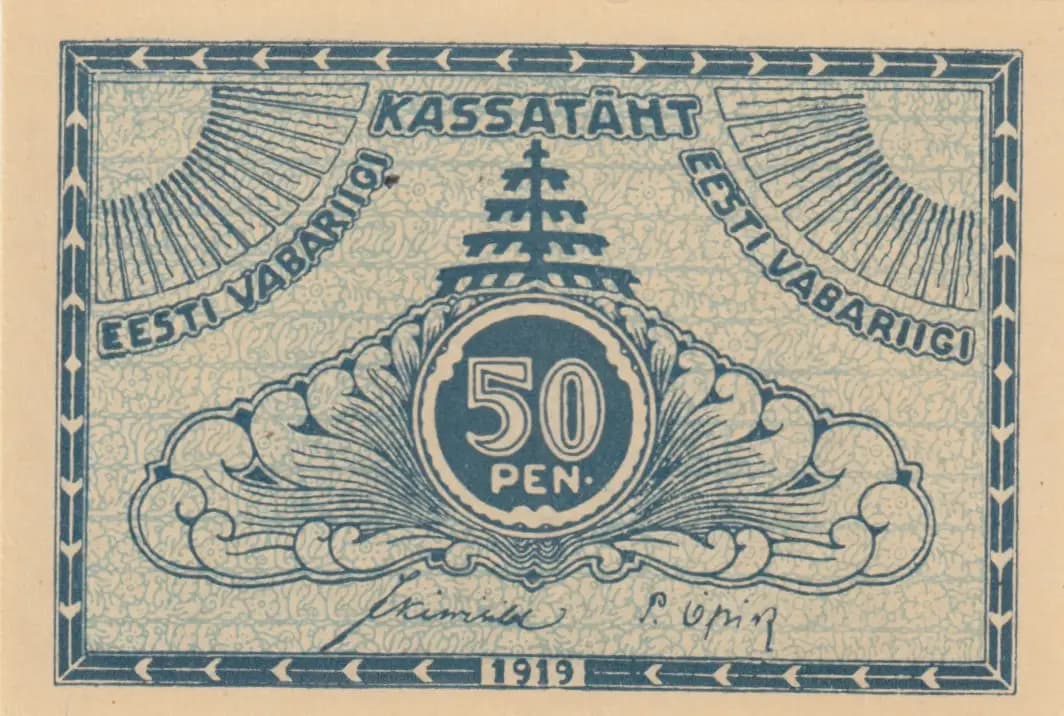
This is an exceptionally well-preserved example of Estonia's earliest independent currency, the 50 penni Treasury note of 1919, graded UNC. The note features an elegant ornamental design with a central cross-topped tree motif and symmetrical fan patterns, rendered in distinctive blue-teal ink on cream-colored paper. The multilingual inscriptions in Estonian, German, Swedish, and Russian reflect the diverse cultural context of the newly independent Estonian Republic during this formative period.
Common. The eBay price history provided demonstrates consistent market activity with pieces in various conditions selling regularly between $0.99 and $12.50 over a six-year period. UNC-graded examples have catalog values around $40 (2016), but this note's frequent appearance in secondary market sales indicates it was issued in substantial quantities and remains readily available to collectors. The regular trading pattern and low barrier to entry confirm this as a common note despite its historical significance.
This note was issued by the Treasury of Estonia in 1919, immediately following the declaration of independence from Imperial Russia on February 24, 1918. The multilingual text—appearing in Estonian, German, Swedish, and Russian Cyrillic—reflects Estonia's complex position as a newly sovereign nation emerging from the Russian Empire with significant Scandinavian and Germanic cultural ties. The ornamental design with its cross-topped tree symbolism connects to Baltic cultural identity and represents the nation's assertion of independence through its own monetary system.
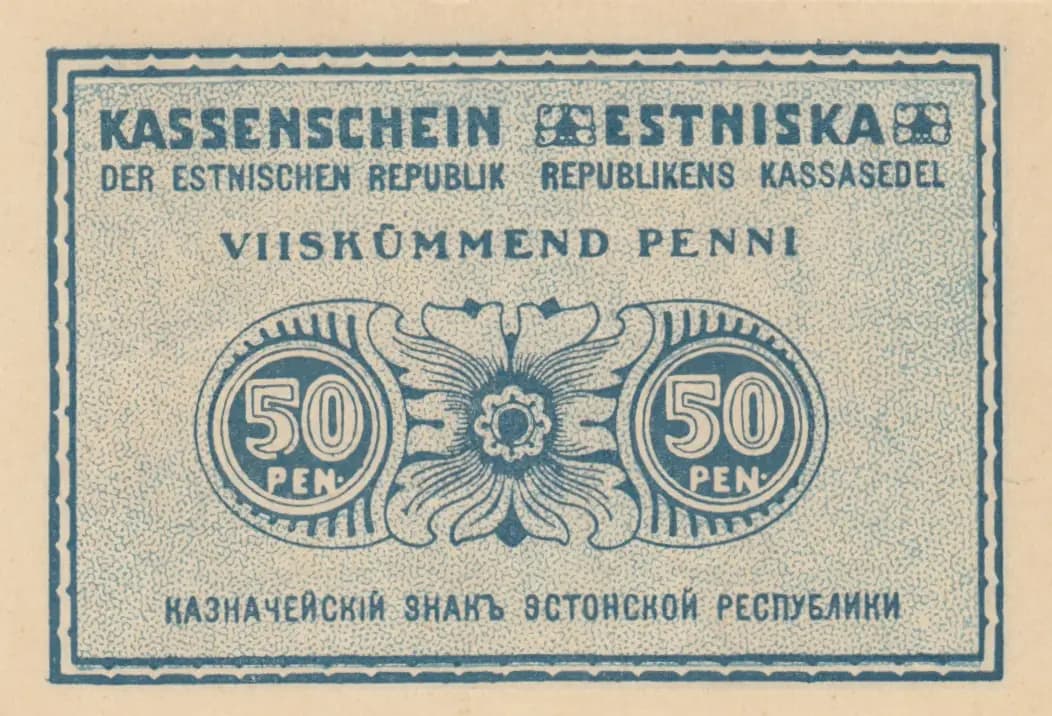
The 50 penni note features a symmetrical ornamental composition centered on a stylized tree or botanical motif crowned with a cross—a symbolic representation of Estonian national identity. The design incorporates radiating fan-like patterns in the upper corners, baroque-style flourishes, and a prominent circular medallion containing the denomination. The back side presents two matching circular medallions flanking a central starburst or flower pattern with a gear-like mechanical element at its center, possibly representing industrial progress and national development. The entire design is framed by decorative borders with chevron and scalloped edge patterns. No portraits or specific landmarks are depicted; instead, the note relies on pure ornamental and symbolic design elements characteristic of early 20th-century European currency design.
FRONT SIDE: 'KASSATÄHT' (Treasury note), 'EESTI VABARIIK' (Estonian Republic), '50 PEN.' (50 penni), '1919' (year of issue), with signatures of 'Kimbel' and 'Pöring' (officials). BACK SIDE: 'KASSENSCHEIN' (German: Treasury note), 'DER ESTNISCHEN REPUBLIK' (German: Of the Estonian Republic), 'ESTNISKA' (Estonian: Estonian), 'VIISKÜMMEND PENNI' (Estonian: Fifty penni), '50 PEN.' (50 penni), 'ESTNISKA REPUBLIKENS KASSASEDEL' (Swedish/Estonian: Estonian Republic Treasury Note), 'КАЗНАЧЕЙСКИЙ ЗНАК ЭСТОНСКОЙ РЕСПУБЛИКИ' (Russian Cyrillic: Treasury note of the Estonian Republic).
The note was produced using intaglio (engraving) printing, evidenced by the fine detail work, precise line work in the radiating patterns, and the crisp definition of the ornamental elements and text. The multilingual text and intricate ornamental borders demonstrate the sophisticated security printing capabilities of the Estonian Treasury's chosen printer. The consistent ink coverage and sharp detail characteristic of intaglio printing is clearly visible in the preserved UNC condition.
Pick P-42 designation confirms this as the standard 1919 issue of the Estonian Treasury. The specific variety is identifiable by the signatures of Kimbel and Pöring visible on the front, which are standard for this emission. No overprints, date variations, or known major varieties are present on this example. The multilingual text configuration (Estonian, German, Swedish, and Russian) is standard for the 1919 Treasury note issue and reflects the official policy of the newly independent Estonian Republic to acknowledge its diverse population and international recognition.