50 marka 1920
Market Prices
About This Note
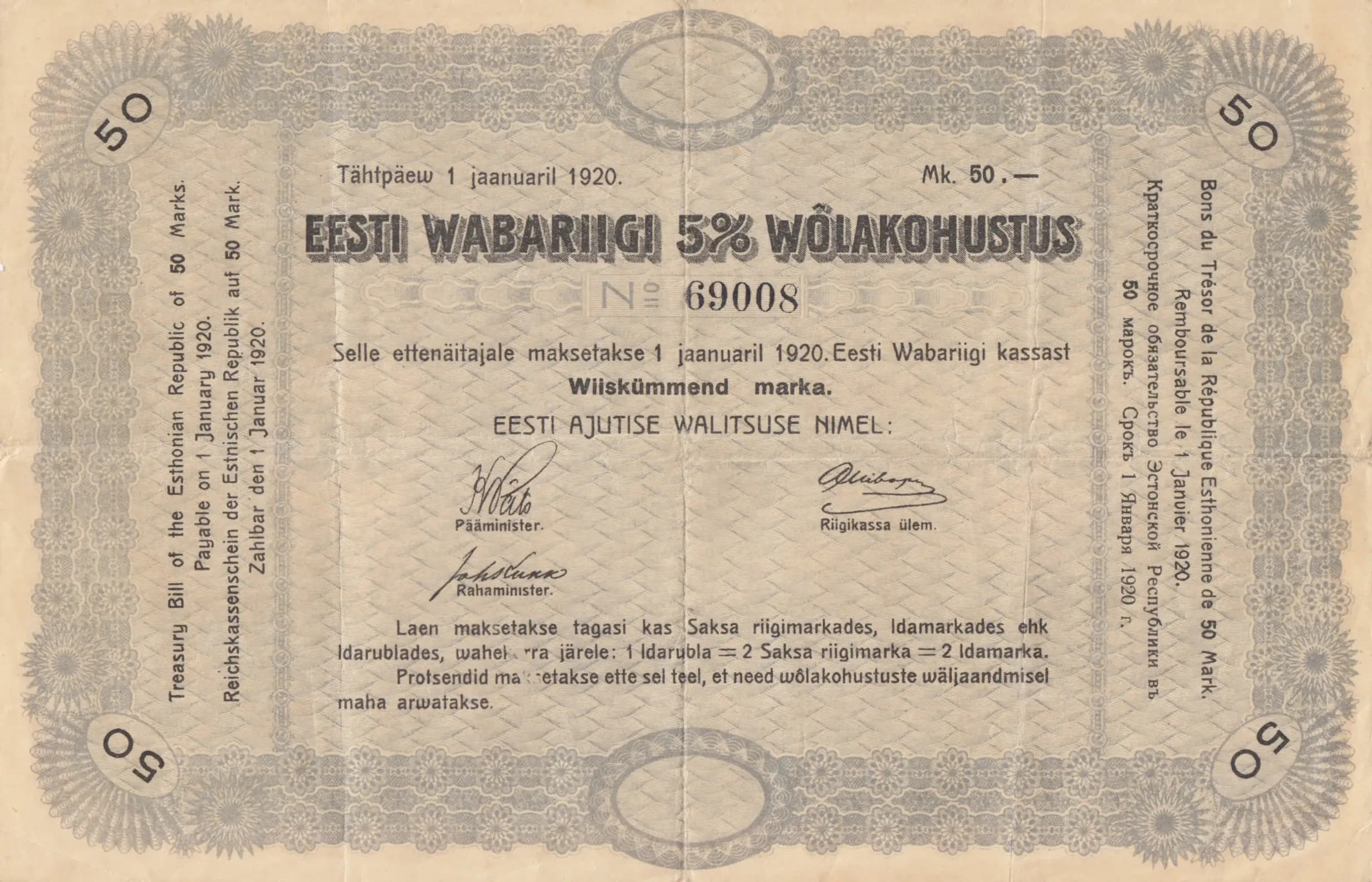
This 50 Marka note from Estonia's 1920 emission represents an early example of the newly independent Estonian Republic's financial instruments. Graded VF, the note displays the characteristic wear of circulation—including a prominent central fold and foxing throughout—yet remains structurally sound with clear impressions of the ornate security design. The note is historically significant as a 5% war loan obligation issued during Estonia's formative years, combining multilingual inscriptions (Estonian, German, French, English) that reflect the geopolitical complexity of the post-WWI Baltic region.
Common. The eBay price tracking data shows regular sales activity across multiple condition grades (ranging from $15 to $275 USD depending on condition), with VF examples consistently available in the $45-$85 range, indicating this is a regularly traded note with sufficient supply in the collector market. As a standard issue from the Estonian Republic's 1920 emissions with a documented series number (suggesting larger print runs), and given its appearance in multiple market sales, this Pick number is not scarce. No historical evidence suggests limited print runs or early recall that would elevate rarity status.
Issued on January 1, 1920, this treasury bond reflects the Estonian Republic's urgent need to finance its independence struggle and consolidate state finances following the Russian Revolution and German occupation. The 5% war loan designation and multilingual text—including provisions for repayment in German Reichsmarks, East marks, or East rubles—document the economic uncertainty and currency instability characteristic of the region during the 1918-1920 transition period. The note's formal design, featuring signatures of the Prime Minister, Finance Minister, and State Treasury Chief, underscores the provisional government's efforts to establish monetary credibility and legitimacy.
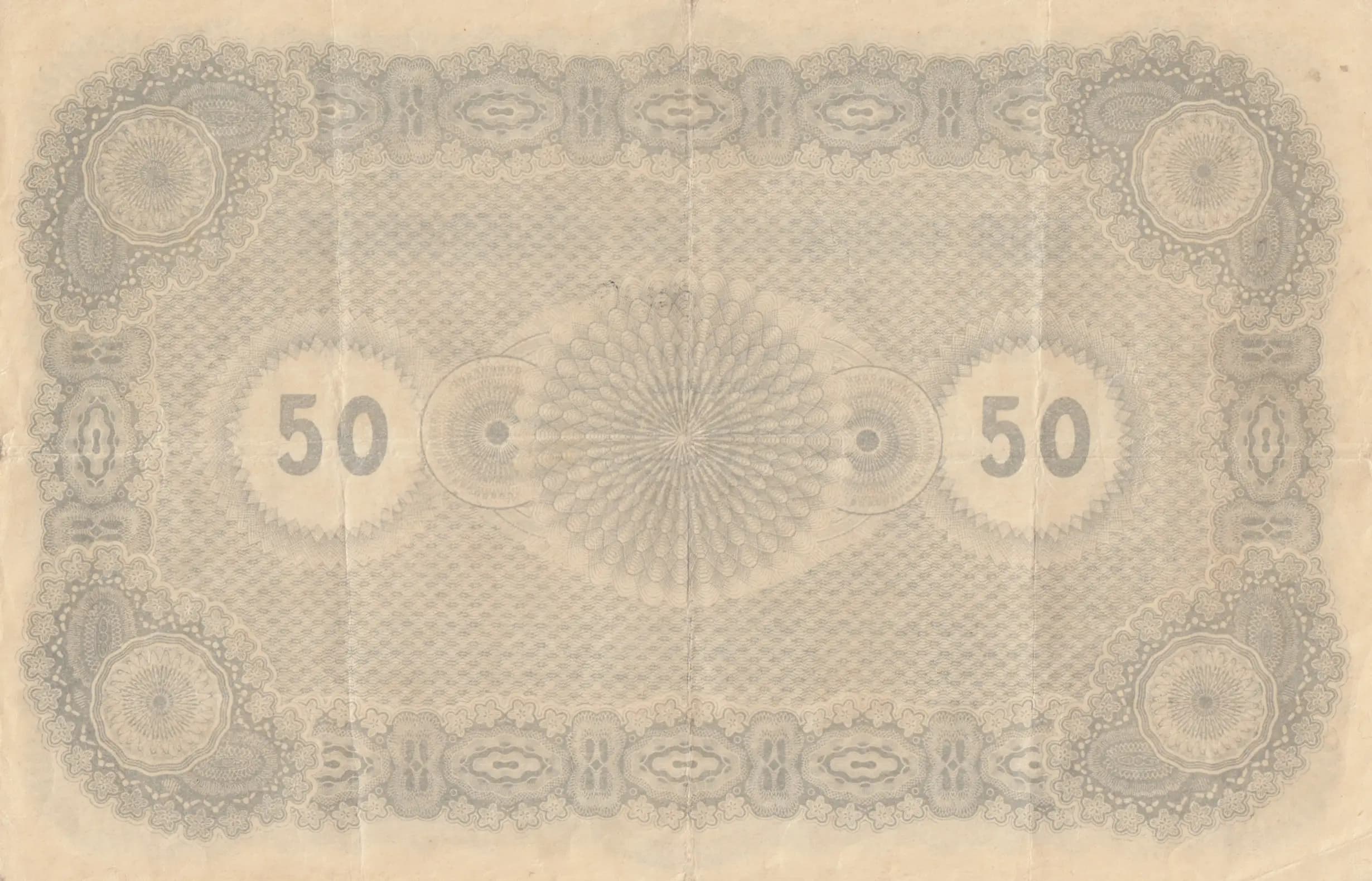
This note employs a classical security design aesthetic typical of early 20th-century European government debt instruments. The front features an elaborate ornamental framework with nested decorative ovals and elaborate corner sunburst patterns with radiating lines, all rendered in black letterpress on cream/beige paper stock. The design lacks figurative portraits, instead relying on geometric and floral security patterns—including repeating motifs along borders, fine-line work forming geometric structures, and complex interlocking patterns that would be difficult to counterfeit with period technology. The back side emphasizes a monumental central sunburst/radial security device with concentric circles, flanked by large denomination numerals. The multilingual text arrayed along the left margin (English, French, German, and Estonian) serves both a practical administrative function and as an additional anti-counterfeiting measure by incorporating complex character sets. The overall design reflects both Austro-Hungarian design traditions and contemporary Baltic security printing practices.
FRONT SIDE: Denomination and identification: '50 Marks' / 'Mk. 50,—' / 'Wiiskümmend marka' (Fifty marks). Date: 'Tähfpäew 1 jaanuaril 1920.' (Dated 1st January 1920). Main inscription: 'EESTI WABARIIGI 5% WÕLAKOHUSTUS' (Estonian Republic 5% Debt Obligation). Authority: 'EESTI AJUTISE WALITSUSE NIMEL:' (In the name of the Estonian Provisional Government). Signatory titles: 'Pääminister' (Prime Minister), 'Rahaminister' (Finance Minister), 'Riigikassa ülem' (State Treasury Chief). Treasury promise: 'Selle ettenäitajale maksetakse 1 jaanuaril 1920. Eesti Wabariigi kassast' (Payment of this note will be made on 1st January 1920 from the Estonian Republic treasury). Repayment clause: 'Laen maksetakse tagasi kas Saksa riigimärkades, Idamarkades ehk Idarublades, vahel -'ra järele: 1 idarubla = 2 Saksa riigimarka = 2 Idamarka.' (The loan will be repaid in German state marks, East marks or East rubles, according to the following: 1 East ruble = 2 German state marks = 2 East mark). Interest clause: 'Protsendid ma -eetakse ette sel teel, et need wõlakohustuste väljaandmisele maha arwatakse.' (Interest will be deducted from the debt obligations issued). Multilingual margins include: 'Treasury Bill of the Estonian Republic of 50 Marks' (English), 'Bon du Trésor de la République Estonienne de 50 Marks' (French), and German text. Serial number: '№ 69008'. BACK SIDE: Denomination display: '50' (appears on both left and right margins).
This note was produced using letterpress (relief) printing, the dominant technology for banknote production in 1920. The crisp impressions of the ornate borders, the sharp definition of the security patterns, and the precise registration of the multilingual margins are characteristic of high-quality letterpress banknote production. The single-color black-on-tan scheme is consistent with the printing capabilities and security-printing practices of the period. The note's printer is not definitively identified in standard references, though it may have been produced by a German or Austro-Hungarian security printer given the German language elements and design style. The ornate decorative elements, while serving an aesthetic function, were designed to create complexity that would deter contemporary counterfeiting methods.
The visual analysis confirms this is the gray/tan color variety referenced in the external catalog notation (Pick-29 gray, contrasted with Pick-30 blue). The serial number visible is '69008,' indicating this is from the documented series of this emission. No significant varieties (such as different signature combinations, overprints, or design alterations) are apparent from the visual examination. This appears to be a standard circulation example of the regular 1920 issue without notable variety characteristics that would distinguish it within the Pick-29 classification.