25 kopikat 1860
About This Note
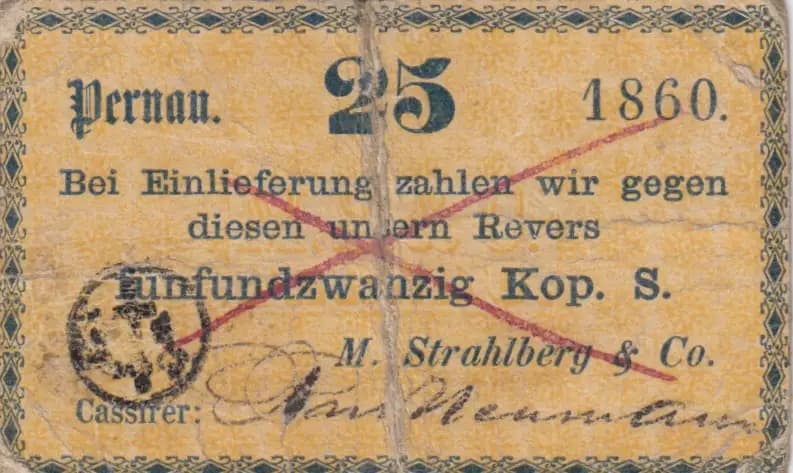
This is a rare private banknote issued by M. Strahlberg & Co. of Pärnu (Pernau), Estonia in 1860, denominated in 25 kopeks. The note displays a distinctive tan/beige background with an ornamental blue/teal geometric border featuring diamond and floral motifs, characteristic of mid-19th century Estonian commercial notes. In VF condition despite significant age-related wear including vertical creasing, foxing, and discoloration, the note bears a prominent red X marking and retains legible German-language inscriptions and a cashier's signature, making it a notable example of pre-Russian Imperial Estonian monetary instruments.
Rare. This note is unlisted in the Pick catalog, indicating it falls outside the scope of major institutional numismatic references and represents an obscure private issue from a small Pärnu merchant house. The specific issuer M. Strahlberg & Co. is not widely documented in Estonian numismatic literature, and surviving examples of 1860s Estonian merchant notes are significantly scarcer than official state banknotes. The unlisted catalog status combined with the antiquity of the note (160+ years) and the specialized nature of Baltic private currency suggests this is not a commonly encountered variety in the collector market.
This private commercial note reflects the period when Estonia was under Russian Imperial rule (1860s), yet local merchants and businesses in Pärnu continued to issue their own credit instruments in German, the language of the Baltic merchant class. M. Strahlberg & Co.'s decision to denominate in Russian kopeks while maintaining German text demonstrates the cultural and commercial hybridity of 19th-century Baltic trade. The 'Bei Einlieferung zahlen wir gegen diesen untern Revers' (payment upon presentation) language indicates this functioned as a promissory note or merchant's credit instrument rather than official currency.
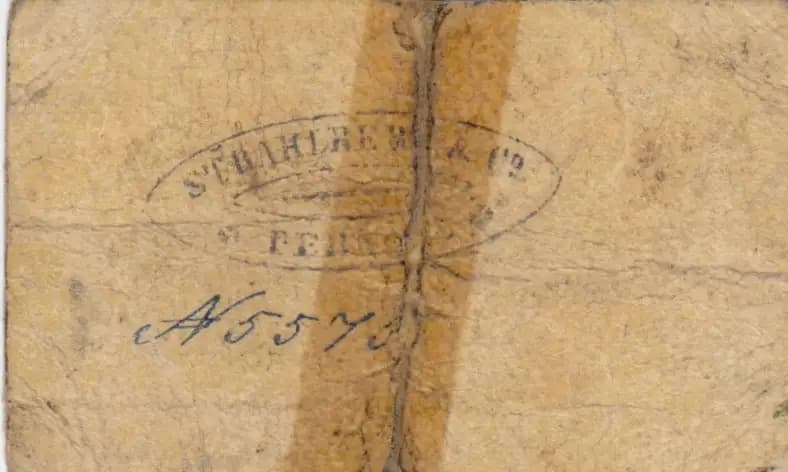
The obverse features a formal commercial note layout typical of 19th-century Baltic private currency. The central field displays the denomination '25' prominently in large numerals, with the German-language promise to pay surrounding it. An ornamental border in blue/teal comprises repeating geometric diamond motifs interspersed with stylized floral elements, creating a sophisticated frame characteristic of the period's security printing practices. A circular stamp or merchant's seal appears in the lower left, likely the official mark of M. Strahlberg & Co. The reverse is largely plain, suggesting a space reserved for institutional endorsements or stamps, with an oval seal impression (possibly representing a financial institution or guarantee authority) visible in the upper portion. The handwritten notation 'A557' indicates this note was cataloged or registered in a merchant's ledger system.
FRONT SIDE: 'Pernau' (place name, Pärnu in Estonian); '25' and '1860' (denomination and year); 'Bei Einlieferung zahlen wir gegen diesen untern Revers' (Upon presentation, we pay against this reverse); 'fünfundzwanzig Kop. S.' (twenty-five kopeks); 'M. Strahlberg & Co.' (issuer name); 'Cassirer:' (Cashier:) followed by a handwritten signature. BACK SIDE: Oval stamp impression containing text (partially illegible, possibly 'SCHLÜSSELBURG' or similar institutional reference); handwritten notation 'A557' (reference or catalog number).
This note was produced using letterpress printing with hand-colored or chemically tinted background, a standard method for private banknotes of the 1860s. The fine ornamental border pattern shows characteristics of wood or steel engraving, while the denomination numerals and text were set in movable type. The teal/blue border coloring appears to have been applied either through hand-coloring or a separate printing pass. The circular and oval seals/stamps were likely impressed or embossed. The presence of a handwritten signature and reference number indicates this was a semi-manufactured note requiring manual completion by the issuer's cashier, typical of private commercial instruments of this era.
This appears to be the primary (possibly only) known variety of the M. Strahlberg & Co. 25 kopeks 1860. Distinguishing features include the 'A557' handwritten notation on the reverse (suggesting sequential cataloging), a specific cashier's signature (partially legible but present), and the oval seal impression on the back. The red X marking across the front was likely added post-issue, possibly indicating cancellation, redemption, or archival marking. Without access to other surviving examples, definitive variety classification is difficult, but the individual handwritten elements suggest each note may possess unique characteristics suitable for detailed variety cataloging by Estonian specialists.