50 kopikat 1912
About This Note
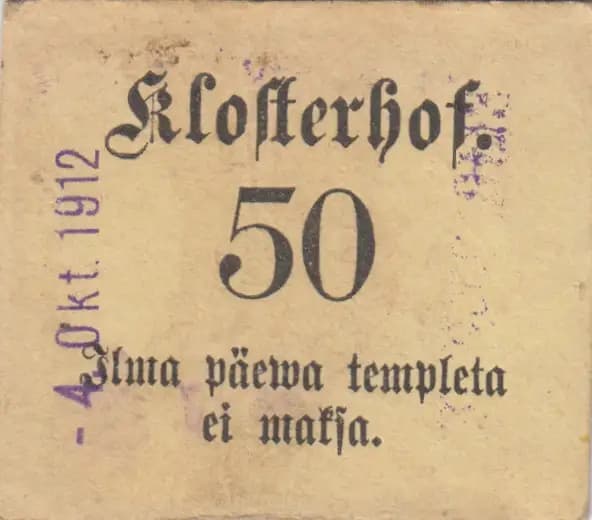
This is a remarkable 50 kopikat emergency banknote issued by Kloostri village in western Estonia on October 4, 1912, during a period of local monetary instability. The note exhibits an AU condition grade with aged cream/beige paper showing foxing consistent with over a century of age, featuring black Gothic German text and an intriguing Estonian poetic inscription. The purple handwritten archival notations in the margins suggest this piece comes from a serious collection or museum provenance, making it a historically significant example of Estonian emergency currency predating the nation's independence.
Very rare. This note is unlisted in the Pick catalog, indicating it was never catalogued in standard reference works, which typically suggests extremely limited documentation and survival. As a hyperlocal emergency issue from a small Estonian village with an uncertain print run, circulation pattern, and survival rate, combined with its 112-year age and the evident archival provenance with specialized collection markings, this represents a scarce piece of early 20th-century Estonian monetary history. The AU condition grade further enhances its rarity, as most surviving examples from this period would show significantly greater wear.
The Kloostri village banknote represents a fascinating moment in Baltic monetary history, issued during the final years of Russian Imperial rule when local communities sometimes created emergency currency to address liquidity crises. The German language inscription 'Klosterhof' and the mixing of German and Estonian linguistic elements reflect the complex ethno-linguistic dynamics of early 20th-century Estonia, where German-speaking Baltic nobility coexisted with Estonian-speaking populations. This 1912 issue predates Estonia's 1918 independence by six years, making it an artifact of the transitional period between imperial and national monetary systems.
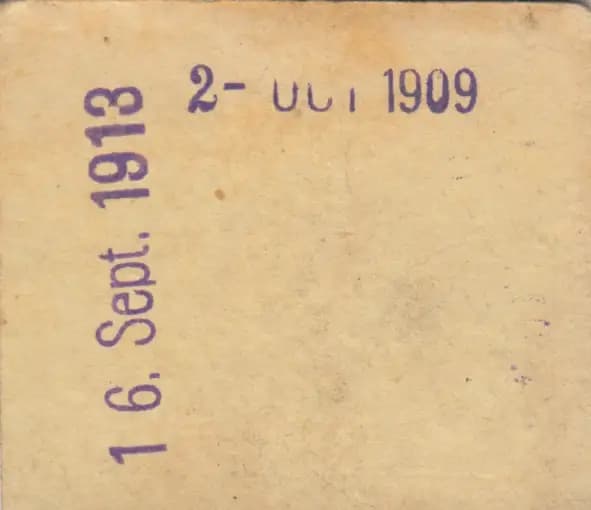
This emergency banknote features a minimalist typographic design typical of local currency issues from the Russian Imperial periphery. The front displays the denomination '50' prominently alongside the issuer identification 'Klosterhof' in German Gothic script on a cream/beige background. The inclusion of an Estonian-language poetic inscription distinguishes this note from purely Germanic issues and suggests an attempt to appeal to the local Estonian-speaking population despite German administrative language. The blank verso with only archival markings is consistent with emergency currency production that prioritized rapid issuing over elaborate security design. The absence of portraits, architectural landmarks, or heraldic symbols indicates a utilitarian approach focused on text-based denomination and issuer identification.
FRONT SIDE: 'Klosterhof' (German: Monastery Court/Farm) - the issuing entity; '50' (numeric denomination); 'Alma päeva templeta ei matja' (Estonian: approximately 'The soul of the day does not bury' - a poetic or proverbial Estonian phrase); '4.9kt. 1912' (German/numeric: October 4, 1912 - the issue date). BACK SIDE: 'Sept. 1918' (English/numeric: September 1918 - likely a catalog or archival date marking); '2- UU 1909' (mixed notation: likely an archival reference code).
Letterpress printing on cream/beige paper stock, utilizing black ink for the primary text and denominations. The sharp, clear impression of the Gothic typeface and numeric characters is consistent with turn-of-the-century letterpress production capabilities. The handwritten annotations in purple/violet ink appear to be post-production archival markings rather than part of the original printing process. No security printer attribution is known for this Pick-unlisted issue, as it represents a small local emission rather than a centralized national or imperial currency production.
The specific variety is determined by the October 4, 1912 date ('4.9kt. 1912') printed on the front. No known variants with alternative dates or denominations have been documented for this Kloostri village issue. The handwritten 'Sept. 1918' notation on the verso appears to be a cataloguer's acquisition or authentication date rather than a production variety marker. The absence of any visible serial numbers, signatures, or identifying marks beyond the date and place of issue is consistent with the emergency currency production standards of the period.