5 rubla 1941
“blank w #”
About This Note
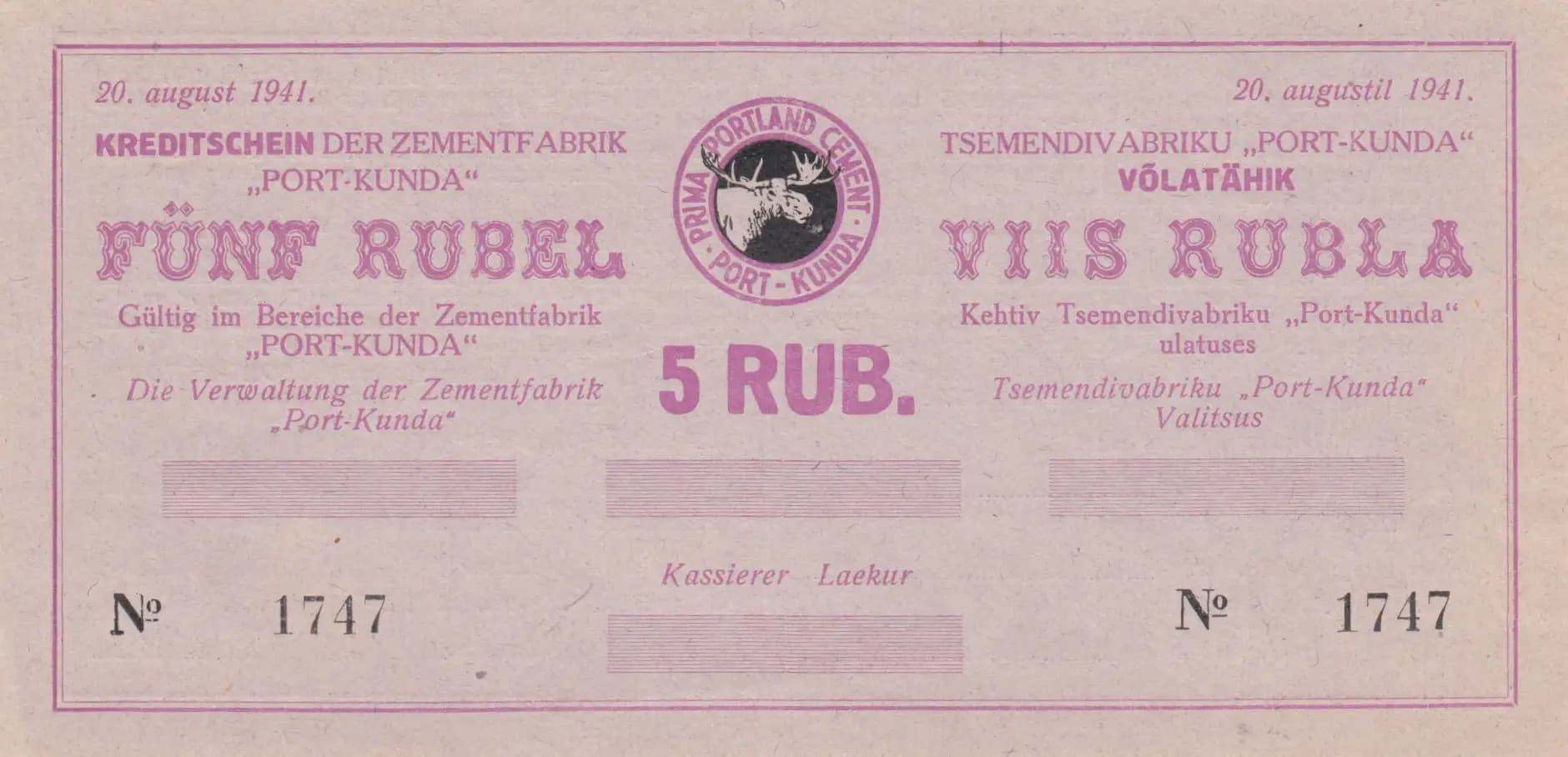
This is a bilingual German-Estonian Kreditschein (credit note) issued by the Port-Kunda cement factory on 20 August 1941, denominated in 5 rubles. The note is printed in purple/magenta ink on cream-colored paper and features a distinctive circular seal depicting a moose head with the factory name, characteristic of Estonian industrial scrip from the German occupation period. In AU condition, the note shows virtually no wear with crisp printing and clean paper, making it an excellent example of this localized wartime currency.
Uncommon. This note falls outside the Pick catalog standard listings (P-unlisted), indicating it was not part of the major international currency classification system, which focused on national currencies rather than localized industrial scrip. Port-Kunda cement factory notes represent a limited and specialized category of Estonian wartime currency. The print run for such industrial credit notes was typically small, issued for localized use within the factory's economic sphere. The AU condition grade further limits availability, as most surviving examples show circulation wear from their use as substitute currency. However, without definitive print run data, and given that some examples do appear in collector hands, it is classified as uncommon rather than rare.
This credit note represents a fascinating artifact of Estonia's wartime economy during the 1941-1942 German occupation (Operation Barbarossa period). The bilingual German-Estonian text reflects the administrative structure of the Nazi occupation, while the moose emblem and Port-Kunda factory name indicate this was industrial scrip issued to workers and used within the cement factory's economic sphere. The validity terms (extendable monthly until January 1942) and the reference to USSR rubles demonstrate the transitional monetary chaos of the occupation period, when German occupiers repurposed Soviet currency frameworks.
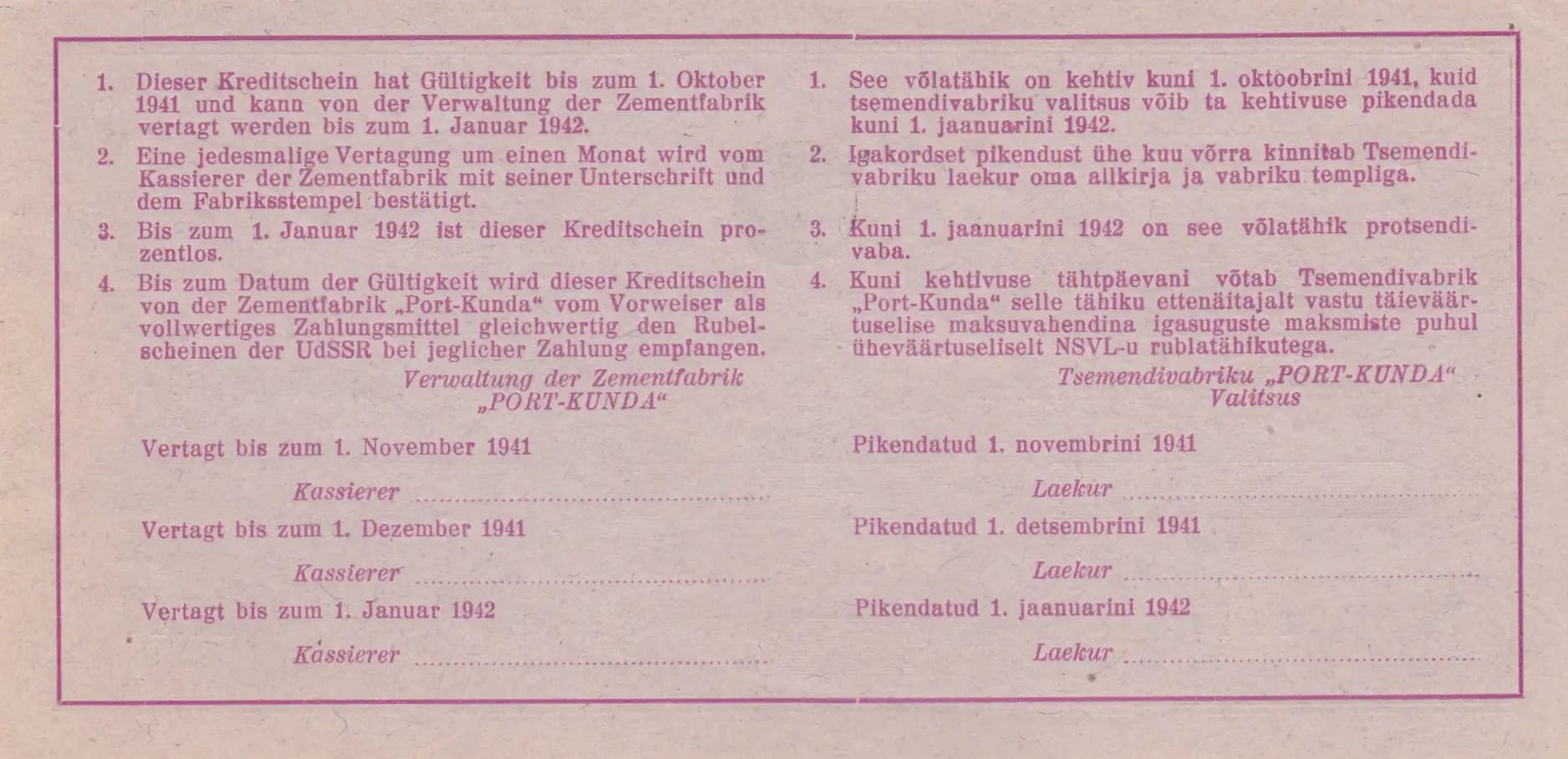
The note features a clean, utilitarian design typical of industrial scrip and wartime credit instruments. The obverse (front) is dominated by a circular emblem in the center-top containing a moose head shown in profile, surrounded by the text 'PRIMAPORTLAND TSEMENT PORT-KUNDA' — the moose was a traditional symbol of the Port-Kunda cement works and Nordic industrial heritage. The large, decorative '5 RUB.' denomination text occupies the central field. The layout employs strict bilateral symmetry with German text on the left and Estonian on the right, emphasizing the dual administrative language of the occupation. The reverse contains four numbered terms and conditions in the same bilingual format, followed by three dated extension sections with blank signature and stamp lines. The paper stock is cream/beige colored, and the entire note is executed in purple/magenta monochromatic printing, a common approach for emergency currency during wartime when materials were scarce.
FRONT: Title: 'Kreditschein der Zementfabrik "Port-Kunda"' (Credit note of the cement factory 'Port-Kunda') / 'Tsemendivabriku "Port-Kunda" Võlatähik' (Debt certificate of cement factory 'Port-Kunda'). Date: '20. august 1941' / '20. augustil 1941' (20 August 1941). Denomination: 'FÜNF RUBEL' / 'VIIS RUBLA' (Five rubles), displayed as '5 RUB.' Validity: 'Gültig im Bereiche der Zementfabrik "PORT-KUNDA"' / 'Kehtiv Tsemendivabriku "Port-Kunda" ulatuses' (Valid in the area of the cement factory 'Port-Kunda'). Issuer: 'Die Verwaltung der Zementfabrik "Port-Kunda"' / 'Tsemendivabriku "Port-Kunda" Valitsus' (The administration of the cement factory 'Port-Kunda'). Officer: 'Kassierer / Laekur' (Cashier). Serial: 'No 1747'. BACK: Terms and conditions (4 numbered paragraphs bilingual): Paragraph 1 states validity until 1 October 1941, extendable by administration until 1 January 1942. Paragraph 2: Each monthly extension confirmed by cashier signature and factory stamp. Paragraph 3: Interest-free until 1 January 1942. Paragraph 4: Accepted as full legal tender in USSR rubles. Extension sections: 'Vertagt bis zum 1. November 1941 / Pikendatud 1. novembrini 1941', 'Vertagt bis zum 1. Dezember 1941 / Pikendatud 1. detsembrini 1941', 'Vertagt bis zum 1. Januar 1942 / Pikendatud 1. jaanuarini 1942', each with signature lines for 'Kassierer / Laekur'.
Letterpress printing on cream-colored paper stock, executed in a single color (purple/magenta ink). The bilateral bilingual layout and large decorative fonts are characteristic of letterpress production, which was the standard method for industrial and commercial scrip of this period. No security printer is identified in the catalog data, suggesting this was produced locally or by the factory's administrative printing department rather than a national security printer.
Serial number 1747 is observed on this specimen. The specific variety is identified by: (1) the exact issue date of 20 August 1941; (2) the factory seal design with moose head emblem; (3) the bilingual German-Estonian text layout; (4) the extension provisions dated through January 1942. No overprints or significant variant signatures are visible on this specimen. The blank signature and stamp lines on the reverse suggest this note was issued in unextended form, with no endorsements applied during its validity period.