5 rubla 1941
“blank”
About This Note
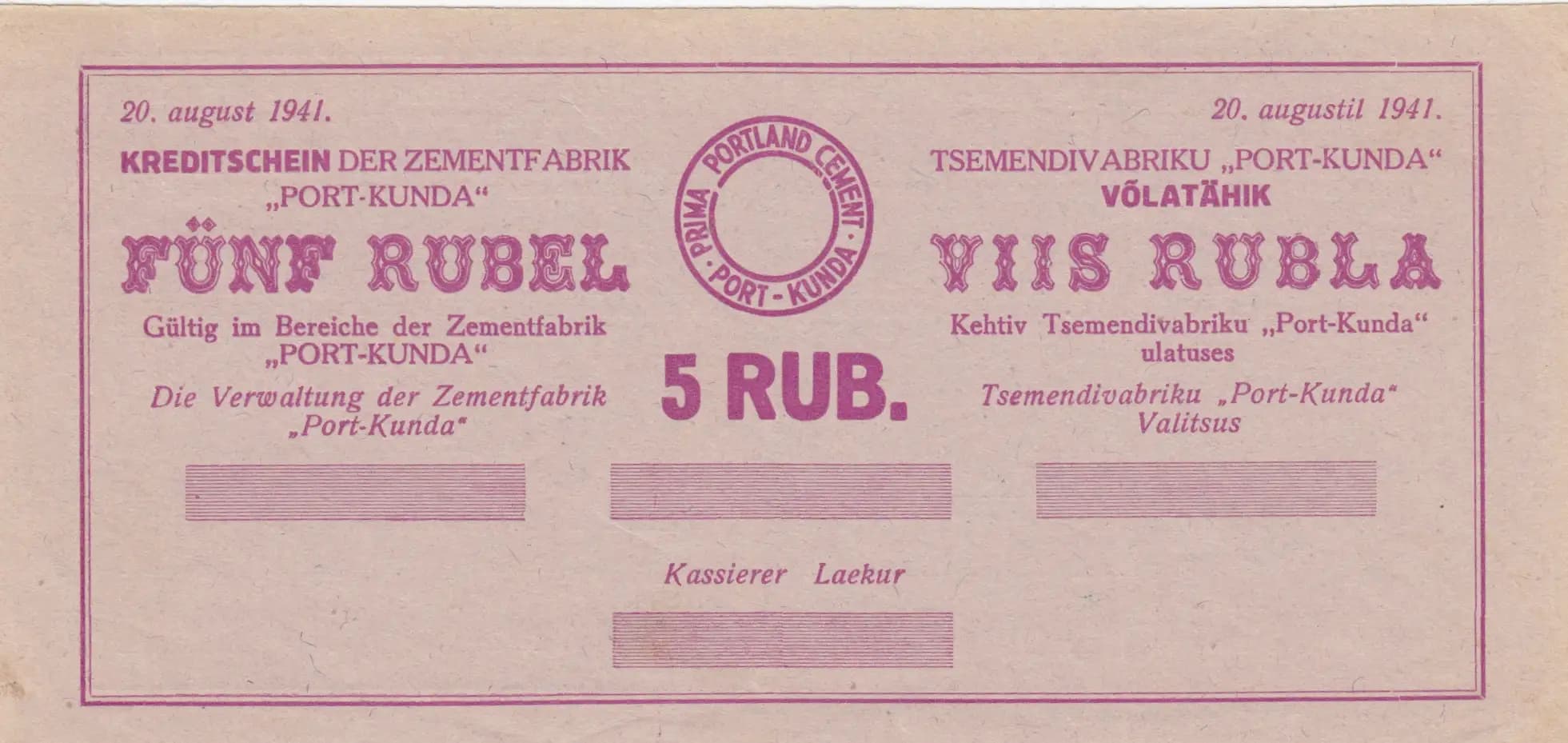
A bilingual German-Estonian credit note (Kreditschein) issued by the Port-Kunda cement factory on 20 August 1941, denominated 5 rubles and printed in purple/magenta ink on tan stock. This note represents a fascinating numismatic artifact from Estonia's World War II occupation period, featuring the factory's distinctive 'Prima Portland Cement' circular seal and dual-language text reflecting the German administrative overlay of the period. The AU condition with minimal wear and unfilled signature lines suggests this may be a specimen or lightly circulated example of an already scarce regional credit instrument.
Scarce. Port-Kunda factory credit notes from the 1941 occupation period are infrequently encountered in numismatic commerce. The specific combination of factors—limited geographic circulation (valid only within the factory compound), short operational lifespan (August 1941 to January 1942), the transitional nature of the occupation currency system, and the industrial rather than governmental origin—naturally restricts survivor population. The AU condition and apparent specimen status (unfilled signature lines) further suggest this represents a preserved administrative example rather than heavily circulated currency. While not exceptionally rare by rarity standards, examples in this condition with complete visual clarity are distinctly uncommon on the market.
This credit note was issued during the German occupation of Estonia (1941-1944), when the Reich's administration utilized local industrial facilities and factory-issued scrip as supplementary currency. The bilingual German-Estonian text and dated issuance of 20 August 1941 place this firmly in the early occupation period, with the note's validity structure (extending to January 1942) reflecting wartime economic controls. The Port-Kunda cement factory's prominence as a 'Prima Portland Cement' producer made it strategically important, warranting its authorization to issue credit instruments accepted as equivalent to Soviet rubles within the factory's operational sphere.
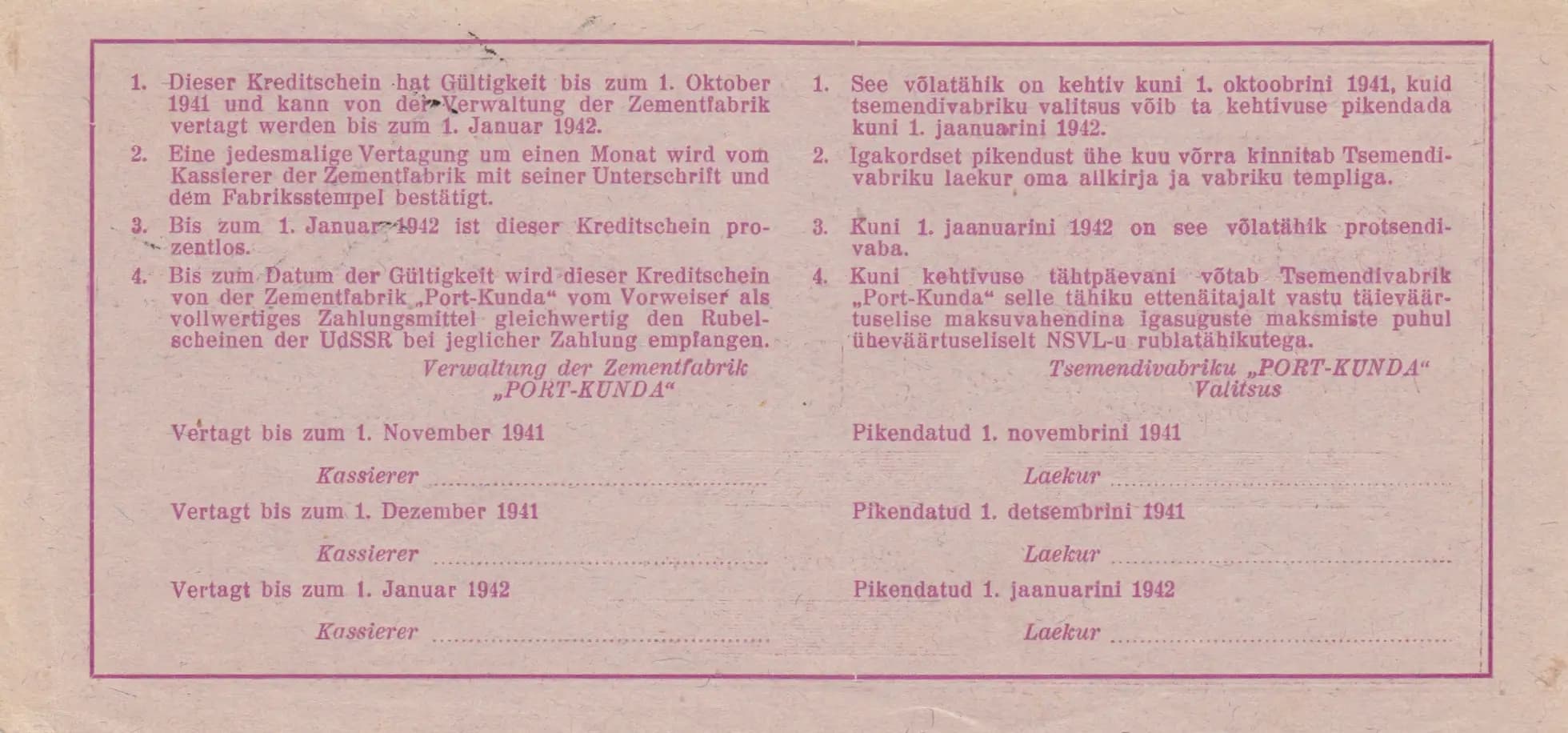
The note features a simple, utilitarian layout typical of industrial scrip issued during wartime occupation. The obverse presents the denomination '5 RUB.' in large ornamental letters as the central focus, flanked by bilingual German (left) and Estonian (right) text detailing the issuer as the Port-Kunda cement factory administration. A prominent circular seal bearing 'PRIMA PORTLAND CEMENT PORT-KUNDA' is positioned centrally at the top, serving as the primary security/authenticity element. The reverse contains numbered terms and conditions (1-4) in parallel German and Estonian text, with provision for monthly extension signatures from November 1941 through January 1942, each requiring the cashier's signature (Kassierer/Laekur) and factory stamp. The purple/magenta printing on tan/beige stock and the symmetrical column-based layout reflect Germanic administrative design conventions applied to Estonian industrial operations during the 1941-1944 occupation period. No portrait or landmark imagery is present; the design relies entirely on typography and the factory seal for visual authority.
FRONT SIDE: Title (German): 'KREDITSCHEIN DER ZEMENTFABRIK "PORT-KUNDA"' (Credit Note of the Cement Factory "Port-Kunda") | Title (Estonian): 'TSEMENDIVABRIKU "PORT-KUNDA" VÕLATÄHIK' (Cement Factory "Port-Kunda" Debt Note) | Denomination (German): 'FÜNF RUBEL' (Five Rubles) | Denomination (Estonian): 'VIIS RUBLA' (Five Rubles) | Central denomination: '5 RUB.' (5 Rubles) | Date (German): '20. august 1941.' (20 August 1941) | Date (Estonian): '20. augustil 1941.' (20 August 1941) | Validity clause (German): 'Gültig im Bereiche der Zementfabrik "PORT-KUNDA"' (Valid in the area of the cement factory "Port-Kunda") | Validity clause (Estonian): 'Kehtiv Tsemendivabriku "Port-Kunda" ulatuses' (Valid within the scope of the cement factory "Port-Kunda") | Issuer (German): 'Die Verwaltung der Zementfabrik "Port-Kunda"' (The administration of the cement factory "Port-Kunda") | Issuer (Estonian): 'Tsemendivabriku "Port-Kunda" Valitsus' (The administration of the cement factory "Port-Kunda") | Seal inscription: 'PRIMA PORTLAND CEMENT PORT-KUNDA' | Signature line label: 'Kassierer Laekur' (Cashier) | BACK SIDE: Condition 1 (German): 'This credit note is valid until 1 October 1941 and can be extended by the administration of the cement factory until 1 January 1942.' | Condition 1 (Estonian): 'This debt note is valid until 1 October 1941, but the cement factory administration can extend its validity until 1 January 1942.' | Condition 2 (German): 'Each extension by one month is confirmed by the cashier of the cement factory with his signature and the factory stamp.' | Condition 2 (Estonian): 'Each one-month extension is confirmed by the cement factory cashier with his signature and factory stamp.' | Condition 3 (German): 'Until 1 January 1942, this credit note is interest-free.' | Condition 3 (Estonian): 'Until 1 January 1942, this debt note is interest-free.' | Condition 4 (German): 'Until the validity date, this credit note will be accepted by the cement factory "Port-Kunda" as a full-value means of payment equivalent to USSR ruble notes for any payment.' | Condition 4 (Estonian): 'Until the validity date, the cement factory "Port-Kunda" accepts this debt note as fully equivalent to USSR ruble notes.' | Extension dates: 'Vertagt bis zum 1. November 1941' / 'Pikendatud 1. novembrini 1941' (Extended until 1 November 1941), 'Vertagt bis zum 1. Dezember 1941' / 'Pikendatud 1. detsembrini 1941' (Extended until 1 December 1941), 'Vertagt bis zum 1. Januar 1942' / 'Pikendatud 1. jaanuarini 1942' (Extended until 1 January 1942)
Letterpress printing executed in single-color purple/magenta ink on tan/beige paper stock. The crisp impressions of text, the circular seal impression, and the uniform ink coverage are consistent with standard offset or rotogravure letterpress production common to German occupation-era documentation. The bilingual parallel text layout and consistent typography across both sides indicate centralized printing, likely by a German or German-administered printer in occupied Estonia. No microprinting, sophisticated watermarks, or advanced security features are evident, consistent with wartime industrial scrip production priorities.
This note is cataloged as Pick unlisted, indicating it does not appear in standard Pick Universal numismatic catalogs. Varieties may exist based on: (1) signature presence/absence and specific cashier initials on extended validity dates through January 1942, (2) presence or absence of factory stamp impressions confirming monthly extensions, (3) different impressions of the circular 'Prima Portland Cement' seal, and (4) potential variant printings. The observed specimen appears to lack filled signature/extension fields, suggesting it may be an unissued specimen or early example. Future cataloging should note the exact status of signature lines and any factory stamp impressions as defining characteristics of specific varieties.