5 rubla 1941
About This Note
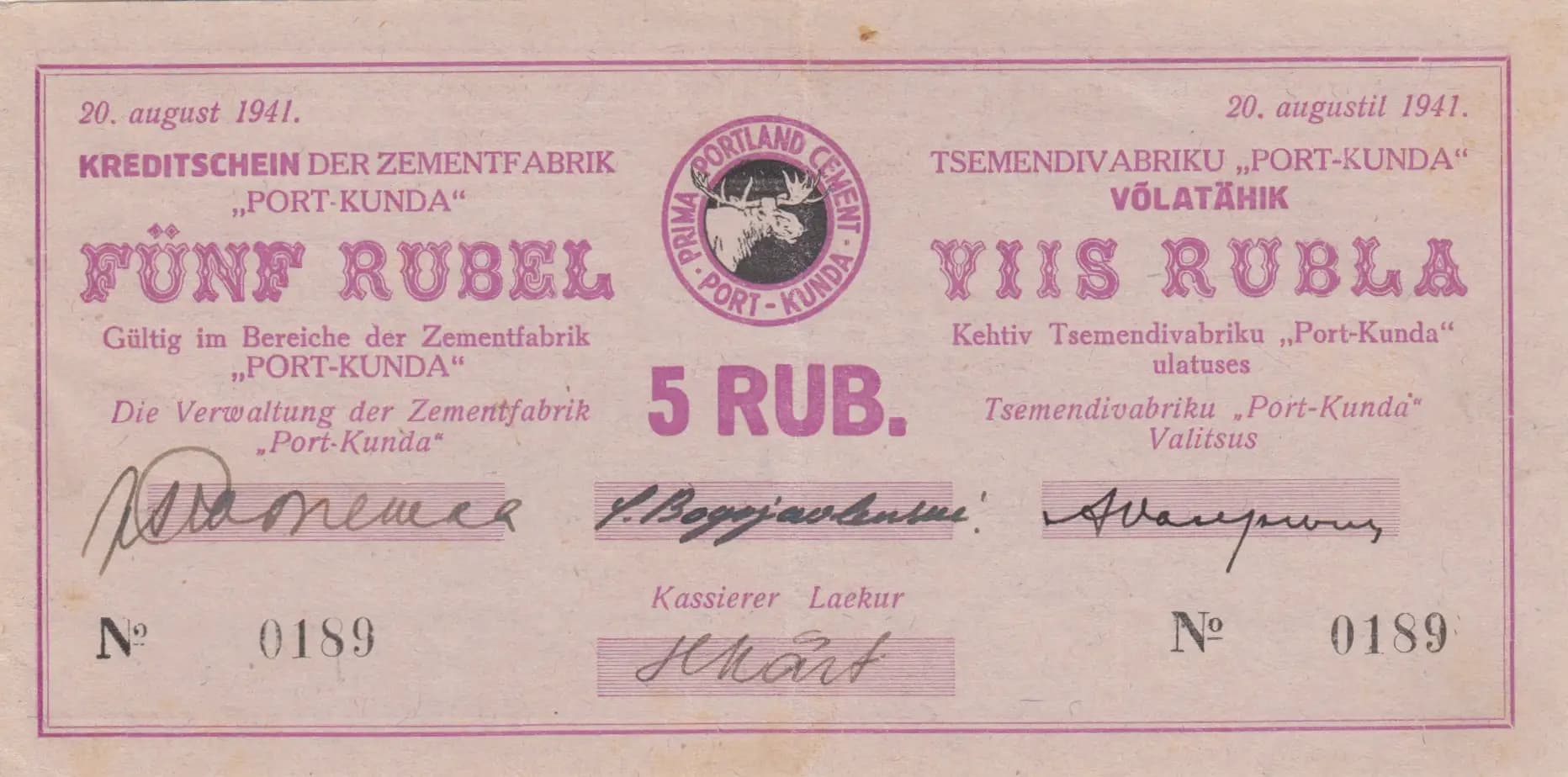
This is a 5 Rubla credit note (Kreditschein) issued by the Port-Kunda cement factory in Estonia on August 20, 1941, during the German occupation. The note is printed in purple/magenta ink on tan/beige paper and features a distinctive circular seal with a horned animal (buffalo/ox head) emblem. In EF condition, the note displays clear printing, visible creases from handling and storage, aged paper patina, and evidence of active use with multiple handwritten signatures and three dated extension stamps on the reverse (extended through January 1, 1942), making it a fascinating example of occupation-era scrip.
Uncommon. While Port-Kunda scrip from the 1941 occupation period was produced in quantities sufficient for local commercial use, the survival rate of such industrial credit notes is modest. This particular example with serial number 0189 and documented extension stamps through January 1942 represents active-use currency from a short-lived issuing authority operating during wartime. The specific combination of high-grade condition (EF) and the complete documentation of extensions makes this a desirable example for collectors of occupation currency, though the base issue itself was not rare. Pick catalog listing as 'unlisted' suggests this note has received limited numismatic documentation, which may indicate either specialized collector interest or relative obscurity in the market. The condition and serial number combination make this particular specimen more valuable than worn examples.
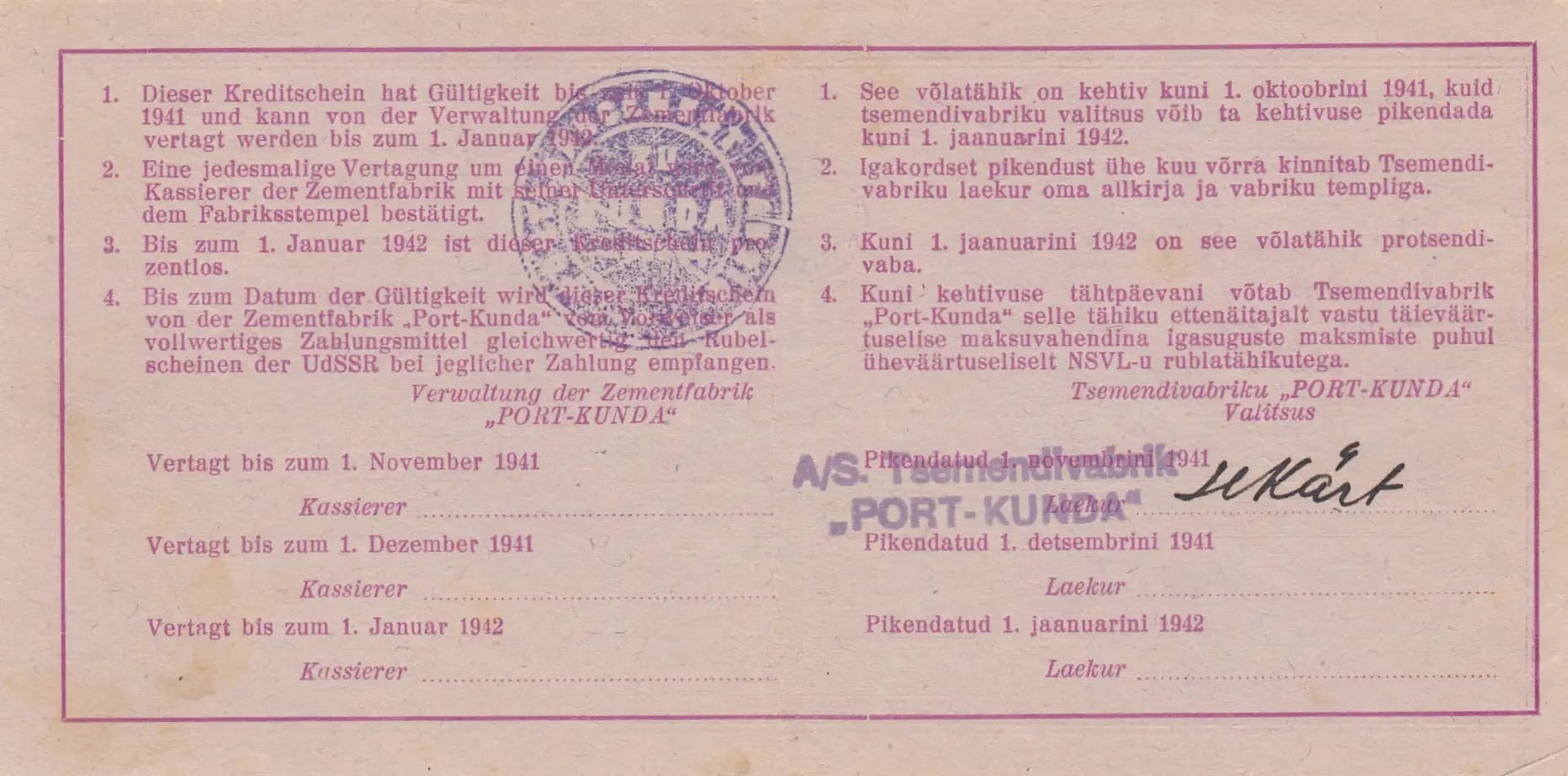
This credit note represents a unique period in Estonian monetary history during the 1941 German occupation, when industrial facilities like the Port-Kunda cement factory issued their own negotiable currency to supplement official circulation. The bilingual German-Estonian text reflects the administrative structure of the occupation period, with German as the language of authority and Estonian as the local language. The multiple extensions stamped on the reverse (November, December 1941, and January 1942) document the actual commercial use and acceptance of this scrip during the tumultuous early years of World War II in the Baltic region.
The Port-Kunda cement factory credit note features a clean, functional layout typical of industrial scrip from the German occupation period. The obverse displays a prominent circular emblem at the top center containing a horned animal head (likely depicting a buffalo or ox, possibly symbolic of strength or industry) surrounded by text reading 'Portland Cement Portland Tsement Port-Kunda,' establishing both the industrial identity and bilingual character of the issuing authority. The large purple '5 RUB.' denomination dominates the center of the note. The design is organized with German text on the left column and Estonian text on the right column, reflecting the dual administrative structure. Serial number 0189 appears in both upper left and right margins. The reverse contains the four terms and conditions of use in the same bilingual format, with evidence of three manual extensions stamped and signed by the factory treasurer/cashier (Kassierer/Laekur), documenting the note's progressive validity periods through January 1942. The entire design employs a minimalist approach appropriate for wartime emergency currency, with no elaborate security features beyond the official factory seal.
FRONT SIDE: 'Kreditschein der Zementfabrik 'Port-Kunda'' (Credit note of the cement factory 'Port-Kunda') / 'Tsemendivabrikku 'Port-Kunda' Volatähik' (Port-Kunda cement factory credit note). Denomination: 'Fünf Rubel' / 'Viis Rubla' (Five Rubles). Date: '20. august 1941' / '20. augustil 1941' (20 August 1941). Validity: 'Gültig im Bereiche der Zementfabrik 'PORT-KUNDA'' / 'Kehtiv Tsemendivabrikku 'Port-Kunda' ulatuses' (Valid in the area/scope of the cement factory 'Port-Kunda'). Authority: 'Die Verwaltung der Zementfabrik 'Port-Kunda'' / 'Tsemendivabrikku 'Port-Kunda' Valitsus' (The administration of the cement factory 'Port-Kunda'). Officer: 'Kassierer Laekur' (Cashier/Treasurer). Serial Number: 'N° 0189' (both sides). BACK SIDE: Term 1: 'Dieser Kreditschein hat Gültigkeit bis zum 1. Oktober 1941 und kann von der Verwaltung der Zementfabrik vertagt werden bis zum 1. Januar 1942' / 'See võlatähik on kehtiv kuni 1. oktoobrina 1941, kuid tsemendivabrikku valitsus võib ta kehtsuse pikendada kuni 1. jaanuarini 1942' (This credit note is valid until October 1, 1941 and can be extended by the cement factory administration until January 1, 1942). Term 2: 'Eine jedesmalige Vertragung um einen Monat mit dem Kassierer der Zementfabrik mit dem Fabrikstempel bestätigt' / 'Igakordset pikendust ühe kuu võrra kinnitab Tsemendivabrikku laekur oma ametliku templinga' (Each monthly extension is confirmed by the cement factory treasurer with his official stamp). Term 3: 'Bis zum 1. Januar 1942 ist dieser Kreditschein zentlos' / 'Kuni 1. jaanuarini 1942 on see võlatähik protsendiväba' (Until January 1, 1942 this credit note is interest-free). Term 4: 'Bis zum Datum der Gültigkeit wird dieser Kreditschein von der Zementfabrik 'Port-Kunda' als vollwertiges Zahlungsmittel gleichwertig mit Rubel-scheinen der UdSSR bei jeglicher Zahlung empfangen' / 'Kuni kehtivuse tähtpäevani võtab Tsemendivabrik 'Port-Kunda' selle täheähitajalt vastu täleväärtusetsellise maksuvahendina igasuguste maksimiste puhul üheväärtusetselliselt NSVL-u rublatähikutega' (Until the validity date, this credit note will be accepted by the cement factory as a full-value payment medium equivalent to USSR ruble notes for any payment). Extensions: 'Vertagt bis zum 1. November 1941' / 'Pikendatud 1. novembrini 1941' (Extended until November 1, 1941), 'Vertagt bis zum 1. Dezember 1941' / 'Pikendatud 1. detsembrini 1941' (Extended until December 1, 1941), 'Vertagt bis zum 1. Januar 1942' / 'Pikendatud 1. jaanuarini 1942' (Extended until January 1, 1942).
The note was produced using letterpress printing in purple/magenta ink on tan/beige colored paper stock. The consistent, clear impression of both text and the circular seal emblem, combined with the sharp definition of the bilingual inscriptions, indicates high-quality letterpress work typical of official German occupation-era printing. The handwritten signatures and extension stamps on the reverse were added post-printing, with the stamps likely applied using the factory's official rubber seal. No security watermarks, guilloché patterns, or other advanced anti-counterfeiting measures are evident, consistent with industrial scrip of this period. The printer is not specifically identified on the note itself, though German occupation authorities typically contracted with established German printers for such documents during 1941.
Serial number 0189 is noted on both sides of this specimen. The reverse shows three dated extension stamps: 'Extended until November 1, 1941,' 'Extended until December 1, 1941,' and 'Extended until January 1, 1942,' each stamped and signed by the factory cashier. These progressive extensions document the inflation of the note's value beyond its original October 1, 1941 expiration date. Varieties of this issue would likely be distinguished by serial number ranges, the presence or absence of extension stamps, the number of extensions applied, and the specific signatures of the authorizing officers. This specimen with three complete extensions represents a heavily-used but well-preserved example that fully documents the commercial circulation of Port-Kunda scrip during the critical late months of 1941.