5 marka 1919 specimen
“thin paper”
Market Prices
1 saleAbout This Note
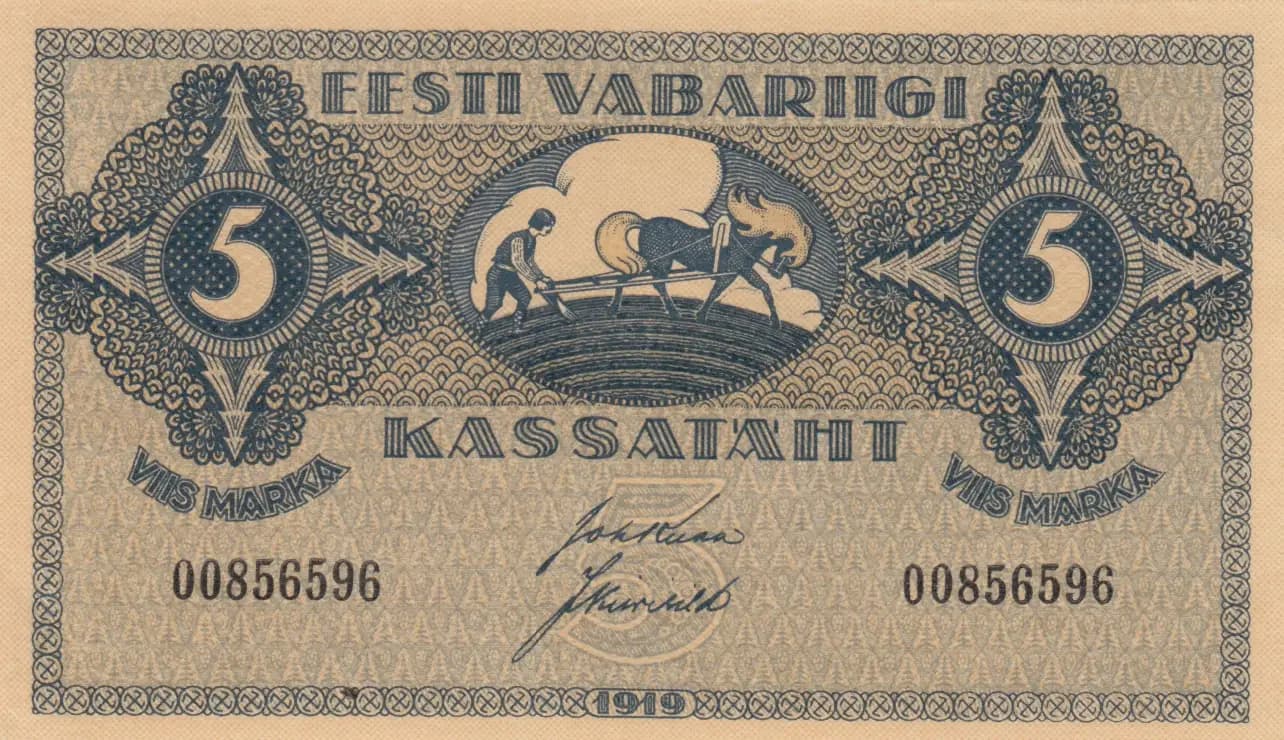
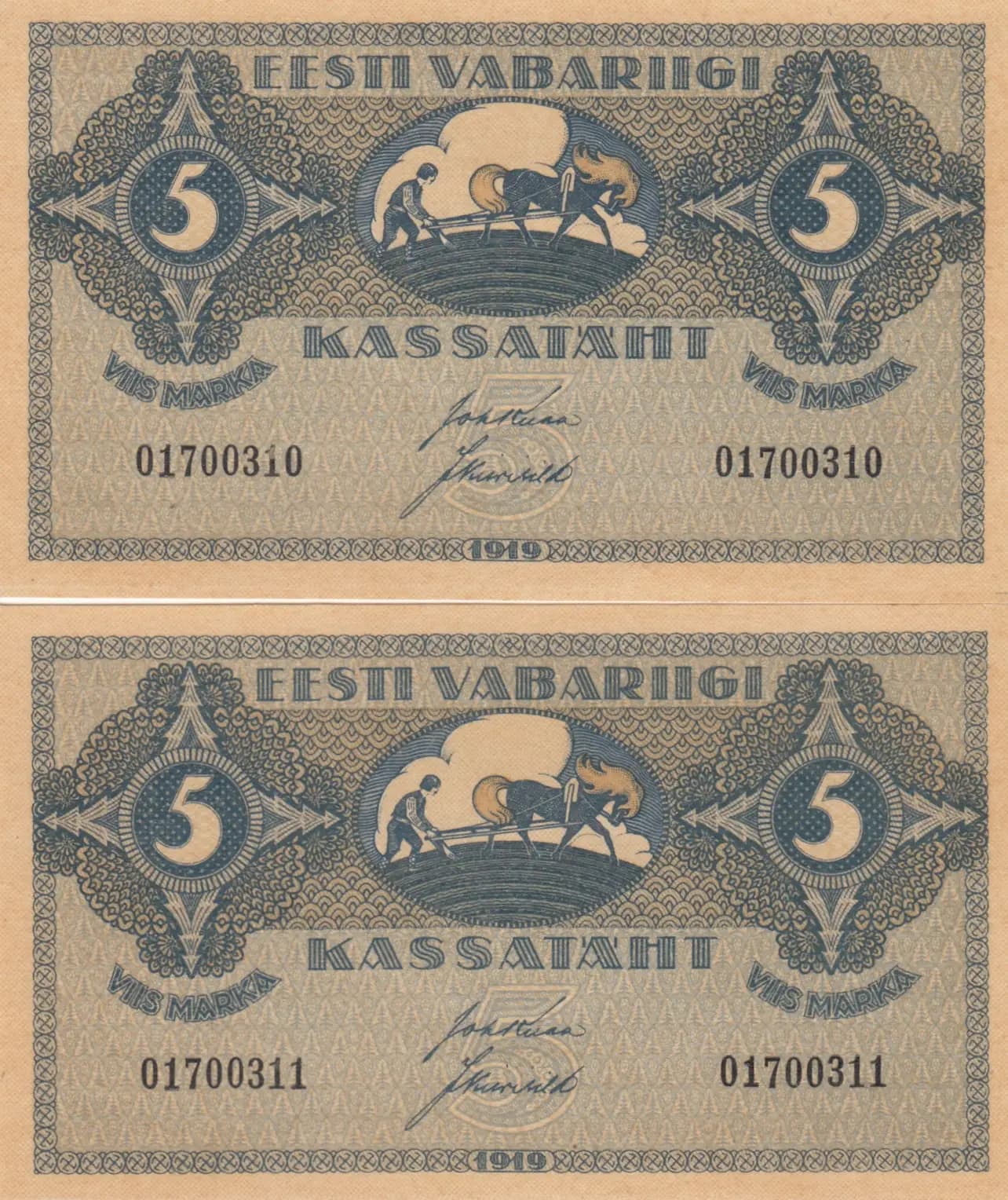
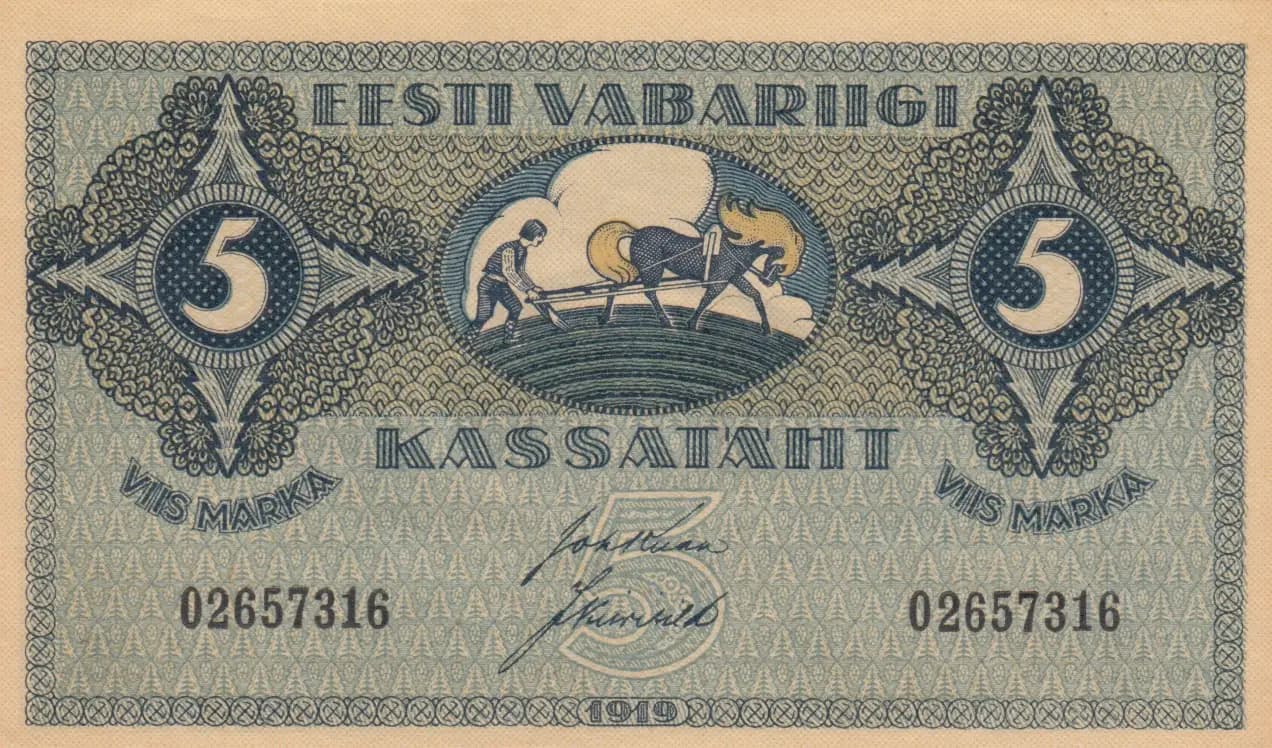
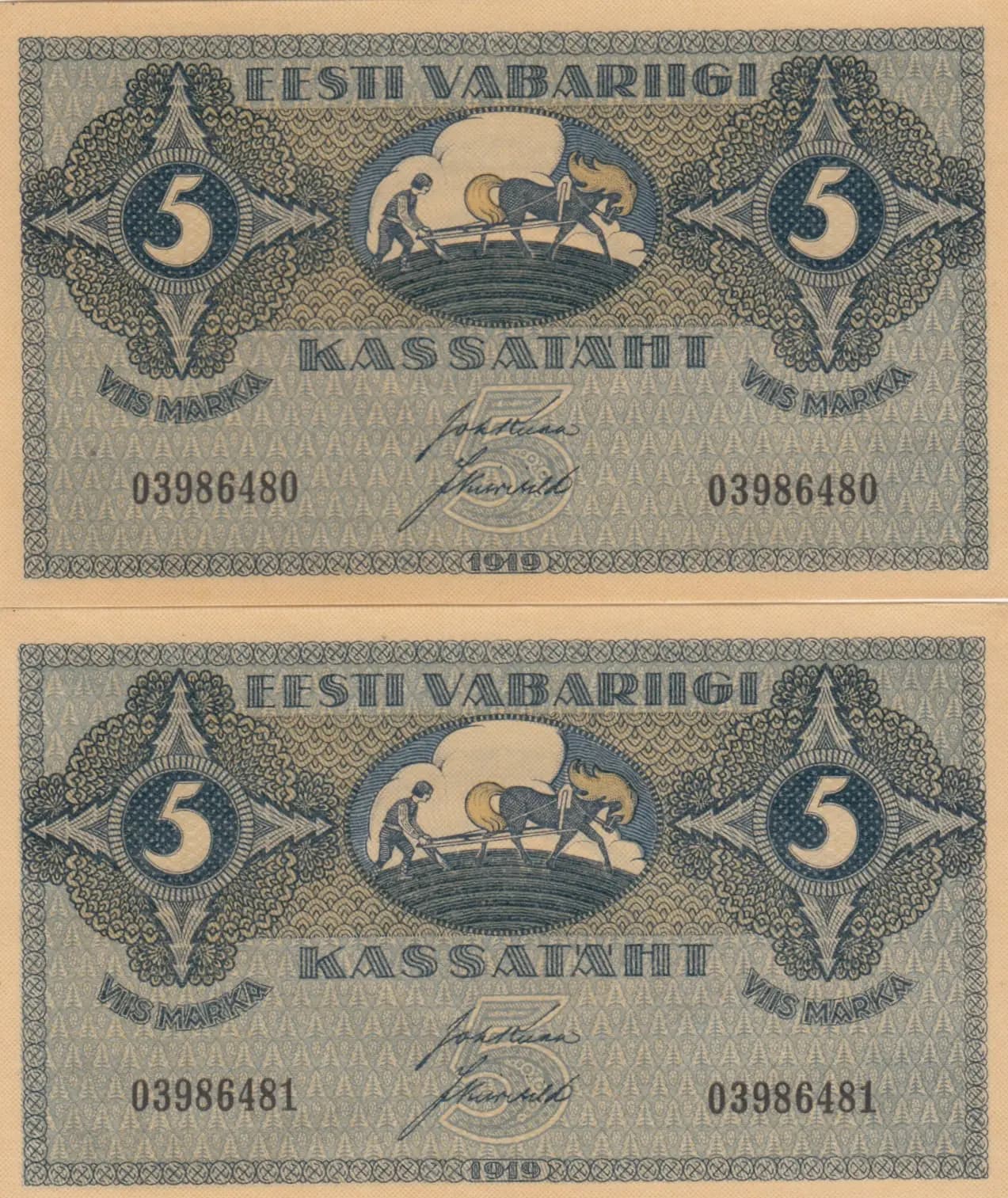
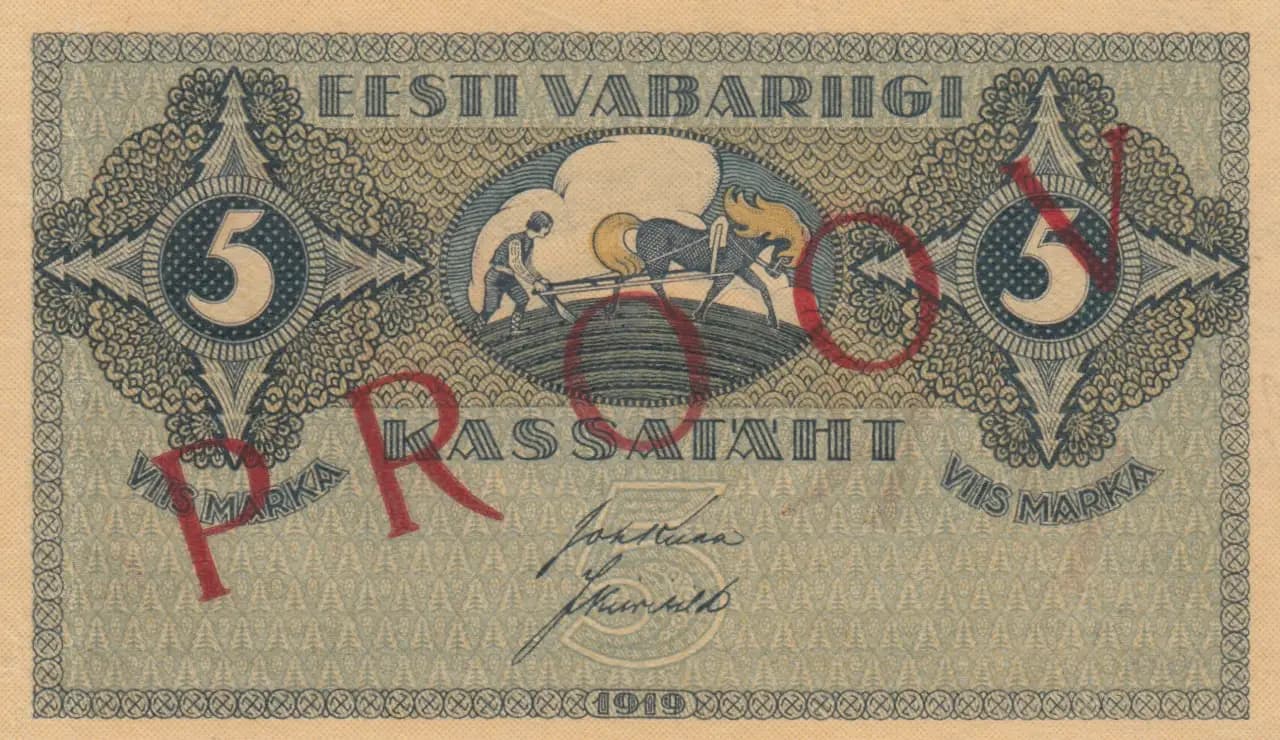
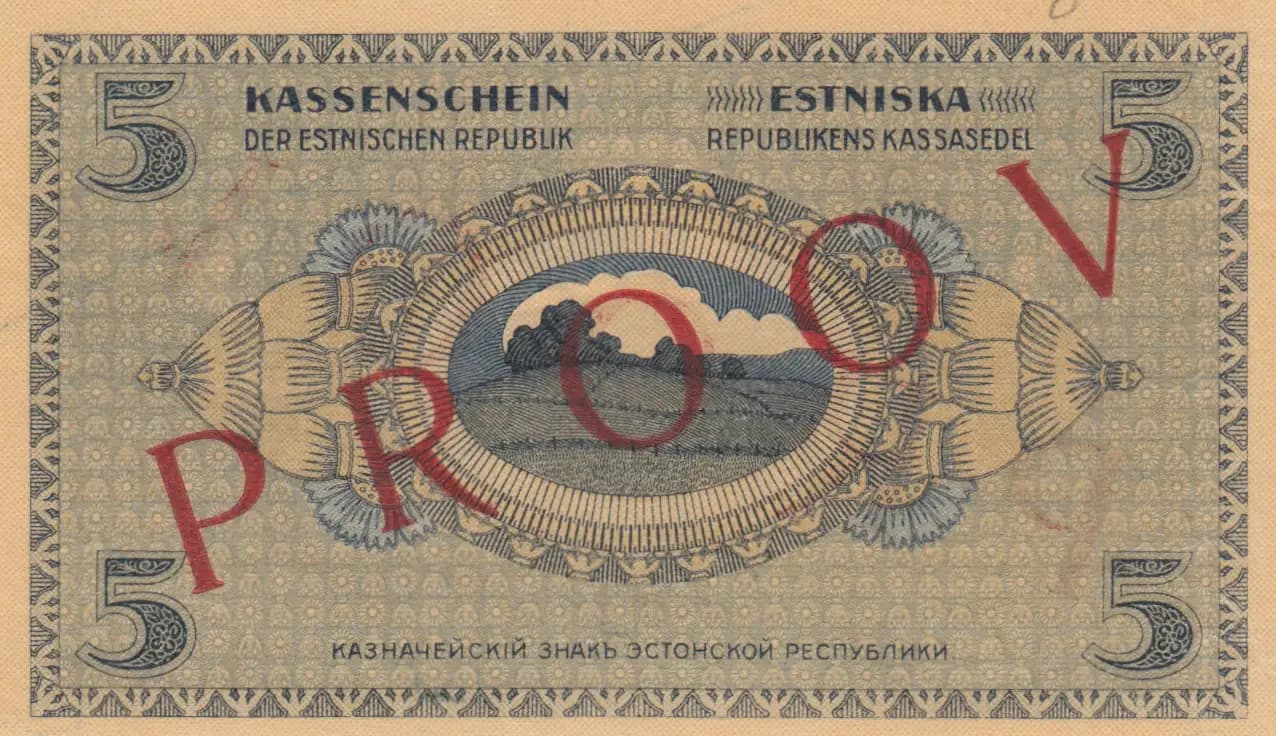
This is a specimen note of Estonia's first independent currency issue, the 5 Marka from 1919, graded AU with notably thin paper stock. The note features striking red specimen overprints across both sides and displays excellent detail in its engraved agricultural vignettes—a plowing farmer on the obverse and a pastoral landscape on the reverse. As a specimen note (marked 'PROVA'), this piece represents an official bank presentation example and carries historical significance as part of Estonia's brief early republican currency period.
Common. The eBay market data provided shows specimens in UNC condition selling for approximately $80-92, well below the threshold indicating rarity. Early Estonian currency has modest collector demand despite its historical significance. While specimen notes command a premium over regular circulation issues, they were produced in quantities sufficient for institutional distribution and archival purposes. The AU grade and thin paper notation are collector observations rather than indicators of rarity.
The 5 Marka banknote was issued by the newly independent Estonian Republic in 1919, following independence from the Russian Empire. The deliberate choice of agricultural imagery—depicting a farmer with plow and horse on the front and a pastoral landscape on the back—reflects Estonia's agrarian economy and cultural identity during this formative period. The multilingual inscriptions in Estonian, German, and Russian underscore the complex linguistic and political environment of the newly independent Baltic nation navigating between Scandinavian, German, and Russian spheres of influence.
The obverse features a dynamic central vignette of a farmer in work clothes executing a plow with horse, symbolizing Estonia's agricultural heritage and labor-oriented national identity. This vignette is framed by an intricate geometric and floral border pattern. Ornate circular medallions containing the numeral '5' are positioned on both left and right sides, rendered in classical engraved style. The reverse displays a serene rural landscape scene—depicting rolling hills or terrain with what appears to be a valley or water feature—enclosed within an ornate oval frame. Corner elements on the reverse also feature the denomination numeral. The overall design employs classical engraving with fine line work characteristic of 1919-era European banknote production.
Front side: 'EESTI VABARIIGI' (Estonian Republic), 'KASSATAHH I' (Treasury note), 'PANK MARKA' (Bank mark), 'VIIS MARKA' (Five marks), '1919' (year), 'PROVA' (Specimen in Estonian). Back side: 'KASSENSCHEIN DER ESTNISCHEN REPUBLIK' (Treasury note of the Estonian Republic in German), 'ESTNISKA REPUBLIKENS KASSASEDEL' (Estonian Republic's treasury note in Estonian/Swedish), 'КАЗНАЧЕЙСКИЙ ЗНАК ЭСТОНСКОЙ РЕСПУБЛИКИ' (Treasury note of the Estonian Republic in Russian), '5' (denomination), 'PROVA' (Specimen).
Steel plate engraving (intaglio printing). The note exhibits the characteristic deep, precise line work and intricate border patterns typical of high-security banknote engraving from the early 20th century. The fine detail visible in both the agricultural vignette and landscape design, combined with the geometric border complexity, indicates professional-grade security engraving. The specimen overprints are applied separately in red ink after initial printing.
This is catalogued as P-45s, the specimen variety of the 5 Marka. The Pick catalog distinguishes between P-45a (regular issue) and P-45s (specimen). The specimen designation is confirmed by the prominent red 'PROVA' overprint visible across both obverse and reverse. No signature varieties or serial number ranges are evident from the visual analysis provided. The thin paper composition is noted in collector records but does not constitute a separate catalogued variety.