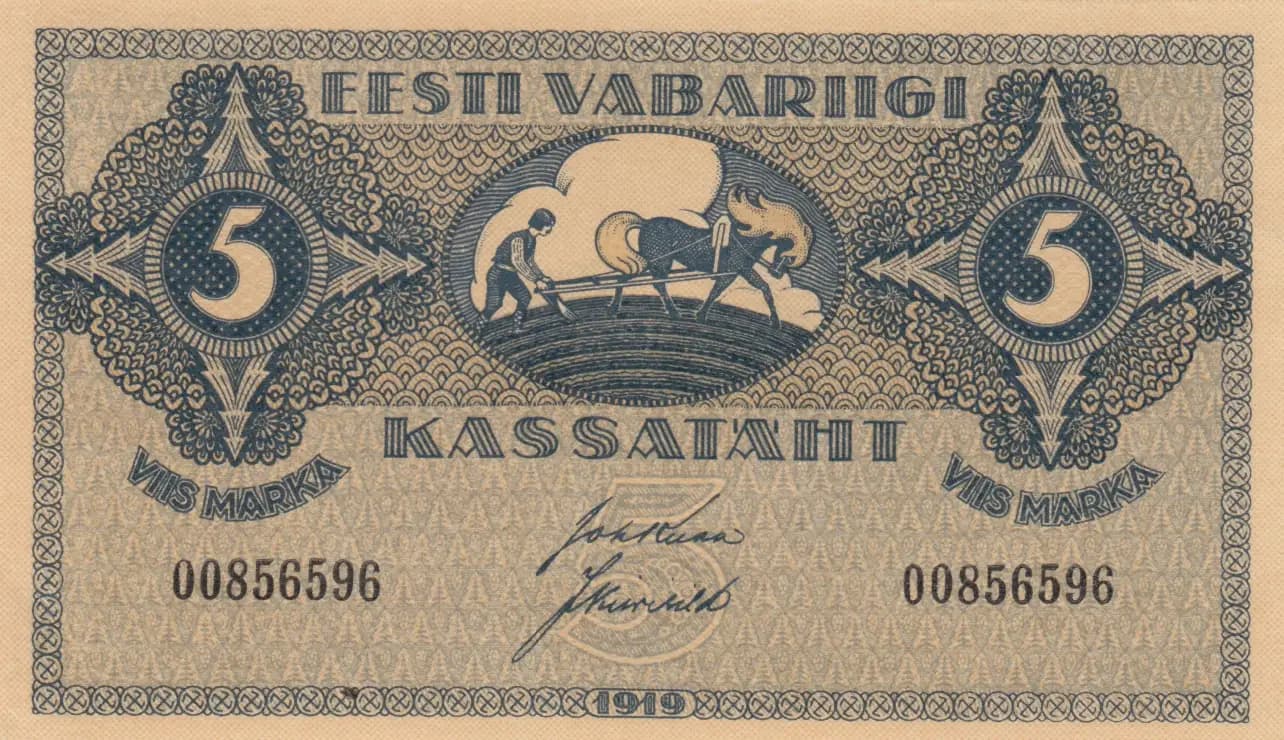
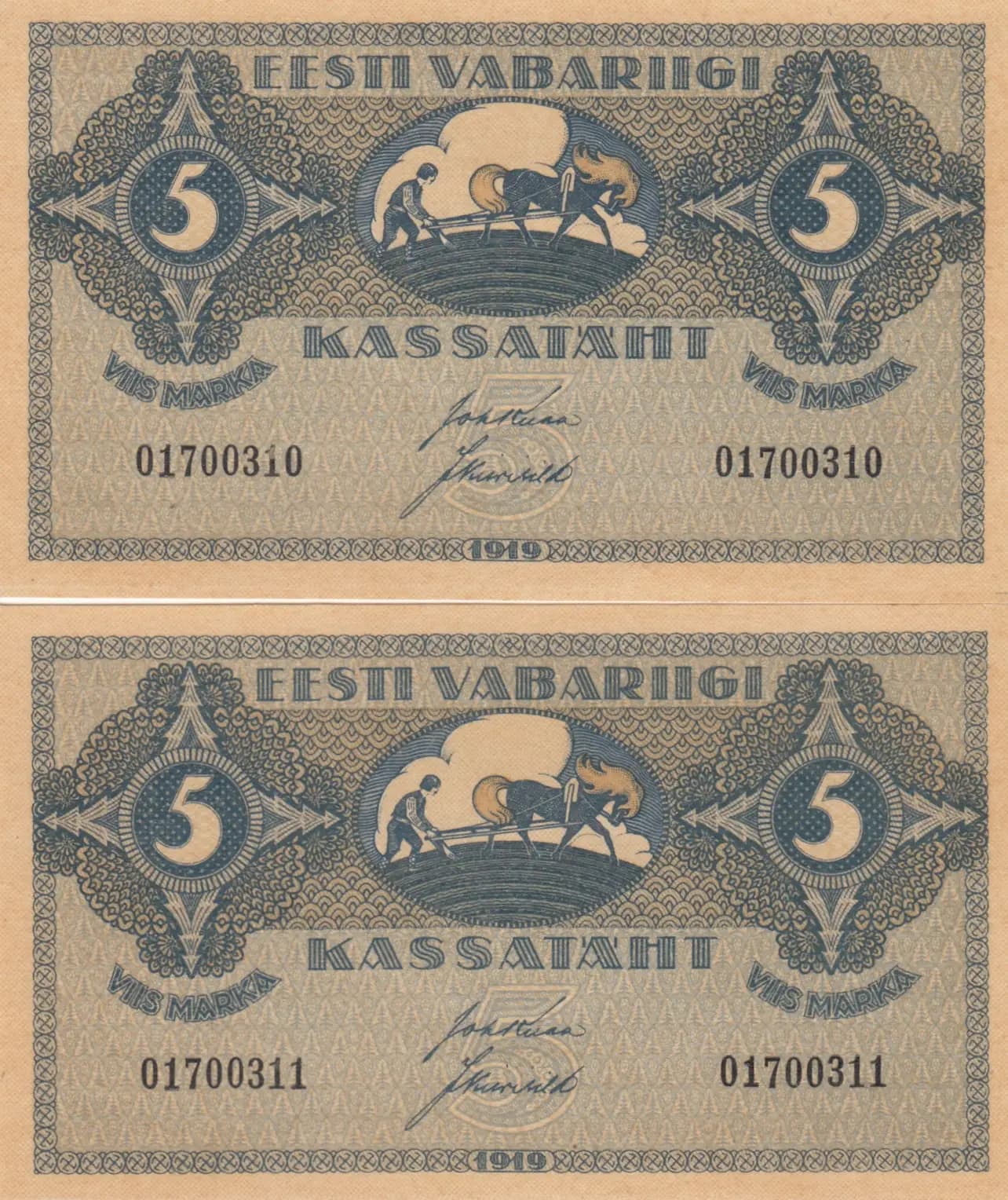
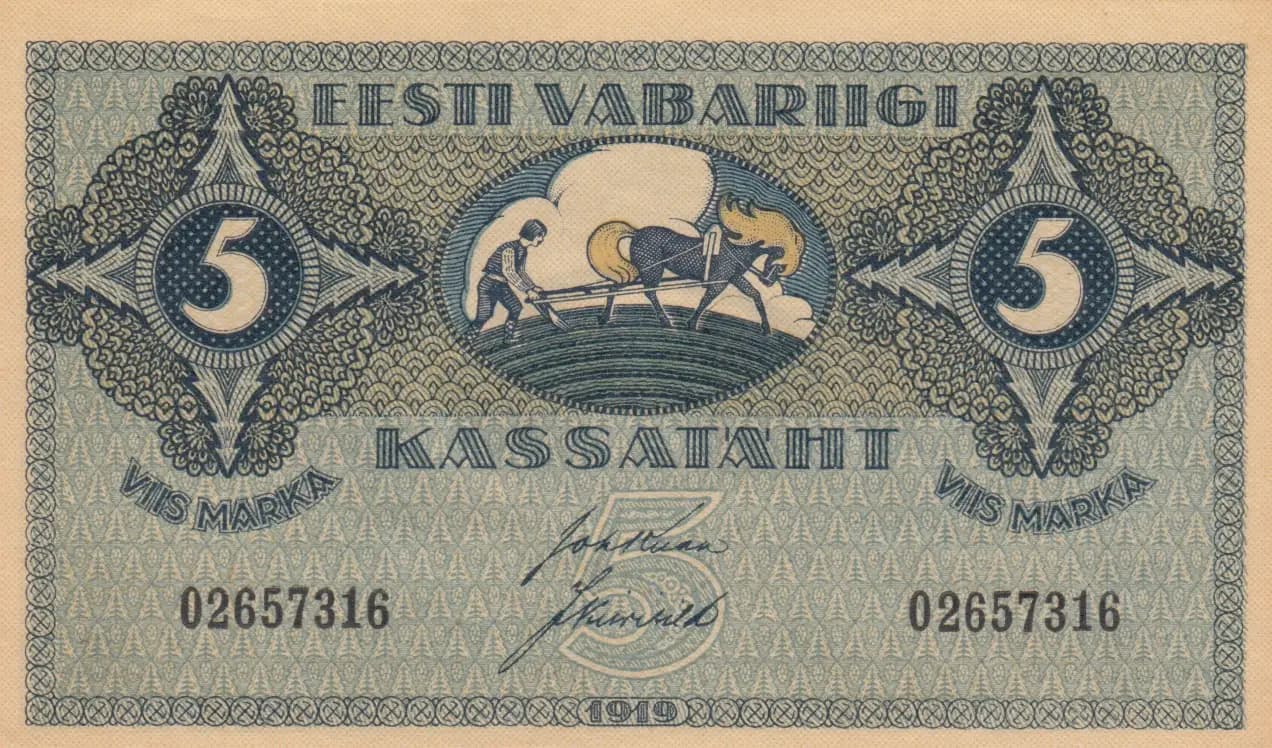
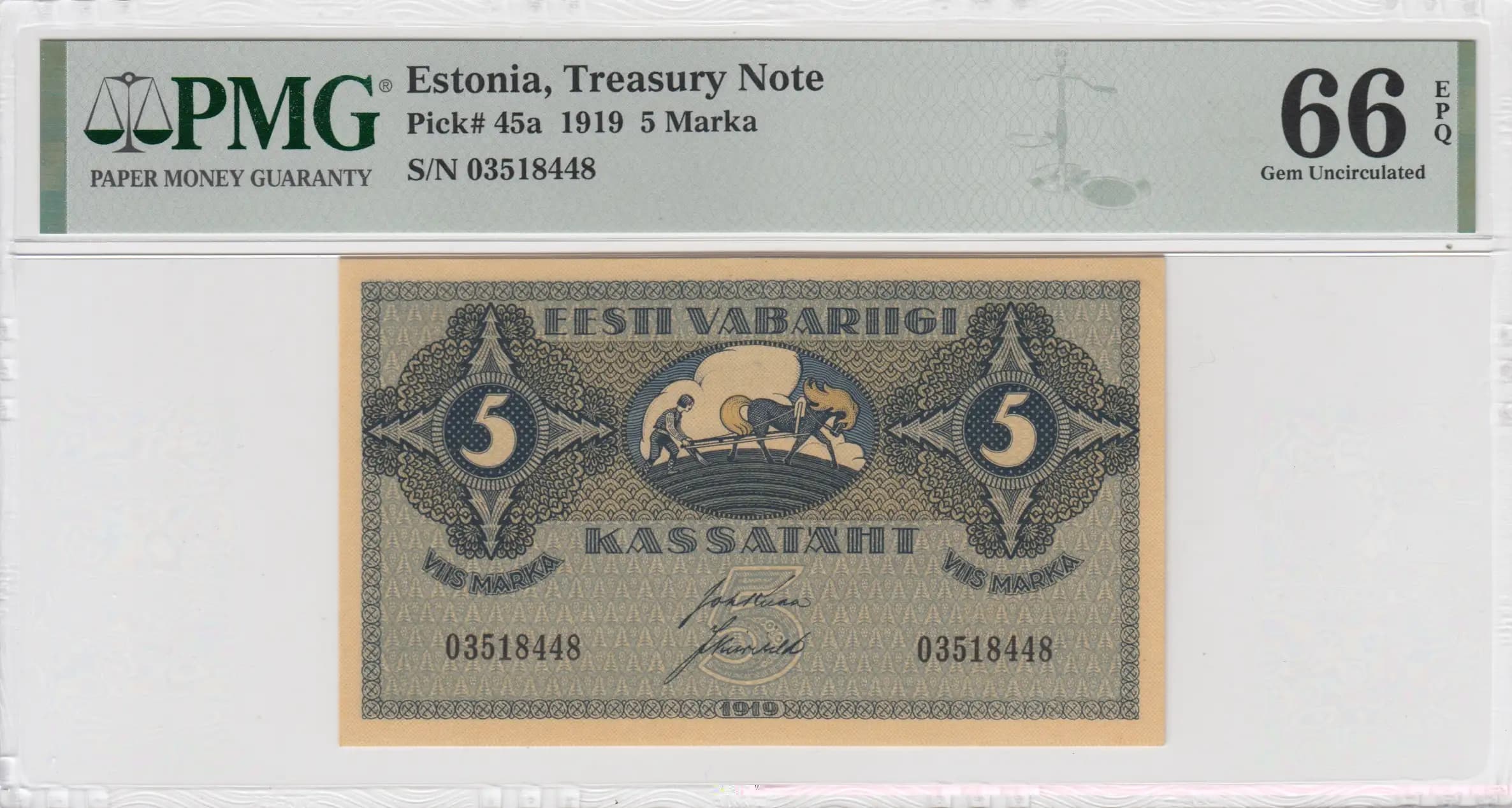
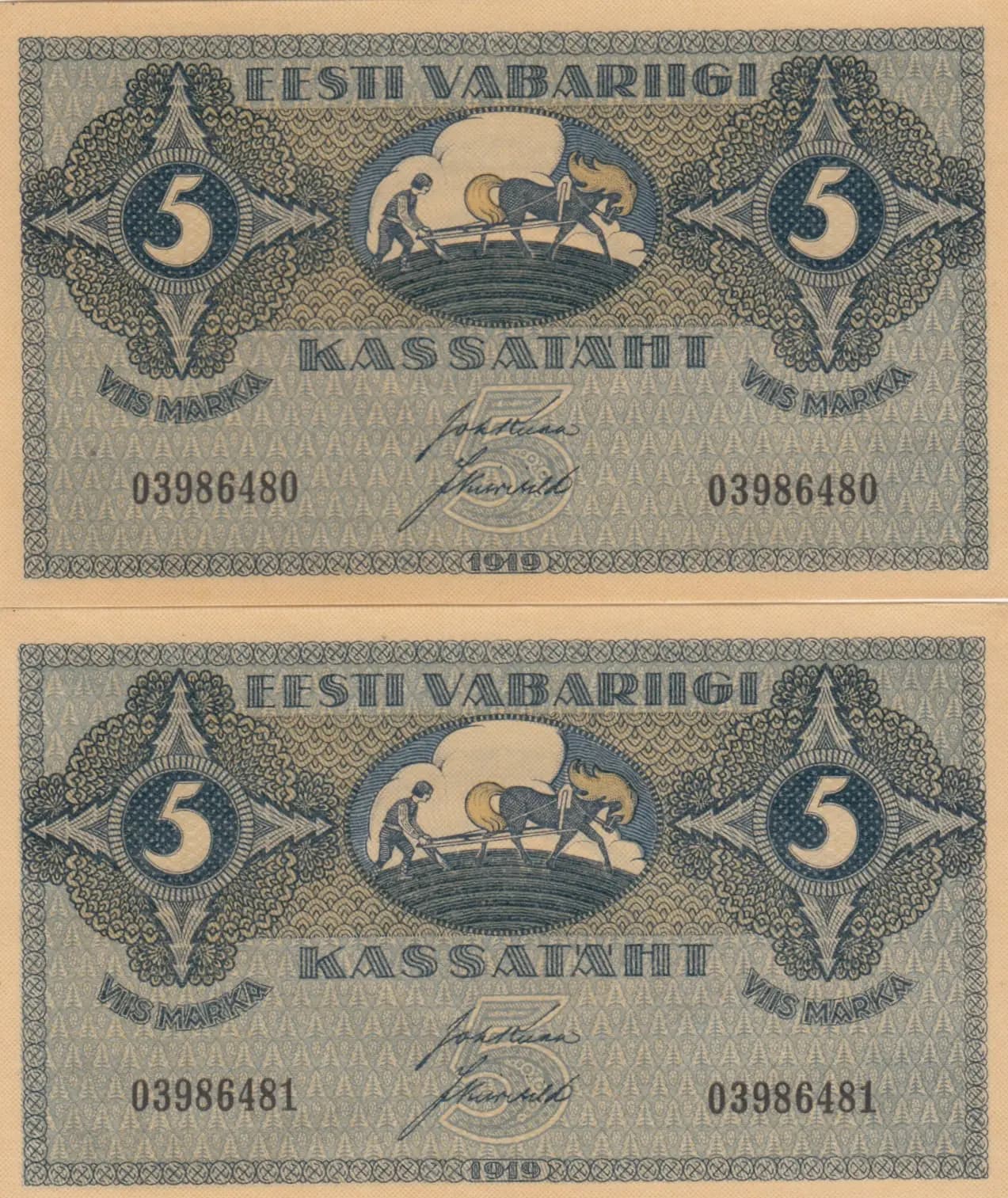
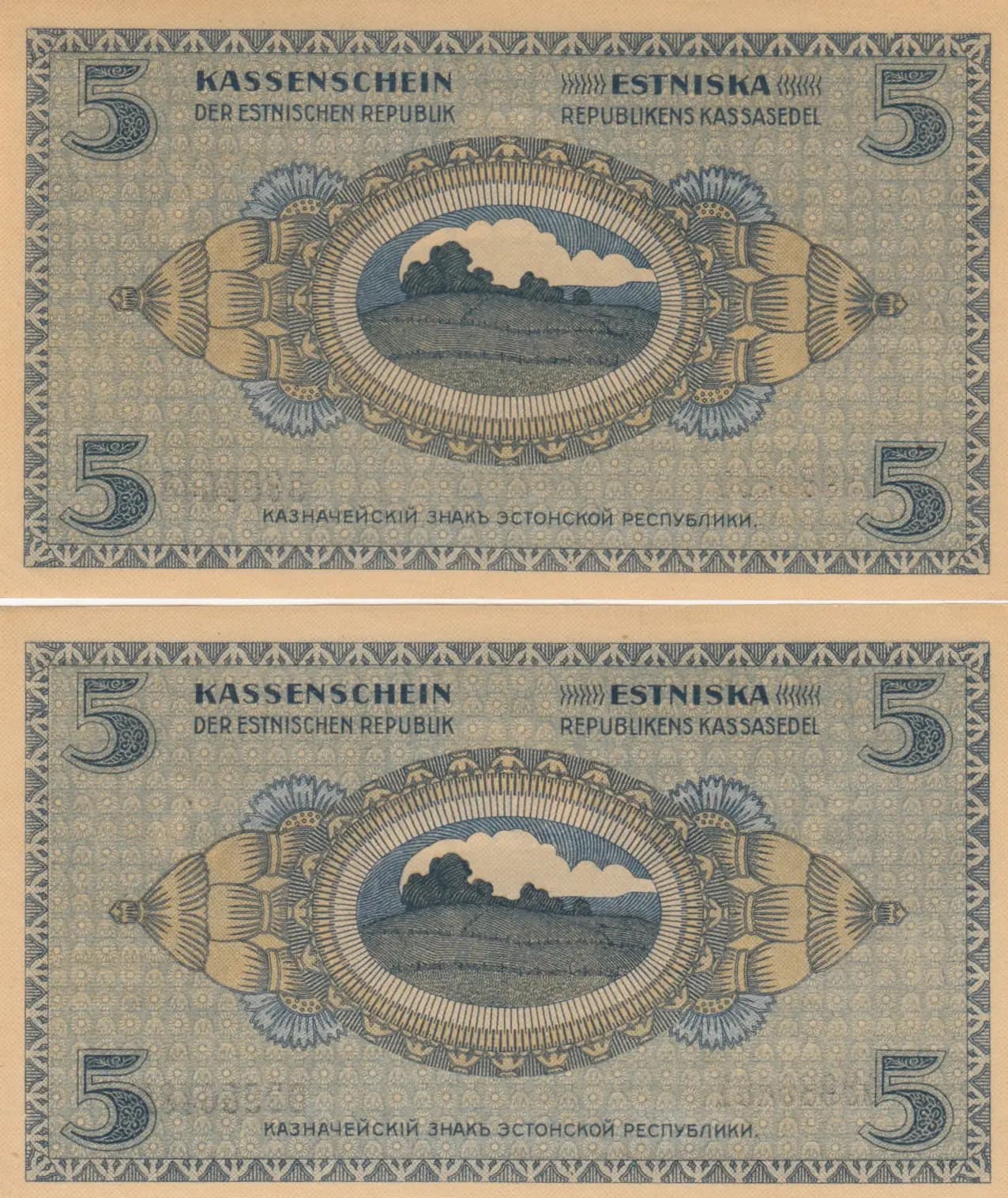
5 marka 1919 pair
“thin paper”
Market Prices
13 salesAbout This Note
A consecutive pair of Estonia's 1919 5 marka notes (Pick P-45) in uncirculated condition, displaying the bilingual/trilingual design characteristic of early Estonian independence currency. Both notes feature vibrant blue and beige ornate borders with central vignettes—the front showing a serene landscape with clouds and fields, the reverse depicting two laborers with a barrel, symbolizing the working class in the newly independent republic. The thin paper stock and pristine condition with sharp printing make this a desirable pair for collectors of Baltic and early 20th-century European currency.
Common. The 1919 5 marka (Pick P-45) was part of the initial treasury note issuance of independent Estonia and saw substantial circulation during the early years of the republic. No historical evidence suggests limited print runs, short-lived status, or widespread recalls that would elevate rarity. The denomination and design were produced in quantities sufficient to serve the monetary needs of the new state. While uncirculated examples in pristine condition command premiums over circulated specimens, the note itself remains common in the collector market.
These notes were issued by the Treasury of Estonia in 1919, during the critical first year of Estonian independence following the Russian Revolution and World War I. The bilingual (German/Estonian) and trilingual (with Russian text) inscriptions reflect Estonia's complex linguistic heritage and transition from Tsarist to independent governance. The imagery celebrating labor and landscape symbolizes the new nation's identity and aspirations, while the early issuance date makes these notes historically significant artifacts of Estonia's founding period.
The front features a large oval vignette depicting a romantic landscape with rolling fields and cloudy sky, framed by decorative fan or shell-shaped ornaments and surrounded by an ornate geometric and floral border pattern in blue and beige. The reverse displays a central oval medallion containing an allegorical scene of two workers or laborers engaged in productive labor with a barrel or large container, symbolizing industrial and agricultural work—a common iconographic choice for the newly independent Estonian state. Both sides feature the denomination numeral '5' positioned in corner circles, fine line work throughout the geometric border patterns, and carefully engraved details. The thin paper stock is notable for the period.
FRONT SIDE: 'KASSENSCHEIN DER ESTNISCHEN REPUBLIK' (German: Currency Note of the Estonian Republic) / 'ESTNISKA REPUBLIKENS KASSASEDEL' (Estonian: Estonian Republic's Banknote) / 'КАЗНАЧЕЙСКИЙ ЗНАК ЭСТОНСКОЙ РЕСПУБЛИКИ' (Russian: Treasury Note of the Estonian Republic) / Denomination: 5. REVERSE SIDE: 'EESTI VABARIIGI' (Estonian: Estonian Republic) / 'KASSATAHIT' (Estonian: Banknote) / 'MARKA' (Estonian: Mark/Marka currency). Serial numbers observed: 03986480 and 03986481 (consecutive pair). Year: 1919.
Intaglio/engraved printing, characteristic of high-security banknote production of the era. The intricate ornamental borders, fine geometric patterns, detailed landscape and figurative vignettes, and precise numeral engraving all indicate professional security-printer engraving plates. The printer for Estonian notes of this period was typically a European security printer, likely contracted through Austria or another Central European source given the design aesthetic and German language inclusion. The sharp impressions and fine line work visible in the images confirm high-quality intaglio execution.
This lot represents a consecutive serial number pair (03986480 and 03986481), which is desirable for collectors seeking matched pairs. The 1919 issue may exist with various serial number ranges and printer variations depending on the production runs. No specific overprints, signature varieties, or major design variants are evident from the visual analysis of these examples. Further catalog research would be needed to determine if specific printer marks, signature combinations, or serial prefixes distinguish recognized varieties within Pick P-45, though no major varieties are widely documented for this straightforward first-issue treasury note.