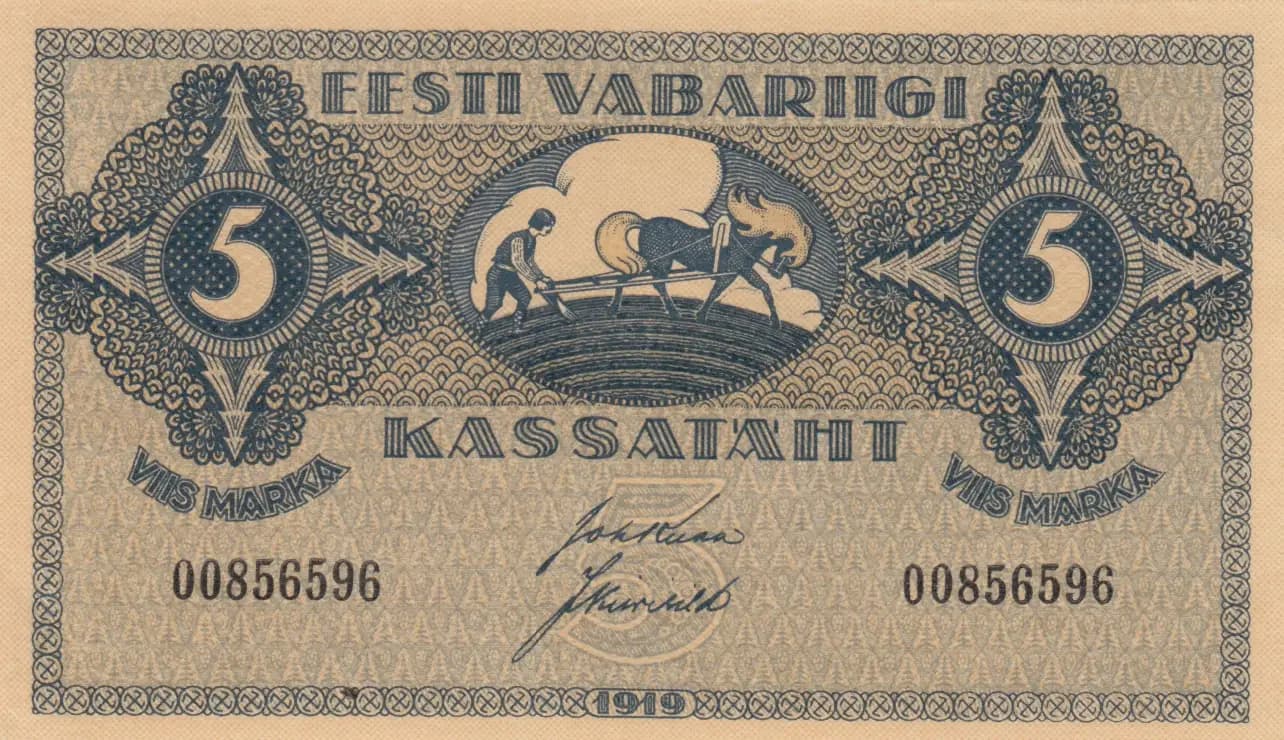
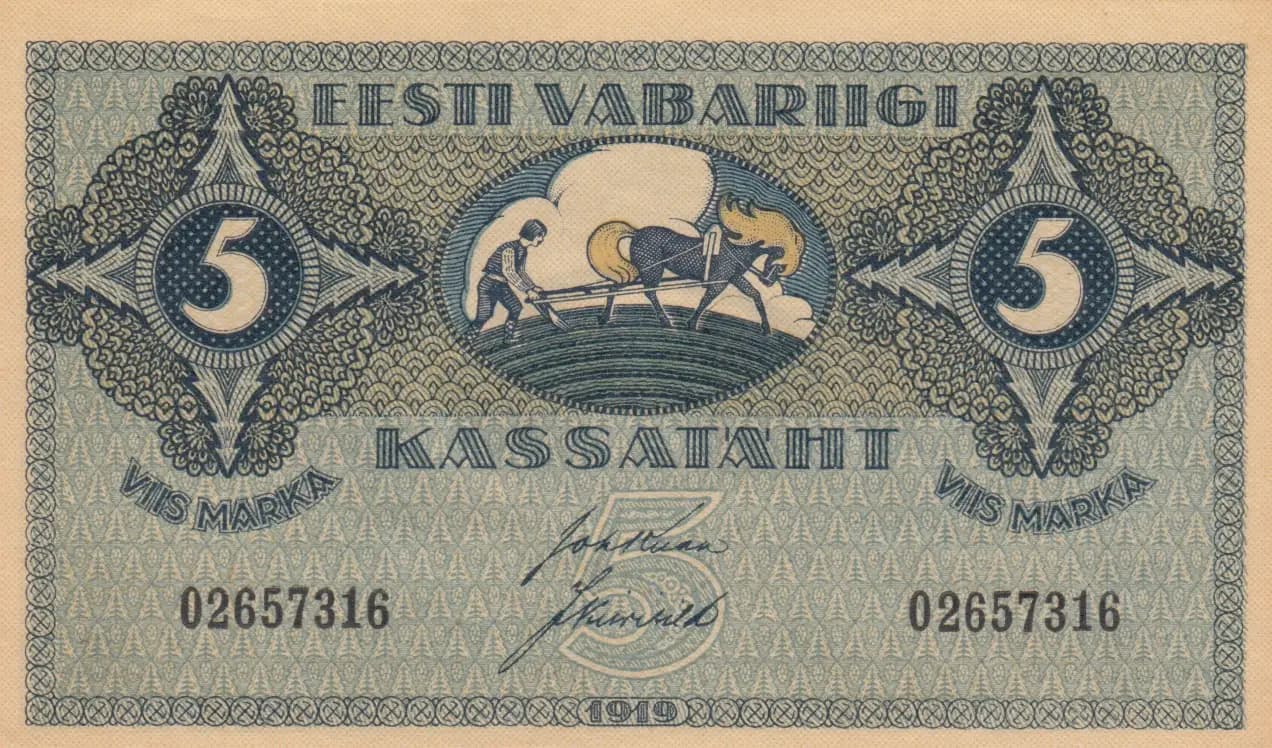
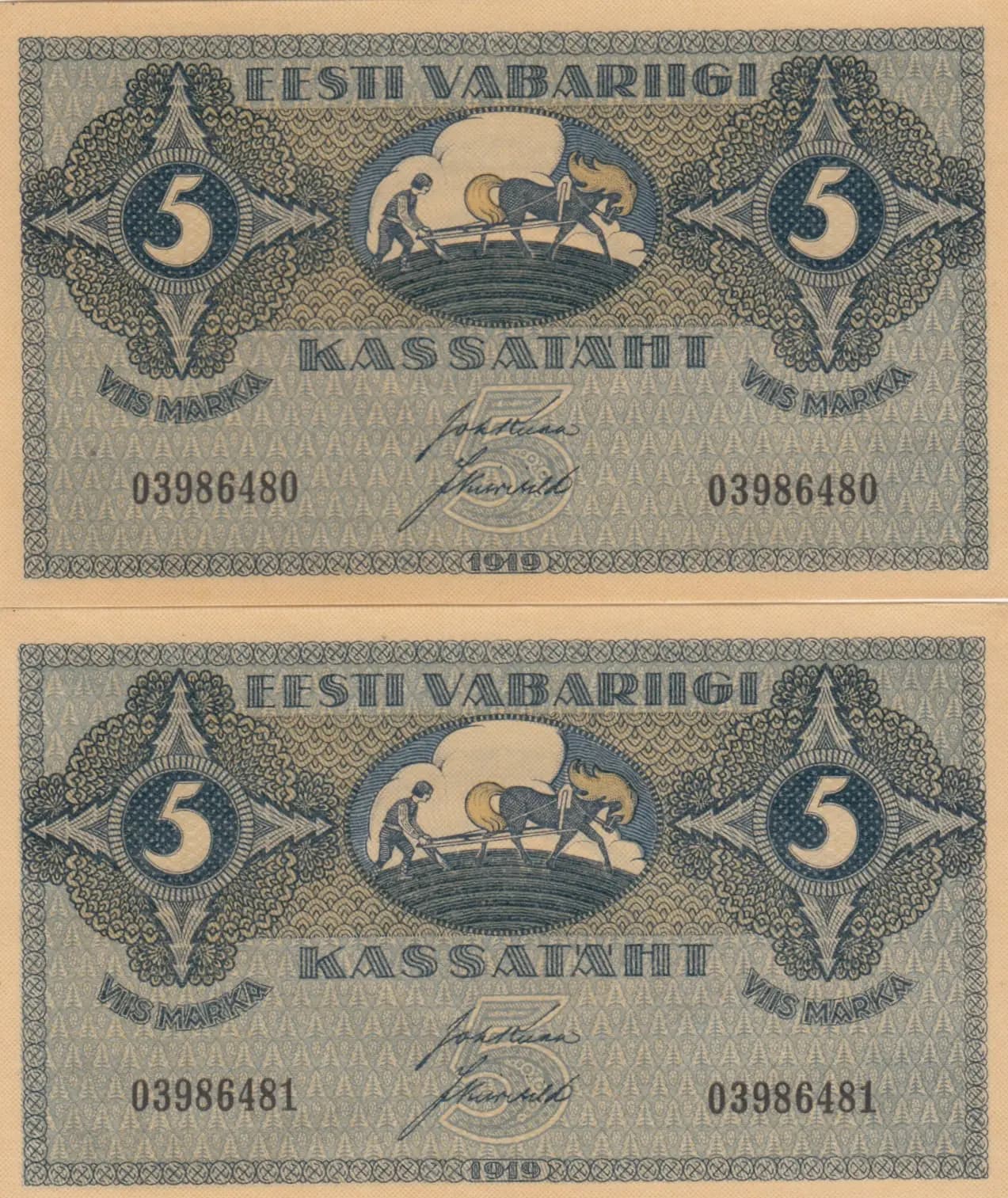
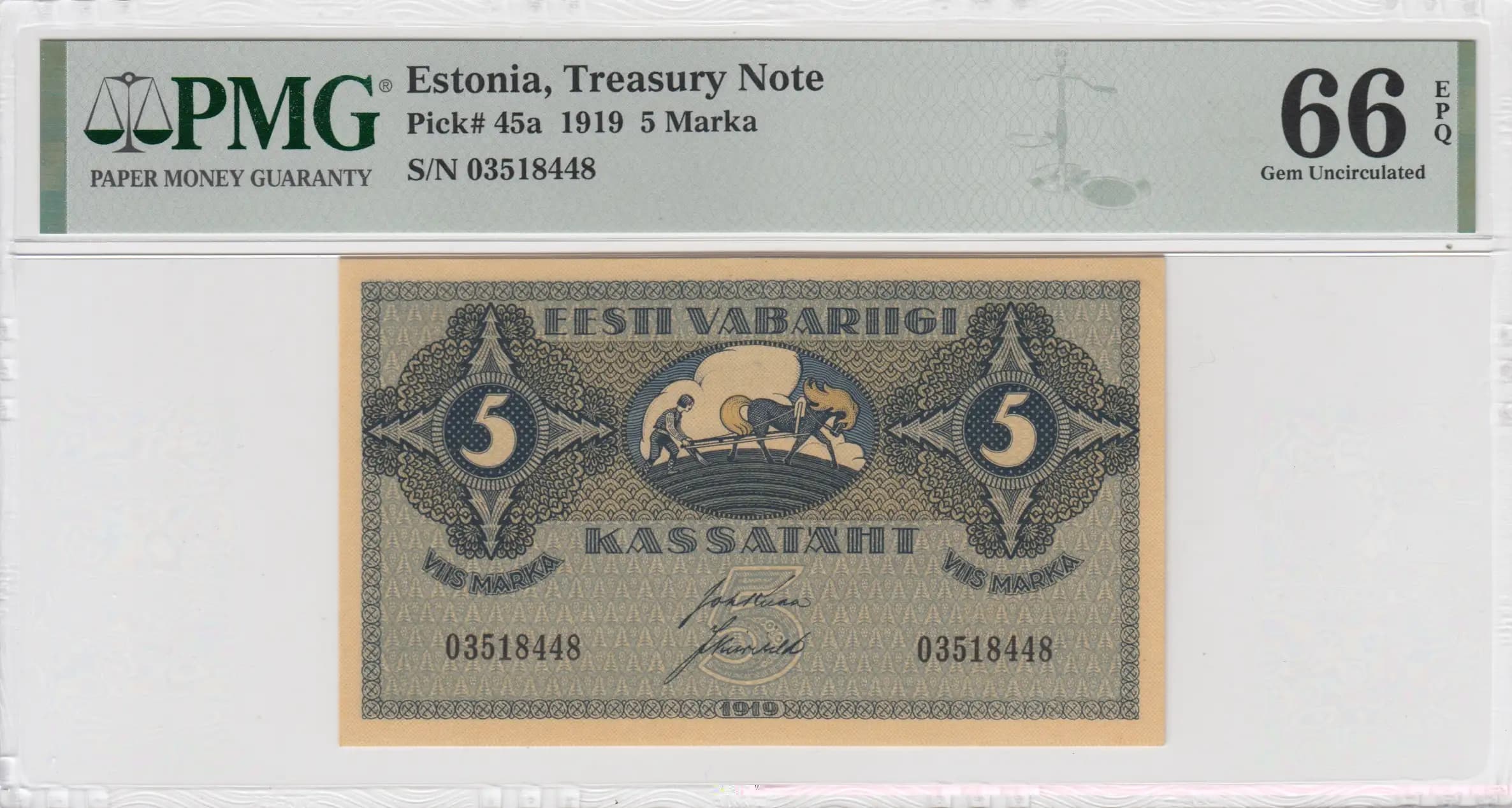
5 marka 1919 pair
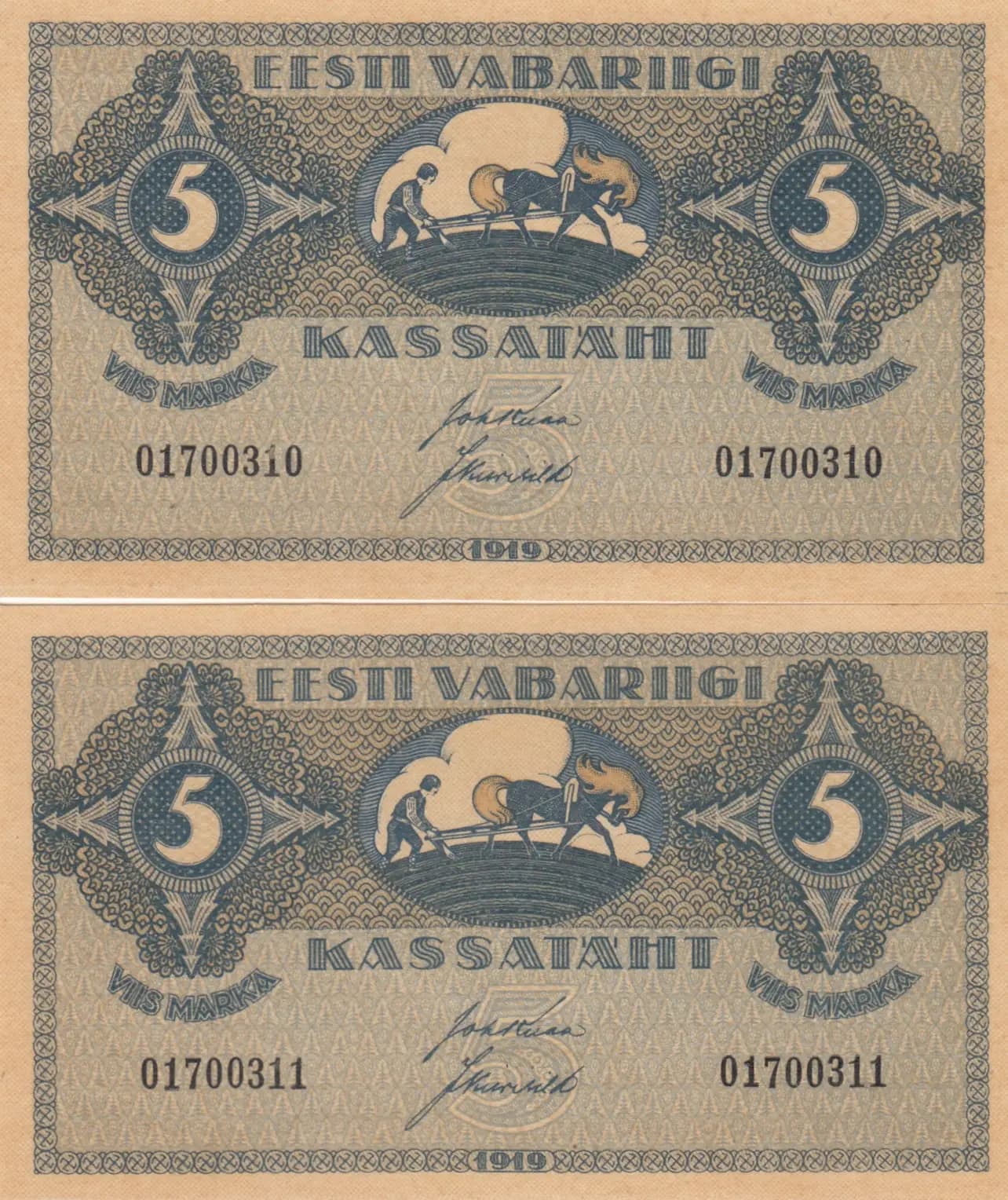
“thick paper”
Market Prices
13 salesAbout This Note
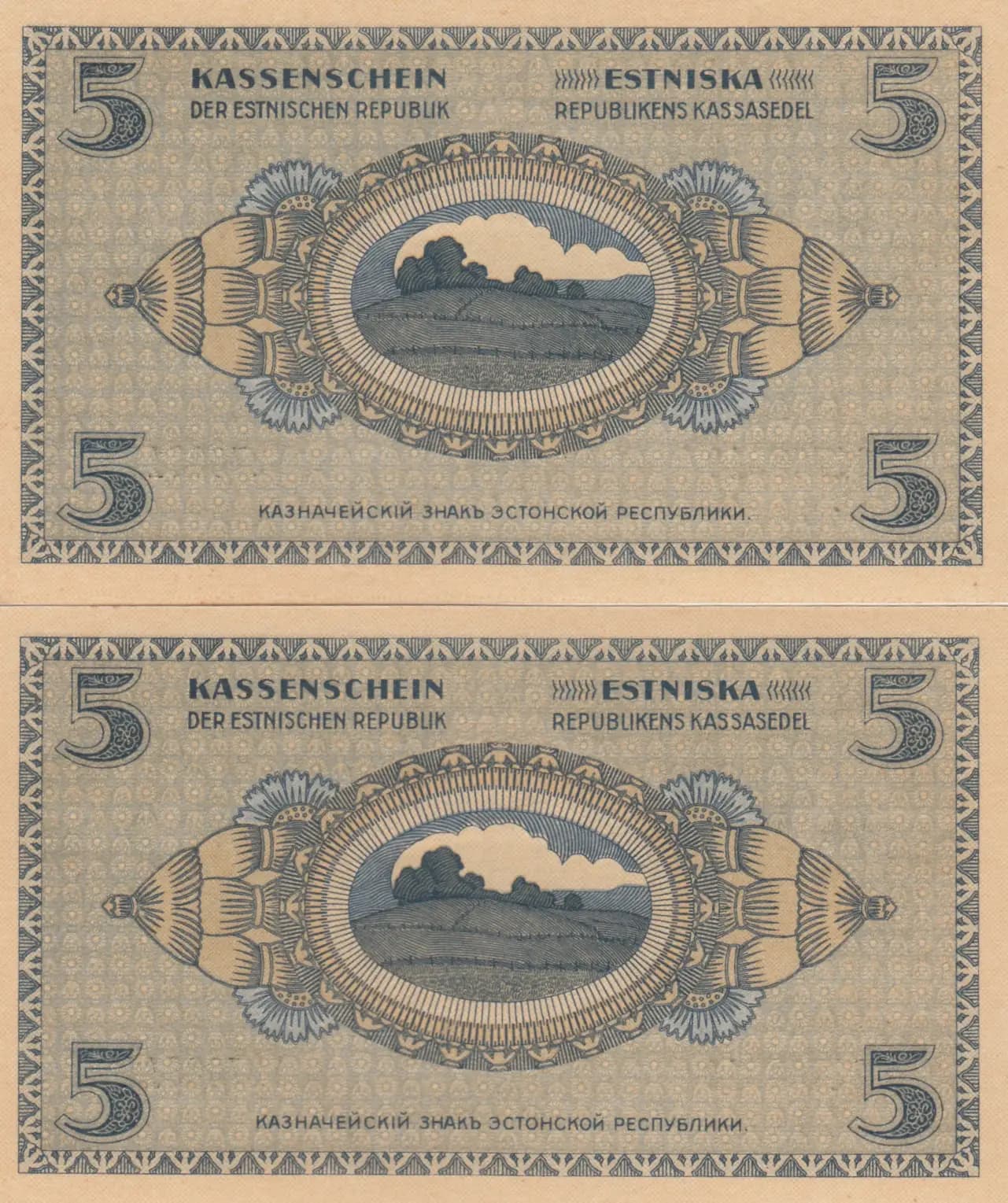
This is a stunning pair of Estonian 5 Marka banknotes from 1919, both in uncirculated condition with consecutive serial numbers (01700310 and 01700311). The notes feature exceptional preservation with sharp printing, uniform coloration, and no visible wear, creases, or foxing. The front displays an engaging central vignette of three laborers in a boat, while the reverse showcases a pastoral landscape—imagery that powerfully represents Estonia's agrarian heritage during its early independence.
Common. While these early Estonian notes have historical significance, the eBay sales data demonstrates consistent market activity with notes in fine to uncirculated condition selling for $8-$30 throughout the 2013-2021 period. A PMG 64 specimen sold for $91.90 in 2019, suggesting modest premiums for professionally graded examples, but the regular circulation of similar examples at modest prices and 2016 catalog values of $100 UNC indicate reasonable availability. The pair format and UNC condition elevate collector interest beyond typical circulated examples, but the denomination and print run do not suggest scarcity.
These notes were issued by the newly independent Estonian Republic in 1919, following the country's declaration of independence from the Russian Empire. The deliberate choice of imagery—workers engaged in maritime labor on the obverse and pastoral agricultural scenes on the reverse—reflects Estonia's economic foundation in farming and fishing during this formative period. The trilingual text (Estonian, German, and Russian) underscores the region's complex cultural and political heritage in the immediate post-WWI era.
The obverse features an ornate geometric border frame in dark blue/teal and black on a beige/tan field. At the center is a circular vignette depicting three figures representing Estonian laborers or workers engaged in a maritime activity within a boat or vessel, symbolizing the nation's working class. Circular medallion denominations marked '5' anchor the left and right sides. The reverse displays a complementary oval landscape vignette showcasing a rural pastoral scene with trees, clouds, and cultivated fields, emphasizing Estonia's agricultural character. Both sides employ period Art Nouveau-influenced ornamental flourishes and corner designs. The thick paper stock noted by the collector enhances the tactile quality characteristic of early Estonian currency.
FRONT: 'EESTI VABARIIGI' (Estonian Republic) | 'KASSATAHT' (Banknote) | 'VIS MARKA' (Five Marka) | Serial numbers: 01700310 and 01700311 | Date: 1919. BACK: 'KASSENSCHEIN DER ESTNISCHEN REPUBLIK' (Treasury note of the Estonian Republic, in German) | 'ESTNISKA REPULIKENS KASSASEDEL' (Estonian Republic's Banknote, in Estonian) | 'КАЗНАЧЕЙСКИЙ ЗНАК ЭСТОНСКОЙ РЕСПУБЛИКИ' (Treasury Note of the Estonian Republic, in Russian) | Denomination: 5
The notes exhibit intaglio (engraved) printing, evident from the sharp line work, fine geometric border details, and crisp inscription rendering. The consistent color saturation and precise vignette execution are hallmarks of professional security printing. This was likely produced by a Central European security printer experienced in early 20th-century banknote production, though the specific printer is not definitively documented for this Pick number in standard references.
The Pick catalog identifies P-45a and P-45s as variants. The observed notes represent the standard P-45 variety based on their design characteristics. The consecutive serial numbers (01700310 and 01700311) suggest these notes were part of the same production batch, making them a naturally paired lot rather than a cataloged variety. No overprints, date variations, or signature variants are apparent in the visual analysis. Collectors should note that the pair format is the primary distinction of this specific offering.