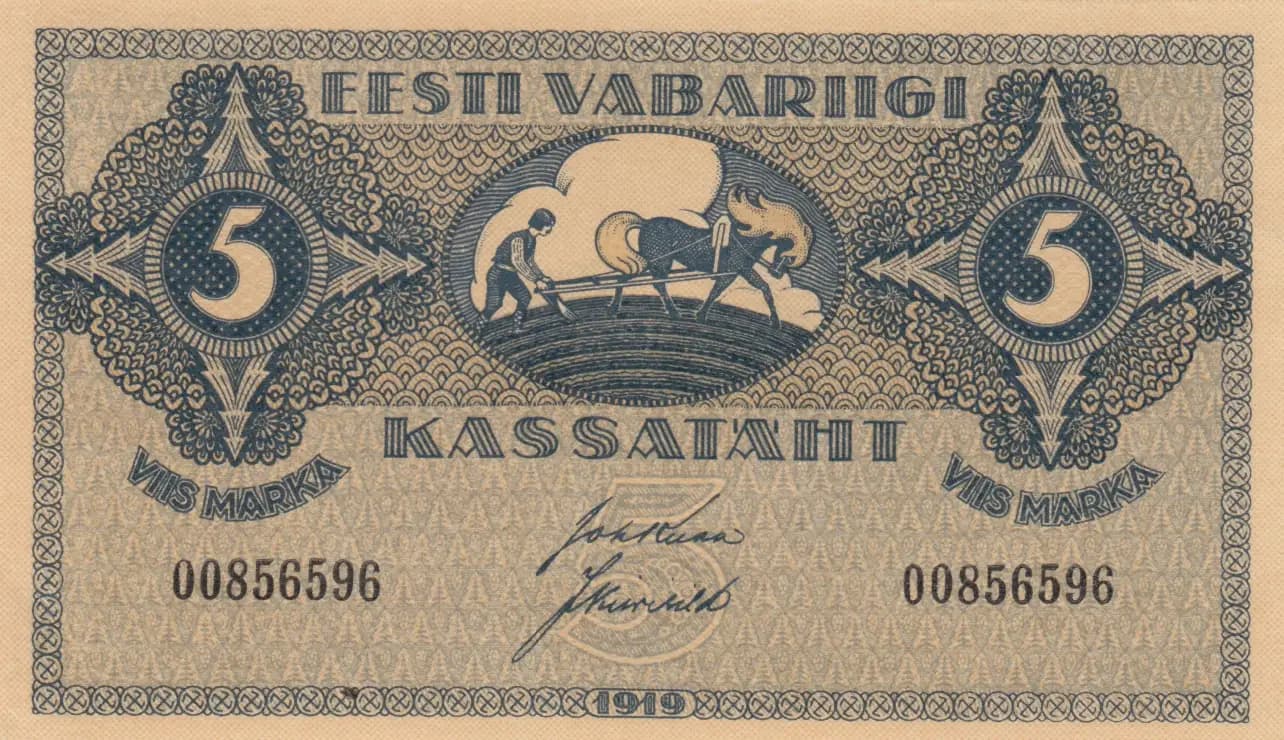
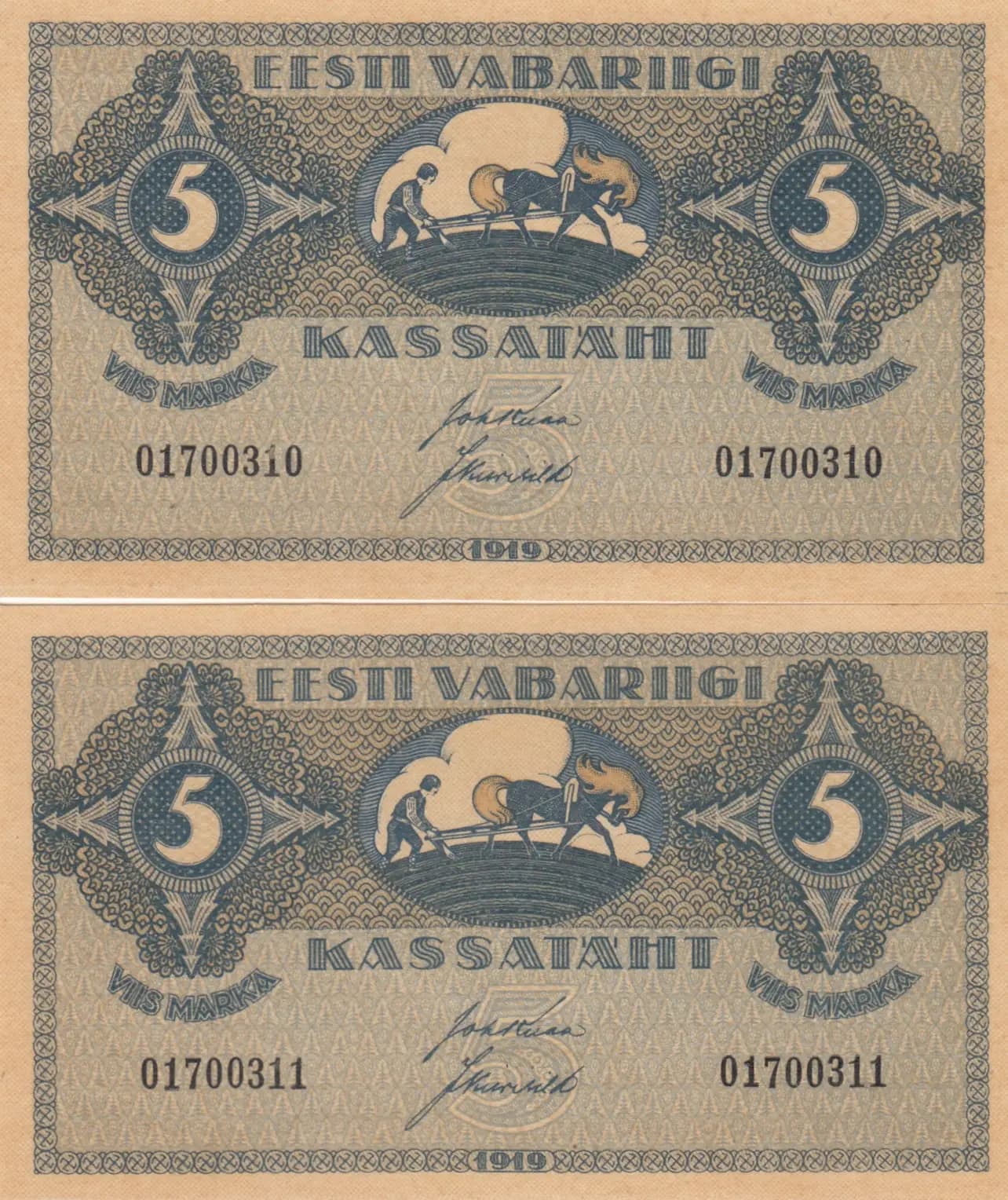
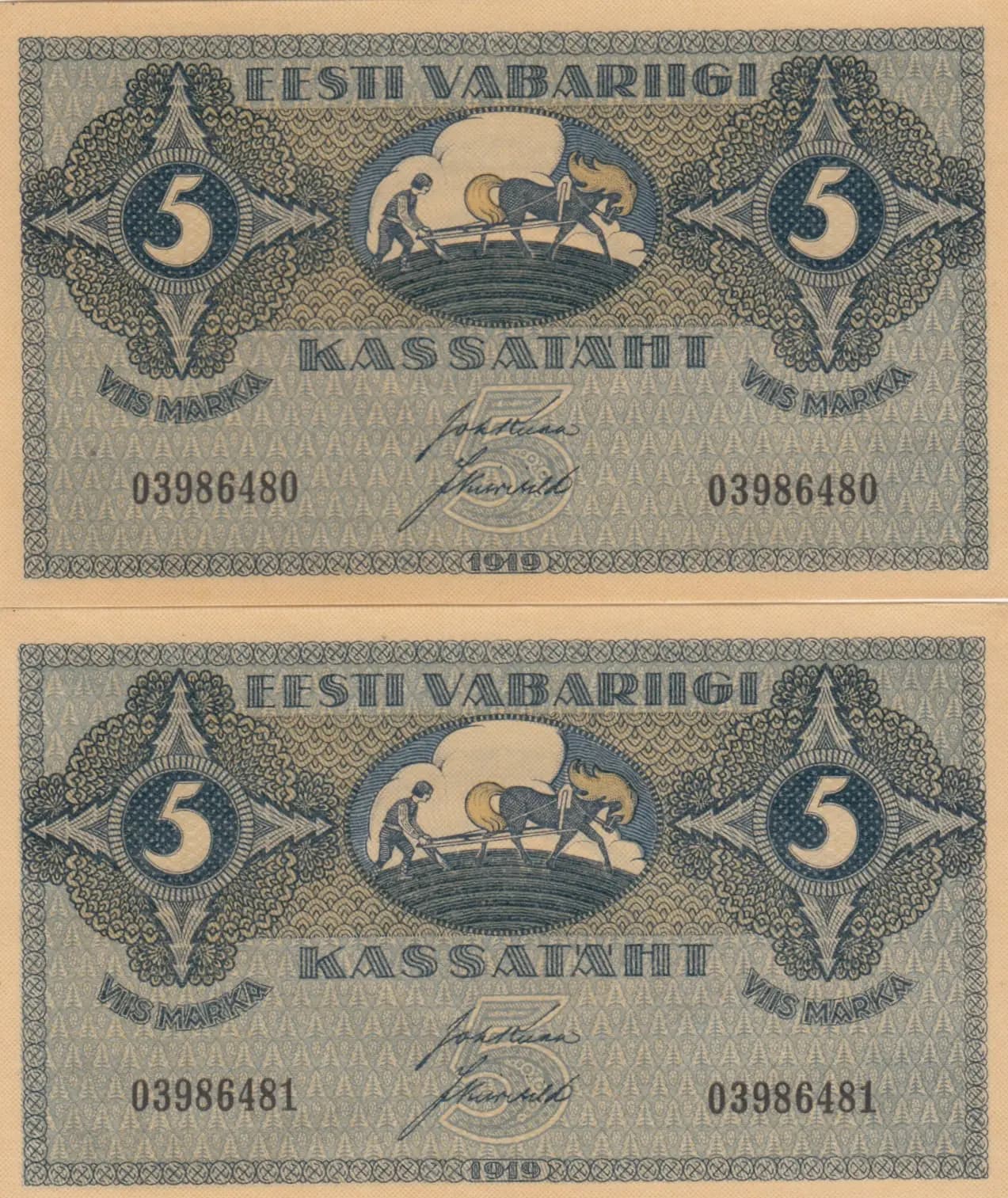
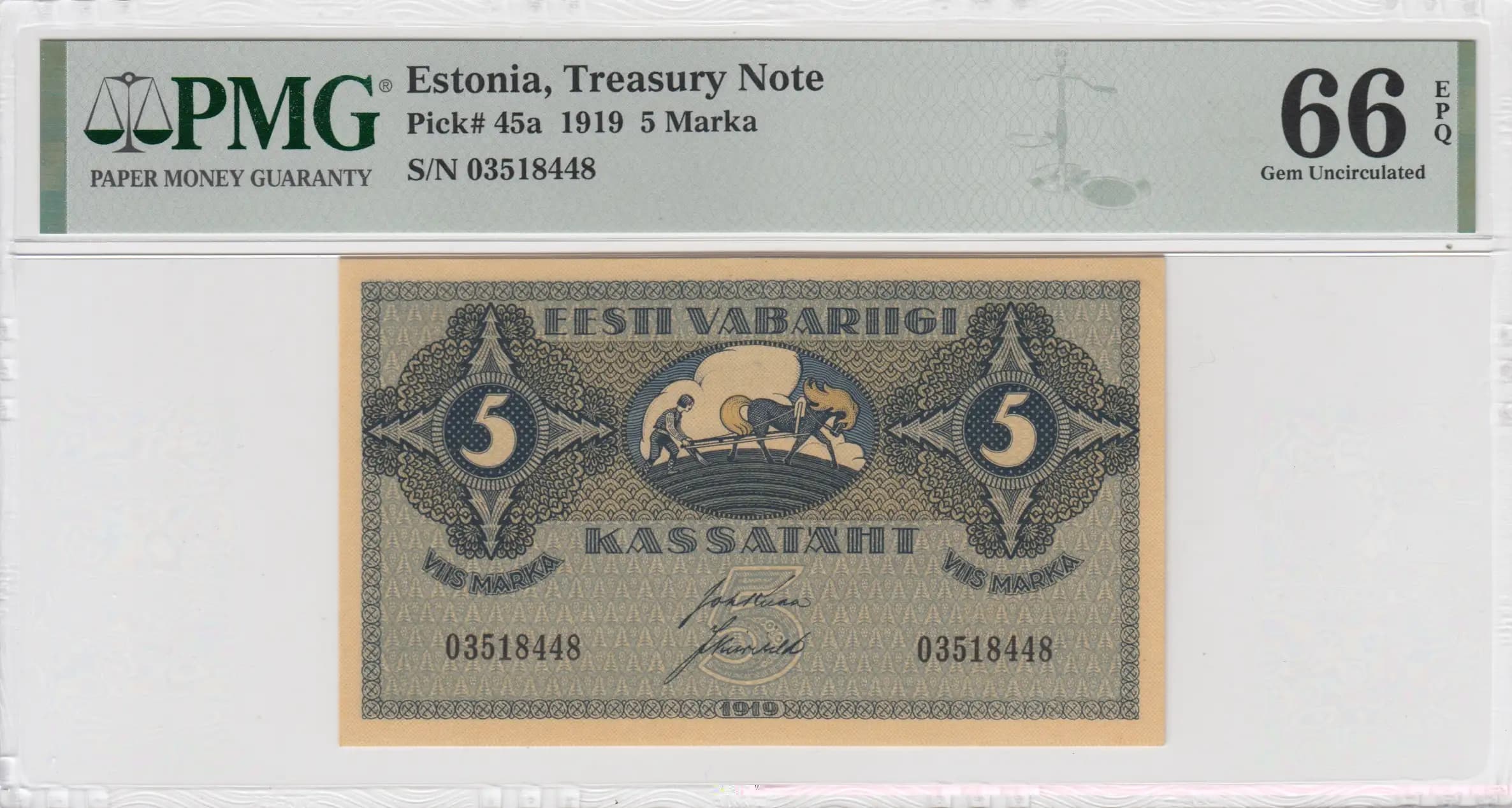
5 marka 1919
“thin paper”
Market Prices
13 salesAbout This Note
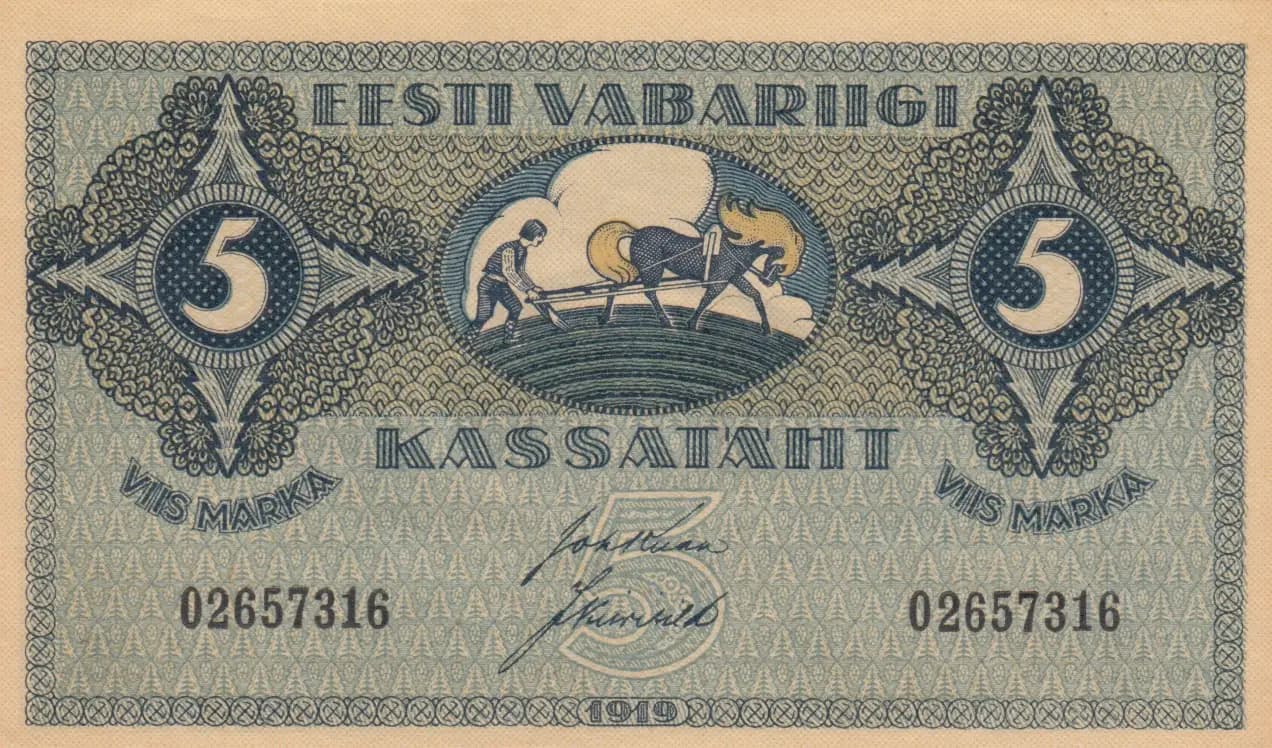
This 1919 Estonian 5 Marka banknote presents an exceptional example of early Estonian monetary design, featuring a striking agricultural theme with two laborers depicted in the central vignette on the obverse. The note exhibits AU (About Uncirculated) condition with sharp printing detail throughout, minimal wear, and no visible creases or tears—characteristics of a note that saw little to no circulation despite being printed on notably thin paper. The intricate ornamental borders and multi-language inscriptions reflect Estonia's complex linguistic and cultural context during its transition to independence.
Common. The eBay price data shows consistent sales in the $8–$30 range for notes in various circulated grades (F, VF, EF), with a PMG 64 (Choice Uncirculated) selling for $91.90 in 2019. The 2016 catalogue value for UNC condition was $100, and multiple sales across multiple years demonstrate steady but not exceptional collector demand. The volume of sales activity and price stability suggest this is a readily available note in the collector market. The thin paper variant noted in the collector comments may be slightly less common than standard examples, but the denomination and design do not indicate a short print run or recall.
Issued in 1919 by the newly independent Estonian Republic's Treasury, this note commemorates the agrarian foundation of the Estonian economy during the nation's early years of independence following World War I. The prominent depiction of agricultural workers and the landscape vignette on the reverse emphasizing rolling hills and wheat motifs underscore the rural character of the nascent Estonian state. The inclusion of Estonian, German, and Russian text reflects the multilingual administrative legacy of the region during this transitional period.
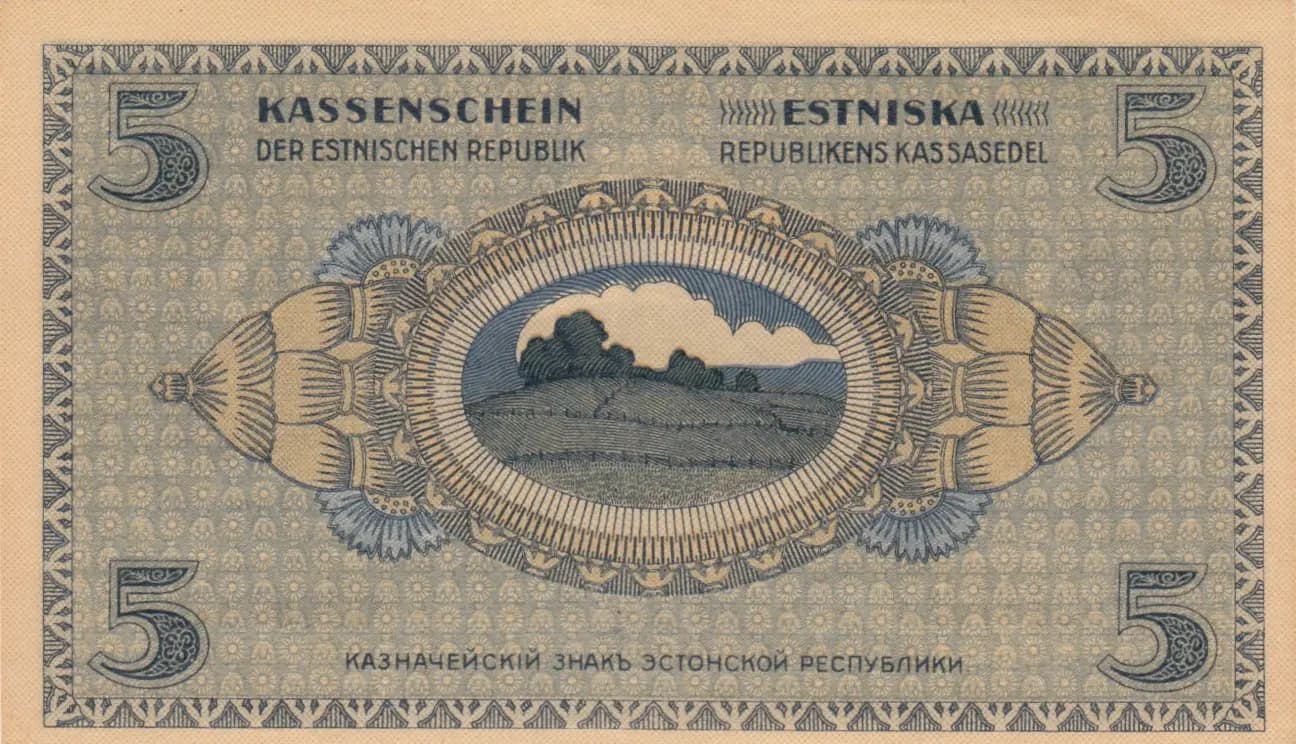
The obverse features a carefully composed agricultural vignette at center showing two workers (laborers or farmers) engaged in constructive work with tools, flanked by symmetrical ornamental coat-of-arms elements and elaborate geometric and floral border patterns in the Art Nouveau tradition. The denomination '5' appears in circular medallions on both left and right sides. The reverse presents a serene landscape vignette within a central oval frame, depicting rolling hills beneath a clouded sky—symbolizing Estonia's natural landscape. Stylized wheat sheaves or agricultural motifs adorn the corners, reinforcing the agrarian theme. Both sides employ a restrained color palette of tan/cream, blue-grey, and black, typical of security printing of the period.
Front side: 'EESTI VABARIIGI' (Estonian Republic), 'KASSATAHIT' (Treasury Note), 'VIS MARKA' (Five Marks), serial number '02657316', year '1919', and official signatures in cursive script. Back side: 'KASSENSCHEIN DER ESTNISCHEN REPUBLIK' (Treasury Note of the Estonian Republic, in German), 'ESTNISKA REPUBLIKENS KASSASEDEL' (Estonian Republic's Banknote, in Estonian), 'КАЗНАЧЕЙСКИЙ ЗНАК ЭСТОНСКОЙ РЕСПУБЛИКИ' (Treasury Note of the Estonian Republic, in Russian), with denomination '5' appearing in four corner positions.
Intaglio (engraved) printing, as evidenced by the intricate fine-line engraving visible throughout the design, the complex decorative borders with precise detail, and the radiating line patterns employed as security measures. The sharpness and clarity of the vignettes and the subtle gradation in the background work are characteristic of professional bank note engraving. While specific printer attribution would require additional archival research, Estonian Treasury notes of this period were typically produced by established European security printers experienced in banknote production.
The PMG population report identifies two catalogued variants for this Pick number: P-45a (standard) and P-45s (specimen). The present note appears to be P-45a based on standard circulation format. The collector notation regarding 'thin paper' may represent a printing characteristic of the 1919 issue series; this should be verified against known production batches. The serial number '02657316' is within the typical range for this issue. No significant overprints, signature variations, or date variations are apparent from the visual analysis.