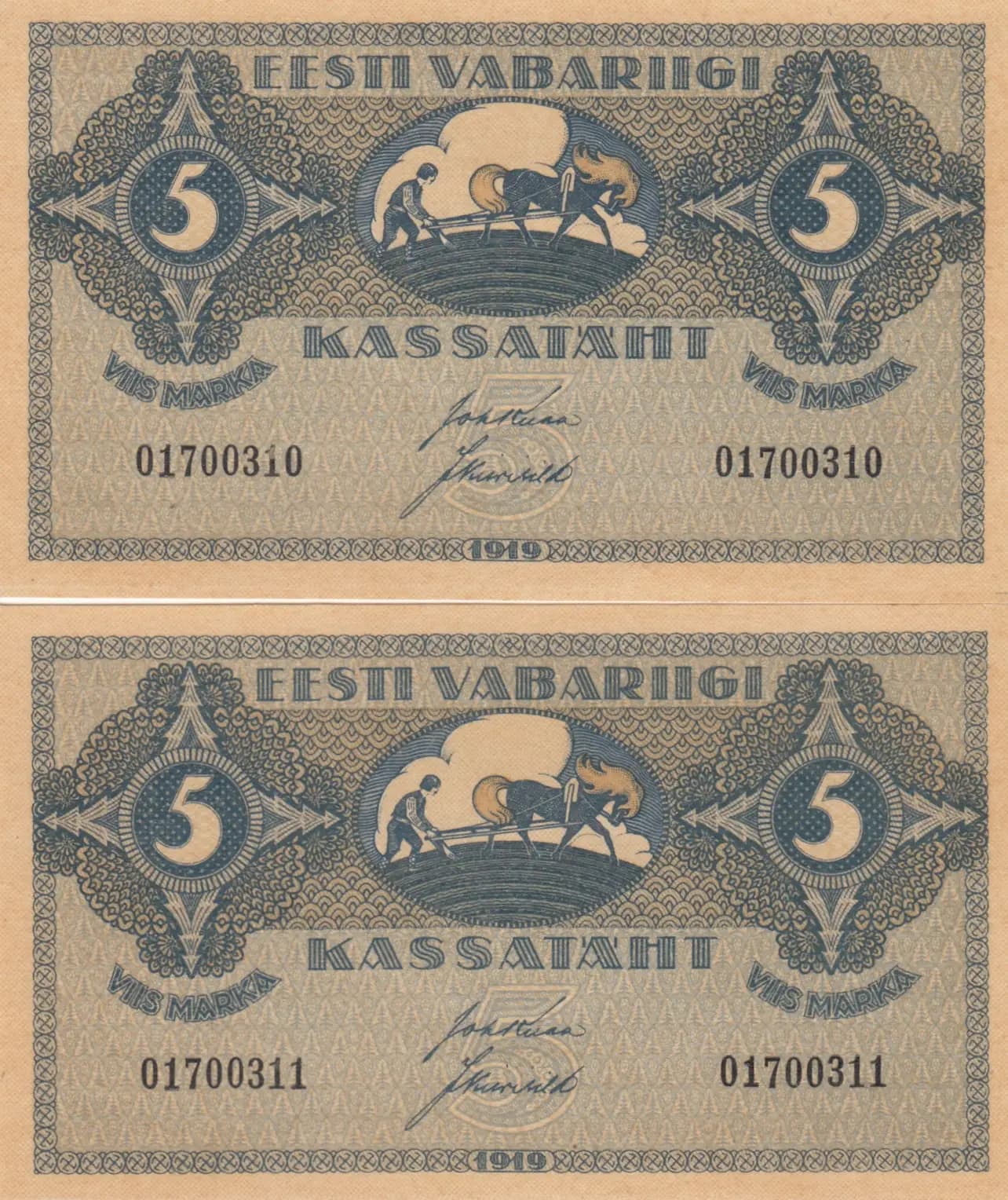
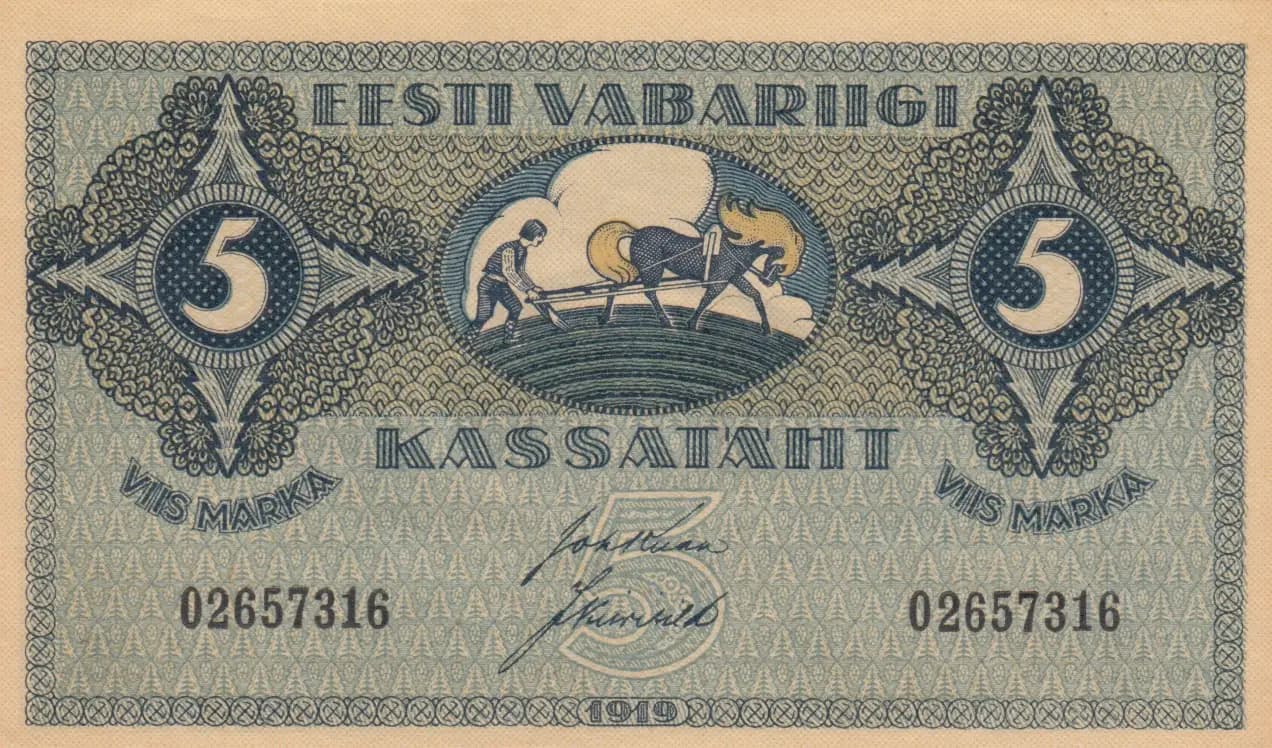
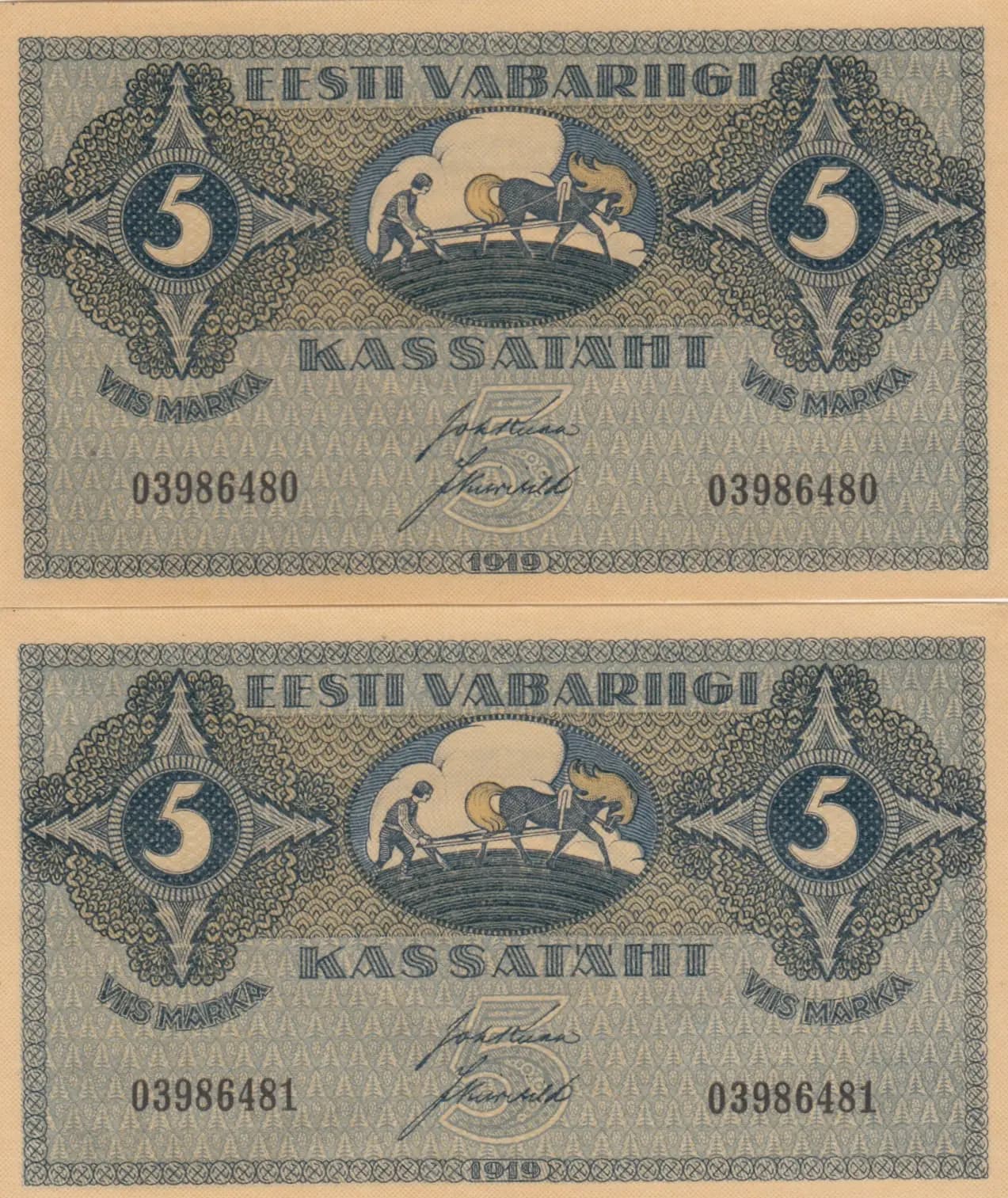
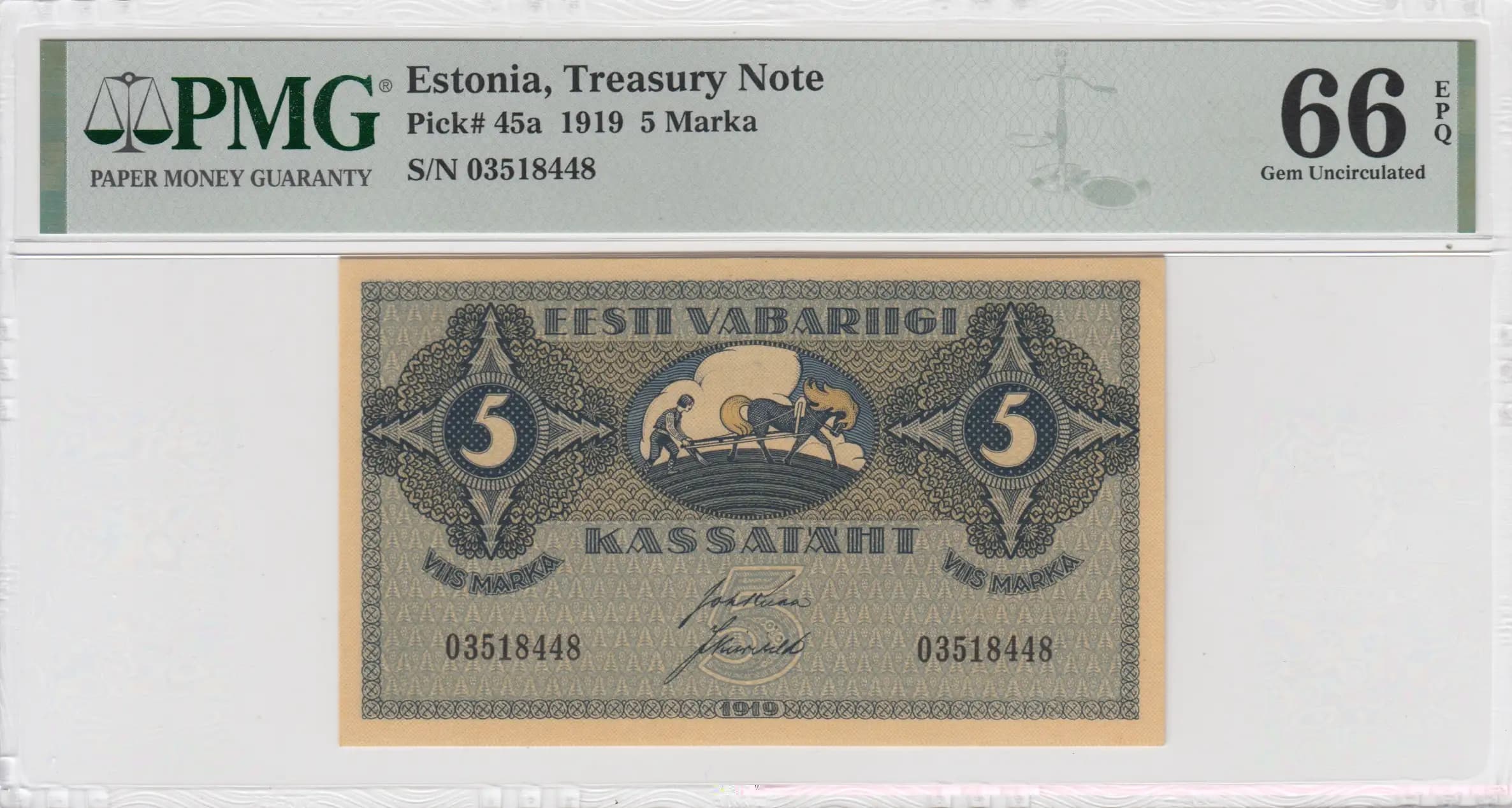
5 marka 1919
“thick paper”
Market Prices
13 salesAbout This Note
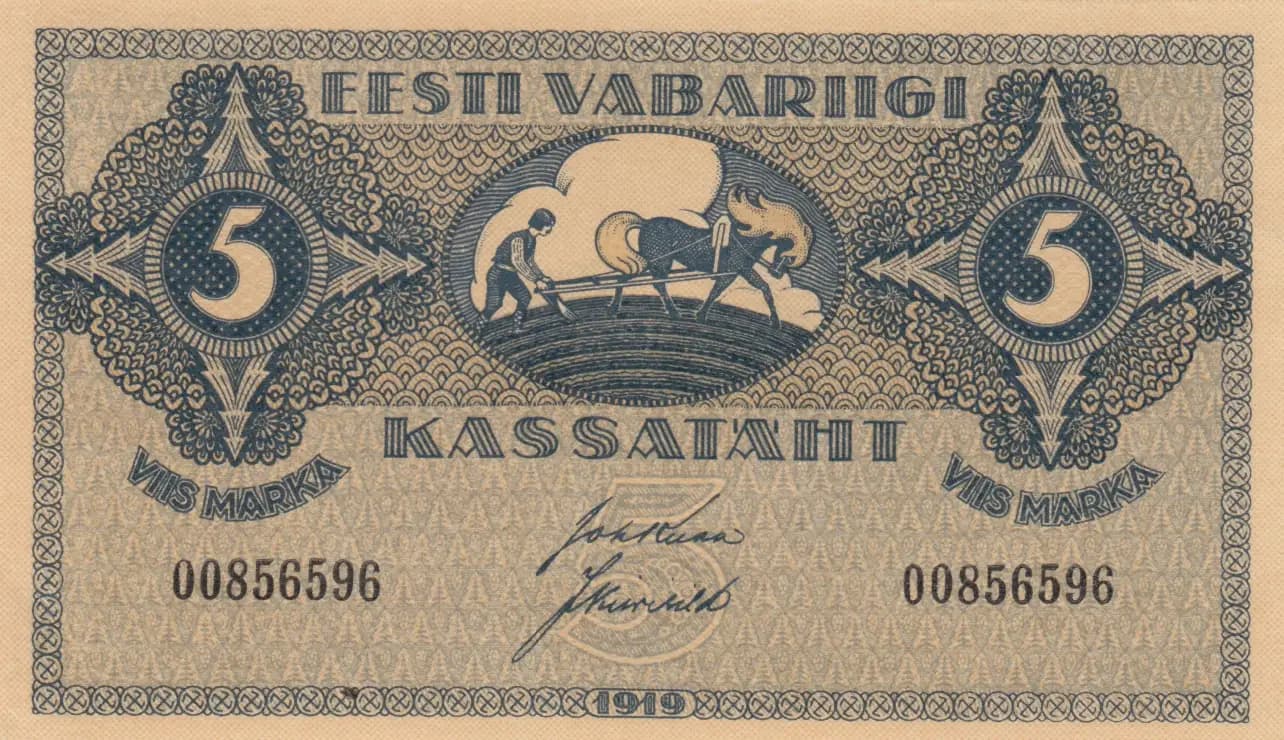
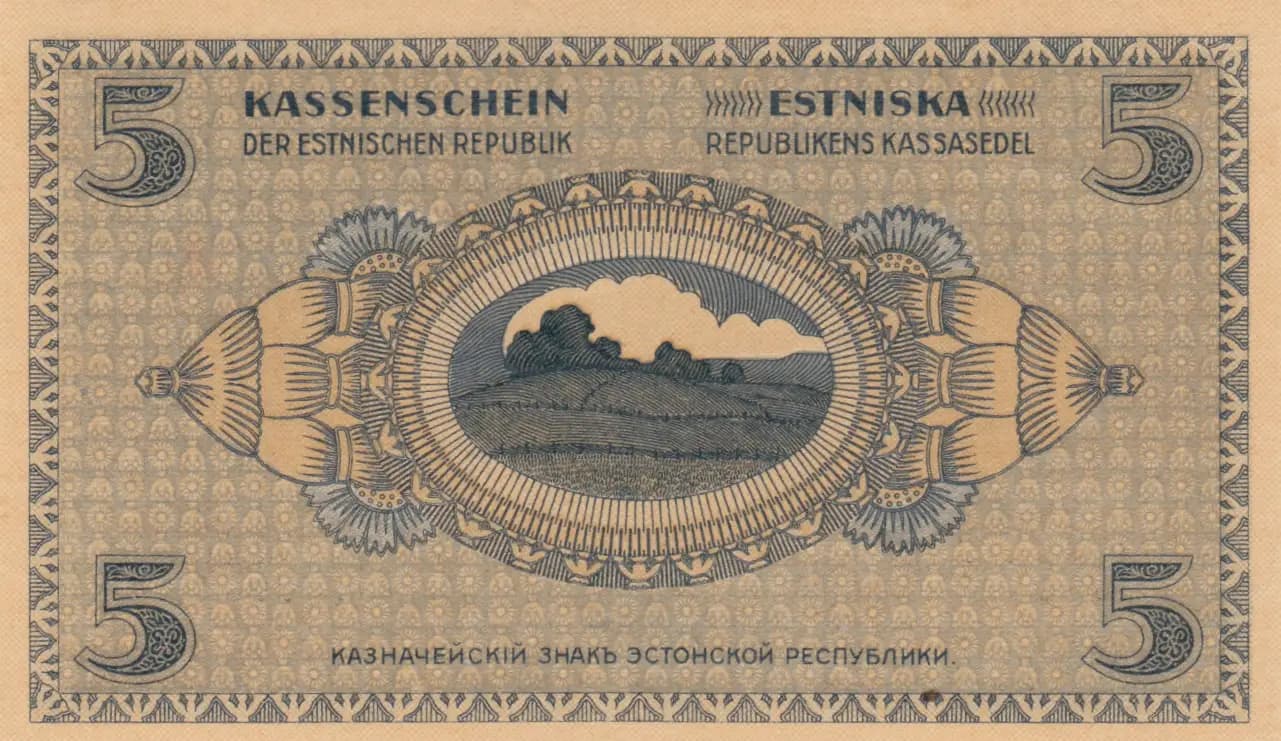
This is an exceptional uncirculated example of Estonia's 1919 5 Marka treasury note, characterized by crisp printing, vibrant tan and blue-gray engraving, and thick paper stock. The note features a distinctive dual-portrait agricultural labor scene on the obverse—showing a man and woman working together with threshing tools—paired with a serene pastoral landscape on the reverse, exemplifying the new nation's agrarian identity. In UNC condition with no visible wear, this note represents a well-preserved specimen of early Estonian monetary sovereignty.
Common. Based on eBay market data, fine examples regularly sell for $8–$9.50, with even PMG-graded specimens (PMG 64) reaching approximately $90. The 2016 catalog value of $100 for UNC examples confirms this is a standard issue with healthy market circulation. Print runs for 1919 Estonian issues were substantial relative to other early Baltic states, and survival rates remain good. The absence of any historical recall, overprint variations, or short-lived production run distinguishes this as a routine circulating issue rather than a scarce variety.
Issued in 1919 by the newly independent Estonian Republic following its declaration of independence from the Russian Empire, this note commemorates the agrarian foundation of Estonian society through its deliberate iconography of agricultural workers and rural landscape. The multilingual inscriptions in Estonian, German, Swedish, and Russian reflect the complex linguistic and cultural composition of the region during this period of transition. The treasury note's imagery—depicting both human labor and the productive land—symbolized the nation's commitment to self-sufficiency and reconstruction during the fragile early years of statehood.
The obverse presents an allegorical vignette of agricultural labor featuring two figures—a man and woman—engaged in grain threshing or winnowing work, depicted in period work clothes and bent forward in active labor, positioned over a large receptacle. This dual-figure composition emphasizes collective national effort and the dignity of agrarian work. The reverse displays a tranquil pastoral landscape vignette set within an elaborate oval frame with radiating line work, showing rolling hills, agricultural fields, and cloud-filled sky, symbolizing Estonia's natural abundance and rural character. Both sides employ ornate decorative borders with geometric and floral patterns, with the numeral '5' appearing in decorative corner medallions (twice on obverse, four times on reverse). The design employs traditional intaglio engraving with a consistent tan/beige and dark blue-gray color palette characteristic of early 20th-century European bank note production.
OBVERSE: 'EESTI VABARIIGI' (Estonian: Estonian Republic) | 'KASSATÄHT' (Estonian: Treasury Note/Banknote) | 'VIS MARKA' (Estonian: Five Marka) | '1919' (year of issue) | Serial number '00856596' (appears twice) | Two handwritten signatures in cursive script. REVERSE: 'KASSENSCHEIN' (German: Banknote/Treasury Note) | 'DER ESTNISCHEN REPUBLIK' (German: of the Estonian Republic) | 'ESTNISKA REPUBLIKENS KASSASEDEL' (Swedish: Estonian Republic's Banknote) | 'КАЗНАЧЕЙСКИЙ ЗНАК ЭСТОНСКОЙ РЕСПУБЛИКИ' (Russian: Treasury Note of the Estonian Republic)
Intaglio (recess/engraved) printing, the standard security printing method for banknotes of this era. The intricate geometric borders, fine line work in the landscape vignette, detailed portrait rendering, and the precise radiating patterns around the central oval frame are all characteristic of intaglio production. The note was printed by De La Rue or another security printer contracted by the Estonian Treasury, employing multiple engraved plates for color separation (tan background with blue-gray engraving).
The PMG catalog records two variant designations for Pick 45: P-45a and P-45s. The 'a' designation likely indicates the standard variety, while the 's' may denote a specimen note or specialized printing variant. The observed serial number '00856596' and the presence of two handwritten signatures are consistent with standard production for this issue. No overprints, color variations, or signature position anomalies are evident in this example, indicating it represents the primary P-45a variety.