45 kopikat 1910
About This Note
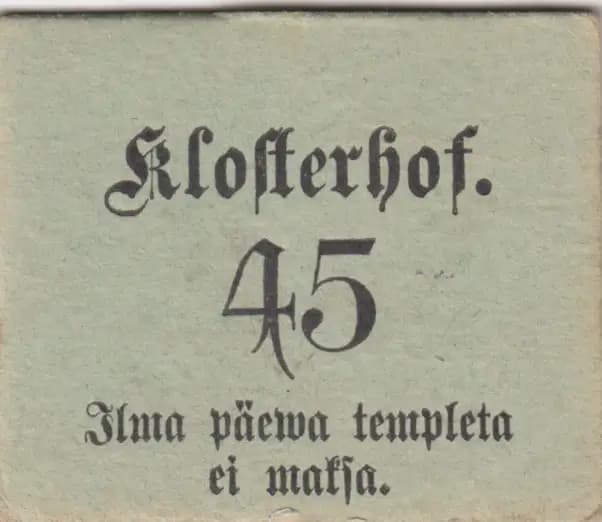
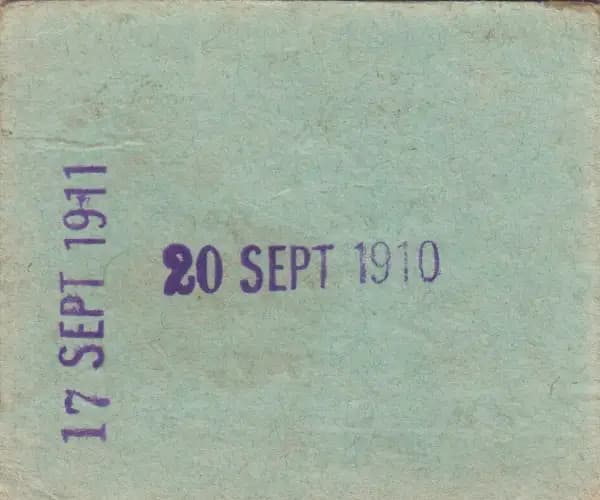
This is a remarkable piece of Estonian numismatic history: a 45 kopikat emergency currency issued by Kloostri village in western Estonia in 1910, graded AU. The note features ornate Gothic typography with the German designation 'Klosterhof' and an intriguing Estonian inscription 'Ilma päewa templeta ei matja' (Without a day's temple there is no burial). The specimen shows excellent preservation with only minor aging and foxing, and retains archival library stamps dated September 1910 and 1911, indicating it was cataloged and preserved by institutional collectors shortly after issue.
Very rare. This is an unlisted Pick catalog number, indicating it has not been formally cataloged in standard international banknote references. The combination of a small rural village issuer (Kloostri), a short-lived emergency currency period, the specific denomination (45 kopikat), and institutional archival provenance all point to a severely limited print run. Emergency local currencies from Russian-occupied Estonia in 1910 rarely survive in AU condition, and the presence of archival documentation stamps suggests this example is from an official collection dispersal—making it a singular artifact of Estonian monetary history rather than a mass-produced note.
This 45 kopikat note represents a fascinating moment in early 20th-century Baltic history when Kloostri village (Klosterhof in German) issued its own emergency currency during a period of economic instability in the Russian Empire's Estonian territories. The German place name alongside Estonian text reflects the complex cultural and linguistic landscape of Estonia under imperial Russian rule. The 1910 dating and institutional archival stamps suggest this was an officially documented monetary experiment, likely issued to facilitate local commerce during a shortage of imperial Russian currency in rural western Estonia.
The front presents a title-page style layout characteristic of emergency notgeld or local currency issues of the era. The design employs ornate Gothic-style typography, with 'Klosterhof' rendered in decorative lettering establishing the issuer's identity. The large numerals '45' prominently display the denomination. The Estonian inscription below serves both as a cultural marker and possibly a legal or explanatory text. The reverse bears institutional archival stamps in purple/violet ink, indicating the note's preservation in an official collection. The paper itself—cream to pale greenish-blue toned—shows authentic aging patterns consistent with genuine paper currency from this period stored in archival conditions.
FRONT: 'Klosterhof' (German: the place name designating Kloostri village); '45' (denomination in kopikat); 'Ilma päewa templeta ei matja' (Estonian: 'Without a day's temple there is no burial' — a cultural or proverbial inscription of unclear specific meaning, possibly relating to funerary customs or community observance). BACK: '20 SEPT 1910' (archival stamp date: 20 September 1910); '17 SEPT 1911' (archival stamp date: 17 September 1911).
Letterpress printing, executed on handmade or rag-content paper typical of early 20th-century Baltic currency. The clear, sharp impressions of the Gothic typeface and the precision of the archival stamps suggest professional printing, likely by an Estonian or Baltic German printer operating under Russian imperial oversight. The bicolor appearance (cream front, pale blue-green back) may result from differential paper aging or intentional use of differently toned stock.
As a Pick-unlisted emission, no standard varieties have been formally documented. However, this example exhibits two distinct archival stamps with dates separated by one year (September 1910 and September 1911), suggesting either multiple cataloging events or institutional re-examination. The 45 kopikat denomination itself is highly unusual—Russian kopeck denominations typically came in round figures (5, 10, 25, 50, etc.), making this an exceptional regional variant. No signatures, serial numbers, or printer marks are visible on the front, consistent with emergency currency practice. The inscription text may exist in variant wordings if other denominations or reissues occurred, though no comparative examples are known to exist in accessible collections.