3 rubla 1941
“blank w #”
About This Note
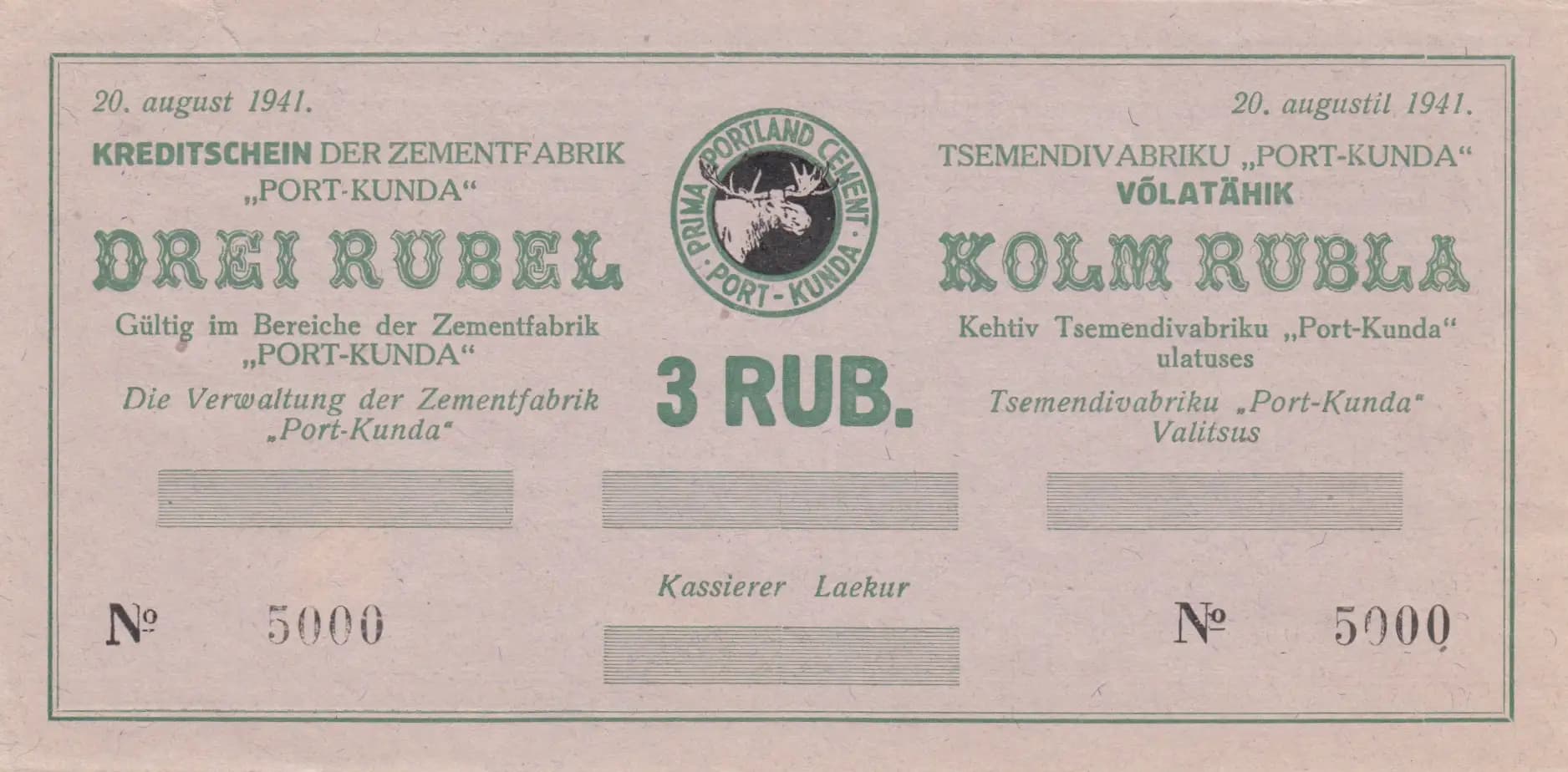
This is a fascinating industrial credit note (Kreditschein) issued by the Port-Kunda Portland Cement Factory in Estonia on August 20, 1941, denominated in 3 rubles. The note is presented in AU condition with visible age-related patina including minor foxing and creasing, and retains excellent legibility of both German and Estonian text throughout. The bilingual format, factory seal featuring a moose/elk head emblem, and the specific historical context of German occupation Estonia make this an important document of wartime industrial administration and currency substitute practices.
Uncommon. This is an unlisted Pick catalog note from a specific industrial issuer (Port-Kunda cement factory) with limited geographic circulation restricted to factory operations in occupied Estonia during 1941-1942. The narrow validity period (August 1941 to January 1942) and the note's function as a wage/credit substitute rather than general circulation currency means surviving examples are likely scarce compared to standard banknotes. However, industrial credit notes from this period exist in varying quantities depending on print runs—Port-Kunda's specific output is not well-documented in standard catalogs. The AU condition and unissued/blank signature state add collector interest but do not significantly increase scarcity value, as many such documents were preserved in institutional or company archives. Without knowledge of original print run figures or documented collector demand, this is assessed as uncommon rather than rare.
This credit note was issued during the Nazi occupation of Estonia (1941-1944), when the Port-Kunda cement factory operated under German administration and used factory-issued credit notes as wage and trade substitutes due to currency instability. The bilingual German-Estonian format reflects the occupation administration's requirement for official documents in both languages. The note's terms, including validity periods extending from October 1941 through January 1942, document the factory's attempts to stabilize internal commerce during the chaotic wartime period, with the promise that these notes would be accepted as equivalent to USSR ruble notes—a remarkable statement given that Estonia was under German occupation at the time.
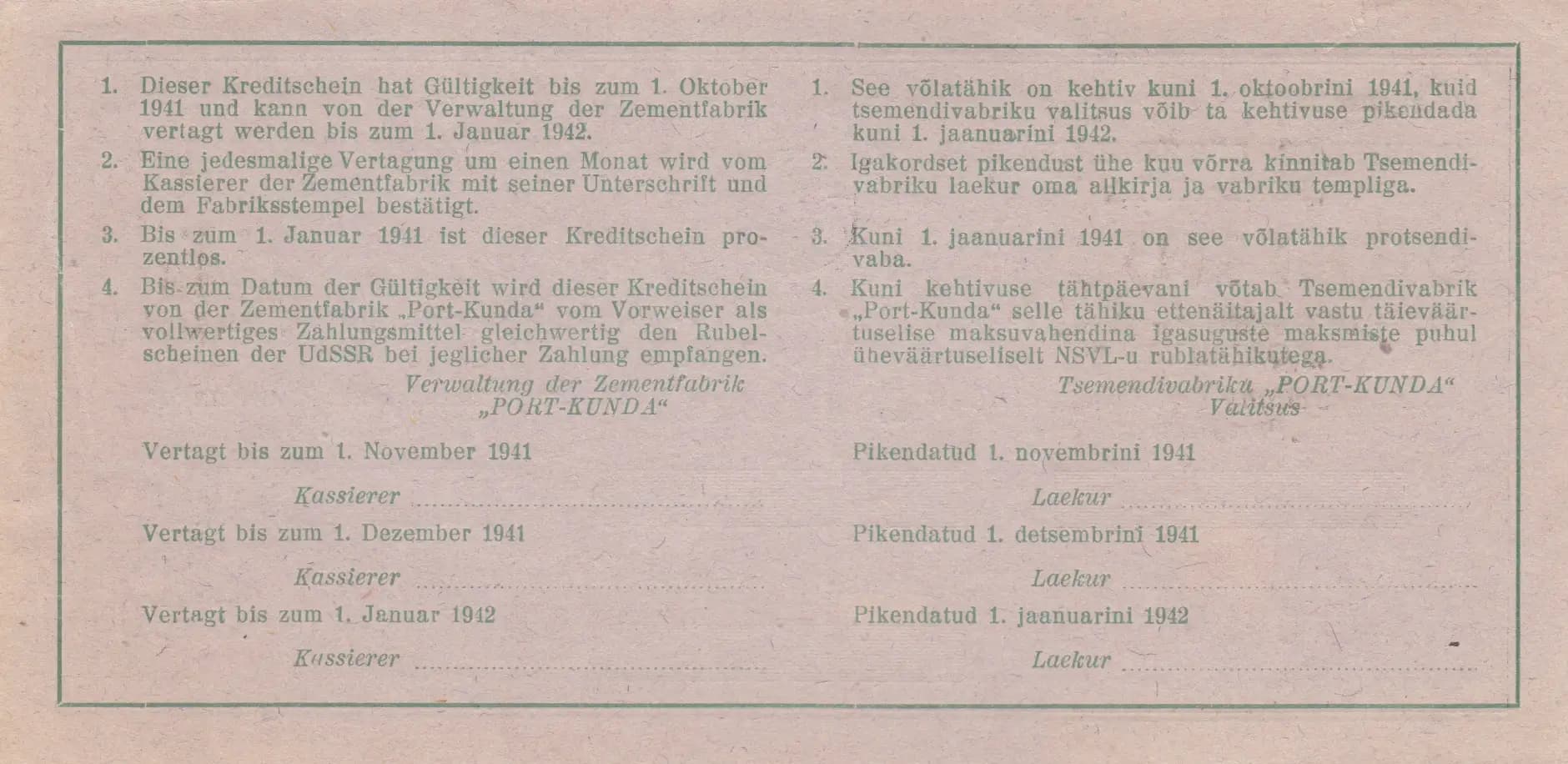
This industrial credit note features a clean, formal layout typical of Germanic administrative design of the 1940s. The front displays the Port-Kunda Portland Cement Factory's circular seal prominently at the top center, featuring a moose or elk head—a symbol likely representing Estonia's natural heritage or the factory's regional identity. The denomination '3 RUB.' appears in multiple locations for clarity. The design employs a simple border frame in green ink on a beige/tan paper stock, creating high contrast for legibility. Serial number 5000 is printed twice (left and right margins) as a security feature. The back side presents four numbered terms and conditions in parallel German and Estonian columns, with blank signature lines and renewal fields for the cashier (Laekur/Kassierer) to authenticate monthly extensions. This format allowed the note to function as a renewable credit instrument, with each extension requiring official confirmation. The bilingual presentation and emphasis on contractual terms distinguish this from standard currency, marking it as an industrial emergency money or wage substitute rather than conventional banknote currency.
FRONT SIDE: Title: "KREDITSCHEIN DER ZEMENTFABRIK 'PORT-KUNDA'" / "TSEMENDIVABRIKU 'PORT-KUNDA' VÕLATÄHIK" (Credit note of the Port-Kunda cement factory). Date: "20. august 1941." / "20. augustil 1941." (20 August 1941). Denomination: "DREI RUBEL" / "KOLM RUBLA" (Three rubles). Validity statement: "Gültig im Bereiche der Zementfabrik 'PORT-KUNDA'" / "Kehtiv Tsemendivabriku 'Port-Kunda' ulatuses" (Valid in the area of the Port-Kunda cement factory). Issuer: "Die Verwaltung der Zementfabrik 'PORT-KUNDA'" / "Tsemendivabriku 'Port-Kanda' Valitsus" (The administration of the Port-Kunda cement factory). Serial number: "N° 5000" and "3 RUB.". Signature line label: "Kassierer / Laekur" (Cashier). BACK SIDE: Terms and Conditions in four numbered points: "1. Dieser Kreditschein hat Gültigkeit bis zum 1. Oktober 1941 und kann von der Verwaltung der Zementfabrik verlangt werden bis zum 1. Januar 1942." / "1. See võlatähik on kehtliv kuni 1. oktoobril 1941, kuid tsemendivabriku valitsus võib-ta kentivuse pikendada kuni 1. jaanuarini 1942." (This credit note is valid until October 1, 1941 and can be demanded by the factory administration until January 1, 1942; the administration may extend validity until January 1, 1942). "2. Eine jedesmalige Vertragung um einen Monat wird vom Kassierer der Zementfabrik mit seiner Unterschrift und dem Fabriksstempel bestätigt." / "2. Igakordsed pikendamist ühe kuu võrra kinnitab Tsemendivabriku laekur oma alkirja ja vabriku templiga." (Each monthly extension will be confirmed by the factory cashier with his signature and factory stamp). "3. Bis zum 1. Januar 1941 ist dieser Kreditschein prozentlos." / "3. Kuni 1. jaanuarini 1941 on see võlatähik protsentidvaba." (Until January 1, 1941 this credit note is interest-free). "4. Bis zum Datum der Gültigkeit wird dieser Kreditschein von der Zementfabrik 'PORT-KUNDA' vom Vorweiser als vollwertiges Zahlungsmittel gleichwertig den Rubel-Scheinen der UdSSR bei jeglicher Zahlung empfangen." / "4. Kuni kehtivuse tähtpäevani võtab Tsemendivabriku 'Port-Kunda' selle tähtiku ettenäitajalt vastu täieväärtuseliselt maksuvahendina jäägustusel maksmisele puhul üheväärtuseliselt NSV Liidu rubla-lehtedele." (Until the date of validity, this credit note will be accepted by the Port-Kunda cement factory as a full-value payment medium equivalent to USSR ruble notes for any payment). Extension fields indicate validity periods: "Vertrag bis zum 1. November 1941" / "Pikendatud 1. novembrini 1941", "Vertrag bis zum 1. Dezember 1941" / "Pikendatud 1. detsembrini 1941", and "Vertrag bis zum 1. Januar 1942" / "Pikendatud 1. jaanuarini 1942" (Contract extended until November 1, 1941; December 1, 1941; and January 1, 1942 respectively).
The note was printed using letterpress or relief printing, evidenced by the crisp, uniform impression of text and the regular border frame visible in the green ink application. The consistent green ink color across both sides and the even distribution of pigment suggest professional commercial printing rather than emergency or makeshift production. The circular factory seal shows the characteristic definition expected from metal die or typographic impression. No gravure or intaglio security features are evident. This was likely produced by a German commercial printer during the occupation period, possibly in Estonia or shipped from Germany, using standard offset or letterpress technology common to administrative documents of that era.
This specimen is identified as serial number 5000 with blank signature lines and unfilled extension fields, indicating either an unissued proof/example or a specimen retained by the factory administration. The specific validity period shown on the reverse (extending through January 1, 1942) matches the initial authorization date. Varieties of this note would likely include: (1) Different serial numbers within the issue range; (2) Examples with completed signatures and factory stamps on the monthly extension lines (November 1, December 1, and January 1 renewal fields); (3) Possibly different printing colors or stock variations depending on whether multiple print runs were produced. The collector notes indicate this specimen has a blank field for variety notation (#), suggesting future documentation of additional printing variations may be discovered as more examples surface from Estonian archives or private collections.