3 rubla 1941
“blank”
About This Note
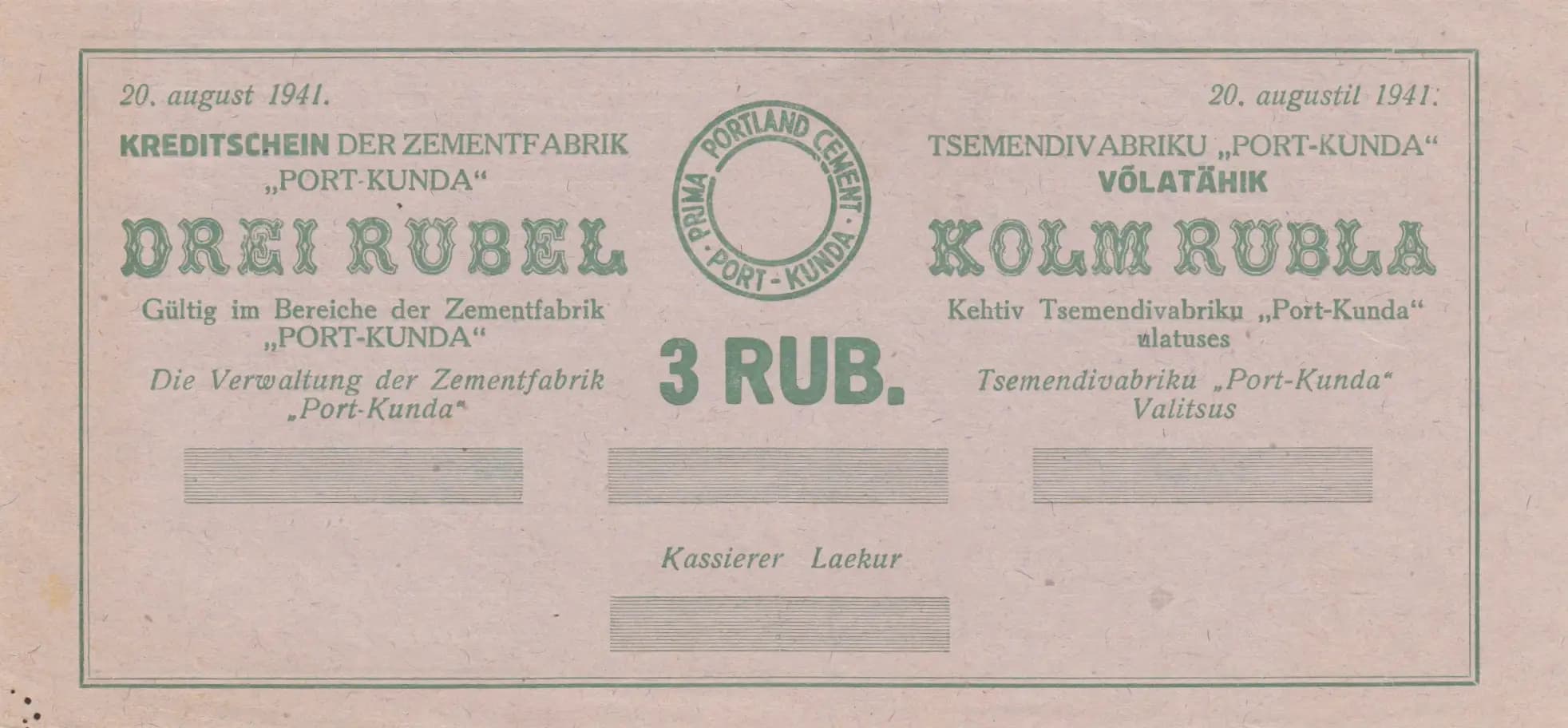
This is a bilingual German-Estonian credit note (Kreditschein) issued by the Port-Kunda cement factory on August 20, 1941, during the German occupation of Estonia in World War II. The note is denominated in 3 rubles and features a symmetrical design with green text on a light pinkish background, bearing the factory's circular seal. In AU condition, the note shows minimal wear with clear, well-preserved printing and no significant tears or creases, representing an interesting example of occupation-era industrial scrip that extends historical context beyond traditional central bank currency.
Common. Port-Kunda cement factory credit notes from 1941 represent localized industrial scrip issued during wartime economic management and likely circulated in substantial quantities within the factory's operations and surrounding workforce. The unlisted status in Pick references indicates these were not included in mainstream numismatic catalogs, which typically focus on central bank issues, rather than indicating scarcity. The survival of this example in AU condition suggests these notes were relatively durable and multiple specimens have endured; industrial scrip from this period is frequently encountered in specialized collections of occupation-era currency and ephemera. No evidence of limited production runs, special recalls, or extreme rarity markers exists.
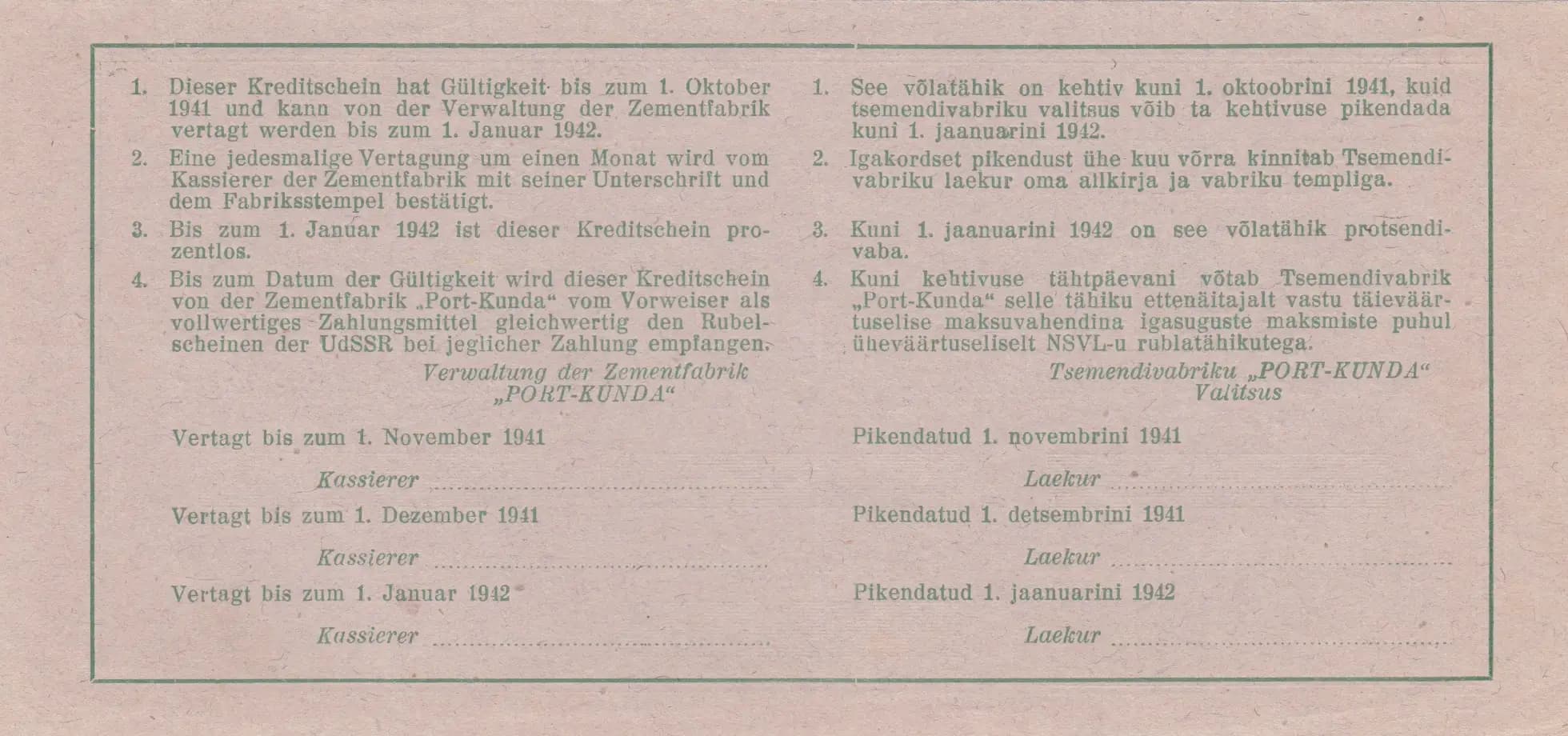
This credit note represents a fascinating intersection of World War II economic history and industrial management during the German occupation of Estonia. Issued during the period when Estonia was under German administrative control (1941-1944), the bilingual German-Estonian format reflects the occupying administration's approach to managing local industry. The Port-Kunda cement factory, a significant industrial concern, issued this scrip as a means of providing workers with credit or wage substitutes during wartime when currency circulation was tightly controlled, with validity terms explicitly tied to monthly extensions through January 1942 as shown on the reverse.
This is a two-sided credit note with a carefully symmetrical bilingual layout reflecting German-Estonian administrative structure during the 1941-1942 occupation period. The front features the Port-Kunda cement factory's circular seal at the top center, prominently displaying 'PRIIA PORTLAND CEMENT PORT-KUNDA'. The denomination '3 RUB.' is centrally positioned with German 'DREI RÜBEL' and Estonian 'KOLM RUBLA' equivalents. The reverse contains four numbered conditions of use in parallel German and Estonian text, with three rows of signature lines for monthly extensions by the factory cashier (Kassierer/Laekur), dated for November 1, December 1, and January 1, 1942. The entire design utilizes green printing on a light pinkish-beige paper stock, creating a unified visual identity appropriate for industrial scrip. No portraits or historical landmarks are depicted; instead, the authority derives from the factory's institutional seal and administrative structure.
FRONT SIDE: Title: 'KREDITSCHEIN DER ZEMENTFABRIK "PORT-KUNDA" / TSEMENDIVABRIK "PORT-KUNDA" VÕLATÄHIK' (Credit note of the cement factory 'Port-Kunda'). Denomination: 'DREI RÜBEL / KOLM RUBLA / 3 RUB.' (Three rubles). Date: '20. augut 1941 / 20. augustil 1941' (August 20, 1941). Validity: 'Gültig im Bereiche der Zementfabrik "PORT-KUNDA" / Kehtiv Tsemendivabrik "Port-Kunda" ulatuses' (Valid in the area of the cement factory 'Port-Kunda'). Issuer: 'Die Verwaltung der Zementfabrik "PORT-KUNDA" / Tsemendivabrik "Port-Kunda" Valitsus' (The administration of the cement factory 'Port-Kunda'). Signature line: 'Kassierer Laekur' (Cashier). BACK SIDE: Condition 1: 'Dieser Kreditschein hat Gültigkeit bis zum 1. Oktober 1941 und kann von der Verwaltung der Zementfabrik verfast werden bis zum 1. Januar 1942 / See võlatähik on kehtiv kuni 1. oktoobrina 1941, kuid tsemendivabrik võib ta kehtivuse pikendada kuni 1. jaanuarini 1942' (This credit note is valid until October 1, 1941 and can be extended by the cement factory administration until January 1, 1942). Condition 2: 'Eine jedesmälige Vertauung um einen Monat wird vom Kassierer der Zementfabrik mit seiner Unterschrift und dem Fabriksstempel bestätigt / Igakordset pikendust ühe kuu võrra kinnittab Tsemendivabrik laekur oma allkirja ja vabrik tempiiga' (Each monthly extension will be confirmed by the cashier with his signature and factory stamp). Condition 3: 'Bis zum 1. Januar 1942 ist dieser Kreditschein prozentlos / Kuni 1. jaanuarini 1942 on see võlatähik protsentidvaba' (Until January 1, 1942, this credit note is without interest). Condition 4: 'Bis zum Datum der Gültigkeit wird dieser Kreditschein von der Zementfabrik "Port-Kunda" vom Vorweiser als vollwertiges Zahlungsmittel gleichwertig den Rubelscheinen der UdSSR bei jeglicher Zahlung empfangen / Kuni kehtiusae tähtpäevani võtab Tsemendivabrik "Port-Kunda" selle võlatähri käitajäelt täisväärtuselihet maksuvahendina igasuguste maksmiste puhul üheväärtuselihet NSV-i rublatähikutega' (Until the expiry date, this credit note will be accepted as fully valid payment equivalent to Soviet ruble notes). Extension dates: 'Vertagt bis zum 1. November 1941 / Pikendatud 1. novembrini 1941', 'Vertagt bis zum 1. Dezember 1941 / Pikendatud 1. detsembrini 1941', 'Vertagt bis zum 1. Januar 1942 / Pikendatud 1. jaanuarini 1942' (Extended until [dates]).
Based on the visual characteristics—sharp, clean green text impressions, consistent ink saturation across the bilingual sections, and the precision of the circular seal rendering—this note was produced using letterpress or similar relief printing methods typical of the period. The evenly distributed green ink and clear definition of text suggest professional printing with carefully maintained type and printing surfaces. The bilingual parallel layout required careful registration to ensure alignment between German and Estonian sections. No security features beyond the circular factory seal are evident, consistent with industrial scrip of the era that relied on institutional authority rather than anti-counterfeiting measures. The specific printer is not identified in available documentation for this unlisted Pick number.
This specific example exhibits the initial August 20, 1941 issue date with evidence of three monthly extensions documented on the reverse (extended to November 1, 1941; December 1, 1941; and January 1, 1942), representing the third and final extension allowed under the terms. Varieties likely exist based on: (1) presence or absence of extension stamps and signatures, (2) number of extensions (original issue vs. singly, doubly, or triply extended), (3) different cashier signatures, and (4) possibly different printer batches. The blank signature lines on this example indicate it may be an unextended specimen or represents a particular state before all extensions were applied. No serial numbers are visible, consistent with industrial scrip design of the period. Further research into Port-Kunda factory archives would clarify the total production and specific variety classifications.