3 rubla 1941
About This Note
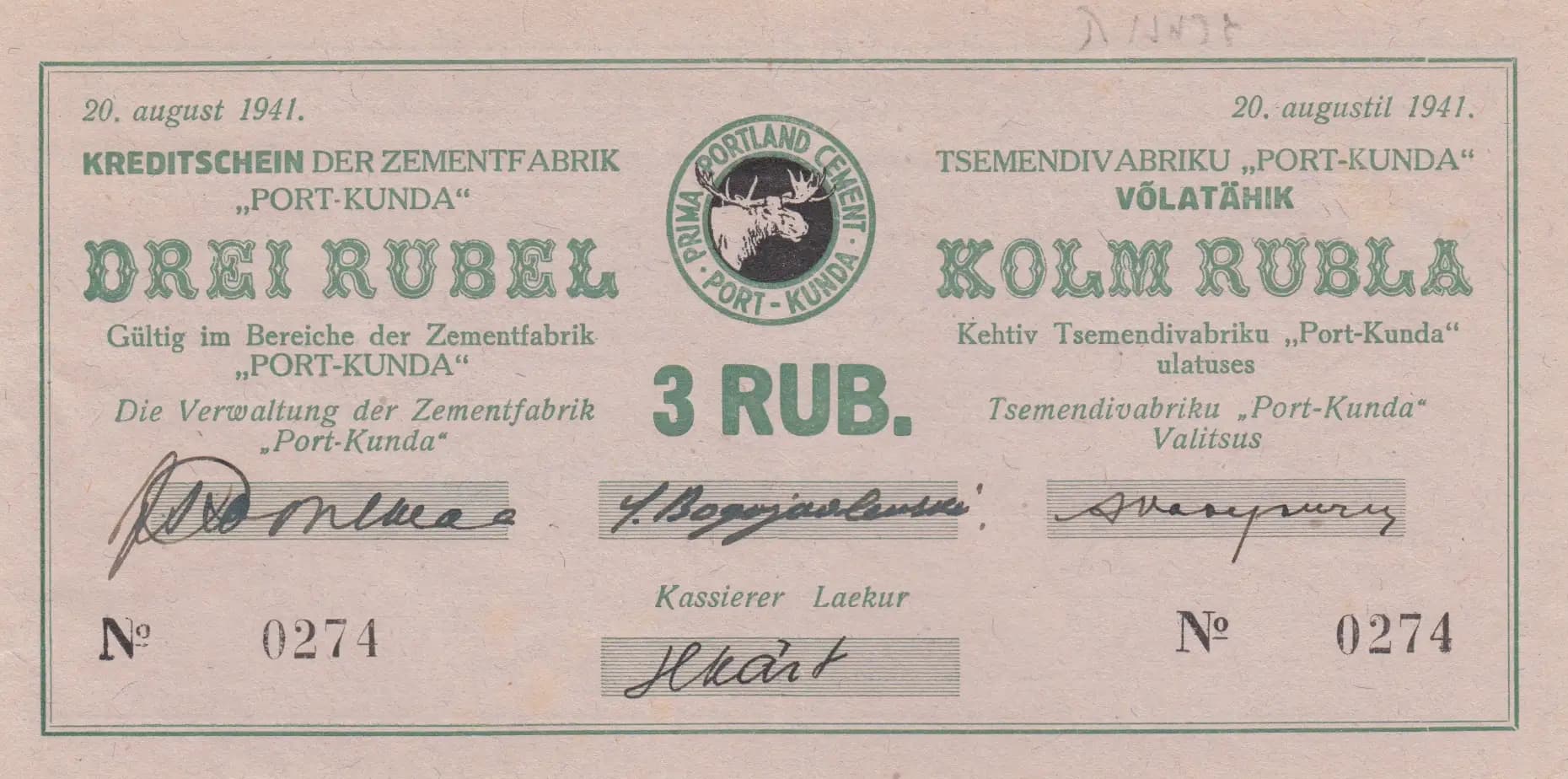
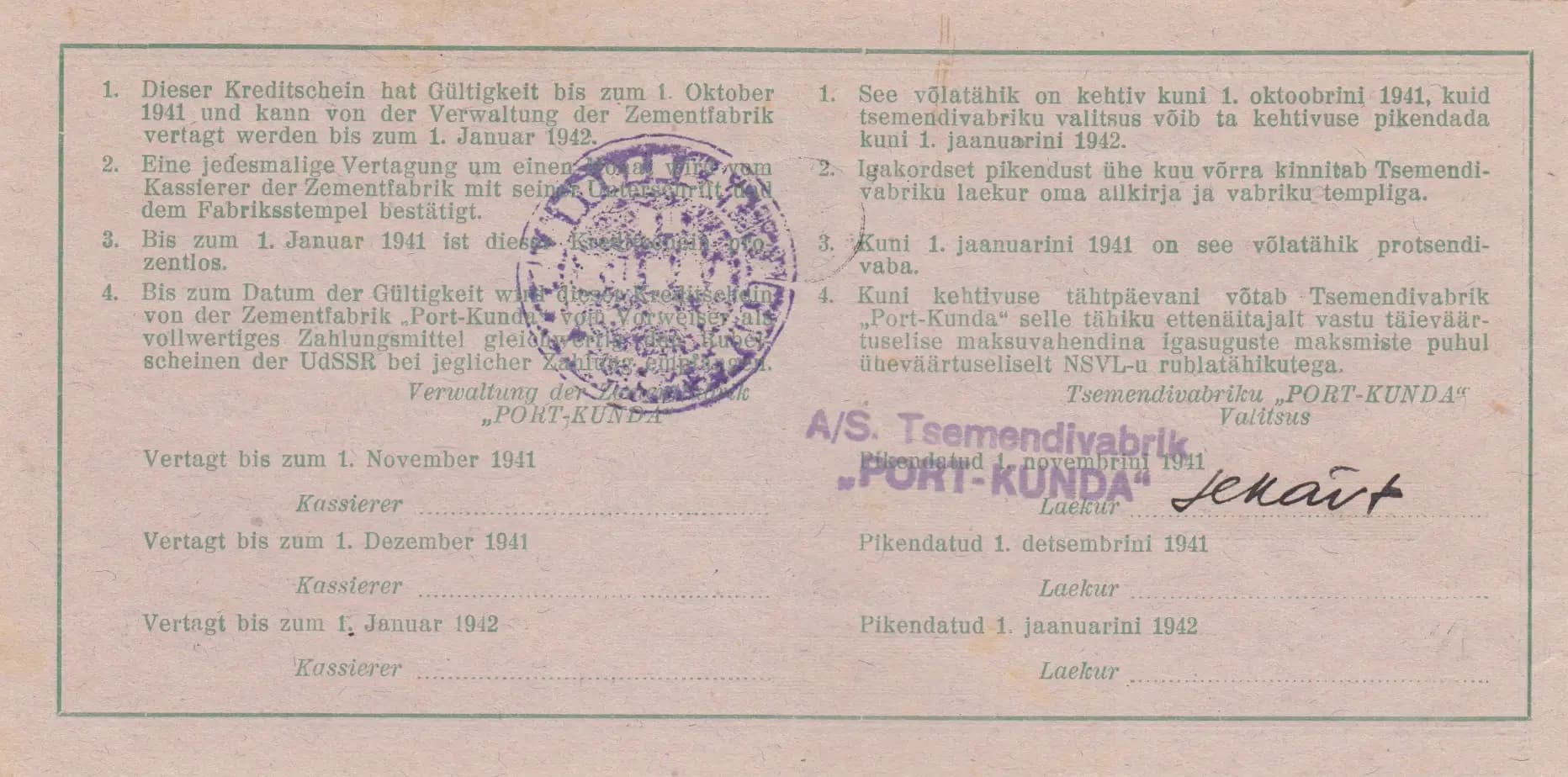
This is a 3 Ruble credit note (Kreditschein) issued by the Port-Kunda Cement Factory on 20 August 1941, presented in UNC condition despite visible signs of age. The note features a distinctive circular seal with a moose head emblem and is bilingual in German and Estonian, reflecting the German occupation period in Estonia. The reverse bears multiple handwritten extensions and an official purple factory stamp dated 1 November 1941, documenting its use as emergency currency with rolling validity periods through January 1942.
common. Port-Kunda was a major cement production facility, and industrial scrip from large enterprises typically had modest but regular print runs to meet operational currency needs. The existence of multiple extension stamps and signatures on this specimen indicates it remained in active circulation, suggesting adequate quantities were printed. Without evidence of a severely restricted print run, rapid withdrawal, or exceptional rarity documentation in specialized catalogs, and given that the note performs its intended function as documented circulating scrip rather than a commemorative or limited-issue piece, this issue should be classified as common among occupational scrip collectors. Pick's notation as 'P-unlisted' reflects the specialized nature of this material rather than extreme rarity.
This note was issued during the Nazi occupation of Estonia (1941-1944), when German administrative structures replaced Soviet authority. The bilingual German-Estonian text and the reference to validity 'equivalent to USSR ruble banknotes' reflect the transitional economic chaos of this period, where private industrial enterprises issued credit notes to compensate for currency shortages. The Port-Kunda Cement Factory's decision to issue this scrip with periodic extensions demonstrates how local industries maintained wage systems and commerce when official currency was scarce or unreliable.
The note employs a clean, functional design typical of German-issued occupation scrip. The obverse features a central circular seal (likely representing the Port-Kunda Cement Factory's corporate emblem) with a moose head as the central motif, surrounded by text reading 'PRIMORLAND CEMENT' and 'PORT-KUNDA'. The denomination '3 RUB.' is prominently displayed in the center in large numerals. The layout is divided vertically with German text on the left and Estonian text on the right, both in green print on a beige/tan paper stock with green borders. The reverse contains the terms and conditions in numbered sections (1-4), similarly bilingual, with space for handwritten extensions and signatures. An official circular stamp impression in purple ink from the Port-Kunda Cement Factory administration (dated 1 November 1941) serves as a security device and validation mark. Handwritten signatures from the cashier (Kassierer/Laekur) and dated extension entries document the note's circulation history and renewal cycles.
FRONT SIDE: Title: 'KREDITSCHEIN DER ZEMENTFABRIK "PORT-KUNDA"' (Credit note of the Port-Kunda Cement Factory) / 'TSEMENDIVABRIKU "PORT-KUNDA" VÕLATÄHIK' (Port-Kunda Cement Factory Debt Note). Date: '20. august 1941.' / '20. augustil 1941.' (20 August 1941). Denomination: 'DREI RUBEL' / 'KOLM RUBLA' (Three Rubles). Validity: 'Gültig im Bereiche der Zementfabrik "PORT-KUNDA"' / 'Kehtiv Tsemendivabriku "Port-Kunda" ulatuses' (Valid within the Port-Kunda Cement Factory area). Issuer: 'Die Verwaltung der Zementfabrik "Port-Kunda"' / 'Tsemendivabriku "Port-Kunda" Valitsus' (The Administration of the Port-Kunda Cement Factory). Serial Number: 'N° 0274'. Signature line: 'Kassierer Laekur' (Cashier). BACK SIDE: Condition 1: 'Dieser Kreditschein hat Gültigkeit bis zum 1. Oktober 1941 und kann von der Verwaltung der Zementfabrik verlängert werden bis zum 1. Januar 1942.' / 'See võlatähik on kehtiv kuni 1. oktoobrini 1941, kuid tsemendivabriku valitsus võib ta kehtivuse pikendada kuni 1. jaanuarini 1942.' (This credit note is valid until 1 October 1941 and can be extended by the cement factory administration until 1 January 1942). Condition 2: 'Eine jedes malige Vertragung um einen Rubel im Kassierer der Zementfabrik ist schein dem Fabriksstempel bestätigt.' / 'Igakordset pikendust ühe kuu võrra kinnitab Tsemendivabriku laekur oma allkirja ja vabriku templiga.' (Each extension by one month from the cement factory cashier must be confirmed by their signature and factory stamp). Condition 3: 'Bis zum 1. Januar 1941 ist diese zins los.' / 'Kuni 1. jaanuarini 1941 on see võlatähik protsendita.' (Until 1 January 1941 this is interest-free). Condition 4: 'Bis zum Datum der Gültigkeit wird es gegen Einzahlung bei der Zementfabrik "Port-Kunda" vollwertiges Zahlungsmittel gleich russischen Scheinen der UdSSR bei jeglicher Zahlung angenommen.' / 'Kuni kehtivuse tähtpäevani võtab Tsemendivabrík "Port-Kunda" selle tähtiku etteniitajalt vastu täieväärtuseliselt maksuvahendina igasuguste maksimiste puhul üheväärtuseliselt NSVL-u rublaiaiiikutega.' (Until the expiration date, it will be accepted as full-value payment equivalent to USSR ruble banknotes at the Port-Kunda Cement Factory). Issuer (back): 'Verwaltung der "PORT-KUNDA"' / 'Tsemendivabriku "PORT-KUNDA" Valitsus' (Administration of Port-Kunda) and 'A/S. Tsemendivabrík "PORT-KUNDA"' (Joint-Stock Port-Kunda Cement Factory). Extensions stamped: 'Vertagt bis zum 1. November 1941' / 'Pikendatud 1. novembrini 1941' (Extended until 1 November 1941), 'Vertagt bis zum 1. Dezember 1941' / 'Pikendatud 1. detsembrini 1941' (Extended until 1 December 1941), 'Vertagt bis zum 1. Januar 1942' / 'Pikendatud 1. jaanuarini 1942' (Extended until 1 January 1942).
Letterpress printing (relief printing) was used for the primary text and borders, evidenced by the crisp, uniform green impressions visible on both sides. The circular moose head seal appears to be a pre-printed design element, likely photomechanically reproduced. The official purple stamp impressions on the reverse were applied by hand-stamp or rubber stamp die during the validation and extension process, which is consistent with administrative practices of the occupation period. The bilingual layout suggests offset or lithographic supplementary printing for the secondary language column, though the predominant technique appears to be traditional letterpress suitable for small-scale industrial scrip production in occupied territory.
This specific specimen is serial number 0274 and documents the complete extension history through January 1942, with dated stamps for extensions to 1 November 1941, 1 December 1941, and 1 January 1942. The handwritten cashier signatures and dated extensions appear to be unique to individual specimens based on actual circulation and renewal dates. No major varieties are evident from the observed print characteristics, though variations in extension stamp dates and individual cashier signatures would create minor collecting varieties. The note represents the late-issue state of this denomination with full extension documentation, making it a complete example of how Port-Kunda scrip functioned as rolling-validity currency during the occupation period.