3 punkt 1945
“w/o serial #”
About This Note
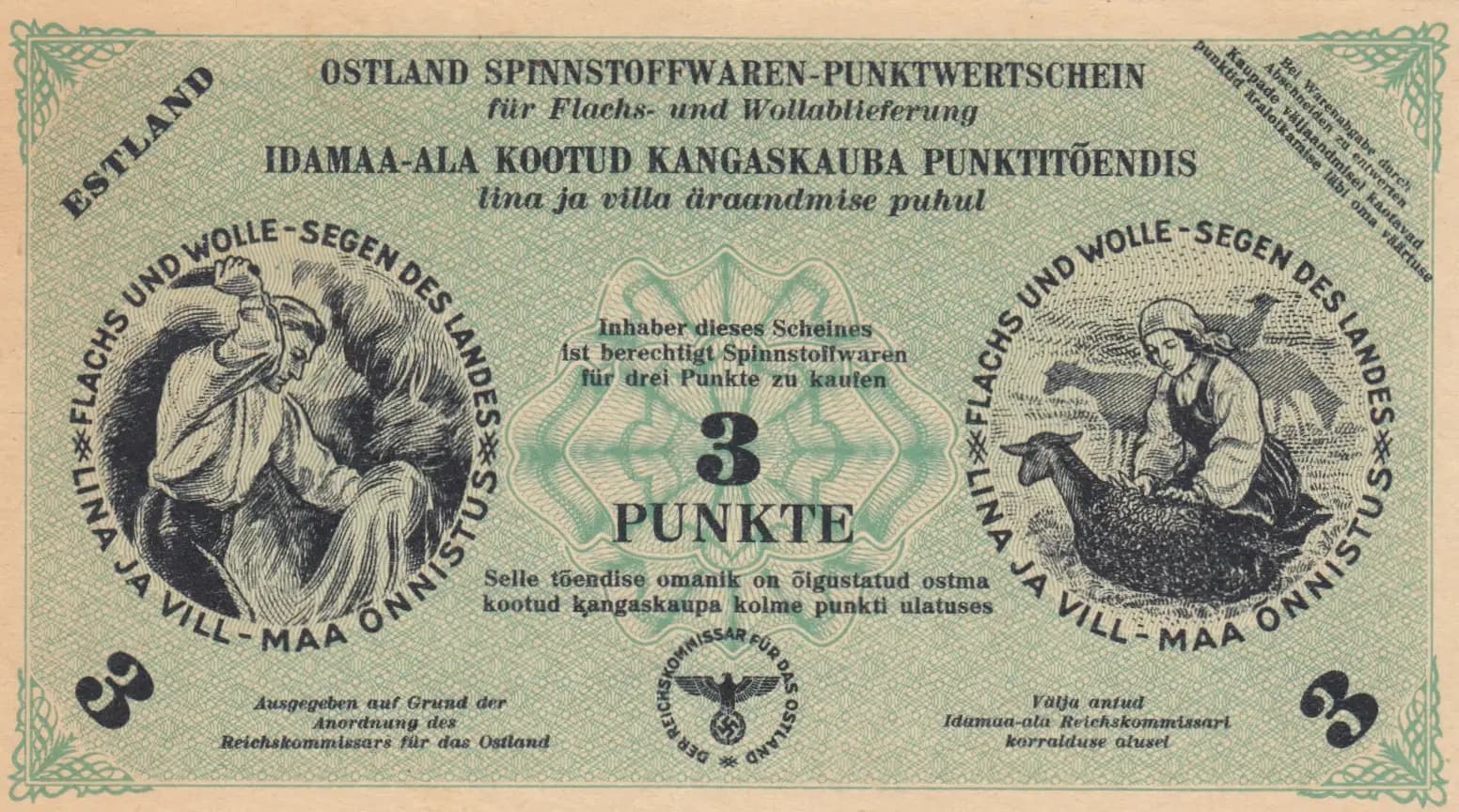
This is an exceptional example of a German occupation-era textile rationing voucher issued in Estonia during 1945, graded AU with crisp, clear printing throughout and no visible wear or damage. The note features striking Art Deco styling with classical female allegorical figures representing textile production (spinning and wool work), rendered in green and black inks on a tan field. As an unlisted Pick number item without serial numbering, this represents a scarce propaganda/administrative piece from the final months of Nazi occupation in the Baltic territories.
Uncommon. While Nazi occupation-era administrative vouchers and rationing certificates from the Baltic territories were produced in significant quantities for practical circulation and consumption, this specific 3-point textile voucher remains scarce in surviving condition, particularly in AU grade without damage or heavy use. Most such documents were destroyed, discarded, or lost during the Soviet re-occupation and subsequent decades. The lack of Pick catalog listing and the absence of serial numbering suggest this was a short-lived administrative issue with a limited lifespan (valid only until April 30, 1945—the final month of Nazi occupation). The specificity of this voucher type and its historical dating to the absolute endgame of occupation governance makes it a specialized collector's item rather than a common circulating note.
Issued by German occupation authorities in Estonia under the Reichskommissar für das Ostland (Reich Commissioner for the East Land), this textile point voucher reflects the Nazi regime's systematic rationing and control of consumer goods during the final year of World War II. The bilingual German-Estonian text, paired with the prominent eagle-and-swastika emblems on both sides, underscores the administrative apparatus of occupation governance. The April 30, 1945 expiration date marks this as among the very last official documents issued before the Soviet liberation of the Baltic states, making it a direct artifact of the region's darkest historical period.
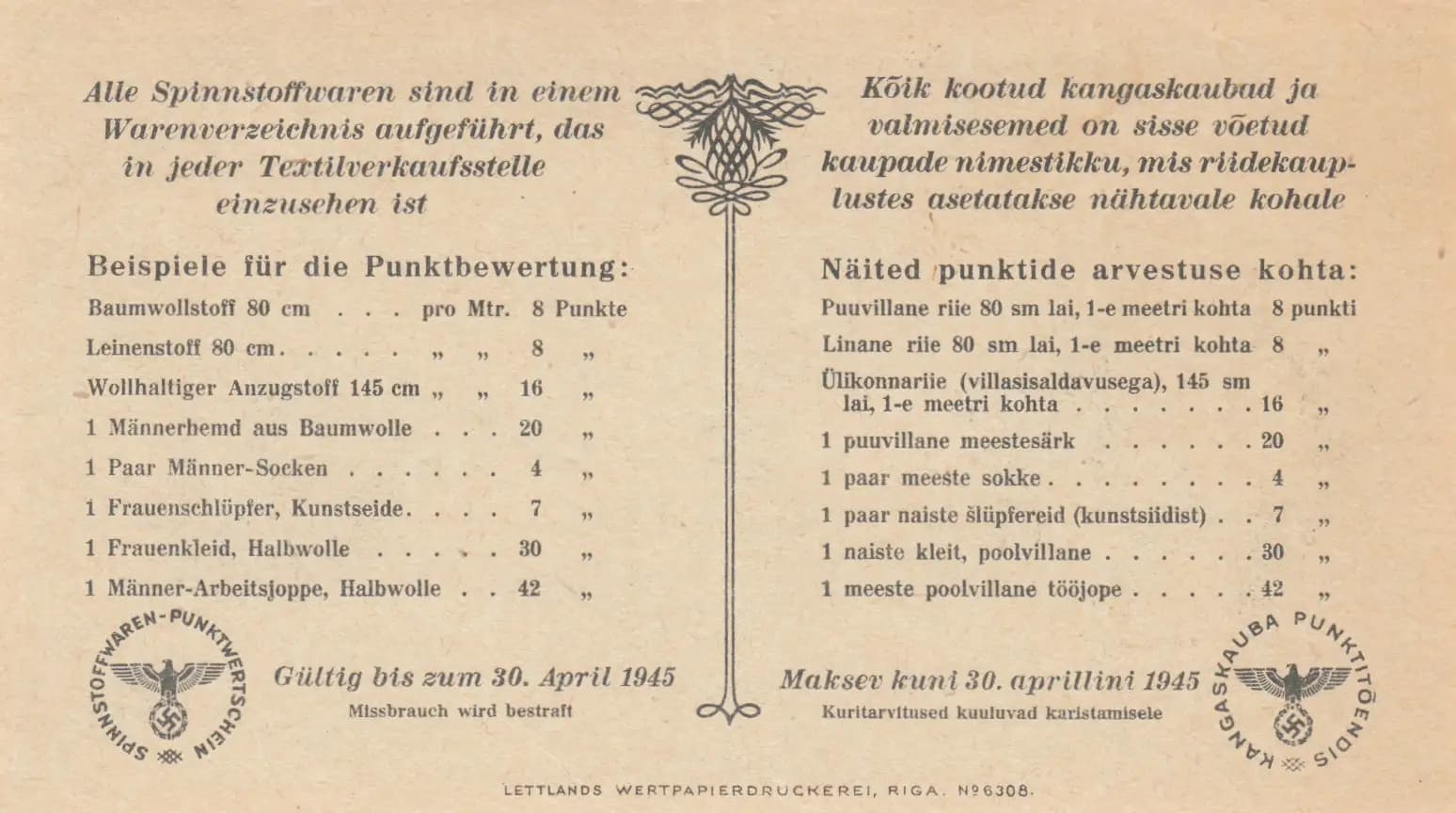
The obverse features an ornamental architectural frame in green and black with classical revival styling, flanking two allegorical female figures representing the textile industry: the left figure holds a spinning wheel or spindle symbolizing flax processing, while the right figure holds wool or textile materials. The central oval medallion displays '3 PUNKTE' in prominent serif typeface. Above and below the central text are decorative winged emblems and floral ornaments. The reverse contains extensive bilingual regulatory text with a decorative winged emblem at top center, organized pricing tables listing textile commodities and their point valuations, and two identical official seal stamps positioned at bottom left and right corners, each featuring an eagle clasping a swastika—the emblems of Nazi administrative authority. The overall design combines utilitarian administrative clarity with propagandistic aesthetic elements celebrating labor and production.
FRONT: 'OSTLAND SPINNSTOFFWAREN-PUNKTWERTSCHEIN für Flachs- und Wollablieferung' (East Land Textile Goods Point Voucher for Flax and Wool Delivery); 'IDAMAA-ALA KOOTUD KANGASKAUBA PUNKTITÖENDIS tina ja villa äraandamise puhul' (East Land Woven Textile Point Certificate for tin and wool delivery); '3 PUNKTE' (3 Points); 'Inhaber dieses Scheines ist berechtigt Spinnstoffwaren für drei Punkte zu kaufen' / 'Selle töendise omanik on õigustatud ostma kangaskaupu kolme punkti ulatuses' (The holder of this certificate is entitled to purchase textile goods for three points); 'ESTLAND' (Estonia). BACK: 'Alle Spinnstoffwaren sind in einem Warenverzeichnis aufgeführt, das in jeder Textilverkaufsstelle einzusehen ist' / 'Kõik kootud kangaskaubad ja valmisesemed on sisse võetud kaupade nimekirikusse, mis riidekaupluses asetakse nähtavale kohale' (All textile goods are listed in a commodity directory that can be inspected at every textile sales outlet); 'Beispiele für die Punktbewertung:' / 'Näited punktide arvestuse kohta:' (Examples for Point Valuation); commodity pricing examples including cotton fabric (8 points per meter), linen fabric (8 points), wool-containing suit fabric (16 points), men's cotton shirt (20 points), men's socks (4 points), women's artificial silk slip (7 points), women's half-wool dress (30 points), men's half-wool work jacket (42 points); 'Gültig bis zum 30. April 1945' / 'Makser kuni 30. aprillini 1945' (Valid until April 30, 1945); 'Missbrauch wird bestraft' / 'Kuritarvitused kuuluvad karistamisele' (Misuse will be punished); 'Ausgegeben auf Grund der Anordnung des Reichskommissars für das Ostland' / 'Välja antud Idamaa-ala Reichskommissari korralduse alusel' (Issued on the basis of the order of the Reich Commissioner for the East Land); 'LETTLANDS WERTPAPERDRUCKEREI, RIGA. N°6308.' (Latvia Securities Printing Works, Riga. No. 6308.)
Letterpress/relief printing with multiple color separations (green and black inks) on a tan/beige paper stock. The crisp definition of ornamental borders, clear registration of bilingual text, and sharp detail in the allegorical figures and eagle emblems indicate professional security printing. The printer attribution clearly states 'LETTLANDS WERTPAPERDRUCKEREI, RIGA' (Latvia Securities Printing Works, Riga, reference No. 6308), indicating production by a specialized security printing facility under German occupation. The precise execution and multi-color overlay technique reflect the high production standards of Nazi-era occupation-period administrative documents.
This note is unlisted in the Pick catalog, indicating it has not been formally cataloged in standard numismatic references. No serial numbers appear on the note, consistent with rationing voucher practices of the period. The printing reference 'N°6308' from the Latvian Securities Printing Works may represent a print order number. The specific April 30, 1945 expiration date makes this a final-issue example from the occupation period; any variants with earlier expiration dates or from different printings would constitute separate varieties. The absence of signature lines or individual authorization marks suggests this was a standardized form issue without personalization.