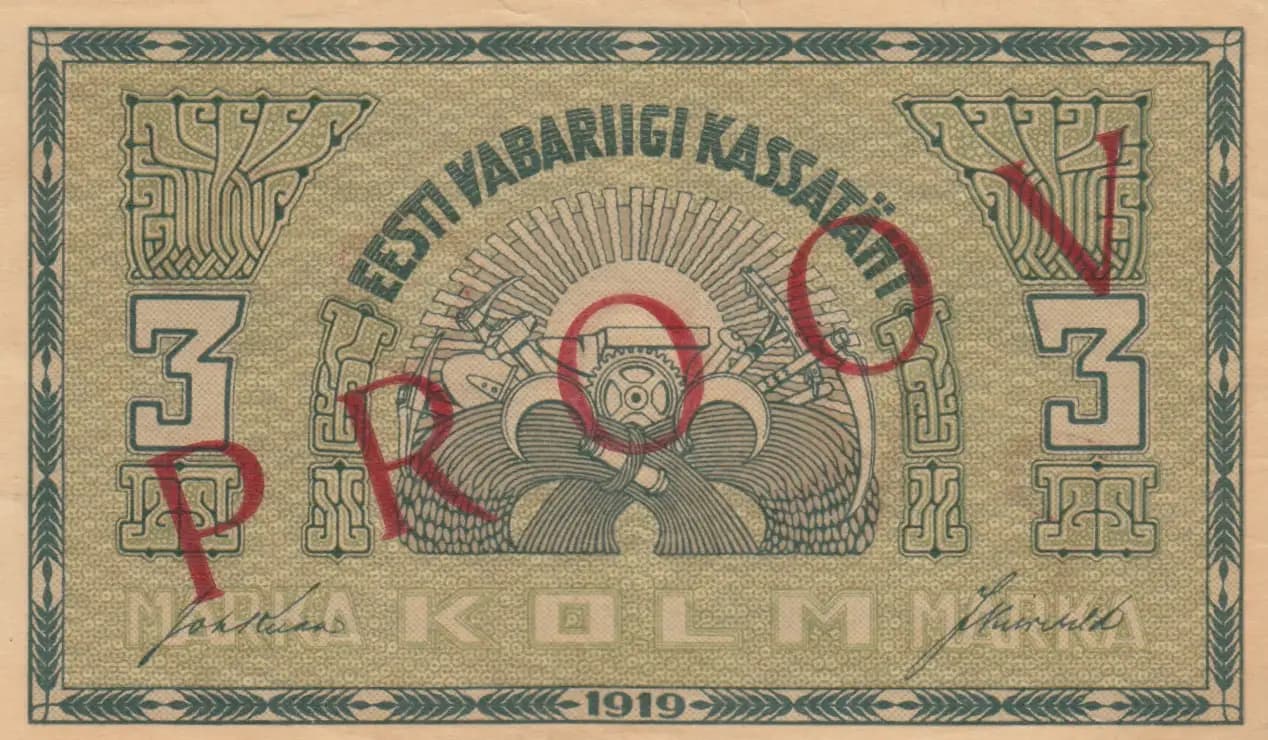
3 marka 1919 pair
Market Prices
About This Note
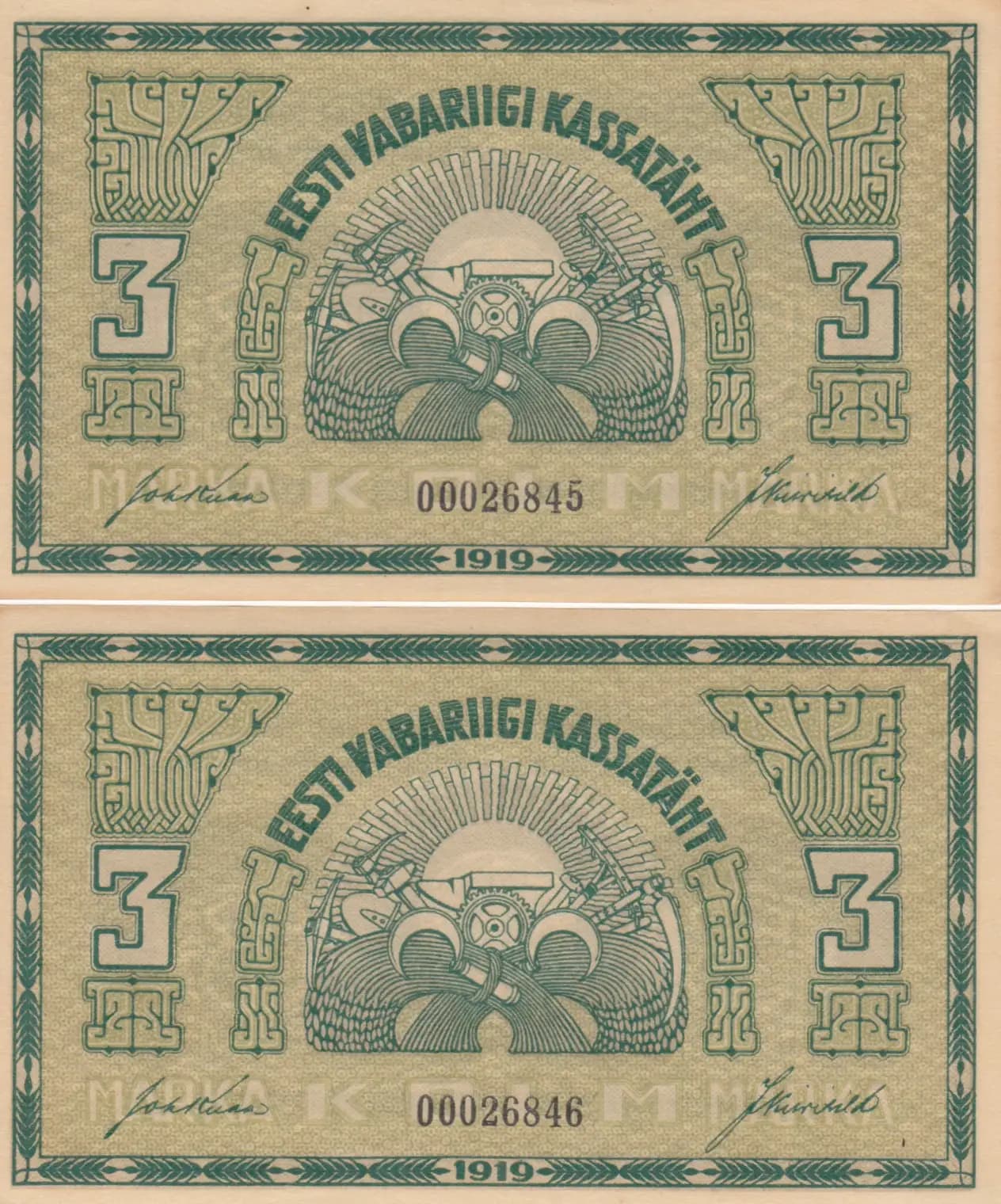
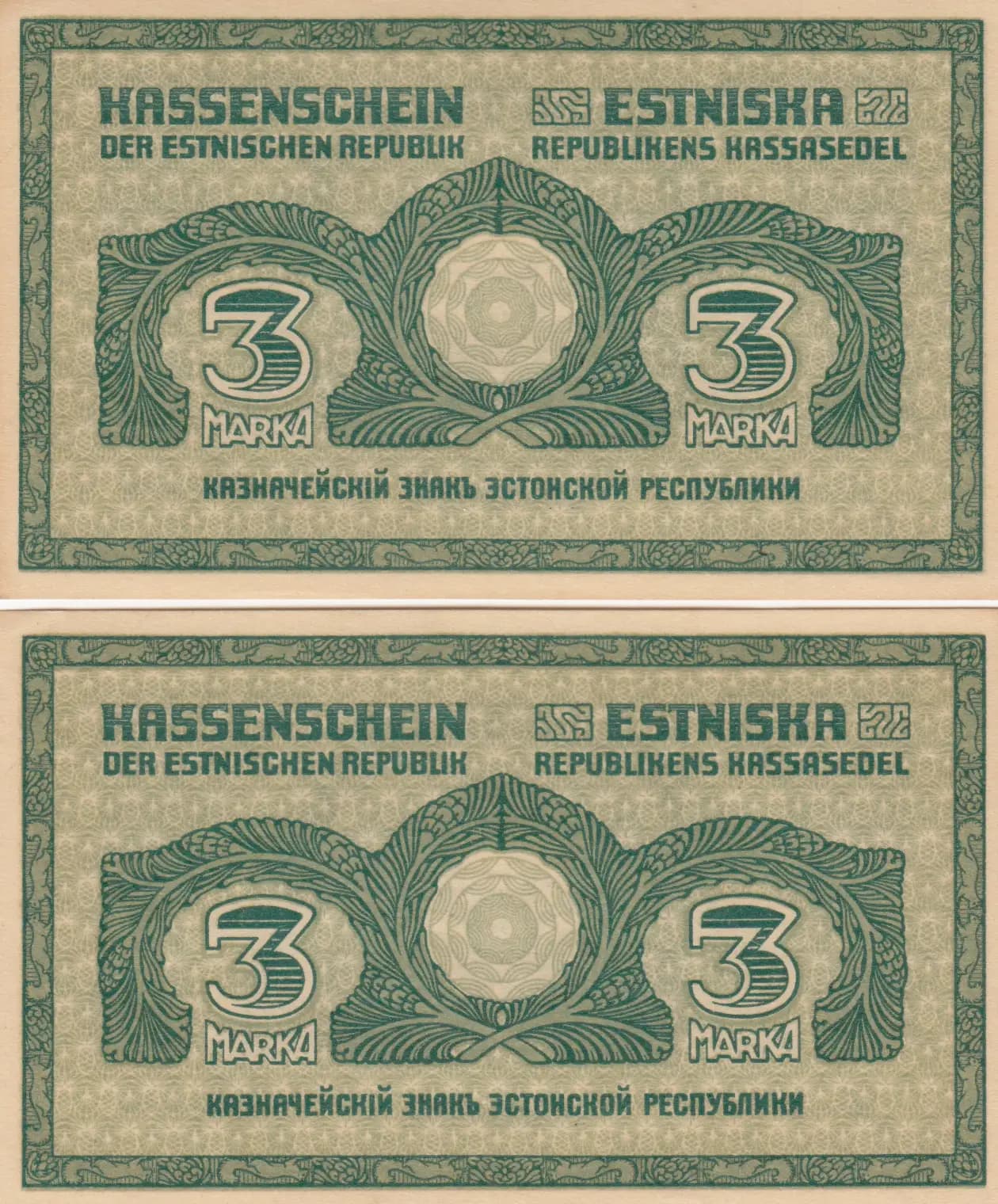
This is an exceptional pair of consecutive 1919 Estonian 3 Marka treasury notes in AU condition, representing early currency from the newly independent Estonian Republic. Both notes display pristine condition with sharp printing, vibrant green/teal coloring on beige backgrounds, and consecutive serial numbers (00026845 and 00026846), making this a desirable matched pair for collectors of Baltic independence currencies. The notes exemplify the transitional design aesthetic of post-WWI Estonia, featuring multilingual inscriptions in Estonian, German, and Russian reflecting the region's complex cultural heritage.
Common. While these are early independence-era notes with historical significance, the 1919 Estonian 3 Marka (Pick-44) remains readily available in the collector market. eBay pricing data shows typical circulation copies trading for $15-25 USD, with uncirculated examples reaching $30-45 USD per current 2016 catalog values. The relatively large print runs typical of early treasury notes and the survival of multiple examples in collector hands indicates no scarcity. This particular pair in AU condition represents quality collector material but does not command premium prices that would indicate rarity.
These notes were issued in 1919 by the Estonian Treasury immediately following Estonia's declaration of independence from the Russian Empire in February 1919. The prominent heraldic winged lion symbol on the obverse reflects the nation's medieval state coat of arms, while the trilingual inscriptions (Estonian, German, Russian) document the linguistic complexity of the newly formed Baltic state during this period of political upheaval and currency reorganization. The 'HASSENSCHEIN' designation on the reverse indicates these were treasury-backed currency notes rather than central bank issues, reflecting the provisional financial infrastructure of the young nation.
The obverse features Estonia's national heraldic symbol—a winged lion rampant facing forward—positioned within a circular medallion with a radiating sunburst pattern, centered beneath the denomination '3'. The lion clutches or stands over a wheel/cross symbol, representing sovereignty and national identity. The design employs Art Deco geometric styling in the corner decorative elements and ornate border patterns characteristic of early 20th-century European currency design. The reverse presents a symmetrical geometric rosette or mandala pattern of nested circles forming an intricate central motif, flanked by the denomination '3 MARKA' in decorative oval cartouches. Both sides employ fine-line engraving throughout with symmetrical ornamental borders, utilizing a restrained color palette of green/teal on beige/cream stock.
FRONT: 'EESTI VABARIIGI KASSATIIR' (Estonian: State Treasury of the Estonian Republic); Denomination '3' displayed on left and right sides; Serial numbers '00026845' and '00026846' respectively in the two notes; Year '1919'. BACK: 'HASSENSCHEIN DER ESTNISCHEN REPUBLIK' (German: Treasury Note of the Estonian Republic); 'ESTNISKA REPUBIIHENS KASSASEDEL' (Estonian: Estonian Republic's Treasury Note); Denomination '3 MARKA' in decorative oval frames; 'КАЗНАЧЕЙСКИЙ ЗНАК ЭСТОНСКОЙ РЕСПУБЛИКИ' (Russian: Treasury Note of the Estonian Republic).
Intaglio engraving, the standard security printing method for banknotes of this era. The fine line work, sharp denomination display, and ornate border details visible in the images are characteristic of professional security printing from the 1919 period. The specific printer for Pick-44 Estonian notes has not been definitively identified in standard catalogs, though several German and Nordic printing firms produced early Estonian currency during this transitional period.
This lot represents a consecutive serial number pair (00026845 and 00026846), which adds modest premium value to collectors seeking matched pairs. No overprints or significant varieties are apparent in the visual analysis. The trilingual design (Estonian/German/Russian text) is standard for the Pick-44 emission and not a variety distinguishing feature. Further research into the signature variations present on these notes may reveal specific signatory varieties, though such distinctions are not typically heavily weighted in valuation for this relatively common denomination.