3 kopikat 1918
About This Note
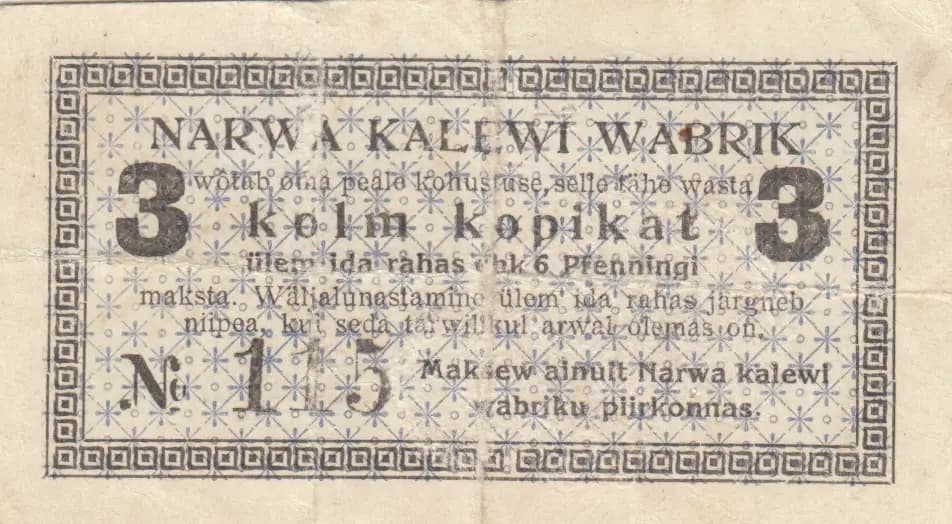
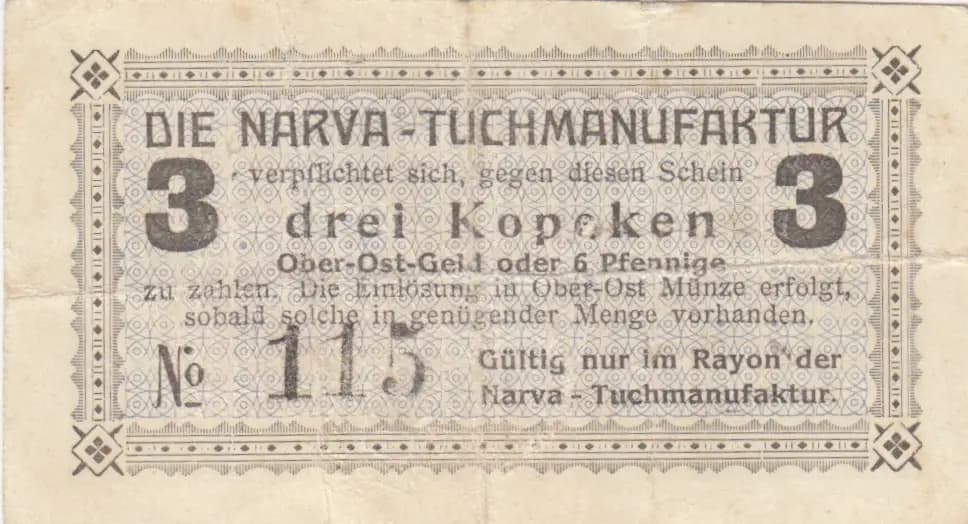
This is a bilingual 3 kopeck emergency note issued by Narva Kalevivabrik (Narva Kalewi Factory) in 1918, featuring parallel Estonian and German text reflecting the region's multilingual character during the German occupation. The note displays a cream/beige background with decorative geometric Greek key borders and scattered blue asterisk symbols, with the denomination prominently displayed in large numerals. In VF condition, the note shows expected age-related creasing and patina consistent with active circulation during this turbulent historical period, making it a fascinating artifact of early 20th-century Baltic economic emergency currency.
Common. While this specific Pick-unlisted number represents a local emergency issue with limited geographic circulation (restricted to the Narva factory district), Estonian factory scrip from 1918 survives in reasonable quantities. The note is not from a particularly short-lived issuer—the Narva Kalevivabrik operated continuously through this period—and no evidence of special recall or destruction exists. Serial number 113 suggests a modest print run, but local emergency currency was typically produced in quantities sufficient for regular circulation within its authorized district. The VF condition grade is neither exceptionally rare nor common for this type of note. Comparable 1918 Baltic factory notes appear in numismatic markets with moderate regularity, and this piece would not command a premium price above typical historical emergency currency values.
This note was issued during the German occupation of Estonia (1918), when local factories issued emergency currency due to monetary chaos following Russian withdrawal and before the establishment of independent Estonian currency. The bilingual nature of the note—with Estonian primary text and German translations—reflects the German military administration's control over the Narva industrial region during Ober-Ost (the German occupation authority in the Eastern territories). The note's restriction to use only within the Narva Kalewi factory district demonstrates how localized emergency currency functioned as both legal tender substitute and worker compensation within industrial complexes during this transitional period.
This bilingual emergency note features a clean, utilitarian design appropriate for industrial factory scrip. The front displays Estonian text identifying the issuer as Narva Kalevivabrik, while the reverse presents the German version identifying it as 'Die Narva-Tuchmanufaktur' (Narva Cloth Manufacture)—both referencing the same Narva textile/leather manufacturing facility. The design employs classical geometric ornamentation: a repeating Greek key pattern forms the primary border frame, with diamond or cross-shaped ornamental corner flourishes visible on the reverse. Small blue asterisk or star symbols are scattered throughout the cream/beige field as background decoration, creating visual interest while maintaining legibility. The denomination '3' appears in large bold numerals in opposite corners (upper left and right), a standard security feature for distinguishing denominations. No portraits, heraldic symbols, or allegorical figures are depicted—the design focuses entirely on geometric patterns and functional typography. The color palette is restrained: cream/beige paper stock with black printed text and borders, and blue decorative accents.
FRONT SIDE: 'NARWA KALEWI WABRIK' (Narva Kalewi Factory) | '3 kopikat' and 'k.o.lm kopikat' (3 kopeck, three kopeck) | 'ida rahas' (in East money) | '6 Pfenningi' (6 Pfennig in German equivalent) | 'Walialunestamme ülem ida rahas' (Management chief in East money) | 'No 113' (serial number) | 'Makiew ainult Narwa kalewi abriku pilrkonnas' (Valid only in Narva Kalewi factory district). BACK SIDE: 'DIE NARVA-TUCHMANUFAKTUR' (The Narva Cloth Manufacture) | '3 drei kopeken' (3 three kopeck) | 'verpflichtet sich, gegen diesen Schein Ober-Ost-Geld oder 6 Pfennige zu zahlen' (obligates itself to pay against this note East money or 6 Pfennig) | 'Die Amlösung in Ober-Ost Münze erfolgt, sobald solche in genügender Menge vorhanden' (The conversion in East money coinage takes place as soon as such are available in sufficient quantity) | 'No 113' (serial number) | 'Gültig nur im Rayon der Narva-Tuchmanufaktur' (Valid only in the district of the Narva Cloth Manufacture).
This note was produced using letterpress printing technology, the standard method for emergency currency notes in 1918. The crisp, clean impression of the geometric borders and clear legibility of both Estonian and German typography are characteristic of well-executed letterpress work. No intaglio (engraved) security features are evident, which is typical for factory emergency notes produced under wartime conditions with minimal security infrastructure. The layered printing of different text elements and the decorative background patterns suggest multiple pass printing, a practical approach for producing bilingual notes. The printer responsible for this issue is not identified in the catalog data, though it was likely a local Narva printer or a German military printing facility operating under Ober-Ost administration.
Serial number 113 is observed on this specimen. As a factory-issued emergency note not cataloged in Pick's Standard Catalogue (hence 'P-unlisted'), this note may exist in a range of serial numbers corresponding to its actual press run. The bilingual nature (Estonian/German parallel text) appears to be the standard design for this issue rather than a variety, reflecting the official German occupation administration's requirement for multilingual notices. No date is printed on the note itself, though historical records confirm the 1918 issuance during the Ober-Ost occupation period. Additional varieties may exist based on signature variants (if present, not clearly visible in the provided analysis) or minor printing differences, but the primary identifying feature remains the serial number and the bilingual Estonian-German text configuration.