25 rubla 1941
“blank w #”
About This Note
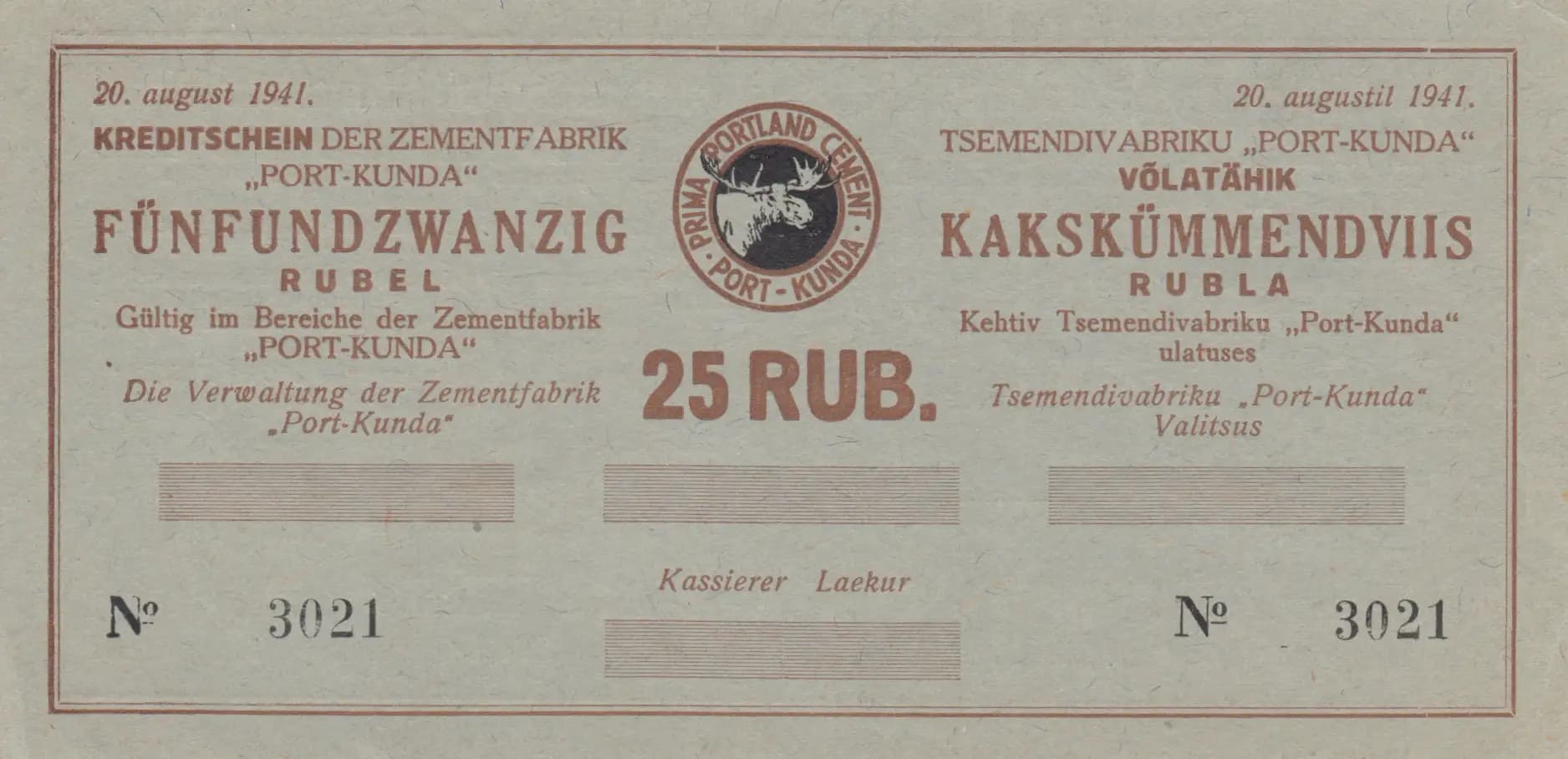
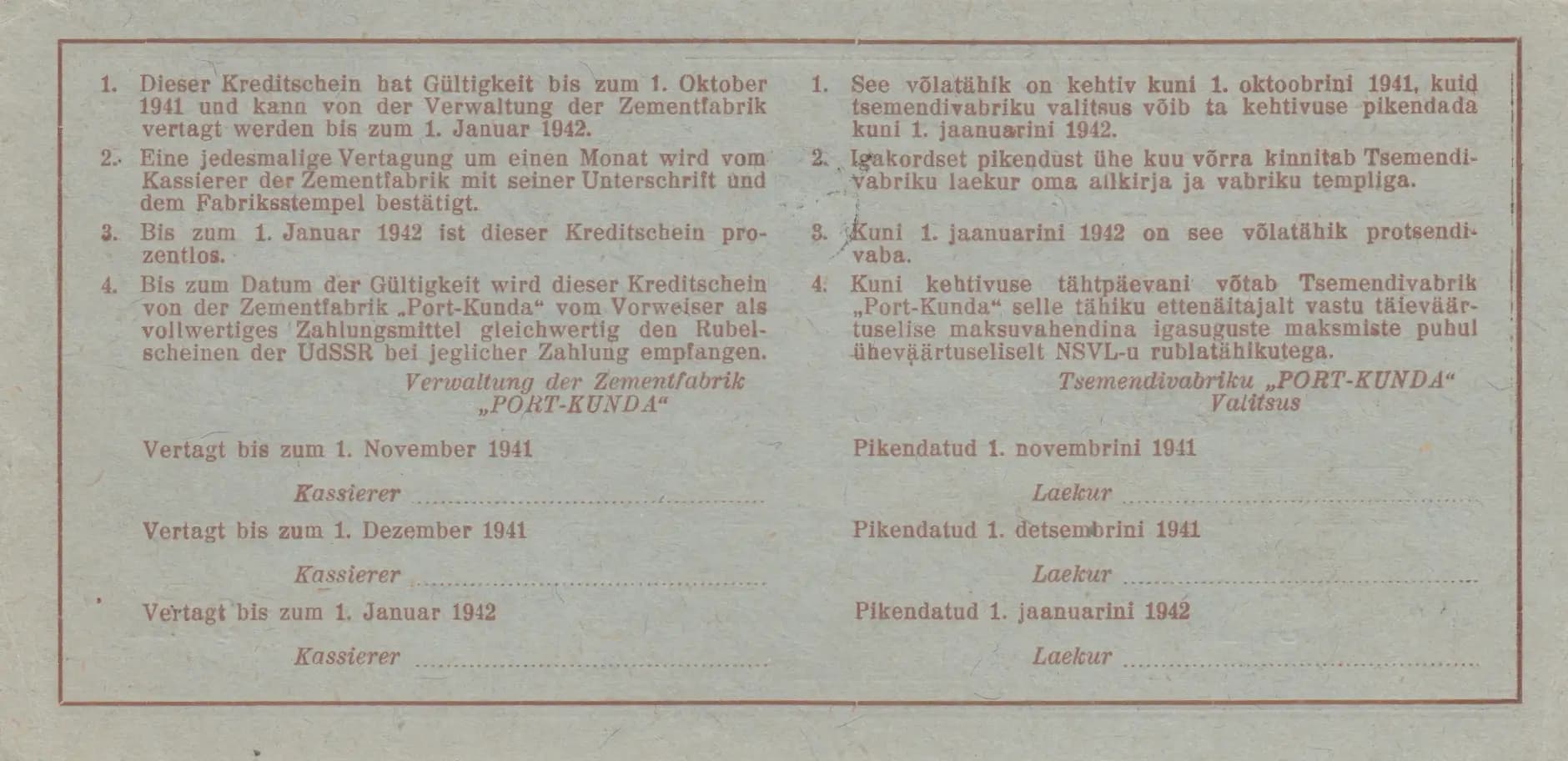
This is a scarce bilingual credit note (Kreditschein) issued by the Port-Kunda cement factory in Estonia on 20 August 1941, denominated at 25 rubles. The note features a distinctive circular emblem with a moose head and is printed in both German and Estonian, reflecting the German occupation of Estonia during World War II. In AU condition, the note displays light foxing and minor creasing consistent with historical storage, with the reverse showing three extension provision sections (November, December 1941, and January 1942) that appear to have remained unsigned, making it a fascinating artifact of wartime industrial credit currency.
Scarce. This note represents a highly specialized category of wartime occupation currency—industrial credit issued by a specific factory with limited circulation radius. The Pick catalog designation of 'P-unlisted' indicates this piece falls outside standard numismatic cataloging, suggesting limited collector recognition and small surviving population. Port-Kunda notes were issued in limited quantities for workforce compensation and local commercial transactions within the factory's operational sphere. The specific serial number 3021 and apparent lack of executed extension signatures suggest this particular example may represent mid-series production. Condition rarity is also a factor; AU examples of such fragile wartime scrip survive infrequently.
This credit note was issued during the Nazi occupation of Estonia (1941-1944), when the Port-Kunda cement factory operated under German administration. The bilingual German-Estonian text on both the obverse and reverse reflects the occupation authorities' administrative approach, while the moose emblem and 'Portland Cement' branding identify the specific industrial facility. The note's validity structure—initially to October 1941 with monthly extension provisions through January 1942—demonstrates how German occupiers managed local industrial credit and currency during wartime resource management.
The note features a bold bilingual layout emphasizing administrative legitimacy during the German occupation period. The obverse displays the denomination '25 RUB.' prominently in the center, flanked by German text on the left and Estonian text on the right. The dominant visual element is a circular emblem featuring a moose head (representing the Nordic/Baltic character of the region) with the inscription 'Portland Cement Port-Kunda' around its circumference, identifying the Port-Kunda cement factory located on the Estonian coast. The reverse contains detailed terms and conditions in parallel German and Estonian, establishing the note's validity period and extension procedures. Three sections on the reverse provide spaces for dated extensions and cashier signatures, structured for monthly renewals through January 1942. The color scheme employs brown, tan, red, and cream tones typical of early 1940s occupation-era industrial scrip. The note carries serial number 3021 in identical positions on both front and back.
FRONT: 'Kreditschein der Zementfabrik Port-Kunda' / 'Tsemendifabriku Port-Kunda Võlatähik' (Credit note of the cement factory Port-Kunda); '25 Rub.' / 'Kakskümmenviis Rubla' (Twenty-five rubles); 'Gültig im Bereiche der Zementfabrik Port-Kunda' / 'Kehtiv Tsemendifabriku Port-Kunda ulatuses' (Valid in the area of the cement factory Port-Kunda); 'Die Verwaltung der Zementfabrik Port-Kunda' / 'Tsemendifabriku Port-Kunda Valitsus' (The administration of the cement factory Port-Kunda); Serial number 'N° 3021' on both sides; Dated '20. august 1941' / '20. augustil 1941' (20 August 1941); Circular emblem inscribed 'Portland Cement Port-Kunda'. BACK: '1. Dieser Kreditschein hat Gültigkeit bis zum 1. Oktober 1941...' / '1. See võlatähik on kehtiv kuni 1. oktoobril 1941...' (This credit note is valid until 1 October 1941 and can be extended until 1 January 1942); '2. Eine jedesmälige Vertigung um einen Monat wird vom Kassierer...' / '2. Igakordset pikendust ühe kuu võrra kinnitab Tsemendifabriku laekur...' (Each monthly extension is confirmed by the cashier with signature and factory stamp); '3. Bis zum 1. Januar 1942 ist dieser Kreditschein prozentos.' / '3. Kuni 1. jaanuarini 1942 on see võlatähik protsentidvaba.' (Until 1 January 1942 this credit note is interest-free); '4. Bis zum Datum der Gültigkeit wird dieser Kreditschein... als vollwertiges Zahlungsmittel gleichwertig den Rubelschein der UdSSR...' / '4. Kuni kehtivuse tähtpäevani võtab Tsemendifabriku Port-Kunda selle täitiku ottentäitajalt vastu täielikult maksuvõimekumatele rubla-üleskirjutiste asemel...' (Until validity expiration, accepted as payment equivalent to USSR ruble notes); Three extension sections dated 'Vertagt bis zum 1. November/Dezember 1941/1. Januar 1942' / 'Pikendatud 1. novembrini/detsembrini 1941/1. jaanuarini 1942' (Extended until 1 November/December 1941/1 January 1942) with signature lines for Kassierer/Laekur (Cashier).
Letterpress printing, characteristic of wartime industrial credit note production under German occupation. The sharp legibility of the bilingual text, clear emblem definition, and consistent ink application across both sides indicate professional printing using metal type and engraved blocks. The absence of complex security features reflects the limited security requirements typical of factory-issued internal credit currency with local circulation only. No specific security printer attribution is noted in the catalog data; production likely occurred at a German-controlled print facility in Estonia or elsewhere in the occupation zone.
Serial number variety: N° 3021 (both sides). Extension state variety: This example shows the three extension provision sections on the reverse with blank signature lines and no dated stamps/signatures, indicating it represents an unextended state or was never presented for extension. The validity period structure suggests three potential extension dates (November 1941, December 1941, January 1942), and notes with different combinations of executed versus blank extensions would constitute distinct collecting varieties. No overprints or additional markings are visible in the AU condition examples examined.