25 rubla 1941
About This Note
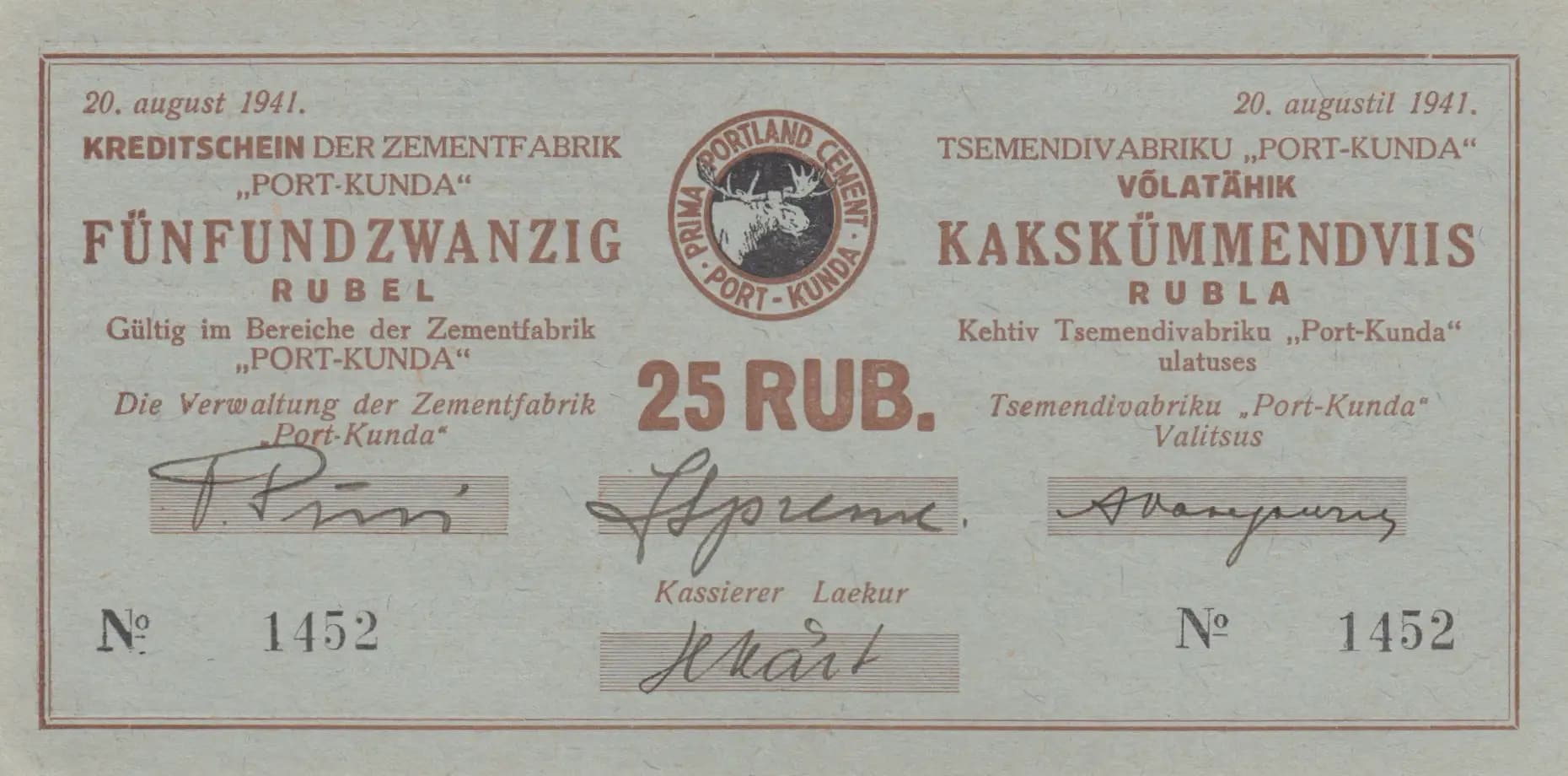
This is a 25 Rubla credit certificate (Kreditschein) issued by the Port-Kunda cement factory on 20 August 1941, presented in UNC condition with excellent preservation despite visible handling marks and administrative stamps. The bilingual German-Estonian document features a distinctive circular seal depicting a deer or elk head, the factory's emblem, and includes multiple handwritten signatures and blue/purple administrative stamps indicating its validity was extended through January 1942. This is a fascinating example of occupation-era factory scrip from Estonia during the German administration period, combining both linguistic and economic aspects of the 1941-1942 period.
Common. While this is an unlisted Pick number reflecting its status as factory scrip rather than official state currency, Port-Kunda cement factory certificates from 1941 were issued in sufficient quantities for operational purposes and multiple examples have survived. The UNC condition and complete preservation of this specimen indicate these documents were not heavily circulated as emergency currency but rather maintained as administrative records. Factory scrip from occupied Estonia, while historically interesting, was produced pragmatically for local labor and supply chain management rather than in limited quantities that would confer scarcity value. The lack of special rarity designations in numismatic literature and the straightforward nature of its issuance suggest standard production runs rather than limited emergency issues.
Issued during the Nazi German occupation of Estonia (1941-1944), this certificate represents the economic instruments used by German-controlled industrial enterprises to manage labor and payment systems. The bilingual presentation in German and Estonian reflects the administrative structure of the German occupation, while the tie to Soviet currency (rubles) indicates the complex monetary transition following the German invasion of the Soviet Union in June 1941. Port-Kunda cement factory's issuance of this scrip demonstrates how essential industrial operations maintained localized payment systems during wartime economic disruption.
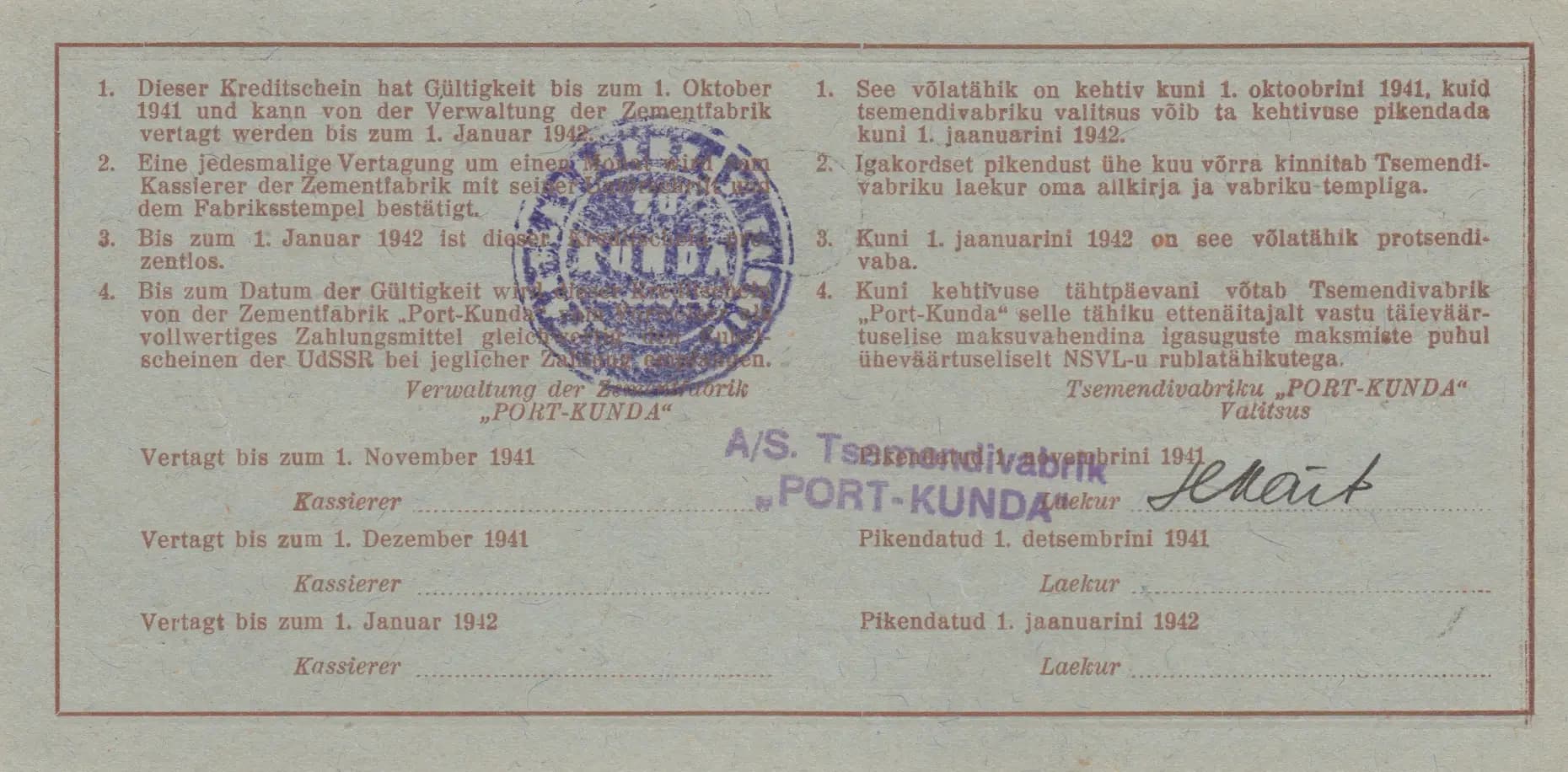
The certificate is printed on cream/beige paper in a horizontal rectangular format with bilingual text layout (German left column, Estonian right column). The front displays a prominent circular seal/logo at the center featuring a stylized deer or elk head with 'PORT-KUNDA CEMENT PORTLAND CEMENT' text encircling the perimeter—this is the principal identifying symbol of the Port-Kunda cement factory. The denomination '25 RUB.' is displayed prominently in the center in both numeric and spelled-out forms ('Fünfundzwanzig Rubel' and 'Kakskümmenviis Rubla'). The document contains spaces for multiple handwritten signatures from the cashier (Kassierer/Laekur) and administration officials. The reverse side presents the terms and conditions in matching bilingual format with four numbered clauses detailing validity periods, extension procedures, interest-free status, and acceptance as payment equivalent to Soviet rubles. The certificate includes a serial number (N° 1452) and date of issuance (20 August 1941). Administrative stamps and repeated extension dates in handwriting demonstrate actual use and validity extensions through early 1942.
FRONT SIDE: 'Kreditschein der Zementfabrik Port-Kunda' / 'Tsemendivabriku Port-Kunda Võlatähik' (Credit certificate of the cement factory Port-Kunda); 'Fünfundzwanzig Rubel' / 'Kakskümmenviis Rubla' (Twenty-five rubles); '25 RUB.' (25 rubles); 'Gültig im Bereiche der Zementfabrik Port-Kunda' / 'Kehtiv Tsemendivabriku Port-Kunda ulatuses' (Valid within the area of the cement factory Port-Kunda); 'Die Verwaltung der Zementfabrik Port-Kunda' / 'Tsemendivabriku Port-Kunda Valitsus' (The administration of the cement factory Port-Kunda); 'Kassierer' / 'Laekur' (Cashier); 'N° 1452' (Serial number 1452); '20. august 1941' (20 August 1941). BACK SIDE: Terms and conditions in four numbered points: (1) 'This credit certificate is valid until 1 October 1941 and can be deferred by the cement factory administration until 1 January 1942' / 'This credit certificate is valid until 1 October 1941, but the cement factory administration may extend its validity until 1 January 1942'; (2) 'Each deferral by a cashier of the cement factory must be confirmed with factory stamp' / 'Each extension by one month by the factory cashier must be completed with factory seal'; (3) 'Until 1 January 1942 it is interest-free' / 'Until 1 January 1942 this credit certificate is interest-free'; (4) 'Until the date of validity, it will be accepted by the cement factory Port-Kunda as full value payment means equal to that of the USSR for any payment' / 'Until the validity deadline, the cement factory Port-Kunda accepts it from the bearer as full-value payment means for any payments equal to USSR rubles'; Multiple handwritten deferral notations: 'Vertagt bis zum 1. November 1941' (Deferred until 1 November 1941), 'Vertagt bis zum 1. Dezember 1941' (Deferred until 1 December 1941), 'Vertagt bis zum 1. Januar 1942' (Deferred until 1 January 1942), and corresponding Estonian versions.
Letterpress printing on cream/beige paper stock, evidenced by the crisp impression of text and the circular seal. The bilingual layout suggests professional commercial printing, likely executed by a German or Estonian printer operating under German administration in 1941. The consistent quality of the printed text and seal indicates industrial printing capability typical of German-controlled Estonian enterprises during the occupation period. Handwritten signatures, dates, and stamps were applied individually to each certificate during issuance and subsequent extensions, as documented by the multiple blue/purple administrative stamp impressions and handwritten deferral notations visible on this specific example.
This specific example is serial number 1452, dated 20 August 1941. The certificate exhibits handwritten extensions dated through 1 January 1942, with evidence of multiple deferral stamps applied at different periods (November, December 1941, and January 1942). Varieties of this issue would be distinguished by serial numbers and the specific pattern of extension stamps applied. The handwritten nature of individual extensions and signatures means each certificate presents a unique combination of deferral dates and administrative markings. No known variants of printed design elements have been documented for this unlisted issue.