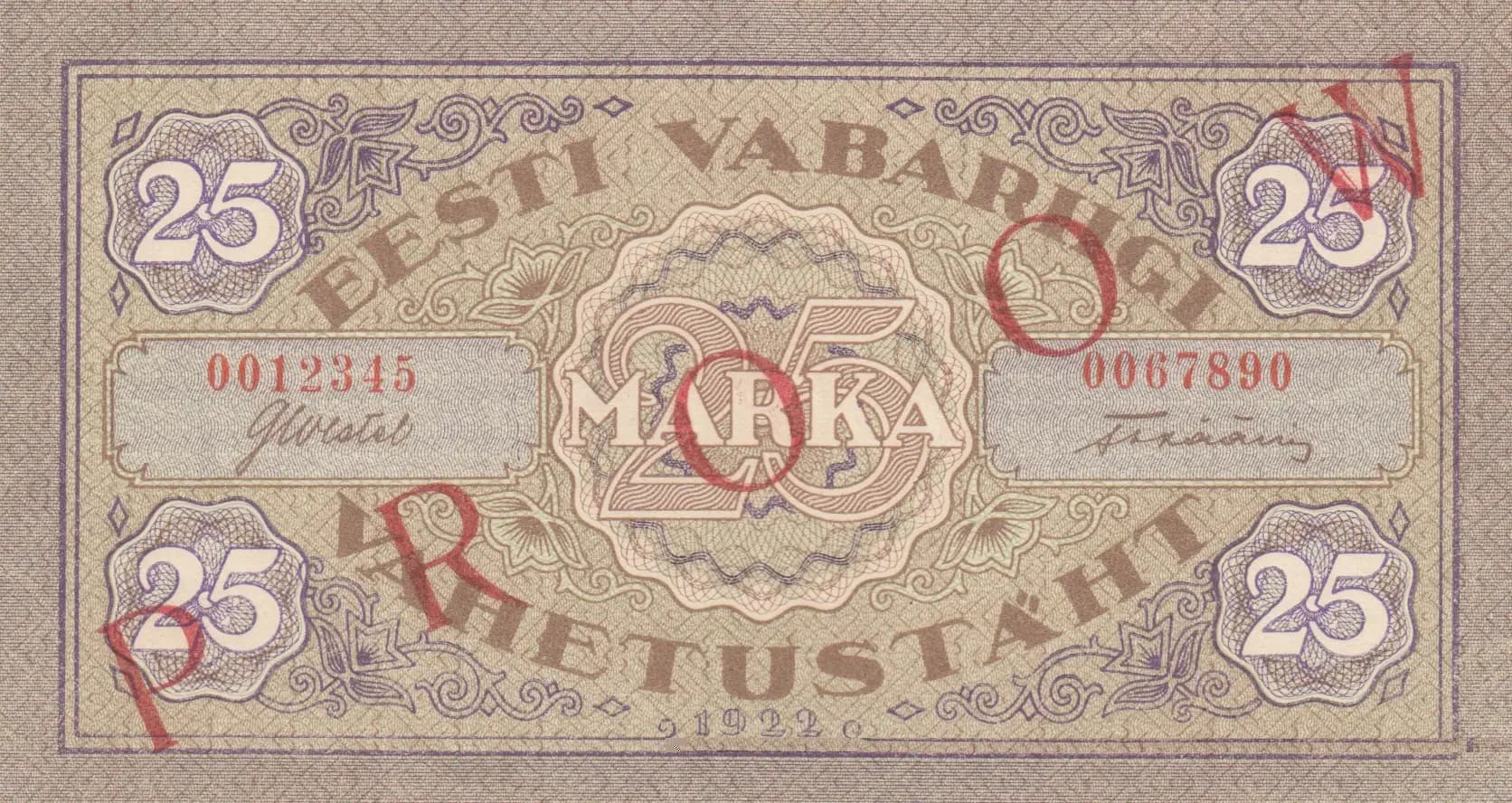
25 marka 1922 specimen, uniface
About This Note
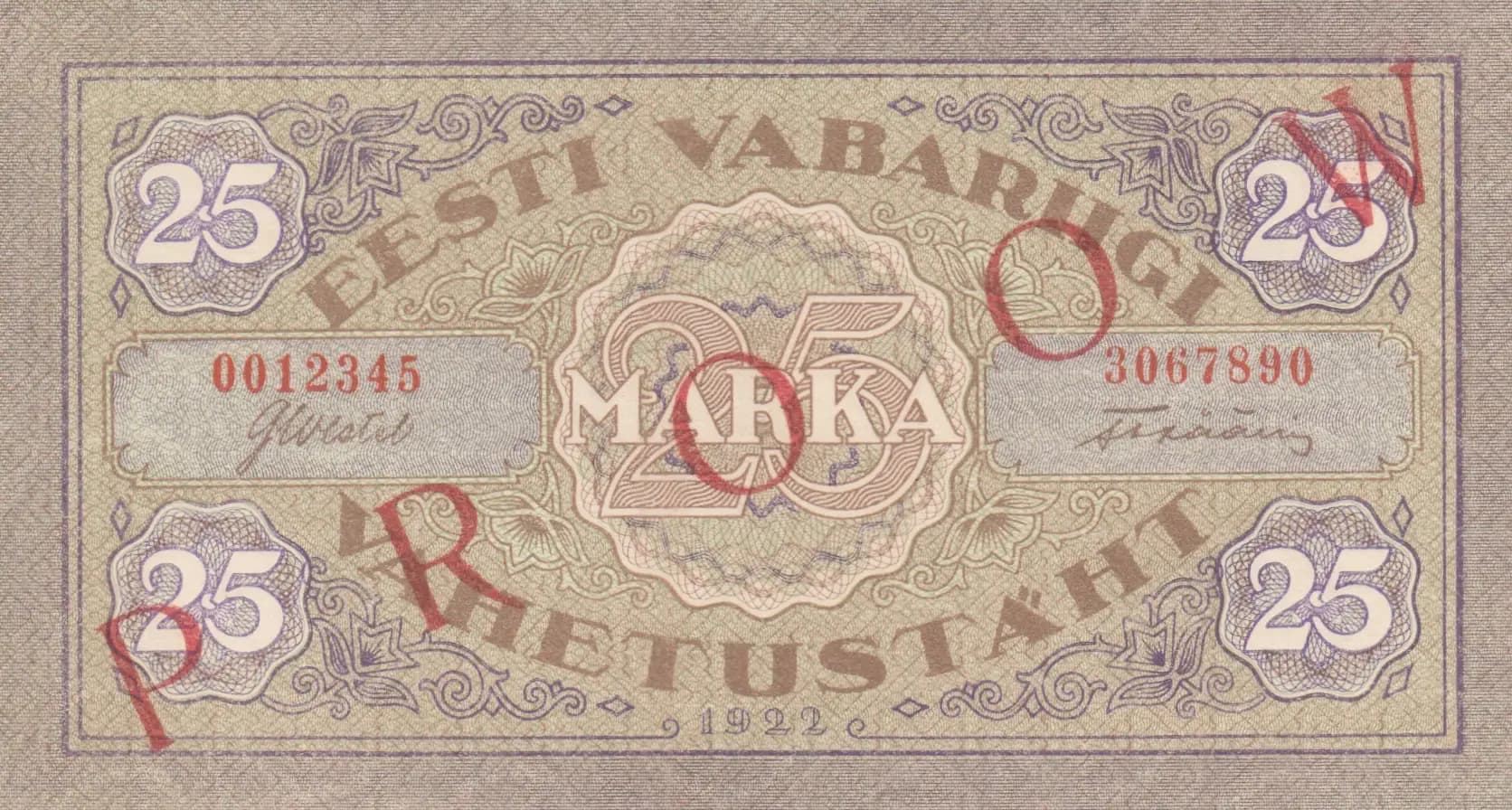
This is a 1922 Estonian 25 Marka specimen banknote featuring an ornate baroque-style design with elaborate scrollwork borders and decorative corner frames. The note displays characteristic red specimen markings across the face and shows period-appropriate aging with fading and discoloration throughout. As a uniface specimen note (front printed only), this represents an early example of Estonia's independent currency during the interwar period, making it historically significant for collectors of Baltic and early 20th-century European currency.
Common. While specimen notes and early Estonian currency issues have collector interest, the 1922 25 Marka was part of a substantial initial issue by the Treasury of Estonia. The specimen designation and uniface nature indicate this was a presentation or archival sample rather than a circulation rarity. No historical evidence suggests an exceptionally limited print run or recall that would elevate this to scarce or rare status. The UNC condition grade is consistent with specimen preservation rather than exceptional rarity.
The 1922 25 Marka note was issued during Estonia's first years of independence following the collapse of the Russian Empire and the Treaty of Tartu (1920). The ornamental design with Estonian inscriptions 'Pesti Vara' (part of 'Pesti Vabariigi' - Estonian Republic) and 'Rahvuse' (relating to the nation/people) reflects the new nation's desire to assert cultural and financial sovereignty through distinctly Estonian iconography and language. This early specimen represents the Treasury of Estonia's initial currency efforts before the subsequent devaluation and redenomination that would follow in the 1920s.
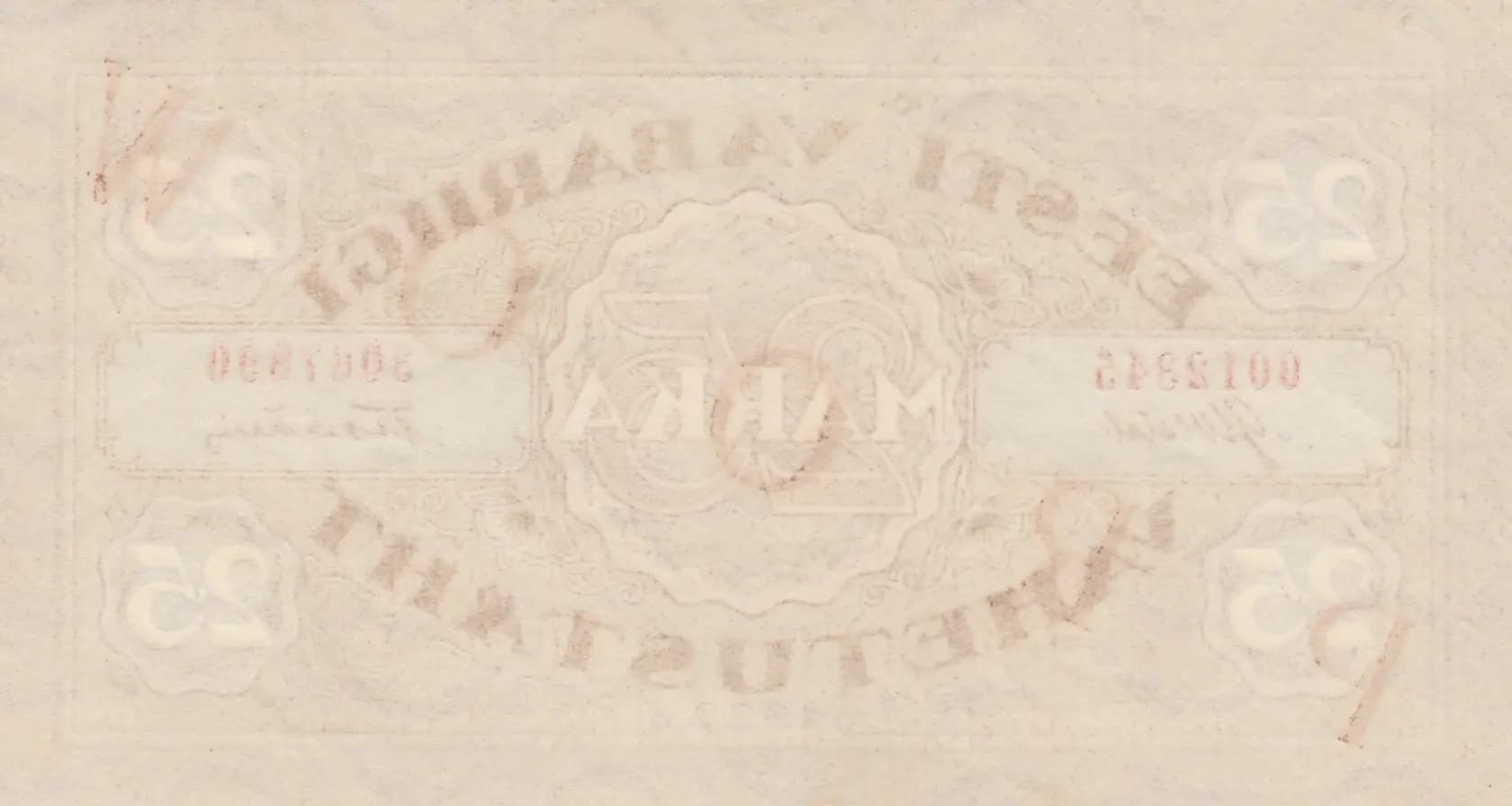
The obverse features a highly ornamental layout typical of early 20th-century central European banknotes, with baroque-style decorative elements dominating the composition. The denomination '25' appears in ornate frames positioned in all four corners, with an additional large oval medallion containing the numeral 25 centered on the note. Elaborate scrollwork borders and fine engraved line work frame the entire design. The reverse side is predominantly blank with only a faint central ornamental oval medallion and minimal additional elements, consistent with uniface specimen printing. The design includes no portraits or specific landmarks but relies entirely on geometric and floral ornamental symbolism to convey authority and security.
Front side: 'PESTI VARA' (part of 'Eesti Vabariigi' - Estonian Republic), 'RAHVUSE' (of the nation/people), '25' (denomination), '1922' (year of issue), serial numbers '0012345' and '30067890'. Back side: Serial numbers '0012345' and '0653100' in red text. All inscriptions are in Estonian, the official language of the newly independent Estonian state.
Intaglio engraving (recess printing), characteristic of banknote production in this era. The fine line work, detailed scrollwork patterns, and ornamental frames visible in the images are consistent with steel plate engraving. The uniface printing (front only) and embossed/lightly printed reverse suggest specimen production using reduced security measures compared to circulation notes. The printer for this issue was likely a European security printer specializing in Baltic currencies, though specific attribution from visual characteristics alone is limited.
This is identified as Pick P-54as3, where the 's' designation indicates 'specimen' status and the '3' likely denotes a specific variety within the specimen printings. The visible serial numbers (0012345 / 30067890 on obverse, 0012345 / 0653100 on reverse) suggest this may be a low-numbered specimen sample. The red specimen markings/stamps across the face are characteristic of archival or presentation specimens and distinguish this from circulation examples. No other known major varieties are noted from visual analysis, though other serial number ranges or printing sessions may exist.