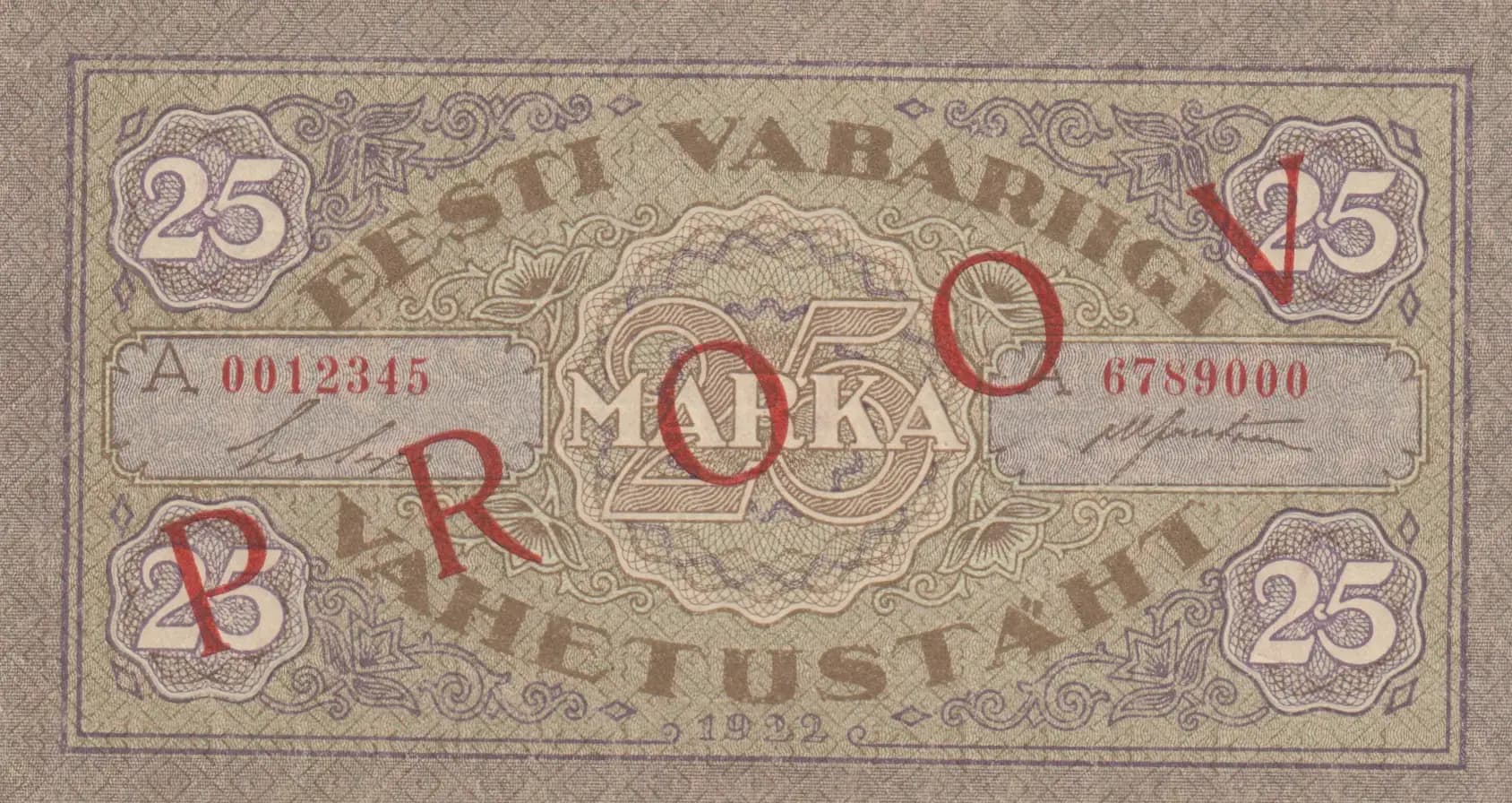
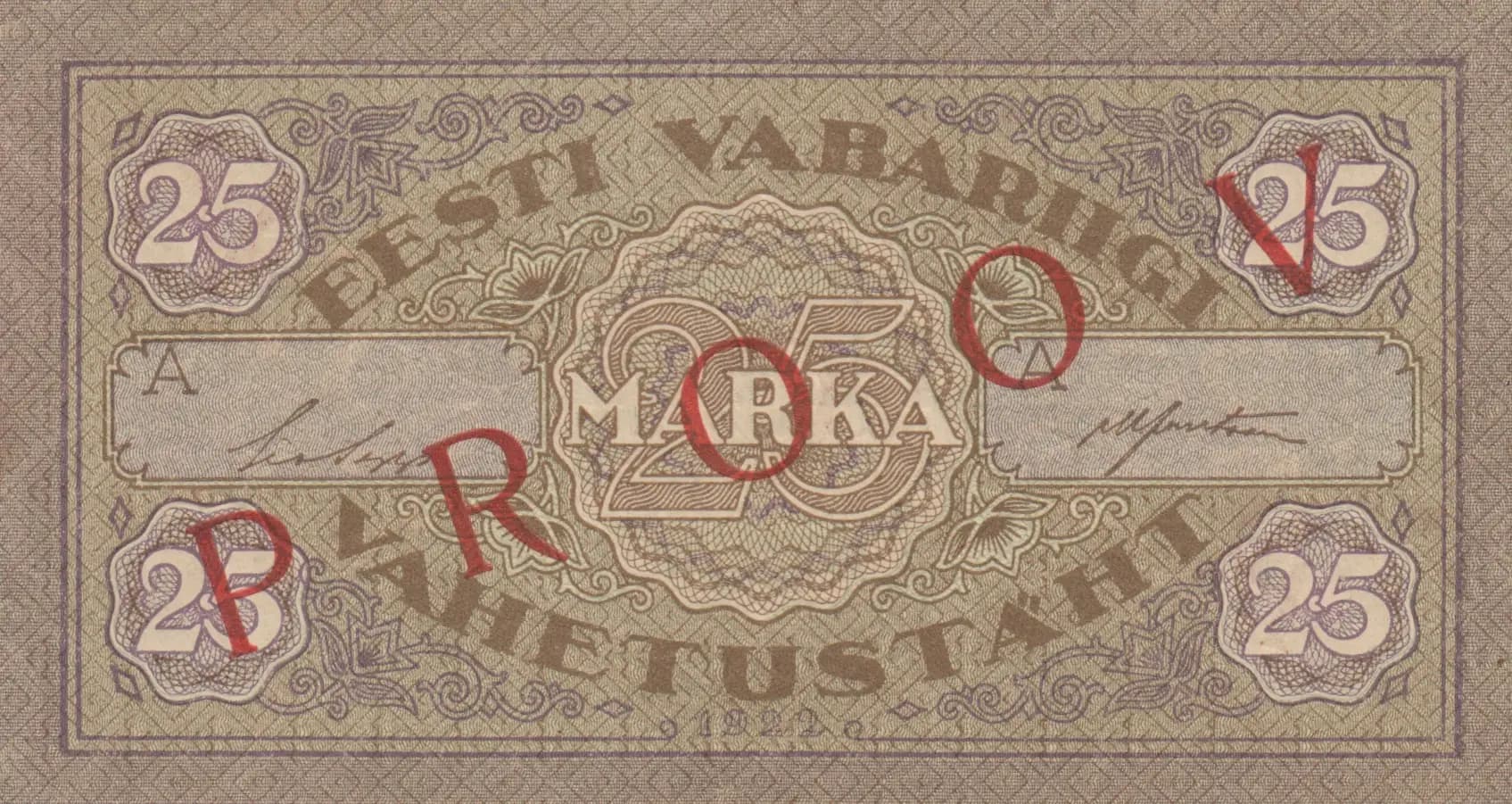
25 marka 1922 specimen
About This Note
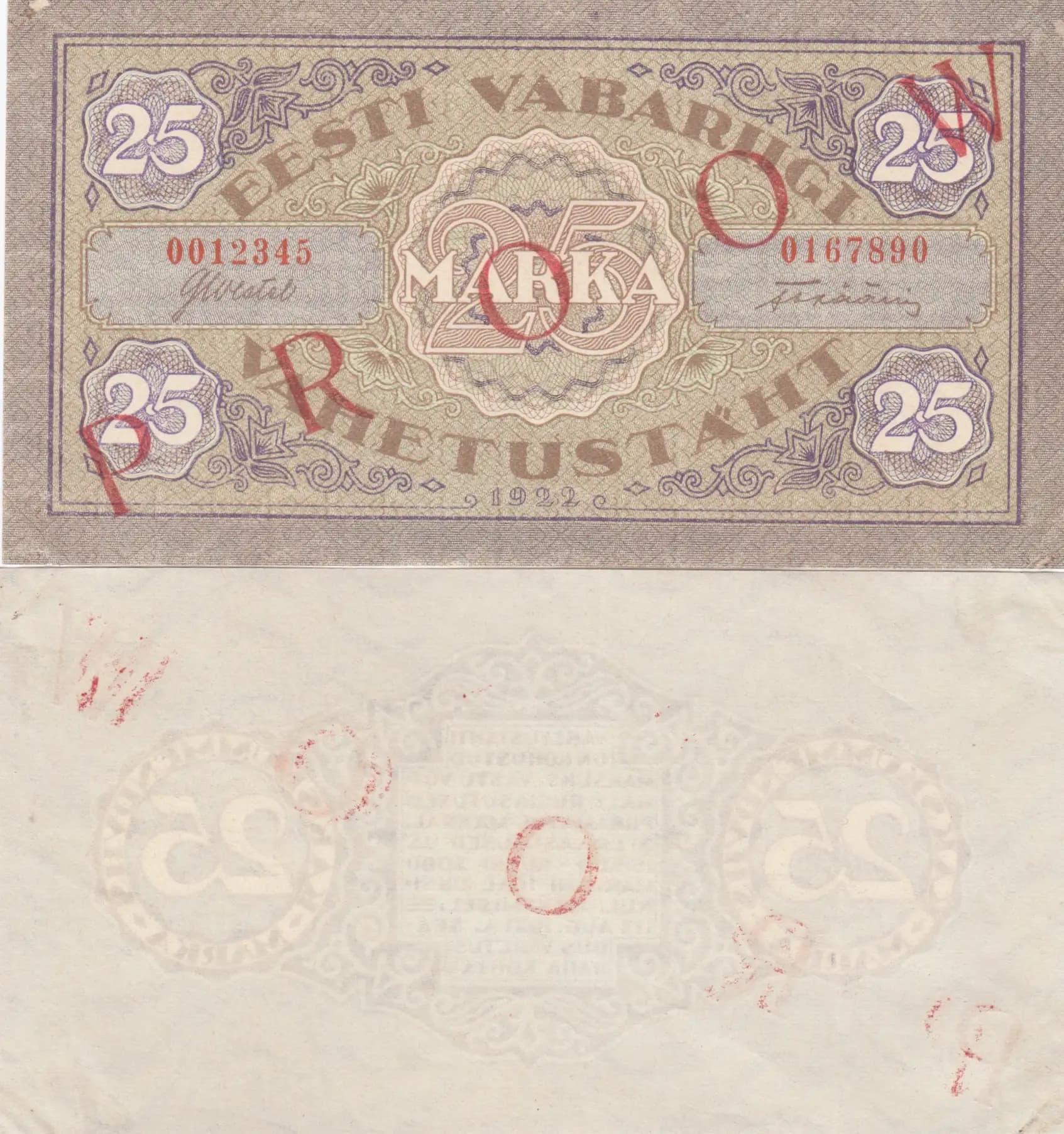
This is a 25 Marka specimen note from Estonia's Treasury, dated 1922, representing an early issue from the newly independent Estonian Republic. The note features an elegant Art Nouveau design with ornate lavender-tinted corner numerals, a central circular rosette, and red "SPECIMEN" and "FACSIMILE" overprints typical of reference/archival examples. In AU condition, this specimen displays the cream-beige patina characteristic of 1920s-era Estonian currency with minimal wear, making it an attractive example of interwar Baltic numismatics.
Common. This specimen note, while historically significant as an early Estonian emission, was produced in standard quantities typical of 25 Marka denominations from 1922. Specimen notes were deliberately produced in larger numbers than regular circulation issues for reference and archival distribution, making them more readily available to modern collectors. While early Estonian currency is collectible, the 25 Marka denomination from 1922 does not have a restricted print run history or documented scarcity. AU condition specimens are desirable but not rare in the current collector market.
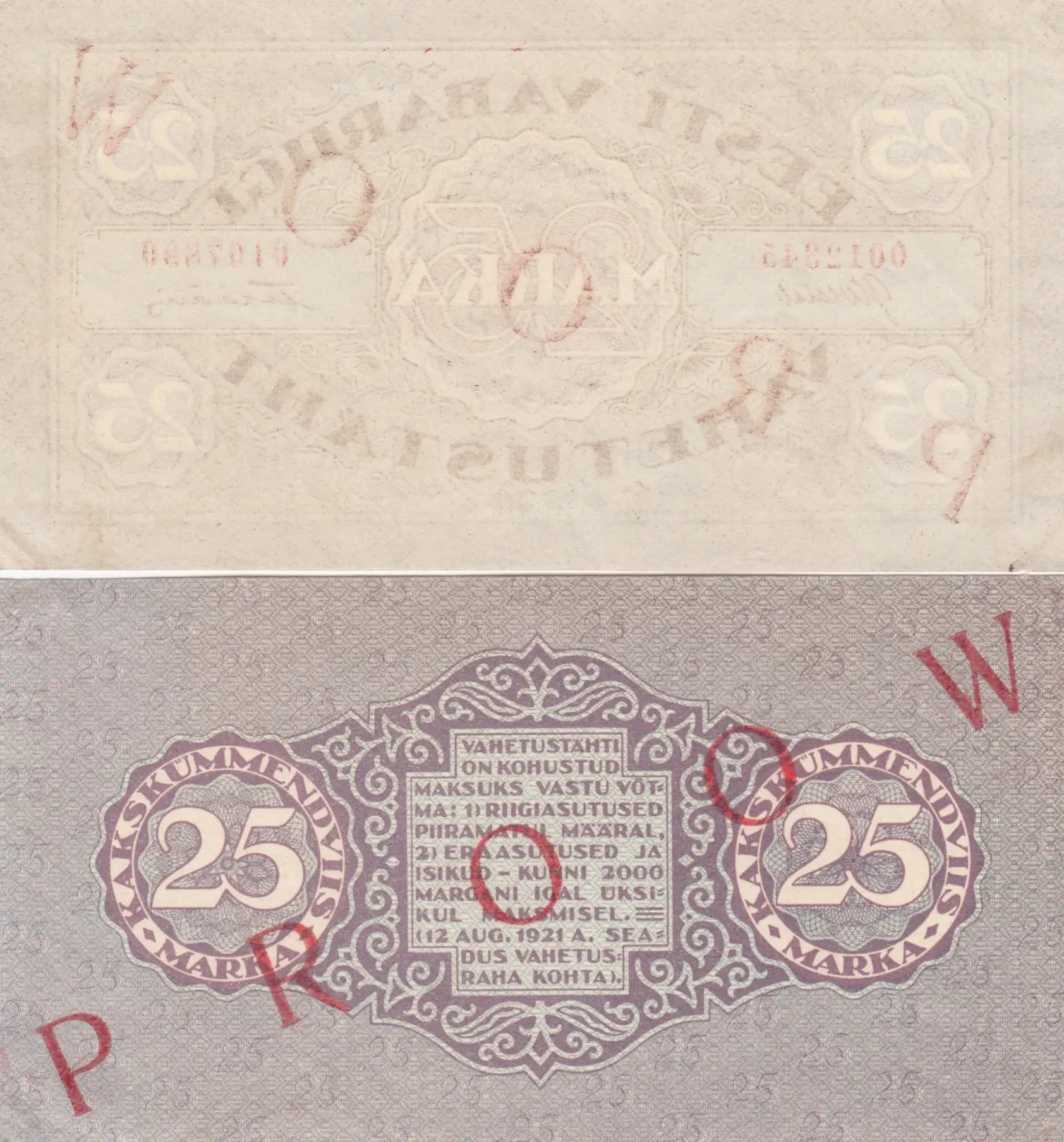
The 25 Marka banknote was issued in 1922 by the Treasury of the newly established Estonian Republic, following independence from the Russian Empire in 1918. The note's reverse contains legal text dated August 12, 1921, regulating exchange periods and payment acceptance limits, reflecting Estonia's efforts to establish stable monetary institutions during a period of significant economic reorganization. The ornate, classical design aesthetic reflects the aspirations of a young nation to project legitimacy and financial stability through sophisticated currency design.
The 25 Marka note employs a classical European banknote design aesthetic prevalent in the 1920s, with no portraits but rather symbolic ornamentation. The front features prominent corner numerals in purple/lavender tint within decorative frames, a central circular rosette medallion (likely containing heraldic or national symbolism), and extensive ornamental scrollwork and floral patterns throughout. The reverse maintains symmetrical design with large circular corner ornaments containing the denomination, framed by an ornamental border in brown and gray tones. The central element is a rectangular cartouche containing legal text in Estonian, establishing this as a formally authorized issue by the state treasury. The cream/beige paper tone and purple/brown color scheme are consistent with period printing practices. The overall design reflects Art Nouveau and classical influences typical of early 20th-century European currency design.
FRONT SIDE: Principal denomination marking "25" appears in corner numerals and central circular design. English-language phrase "IN GOD WE TRUST" is printed diagonally across the obverse. Red overprints read "SPECIMEN" and "FACSIMILE" identifying this as reference material. Serial numbers "0012345" (left) and "0167890" (right) are printed in red. Year "1922" appears on the note. BACK SIDE: Denomination "25 MARKA" is prominently displayed in corner ornaments. Central cartouche contains Estonian legal text: "EESTI VABARIIGI RIIGIKASSA" (State Treasury of the Estonian Republic). Regulatory text reads: "VAHETUS TÄHTAEG ON KOHUSTUD MAKSUS VASTUV[õtt]" (Exchange period is compulsory for payment acceptance). Additional legal provisions specify: "1) PRIIGIASUITUD DHRA MASSAL" [institutional provisions] and "2) ERAASUITUD JA ISIKLE - KUNI 2000 MARKNI" (For individuals - up to 2000 Marks). Reference to "12 AUG. 1921 A. SEA... DUS VAHETUS-RAHA KOHTA" (12 August 1921 Law regarding exchange money).
Based on the visual characteristics—fine ornamental detail, complex scrollwork patterns, precise corner numerals, and layered color application—this note was produced using intaglio (engraved) printing, the standard security printing method for banknotes of this era. The red overprints "SPECIMEN" and "FACSIMILE" appear to be applied as a secondary printing step, typical of specimen notes prepared for reference and distribution to banks and financial institutions. The printer for Estonian 1922 issues is believed to be Reichsdruckerei (Berlin) or another established European security printer, though this specific variety's printing source is not definitively established from visual analysis alone.
This is cataloged as Pick 54as1, identifying it as a specimen (s suffix) of the standard 1922 design. The red "SPECIMEN" and "FACSIMILE" overprints with sequential serial numbers "0012345" and "0167890" (appearing as test/demonstration numbers) confirm this as a specimen variety rather than a circulating issue. The overprint pattern and serial numbering scheme are consistent with specimen issues from this period. No signature varieties or date variants are evident in the visual analysis. This specimen represents the primary documented variety for the 25 Marka 1922 issue in major catalogs.