25 marka 1919 pair
About This Note
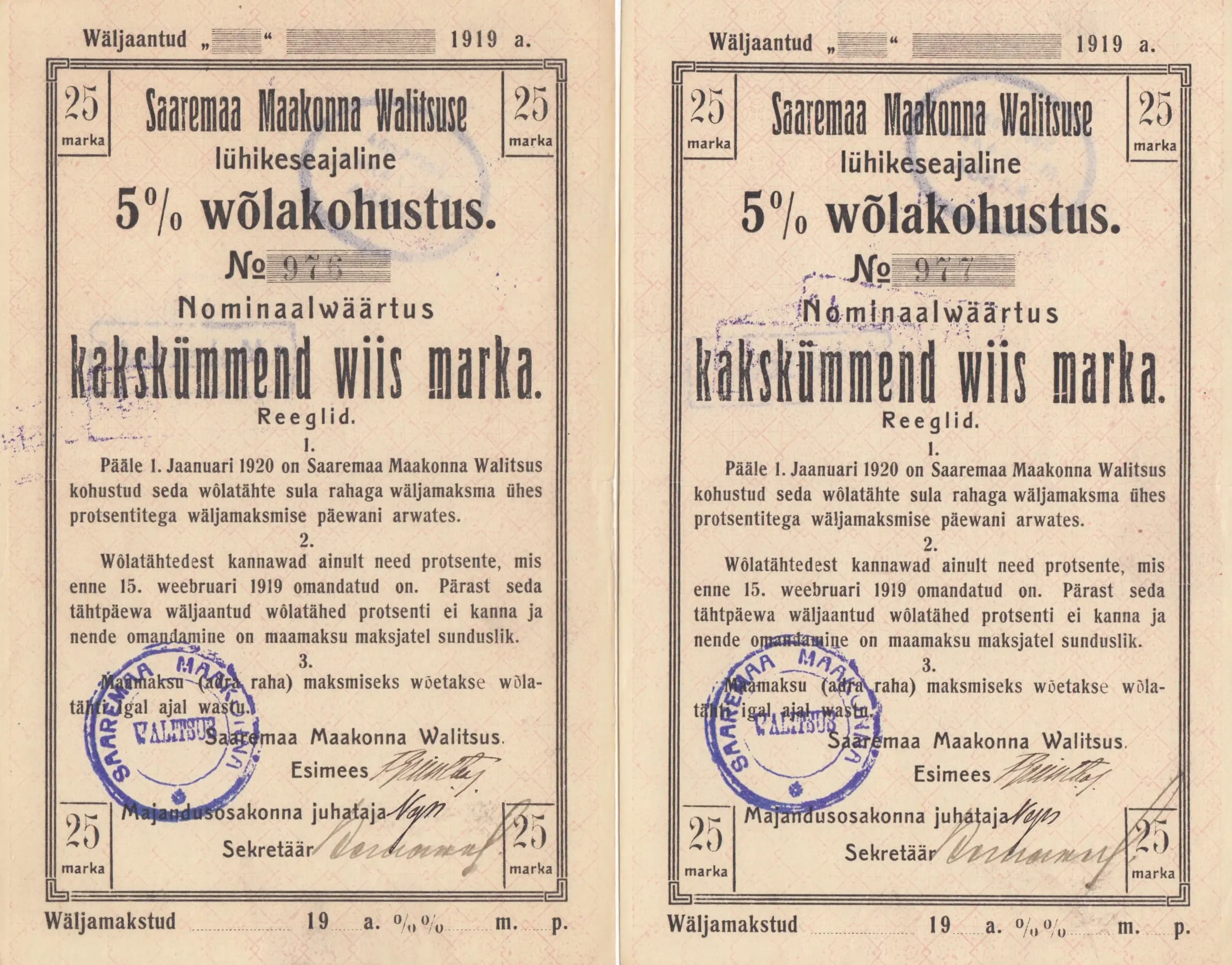
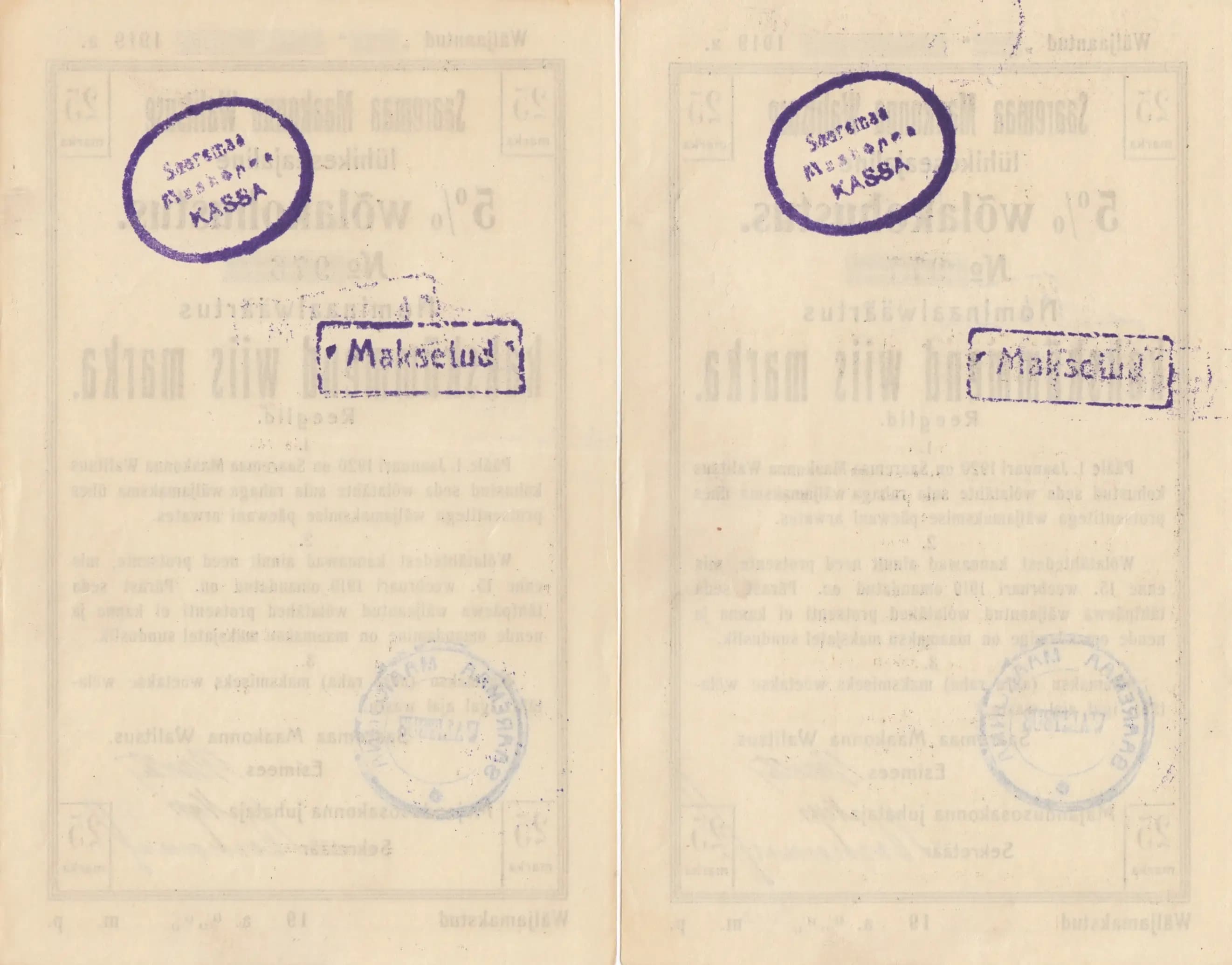
A 25 marka short-term debt obligation issued by the Saaremaa County Government in 1919, featuring Estonian-language text and official seals from both the county government and treasury. The note exhibits appropriate aging for a 1919 issuance with yellowing, foxing, and water stains throughout, consistent with AU condition. The presence of handwritten signatures, serial number 97F, and dual official stamps (one circular reading 'WALITSUSE' on the front and 'Saaremaa Maakonna Kassa' on the back) demonstrates its authentic administrative character as a regional emergency currency during Estonia's early independence period.
Uncommon. As an unlisted Pick number issued by a regional county government (Saaremaa) rather than the central Estonian government or a major private bank, this note had a limited circulation area and print run. The specific nature as a short-term debt obligation with defined redemption terms (payable by January 1, 1920) means many notes were likely redeemed and removed from circulation. The AU condition grade is favorable for survival, as these regional issues often saw heavy handling and poor storage. Regional Estonian government debt obligations from 1919 are less commonly encountered in collections than central government currency, supporting an 'uncommon' rather than 'common' assessment.
This promissory note represents the financial instruments issued by Saaremaa County during the critical transition period of 1919, when Estonia was establishing independence and regional governments were managing local economies during currency shortages. The note's terms—offering 5% interest payable from January 1, 1920, and acceptance for land tax payments—reflect the pragmatic monetary solutions employed by provincial authorities before centralized Estonian national currency stabilization. The inscription 'Päale 1. Jaanuari 1920' (From 1 January 1920) indicates this was issued as a temporary measure, with the county government obligating itself to redeem the notes in actual currency within a defined timeframe.
The note employs a straightforward administrative design typical of emergency currency from the early Estonian independence period. The front features a simple rectangular border frame with corner ornaments in black ink on cream-colored paper. The denomination '25 marka' appears prominently in the top left and right corners. The central area is dominated by the official conditions of the debt obligation, printed in black ink in Estonian language using the German-influenced spelling conventions of the period ('Walitsus' for government, 'wõlakohustus' for debt obligation). A large circular official seal stamp reading 'WALITSUSE' appears in the upper center area, printed in blue ink. Three signature lines are provided at the bottom for the Chairman, Head of Economics Department, and Secretary. The back is predominantly blank except for two official stamps: a circular seal reading 'Saaremaa Maakonna Kassa' (Saaremaa County Treasury) in the upper portion and a rectangular stamp labeled 'Makselud' (Payments) in the center-right area, both in blue/purple ink. The note contains no portraits or landmarks, relying instead on official seals and administrative text for authority.
FRONT SIDE: '25 marka' (25 marks) - denomination; 'Saaremaa Maakonna Walitsuse lühikesajaline 5⁰/₀ wõlakohustus' (Saaremaa County Government short-term 5% debt obligation); '№ 97F' (serial number); 'Nominaalwäartus kakskümmmend wiis marka' (Nominal value twenty-five marks); 'Reeglid' (Rules); 'Päale 1. Jaanuari 1920 on Saaremaa Maakonna Walitsus kohustud seda wõlatähte sula rahaga wäljamaksma ühes protsentiega wäljamaksimise päewani arwates' (From 1 January 1920 onwards, Saaremaa County Government is obliged to pay this promissory note in cash, together with one percent interest from the date of payment); 'Wõlatähtedest kannawad ainult need protsente, mis enne 15. weebruari 1919 omandatud on. Pärast seda tähtpäewa wõlatähed protsenti ei kanna ja nende omandamine on maamaksu maksjatel sunduslik' (Promissory notes carry interest only if acquired before 15 February 1919. After this date, promissory notes do not carry interest and their acquisition is mandatory for land taxpayers); 'Maamaksu (arra raha) maksmiseks wõetakse wõlatähte igal ajal wascu' (Promissory notes are accepted at any time for payment of land tax/advance payment); 'Saaremaa Maakonna Walitsus' (Saaremaa County Government); 'Esimees' (Chairman); 'Majandussakonna juhataja' (Head of Economics Department); 'Sekretäär' (Secretary); 'Wäljamakstud' (Issued); '19 a. ⁰/₀₀ m. p.' (19 [year] [month/date]). BACK SIDE: 'Saaremaa Maakonna Kassa' (Saaremaa County Treasury); 'Makselud' (Payments).
Letterpress printing on cream-colored bond paper, with the primary text and denomination figures printed in black ink. Official seals and stamps applied in blue ink, likely using rubber stamps or official seal dies. Handwritten signatures in manuscript form. The printing quality and technique are consistent with small-scale regional government printing operations of 1919 Estonia, rather than centralized banknote printing facilities. No security printer attribution is listed in available catalogs for this Pick unlisted issue.
Serial number 97F observed on this note. As an unlisted Pick catalog item, comprehensive variety information for serial number ranges, signature combinations, and printing dates is not systematically documented. The date notation '19 a. ⁰/₀₀ m. p.' appears to indicate issuance in 1919, likely in one of the numbered months (⁰/₀₀ suggesting a handwritten month fill-in). Collectors should note variations in handwritten dates, signature combinations among the three required officials (Chairman, Economics Head, Secretary), and potentially different circular seal impressions reflecting different treasury issuances. The pair designation in the catalog data suggests this lot represents two separate notes with potentially different serial numbers.