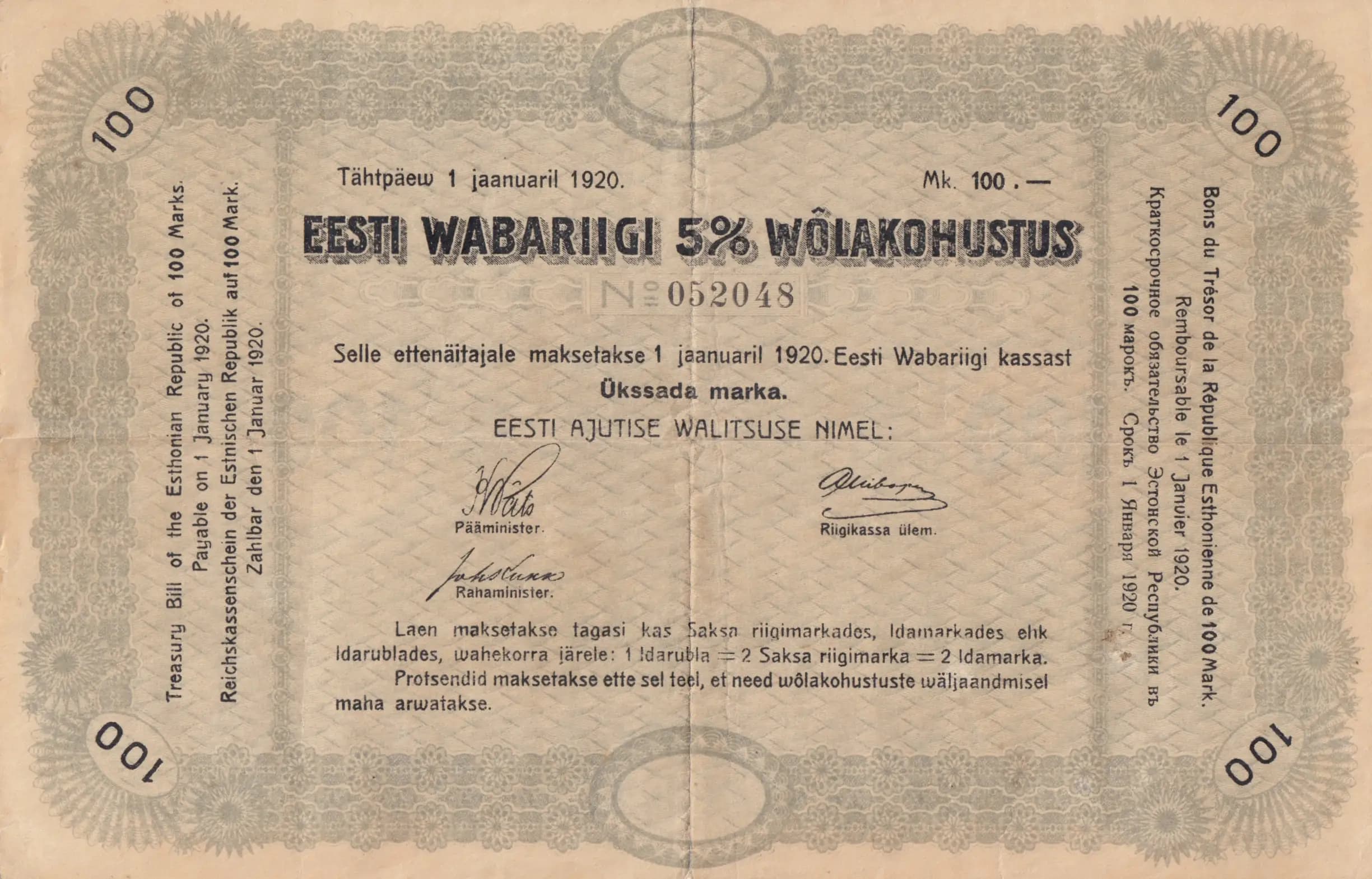
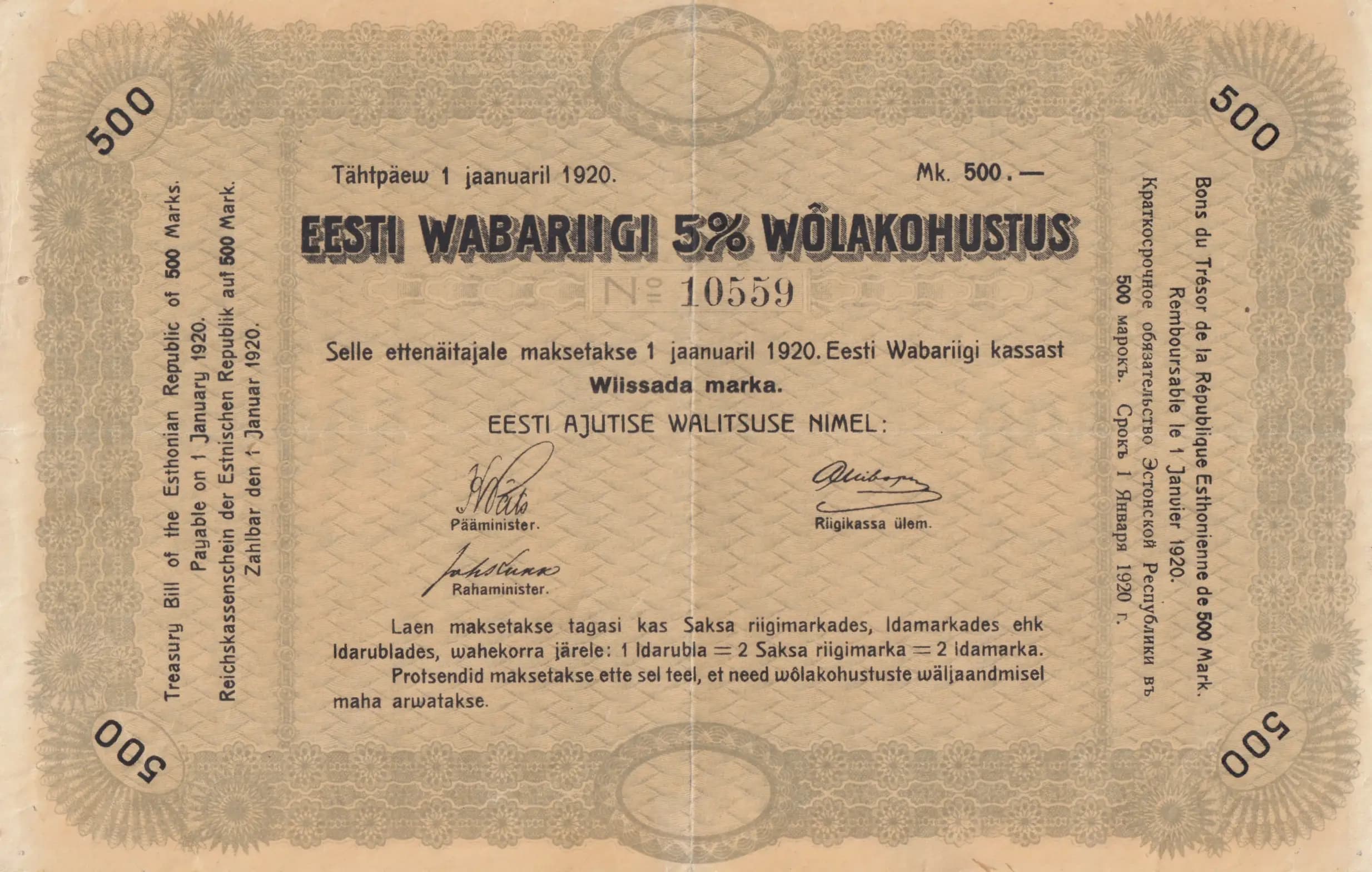
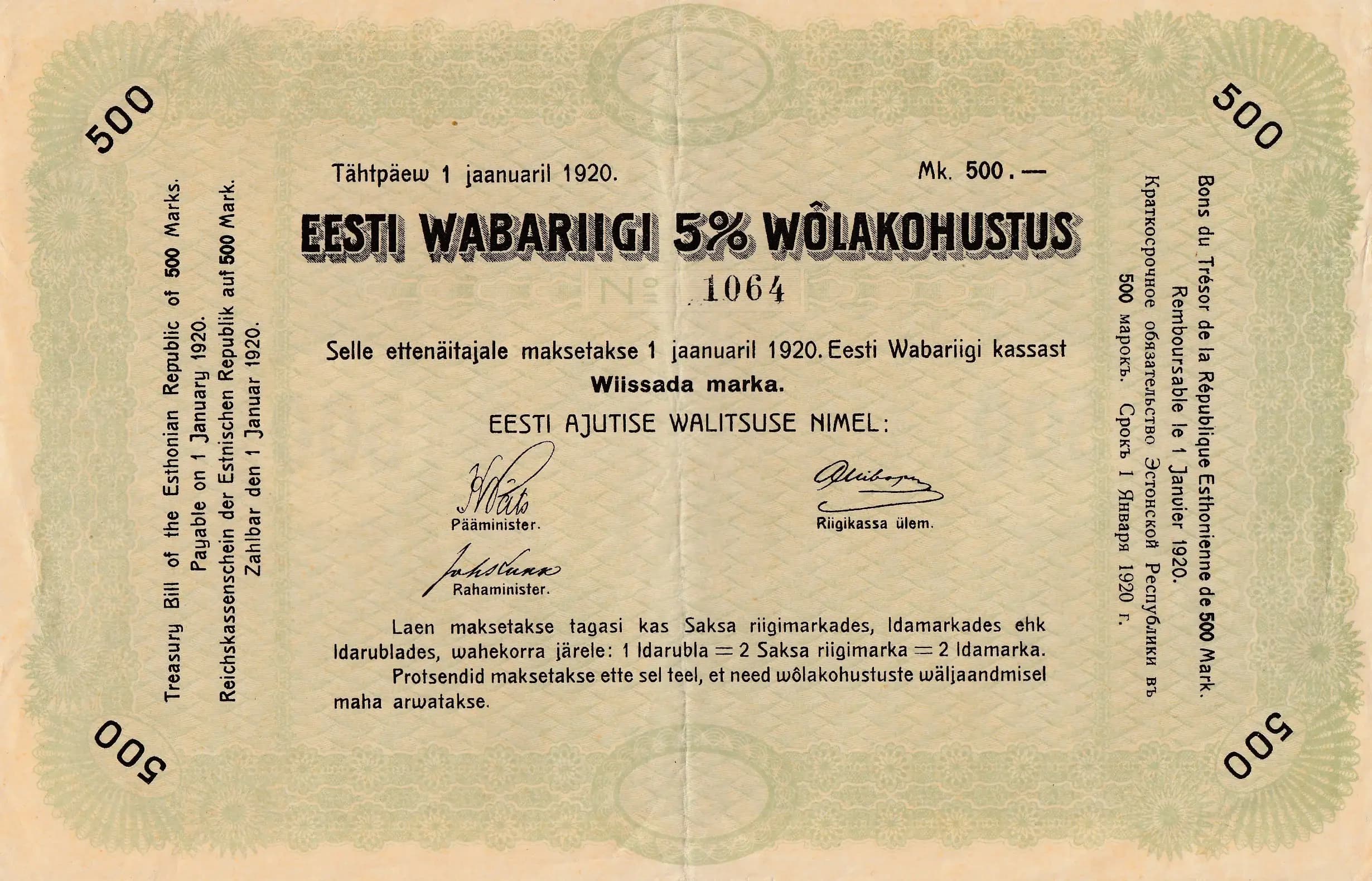
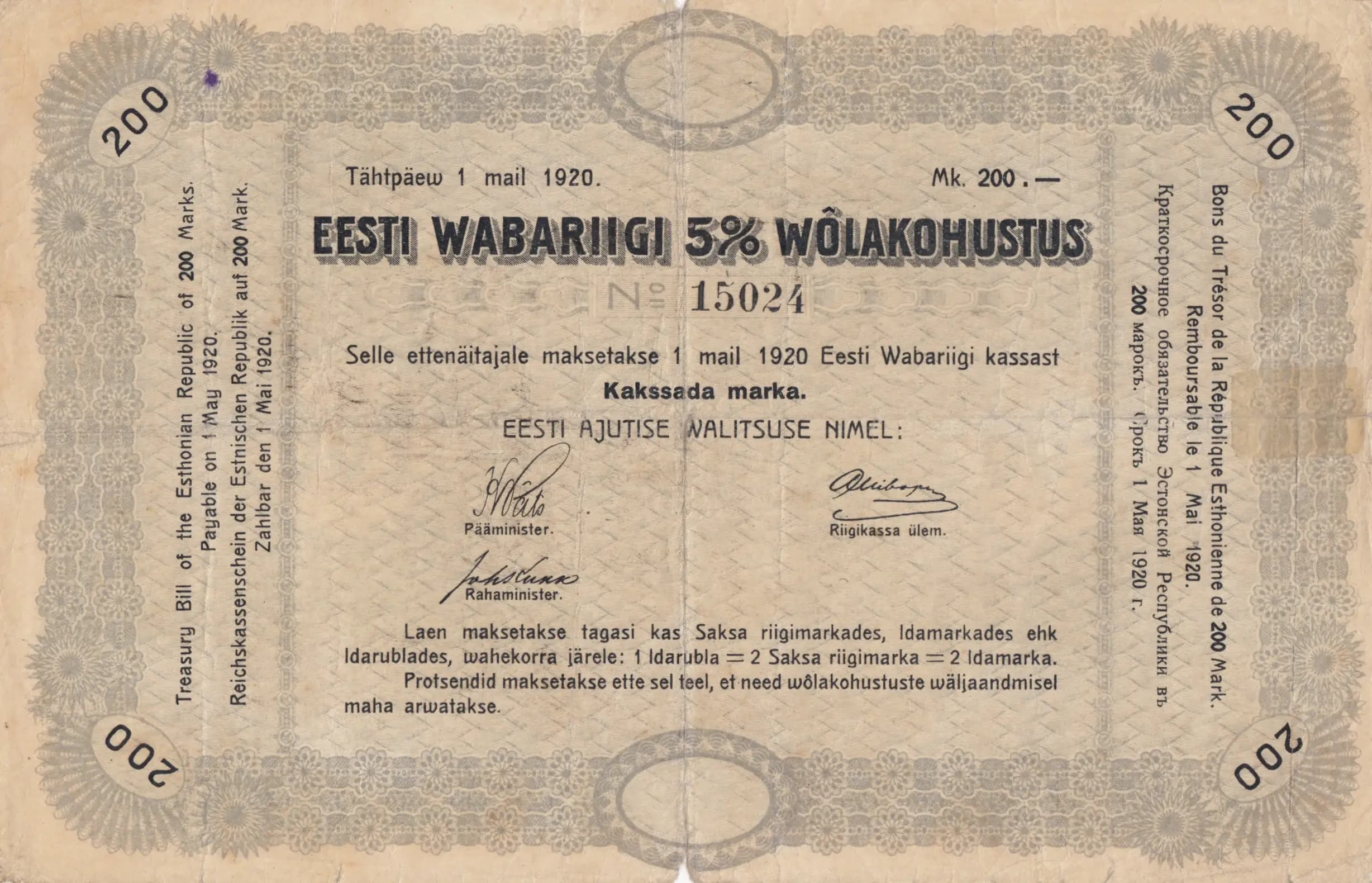
200 marka 1919
“serie A”
Market Prices
About This Note
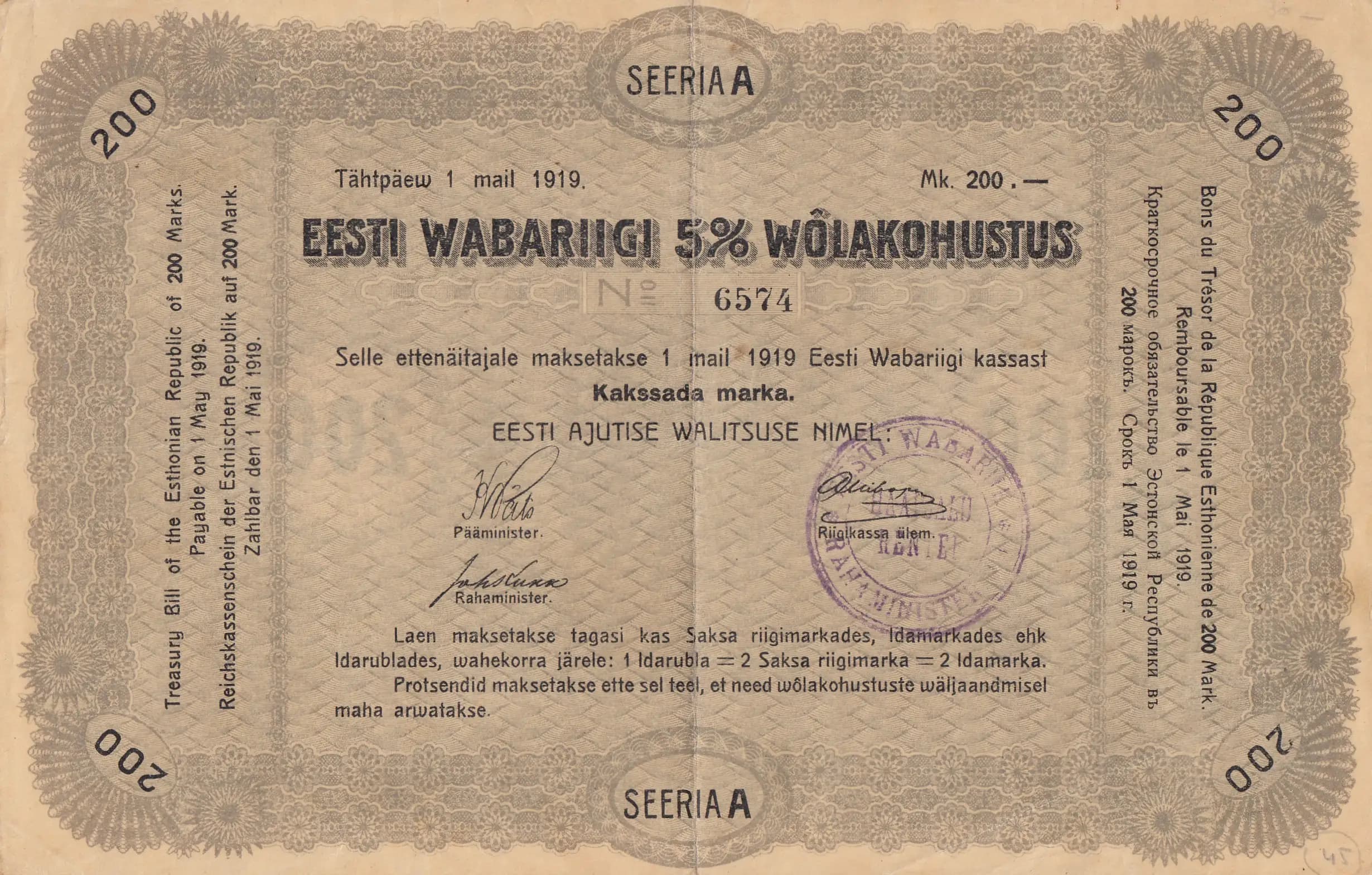
This Estonian Republic 200 Marka treasury bill from 1 May 1919 is a scarce early emission from the newly independent nation's provisional government. The note features an ornate decorative border with radiating fan patterns and a purple State Treasury seal, presented in Series A with visible aging including a central fold and foxing consistent with VF condition. This uniface design (printed on one side only per the catalog note) represents a crucial transitional financial instrument issued during Estonia's first months of independence.
Uncommon. While this is an early emission from Estonia's provisional government, the 200 Marka denomination appears regularly in collections of Baltic numismatics. eBay market data shows VF specimens trading in the $45–$245 range with a mid-point around $50–$100, indicating steady but not high demand. The note is neither common (sub-$20 pricing) nor rare (consistent $300+ pricing), placing it in the 'uncommon' category. Series A uniface issues from May 1919 represent the first official emissions of the Estonian Republic, giving them historical significance without extreme scarcity. Availability in the collector market suggests moderate print runs were distributed.
Issued during the Estonian War of Independence (1918-1920), this 5% debt obligation was a temporary financial measure by the Estonian Provisional Government to fund state operations. The note's trilingual text (Estonian, German, and English) and currency conversion provisions (referencing German marks and Eastern rubles) reflect the complex post-WWI Baltic geopolitical situation. The purple State Treasury seal and signatures of the Prime Minister and Finance Minister authenticate this critical document in Estonia's establishment as a sovereign state.
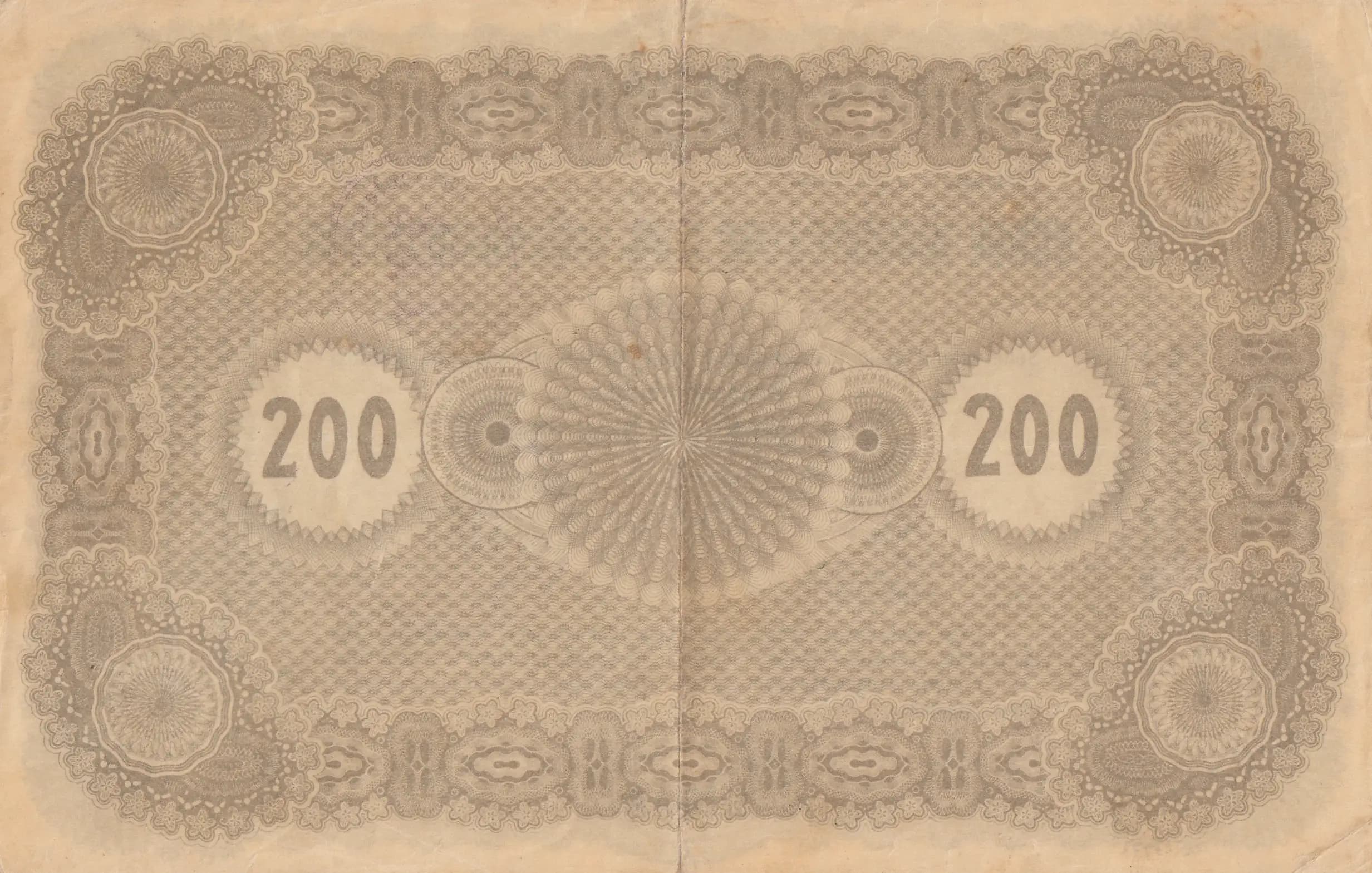
The 200 Marka treasury bill employs an austere yet elegant design appropriate to a state debt instrument rather than circulating currency. The obverse features a comprehensive text-based layout dominated by official governmental language, with the denomination appearing in multiple locations (top corners and margins). The central design element is not a portrait or landmark but rather an ornate geometric border with radiating fan patterns in all four corners—a common security feature of the period derived from Art Nouveau styling. The reverse side eschews textual content entirely, instead showcasing a symmetrical ornamental composition with elaborate geometric patterns, multiple layers of radiating sunburst designs emanating from central oval medallions, and fine-line decorative work throughout. The entire note is framed by an intricate border featuring repeated fan and floral motifs. No portraits or named landmarks appear; the design relies on decorative complexity and official seals for security and authentication.
FRONT SIDE: 'SEERIA A' (Series A); '200' and 'Mk. 200.—' (denomination); 'Tähepäev 1 mail 1919' (Date 1 May 1919); 'EESTI WABARUIGI 5% WÕLAKOHUSTUS' (Estonian Republic 5% Debt Obligation); '6574' (serial number); 'Selle ettenäitajale maksetakse 1 imail 1919 Eesti Wabariigi kassast' (This will be paid on 1 May 1919 from the Estonian Republic treasury); 'Kakksada marka' (Two hundred marks); 'EESTI AJUTISE WALITSUSE NIMEL' (In the name of the Estonian Provisional Government); 'Pääminister' (Prime Minister); 'Rahaminister' (Finance Minister); 'Riigikassa allem' (State Treasury seal); Repayment clause in Estonian specifying conversion rates: '1 Idarubla = 2 Saksa riigimarka = 2 Idamarka' (1 Eastern ruble = 2 German state marks = 2 Eastern mark); Interest provision explaining advance deduction of interest payments. English translation: 'Treasury Bill of the Estonian Republic of 200 Marks 1919'; German text: 'Reichskassenschein der Estnischen Zählen 1 Mai 1919' (Reich Treasury Bill of Estonian Count 1 May 1919). BACK SIDE: '200' (denomination); 'SEERIA A' (Series A).
The note exhibits characteristics of intaglio (engraved) printing, evidenced by the fine, crisp line work visible in the ornate borders, radiating patterns, and geometric designs. The depth and precision of the decorative elements, particularly the fan patterns and sunburst designs on the reverse, are consistent with steel engraving. The 1919 dating and Estonian provenance suggest production by a European security printer, likely contracted by the Estonian Provisional Government during the transition period. The detailed geometric security patterns show the sophisticated printing standards typical of legitimate state financial instruments of this era.
This note is identified as Pick P-3A (Series A, uniface variety). The catalog reference notes the existence of a similar note printed on both sides as a distinct variant. The observed specimen bears the following identifying characteristics: Series A designation, serial number 6574, date of 1 May 1919 (the official issue date), and uniface printing (front only). The purple State Treasury seal and dual signature lines for Prime Minister and Finance Minister are consistent with standard authorization for this issue. No overprints, specimen markings, or cancellations are evident. This represents the standard P-3A variety as distinguished from the two-sided printing variant mentioned in catalog references.