200 marka 1920
Market Prices
About This Note
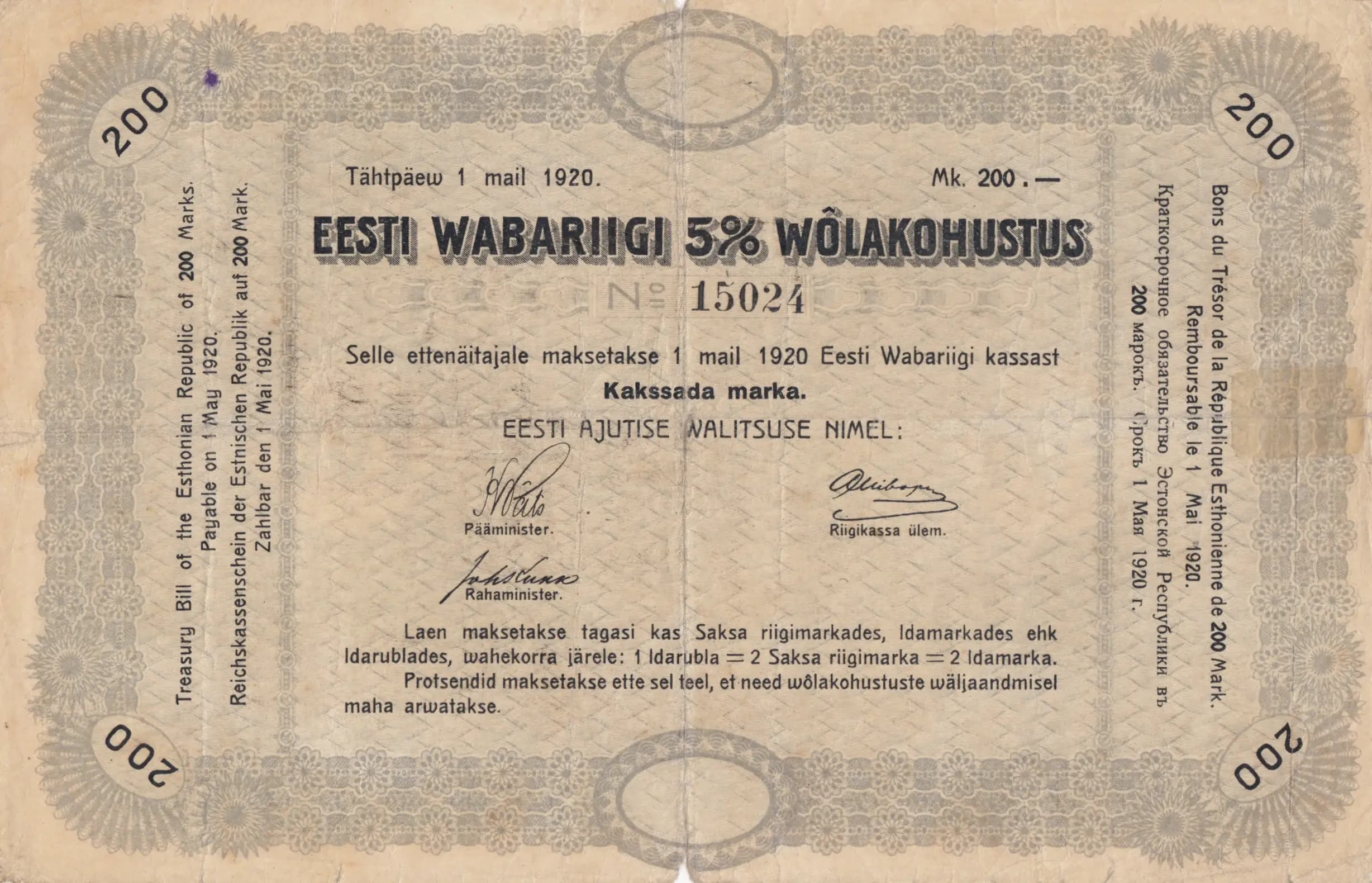
This is a 200 Marka debt obligation issued by the Estonian Republic on 1 May 1920, captured in Fair (F) condition with visible signs of age and circulation wear. The note features an ornate design with decorative borders, rosette patterns, and dual circular seals characteristic of early Estonian currency. The prominent vertical center fold, foxing, and faded ink are consistent with nearly a century of handling, making this an authentic example of Estonia's transitional monetary period during independence.
Common. The eBay price tracking data shows multiple sales in the $9–$185 range, with Fair condition notes typically priced between $15–$100, and the 2016 catalogue value for F grade at $300 USD indicating steady market availability. This is a regular treasury bill issue from a newly formed state with presumably substantial print runs to meet fiscal obligations. The note's historical significance to numismatists is considerable, but its actual rarity in circulation is low—many examples survive due to preservation as historical documents rather than currency depletion.
This note represents a critical moment in Estonian history—the provisional government's 5% debt obligation issued just weeks after declaration of independence from the Russian Empire in February 1920. The dual-language and currency notation (German marks, ldamarks, ldarubles) reflect the chaotic post-WWI economic environment where Estonia sought stability through multiple monetary anchors. The treasury bill format and government signatures underscore Estonia's urgent need to establish fiscal credibility while stabilizing its new republic.
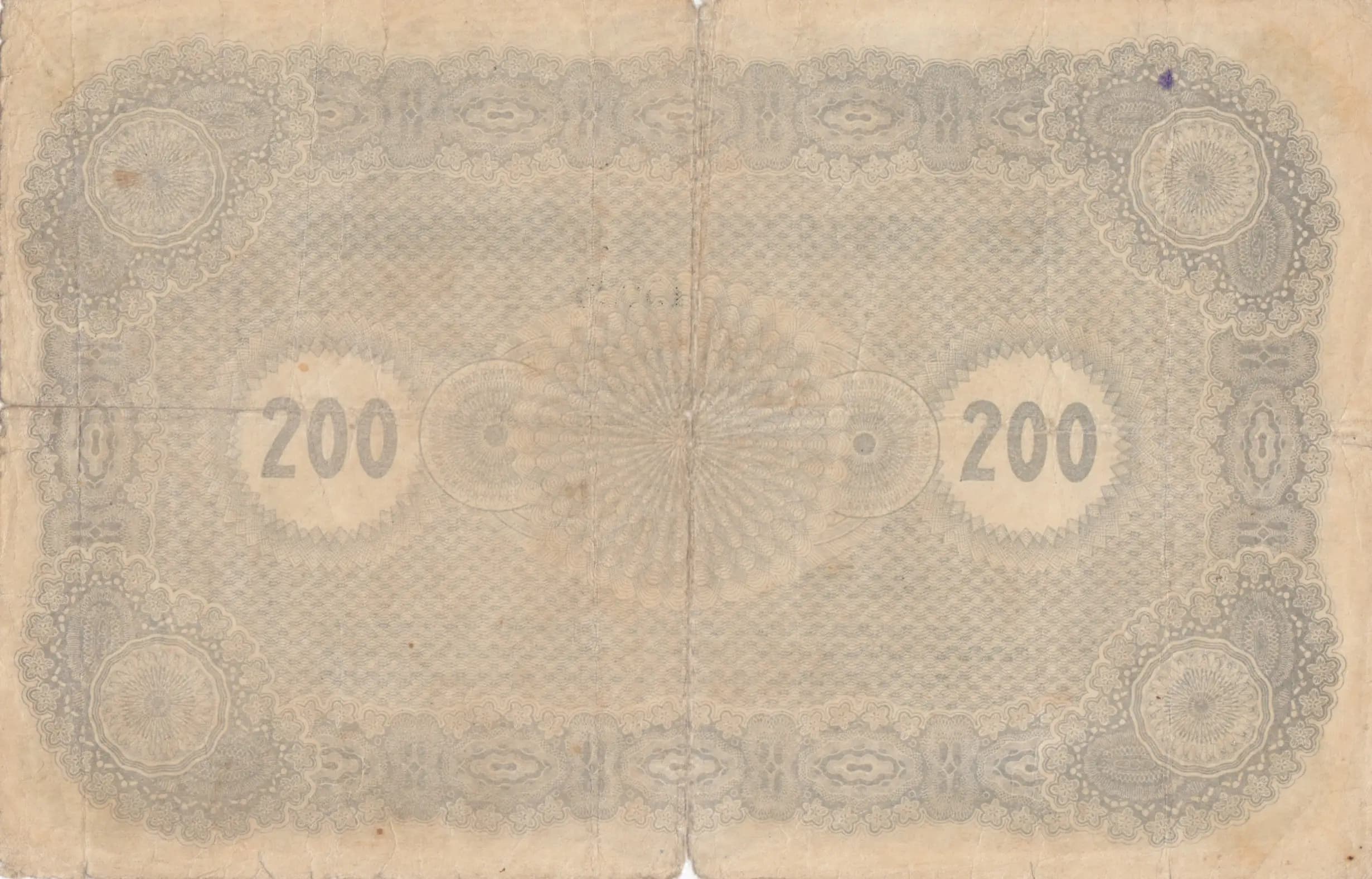
The 200 Marka note employs a classical security design typical of early 20th-century European debt instruments. The obverse features elaborate ornamental borders composed of floral motifs and geometric lattice patterns arranged symmetrically. Two circular seals or emblems—positioned in the upper and lower center areas—serve both decorative and security functions, likely representing state authority. Corner rosette patterns and decorative sunburst designs along all margins create complexity to deter counterfeiting. The reverse maintains the ornamental theme with matching corner rosettes, border sunburst designs, and central geometric lattice work, with large '200' denomination numerals positioned prominently in upper and lower center areas. No portrait is featured on this issue, which was standard for Estonian treasury bills of this period. The color scheme is intentionally austere—beige/tan paper with gray/black ink—reflecting wartime and post-war printing economy.
FRONT: 'EESTI WABARIIGI 5% WÕLAKOHUSTUS' (Estonian Republic 5% Debt Obligation); 'Tâhtpäew 1 mail 1920' (Date: 1 May 1920); 'Mk. 200.—' (Marka 200); 'Selle ettenäitajale maksetakse 1 mail 1920 Eesti Wabariigi kassast Kakssada marka' (This bill will be paid from the Estonian Republic treasury on 1 May 1920 for Two hundred marka); 'EESTI AJUTISE WALITSUSE NIMEL' (In the name of the Estonian Provisional Government); Authority signatures labeled 'Pääminister' (Prime Minister), 'Rahaminister' (Finance Minister), 'Riigikassa ülem' (Head of State Treasury); 'Laen maksetakse tagasi kas Saksa riigiraarkades, ldamarkades ehk ldarublades, wahekorra järele: 1 ldarubia = 2 Saksa riigiraarka = 2 ldamarka' (The loan will be repaid in German state marks, ldamarks or ldarubles, according to exchange rate: 1 ldaruble = 2 German state marks = 2 ldamarks); 'Protsendid maksetakse ette sel teel, et need wõlakohustuste wäljaamdimisel maha aruwatakse' (Interest is paid in advance by deduction from issuance of these debt obligations); Serial number 'N° 15024'. BACK: Large denomination '200' numerals in center positions.
Letterpress (relief) printing on laid bond paper, evidenced by the crisp detail of fine ornamental elements, consistent ink impression across intricate border designs, and characteristic mechanical production visible in the geometric patterns. The security design's complexity—featuring multiple decorative layers and fine-line work—suggests professional government printing works, likely the Estonian State Printing Office (Eesti Riiklik Trükikoda). No evidence of color printing is visible; the note relies entirely on single-color (black/gray ink) design.
Pick P-38 (gray/tan version). The catalog reference explicitly notes a P-38A variety with orange coloring. The visual analysis confirms this specimen as the standard gray-toned version. The serial number observed is N° 15024; potential variety collecting focuses on signature combinations (three officials signed each note) and serial number ranges, though no specific signature variants are documented in standard catalogues. No overprints or date variations are evident on this example.