25 000 marka 1920
“serie A”
Market Prices
About This Note
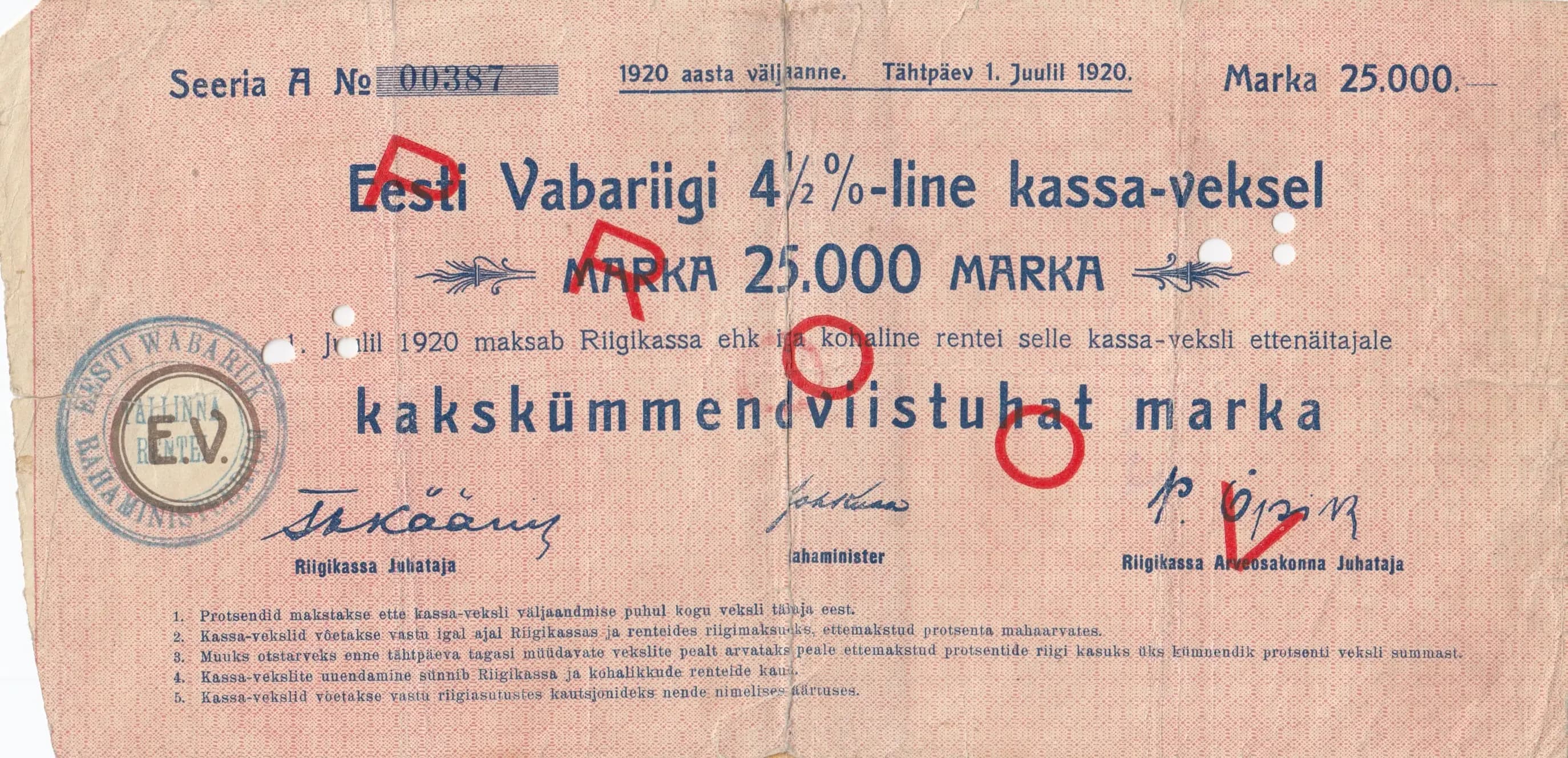
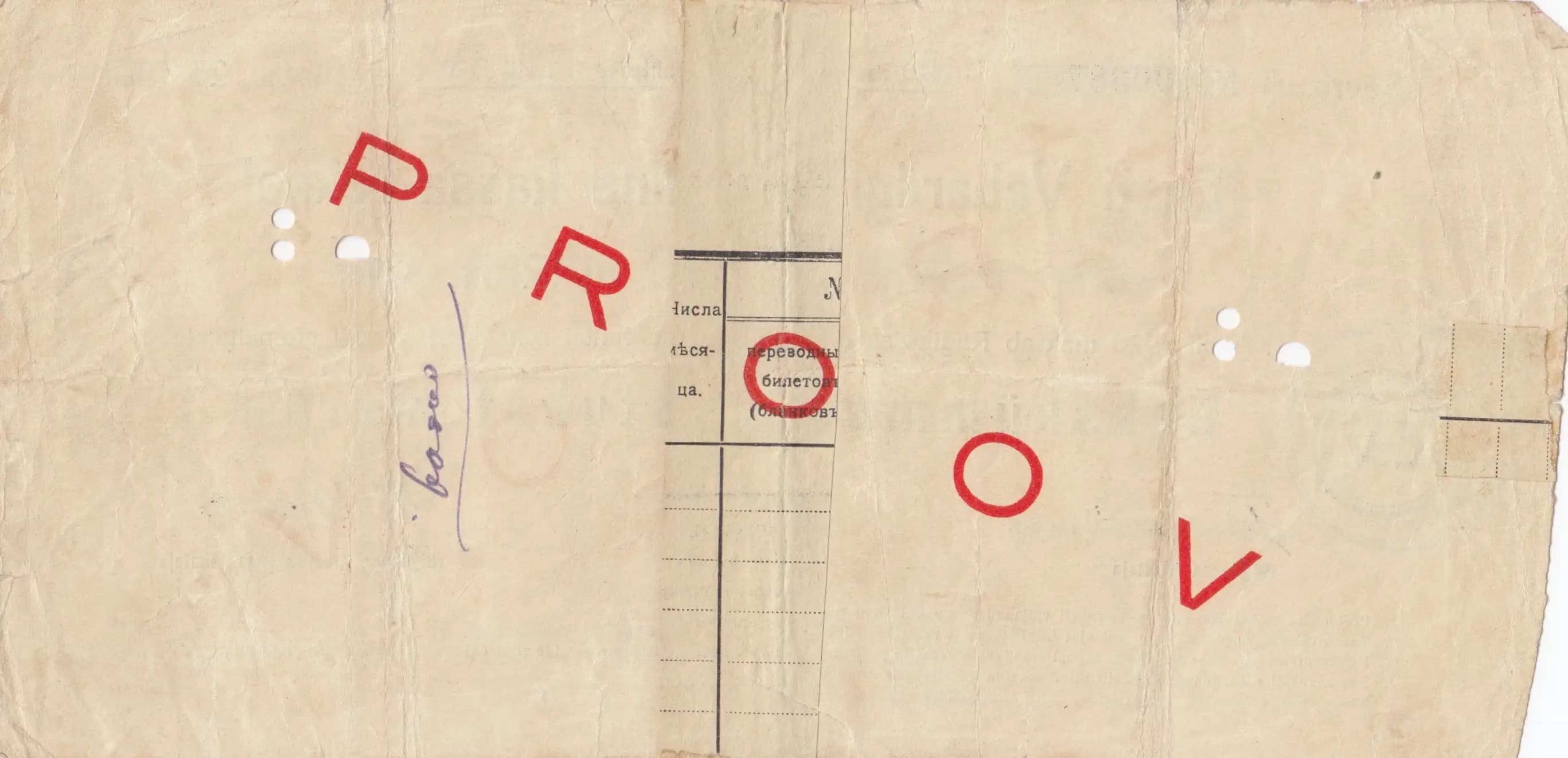
This is an Estonian Republic 25,000 marka Treasury bill (kassa-veksel) from 1920, issued during the early independence period. The note exhibits Fair condition with significant aging, creasing, and fading typical of heavily circulated paper money from this era. The front features prominent red administrative stamps and handwritten marks over the formal certificate-style text, with a circular official seal bearing 'EIV' initials, while the reverse is largely blank with administrative notation marks, making this a notable example of Estonian fiscal documentation from the turbulent post-WWI period.
common. The eBay market data shows these notes trading across a wide range of prices ($2.95 to $450 USD) with multiple listings at modest price points (under $100), indicating steady collector availability. While the specific Pick-38Es variety in Fair condition is not exceptionally scarce, the wide price variation suggests condition variance significantly affects value. The series A notation and serial number 00387 are unremarkable. As an early Estonian fiscal document, these notes have accumulated collector interest, but surviving examples remain sufficiently available in the market to be classified as common rather than rare.
This 4½% Treasury bill represents Estonia's early monetary stabilization efforts following independence from Russia in 1918. Issued on July 1, 1920, during a period of significant hyperinflation and economic restructuring, the note functioned as both a payment instrument and interest-bearing security, redeemable at the State Treasury or local offices. The bilingual administrative markings and formal Treasury structure reflected Estonia's transition to independent nation-state finances while managing the economic chaos of the post-war period.
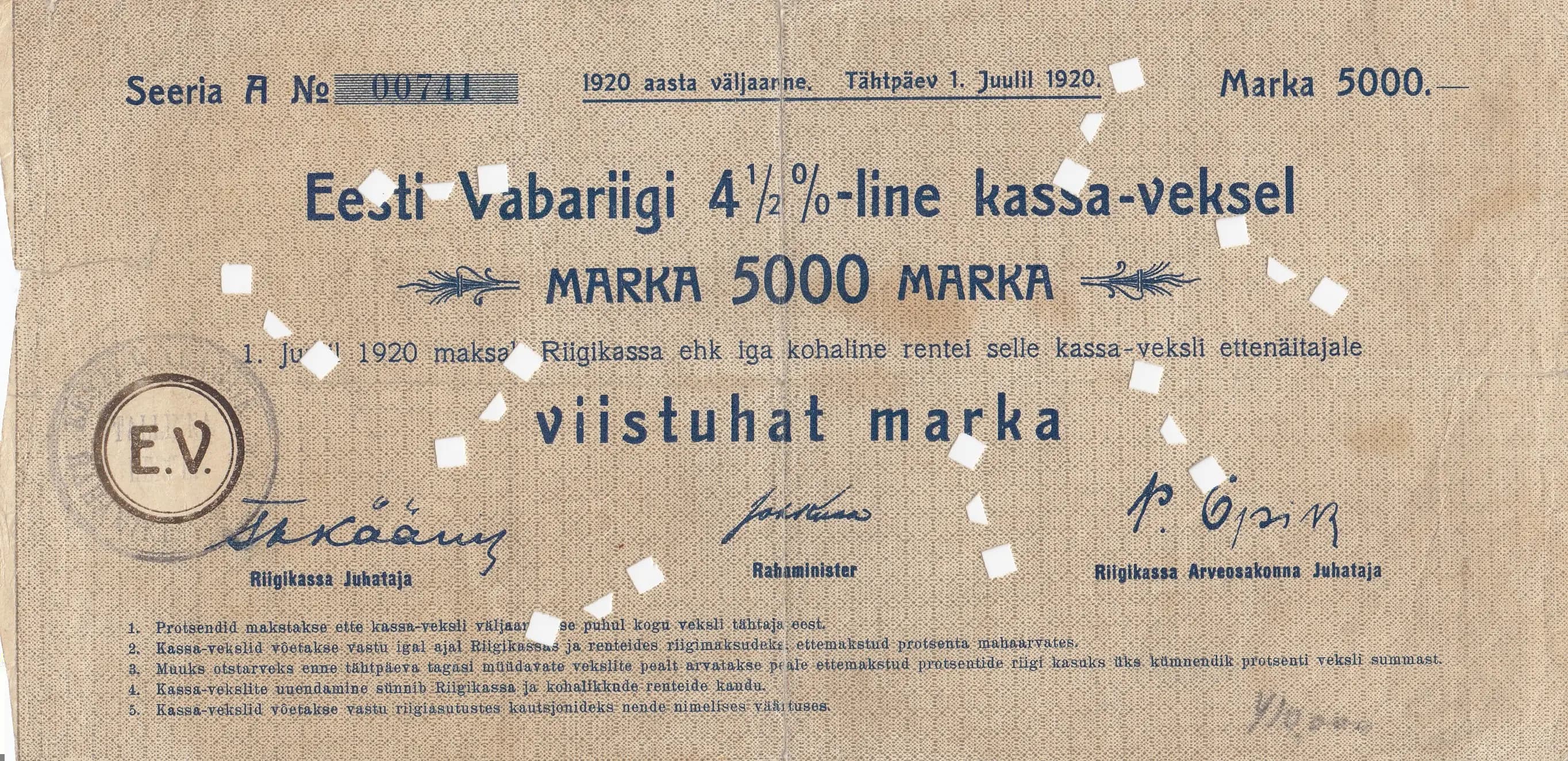
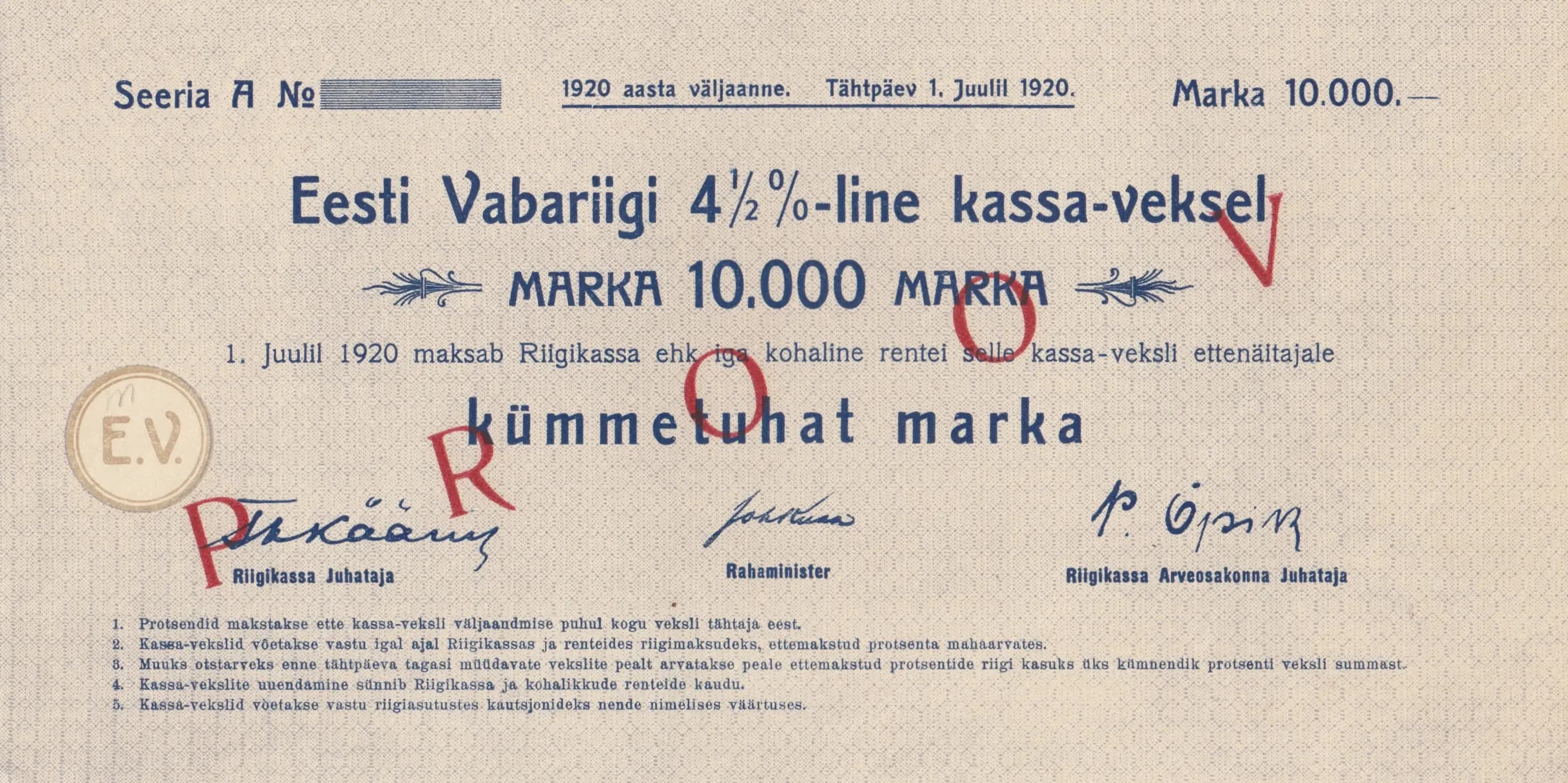
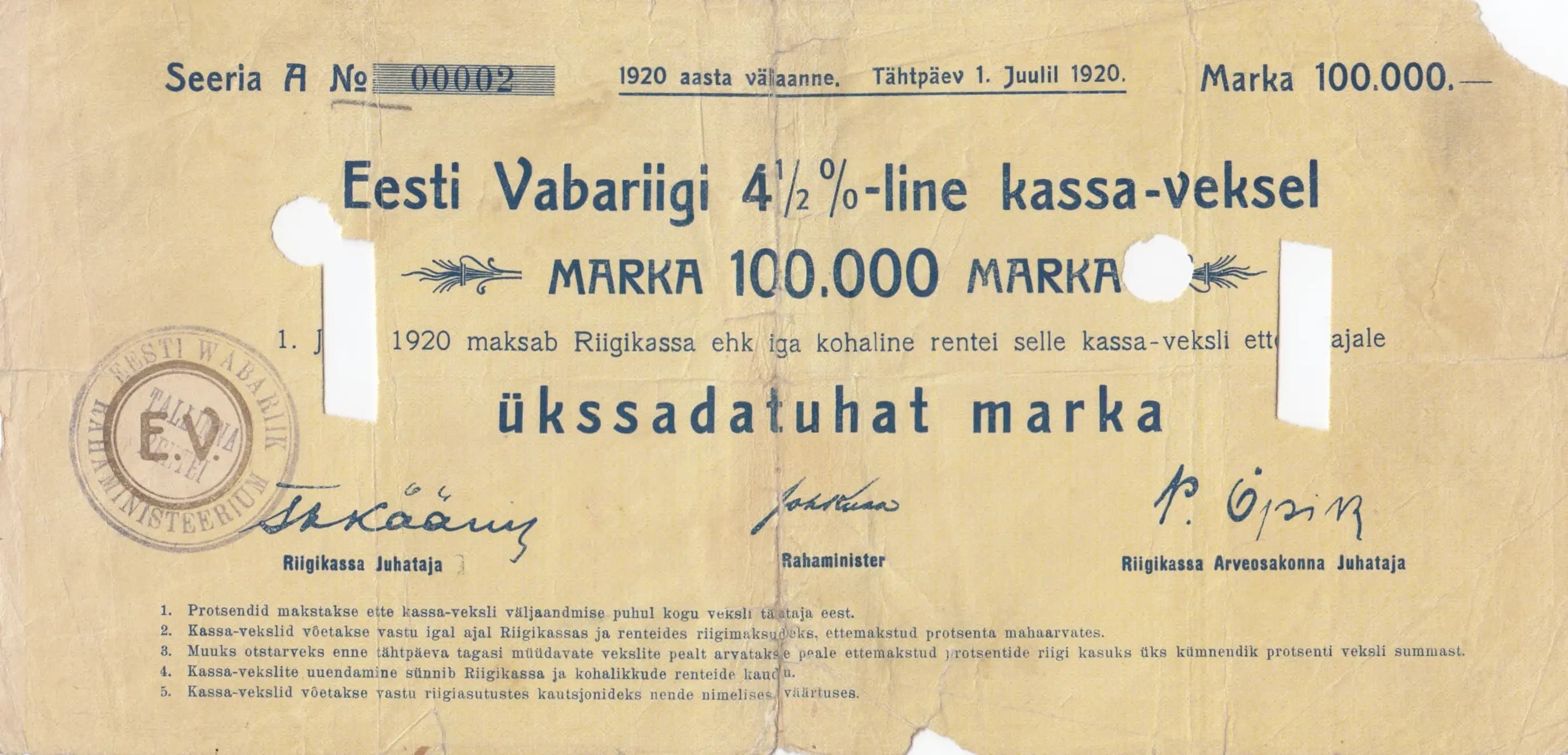
This Treasury bill features a formal certificate layout typical of early 20th-century fiscal instruments rather than decorative banknote design. The front is dominated by large, bold typography announcing the denomination and security type, with the text arranged in a legal document format. A circular official seal containing 'EIV' initials (likely representing 'Eesti Vabariigi' or similar authority) appears on the left side as the primary security/authenticity feature. The note includes three designated signature lines for State Treasury officials, reflecting the formal government authorization required for these instruments. The reverse contains a mostly blank table structure, suggesting space for additional administrative notation, security features, or accounting purposes. Red handwritten stamps and marks overlay both sides, representing official processing, approval, and authentication marks applied during handling. The tan/beige paper shows the characteristic aging and foxing of 1920-era Estonian paper stock, with pronounced creasing from circulation.
FRONT SIDE: Main denomination and type: 'Eesti Vabariigi 4½%-line kassa-veksel' (Estonian Republic 4½% Treasury bill) / 'Marka 25.000' and 'kakskümmenviis tuhat marka' (25,000 marka in numerals and words) / Series designation: 'Seeria A № 00387' (Series A No. 00387) / Issue date: '1920 aasta vällianne. Tähipäev 1. Juulii 1920.' (1920 issue. Dated 1 July 1920) / Payment terms: 'Juulil 1920 maksab Riigikassa ehk ja kohaline rentei selle kassa-veksli ettenäiltajale kakskümmenviis tuhat marka' (In July 1920, the State Treasury or local office shall pay this treasury bill to the presenter twenty-five thousand marka) / Signatory positions: 'Riigikassa Juhataja' (State Treasury Director), 'Rahaminister' (Finance Minister), 'Riigikassa Arveosakonna Juhataja' (State Treasury Accounting Department Director) / Additional terms: 'Protsendid makstatakse ette kassa-veksli viljaaadmise puhul kogus veksli tähuja eest' (Interest is paid when the treasury bill is submitted in full by the date holder) / 'Kassa-vokslid voetakse vasin igul ajal Riigikassas ja renteides riigimaksusks, ettemaksetus protsenta mahaarv ates' (Treasury bills are accepted at any time at the State Treasury and offices as tax payment with interest deducted) / Further conditions regarding early redemption and endorsement rights. REVERSE SIDE: Faint administrative table outline with minimal legible text; some Russian-language notations appear present including 'Числа' (Numbers) and fragmentary administrative references, along with red handwritten letters 'P', 'R', 'O', 'V' indicating processing marks.
This Treasury bill was produced using letterpress printing, evident from the crisp, embossed quality of the text and the formal typographic arrangement. The black primary text combined with red administrative stamps applied by hand or rubber stamp indicates a two-stage printing process: initial black letterpress for the main document, followed by manual red stamp application for processing and authorization marks. The faint table structure on the reverse suggests simultaneous reverse-side printing. No evidence of advanced security printing techniques (such as intaglio or elaborate countermark features) is visible; this reflects the practical, administrative nature of Treasury bills as governmental fiscal instruments rather than decorative currency.
This note is identified as Pick-38Es (series A) with serial number 00387. The 'Es' designation in the Pick catalog indicates this is the Estonian-language version of the 25,000 marka Treasury bill. The external catalog reference notes a distinction between gray-colored and orange-colored variants (P-38A referenced), suggesting multiple color varieties exist for this denomination. The handwritten series 'A' designation and the circular 'EIV' seal are consistent with early 1920 Estonian Treasury issue characteristics. The specific variety classification (Es) distinguishes this from potential German, Russian, or other language versions that may have been issued simultaneously or subsequently.