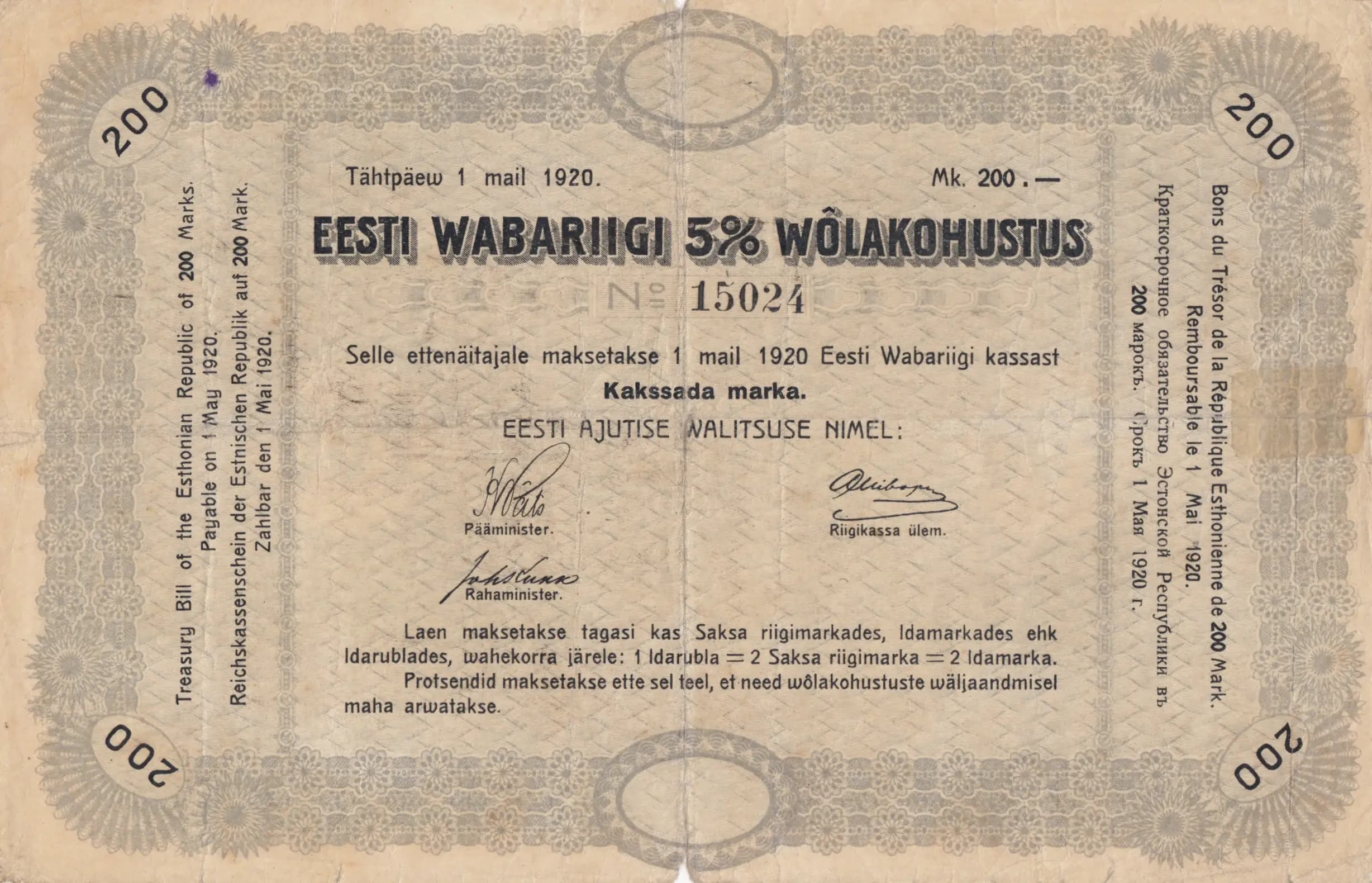
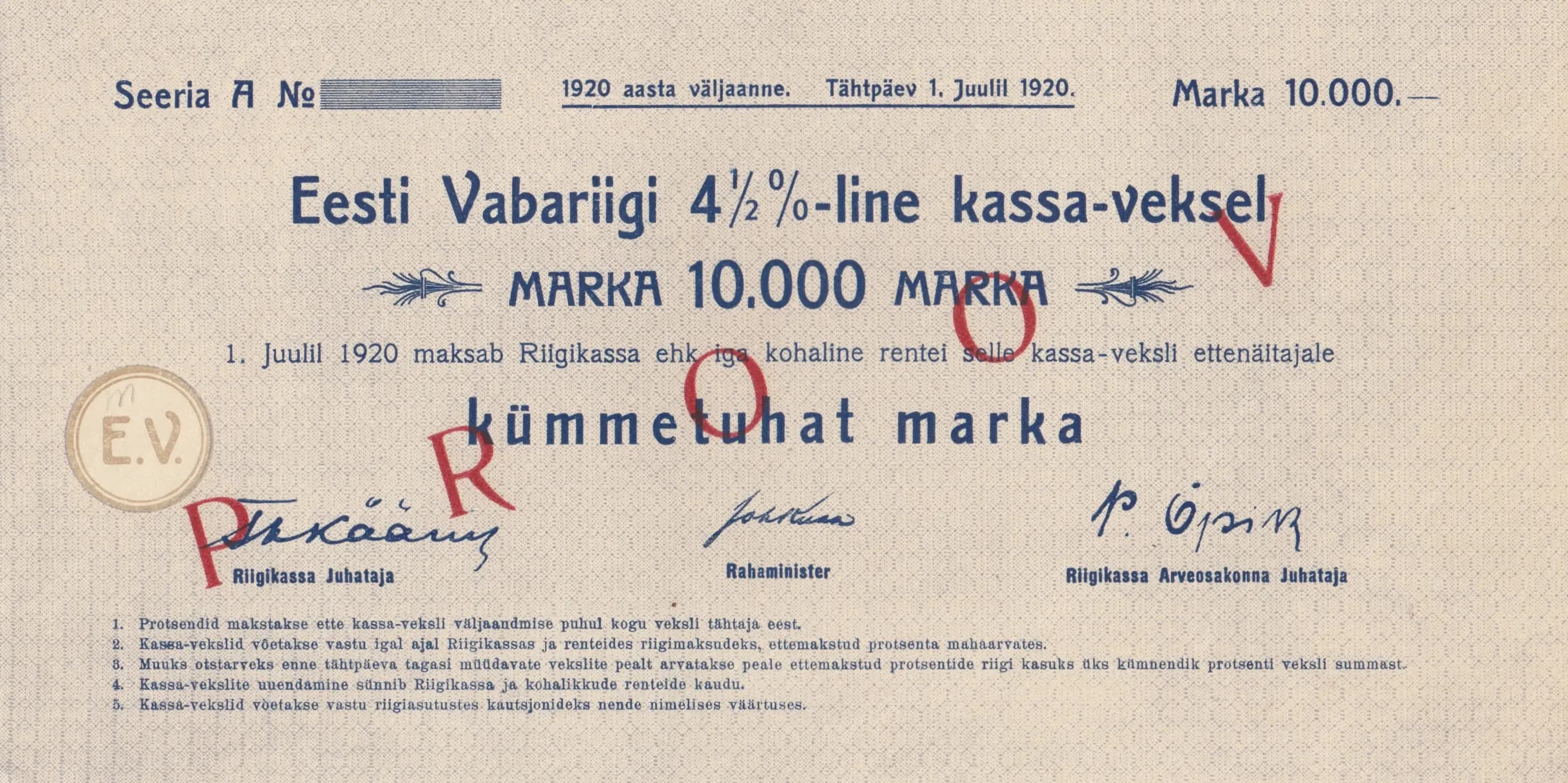
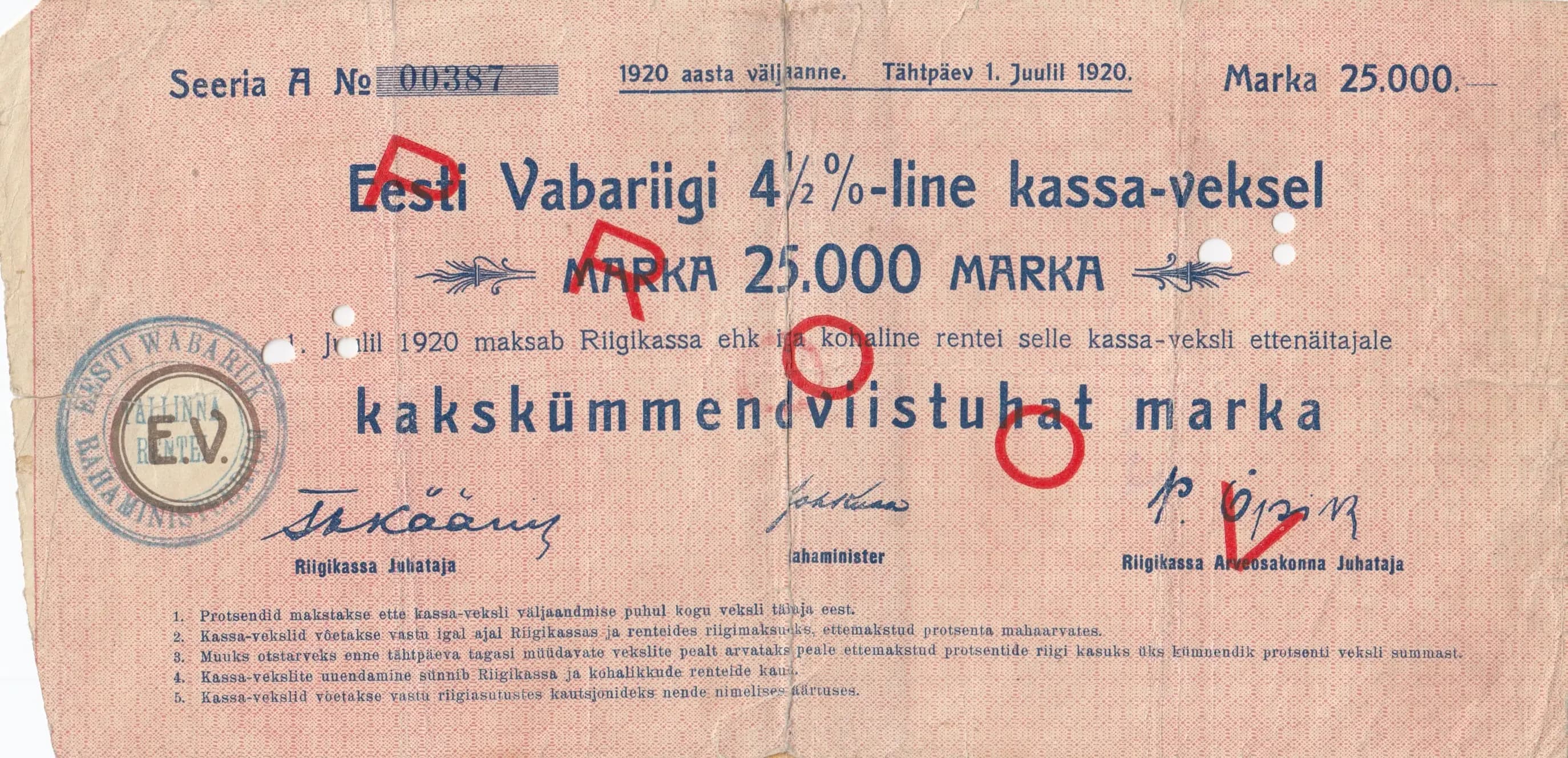
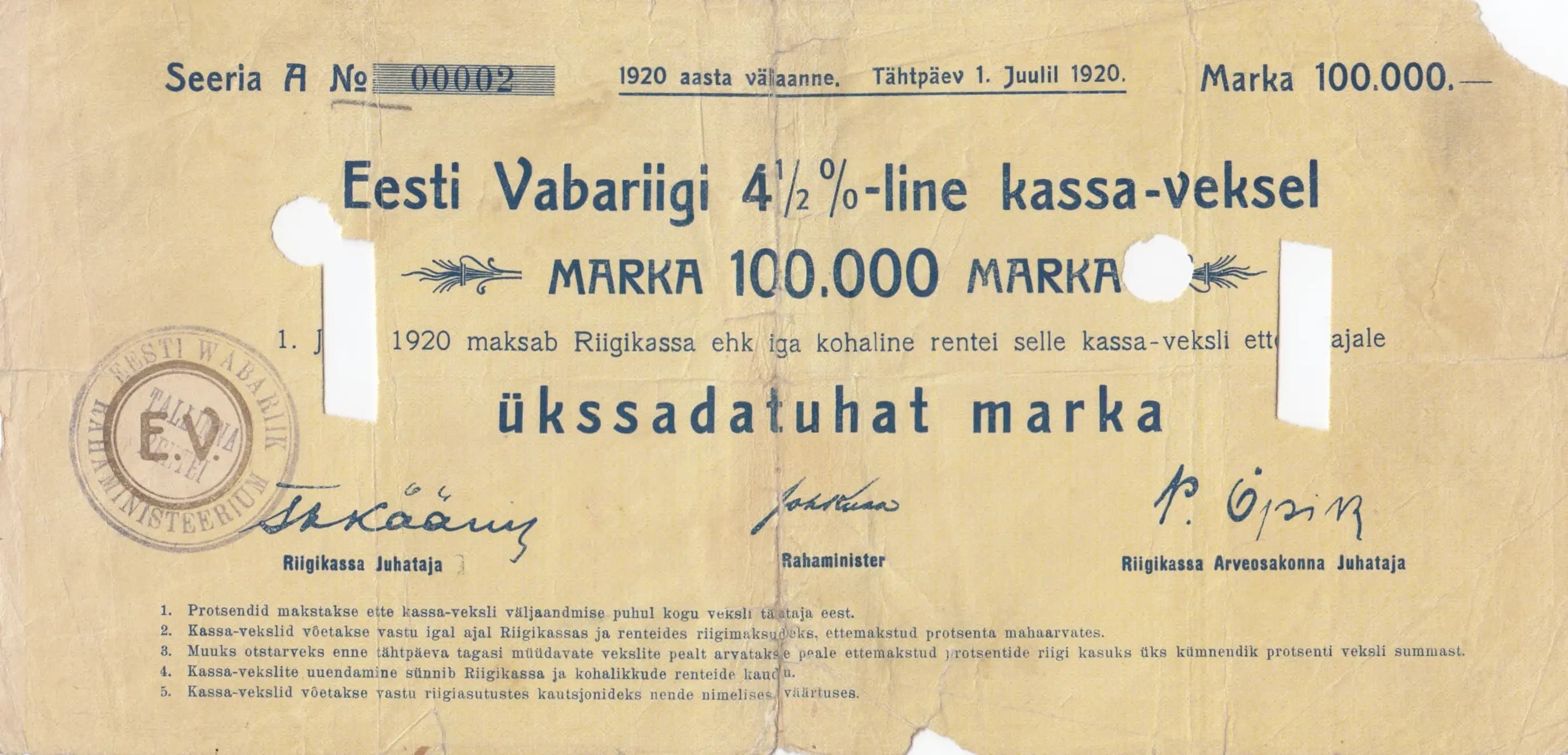
5000 marka 1920
“serie A”
Market Prices
About This Note
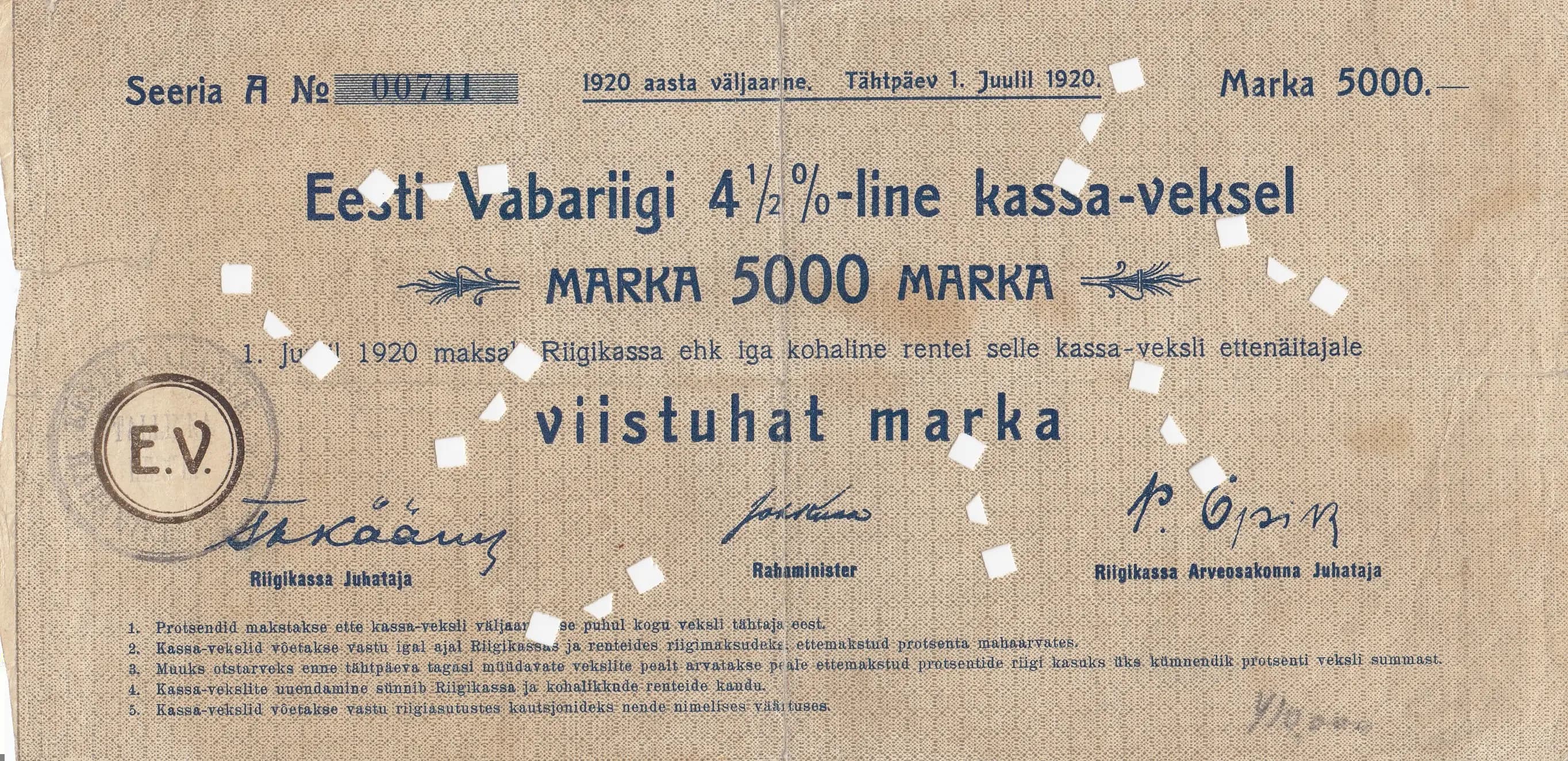
This is a 5000 marka Estonian treasury bond from 1920, issued by the newly independent Estonian Republic in its early post-WWI period. The note is graded F (Fair) and displays significant aging characteristics including foxing, creasing, adhesive residue marks, and overall paper brittleness consistent with 100+ years of storage. The tan/beige coloring with blue text and decorative elements remains legible, and the circular E.V. seal is clearly visible, making this an important example of Estonia's early financial instruments during the turbulent 1920s transition period.
common
This 4½% treasury bond reflects the financial challenges faced by the newly independent Estonian Republic in 1920, issued just two years after declaring independence from Russia. The note's prominent display of state authority through multiple signature lines (Head of State Treasury, Finance Minister, and Accounting Department Head) underscores the importance of establishing credible financial institutions during nation-building. The maturity date of July 1, 1920, and the bond's conditions printed on the reverse demonstrate Estonia's efforts to stabilize its economy through short-term treasury instruments during the volatile early independence period.
This Estonian treasury bond features a clean, formal design typical of government financial instruments of the early 1920s. The front is dominated by tan/beige colored paper with dark blue typography and decorative elements. The primary denomination '5000 MARKA' is centered and flanked by ornamental feather or leaf designs that provide visual symmetry. A circular seal bearing the initials 'E.V.' (Eesti Vabariigi – Estonian Republic) is positioned on the left side, serving as the primary security and authenticity marker. The note contains no portraits, consistent with its function as a treasury bond rather than circulating currency. Three signature lines with official titles occupy the lower center section, representing the authority structure of the Estonian state treasury system. The extensive terms and conditions printed below demonstrate the bond's nature as a financial instrument with specific regulatory requirements. The overall design reflects the austere, functional aesthetic appropriate for government debt instruments of the period.
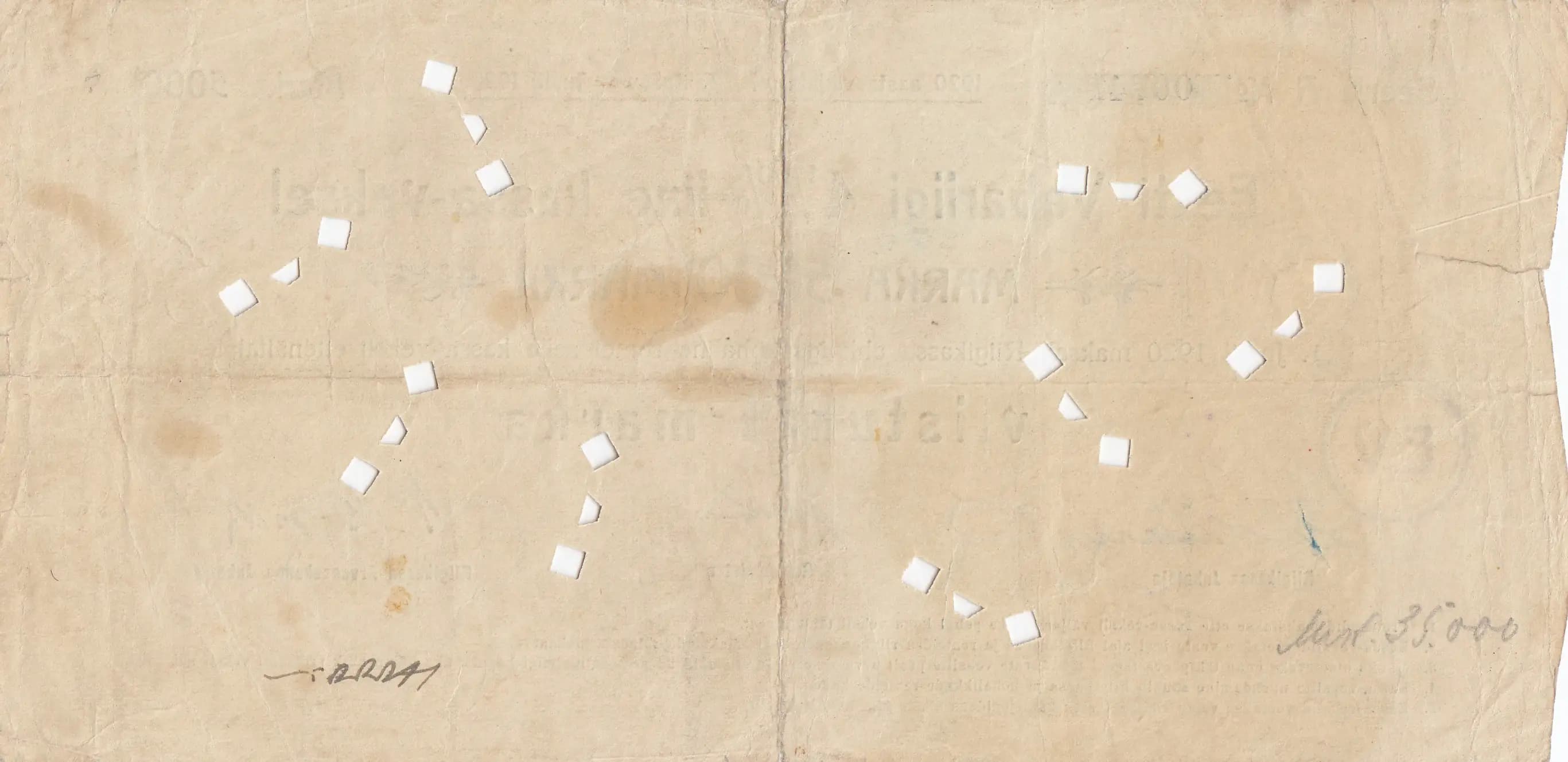
FRONT SIDE: Series A No. 007411 (Seeria A № 007411) | Issued in 1920. Due date July 1, 1920. (1920 aasta väljaarve. Tähtpäev 1. Juuli 1920.) | 5000 marka (Marka 5000) | Estonian Republic 4½% treasury bond (Eesti Vabariigi 4½%-line kassa-veksel) | 5000 MARKA [with decorative dividers] | On July 1, 1920, the State Treasury or any local treasury will pay to the bearer of this treasury bond (1. juu 1920 maksa Riigikassa ehk iga kohaline rentei selle kassa-veksli ettenäitajale) | five thousand marka (viistuhat marka) | Signature line titles: Head of State Treasury (Riigikassa Juhataja) | Finance Minister (Rahaminister) | Head of State Treasury Accounting Department (Riigikassa Arveosäkonna Juhataja) | TERMS AND CONDITIONS: 1. Interest is paid in advance for the treasury bond at the time of issuance until maturity (Proisendid maksakse ette kassan-veksli väljäär se puhul kogn veksli tähtajja dost.) | 2. Treasury bonds are accepted at any time at the State Treasury and branches for state duty payments and tax prepayments (Kassa-vekslist vöotakse vastu igat ajat Riigikassas ja reuteldes Riigimatsakudni ettamaksud protestri maahärjates.) | 3. Regarding arbitration and disputes, the State Treasury and local treasuries are not responsible for payment of the bond amount (Käände äkirandil anue Riigikassad ja kohalikud renteid arvahiste mahahistusid otsustawal vahe käisendib protetsteil veksli summast.) | 4. Treasury bond renewal is handled by the State Treasury and local treasuries (Kassa-vekslie uuondamine stsmndi Riigikassa ja kobalinekuke-renteide käuda.) | 5. Treasury bonds are accepted in state institutions for official transactions at their face value (Kassa-vekseli vöotakse vastu riigiastustes käujsoniteks nende nimelises yähtuses.) | BACK SIDE: Handwritten notations including reference number 222427 and date notation 'June 25, 000' appear in pencil.
This note appears to have been produced using letterpress printing, evident from the sharp, consistent impression of the blue text and the regular spacing of the decorative elements. The uniform color saturation and crisp edges of the typography are characteristic of relief printing methods common in 1920s Baltic security printing. The circular E.V. seal shows the clarity and definition typical of relief-printed stamps or seals. Specific printer information for Estonian Pick-38 notes is not definitively documented in standard catalogs, though early Estonian treasury notes were produced by various European security printers. The absence of complex background patterns or security features suggests this bond predates more sophisticated printing techniques adopted by Estonia in later denominations.
This note is identified as Pick-38C (series A variant) based on catalog data. The visual analysis confirms Series A designation with serial number 007411. Pick-38 shows documented variety with at least Pick-38A (orange color variant) noted in external references, with this specimen being the gray/blue variant (38C). The series designation and serial number format are consistent with early Estonian state treasury bond production. No overprints, security features beyond the E.V. seal, or unusual printing variations are evident in this specimen. The condition and adhesive residue suggest this note may have been stored in a collection or archive with conservation materials, typical of institutional holdings of early republic-era financial instruments.