20 penni 1919 specimen
Market Prices
About This Note
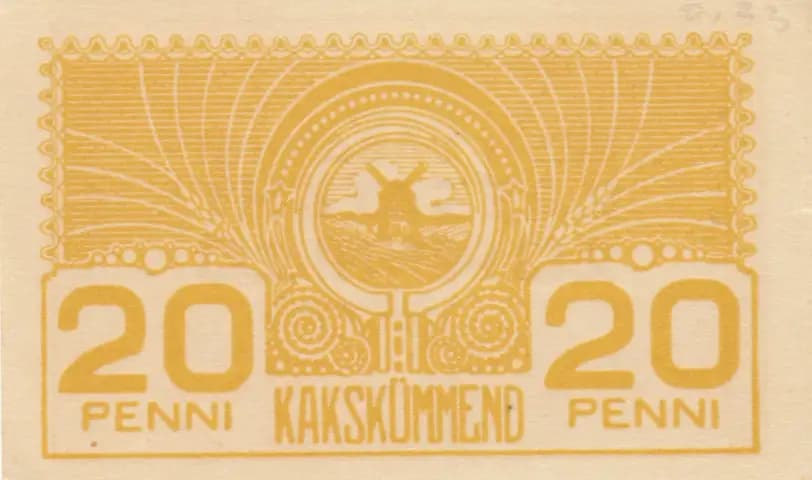
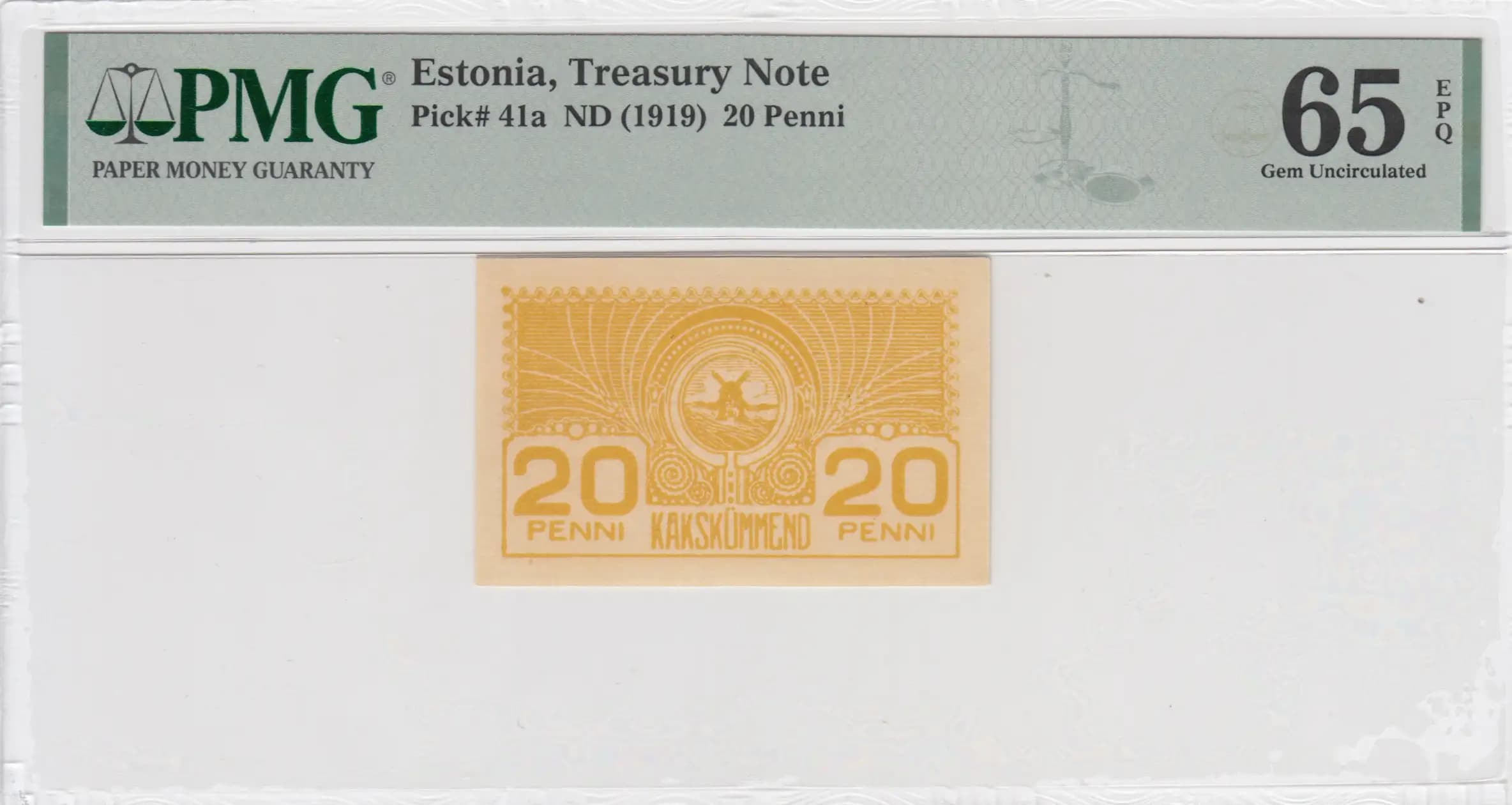
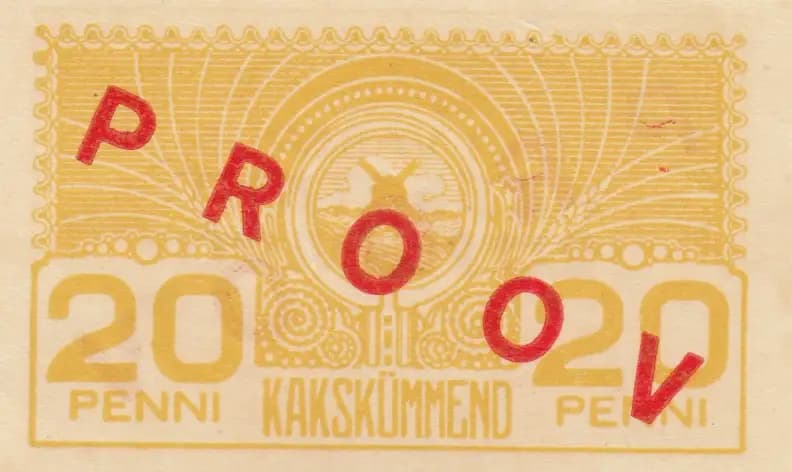
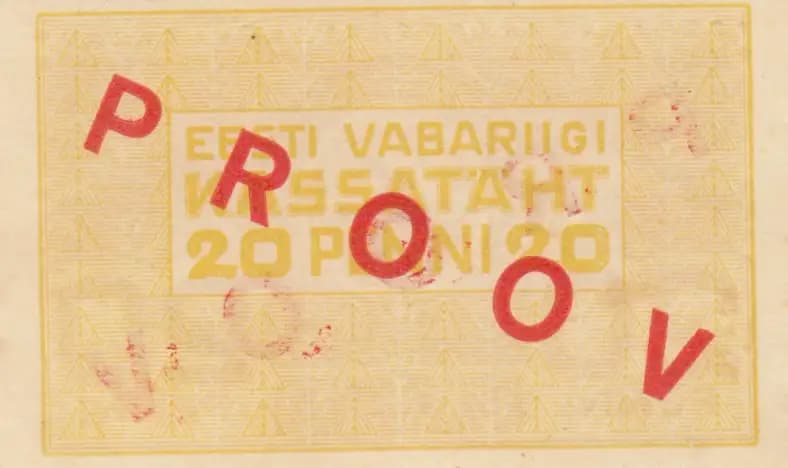
This is a 1919 Estonian 20 Penni specimen note in uncirculated condition, featuring a striking yellow-gold color scheme with ornate Art Nouveau-influenced geometric design elements including a prominent radiating sunburst pattern and concentric circles. The note bears a diagonal red 'SPECIMEN' overprint (rendered as 'PRO' and 'V' fragments visible in the visual analysis) across both obverse and reverse, indicating its status as a non-circulating specimen issue from the newly independent Estonian Treasury. The crisp, well-preserved condition with minimal wear exemplifies the high quality typical of specimen notes preserved in collections.
Common. eBay market data shows consistent pricing in the $16–$35 USD range for UNC specimens, with multiple transactions at $17–$32, indicating stable but modest collector demand typical of common early 20th-century banknotes. The 2016 catalogue valuation of $50 UNC aligns with current market observations. This note was produced by the Estonian Treasury as part of standard initial currency issuance; no evidence suggests an exceptionally limited print run or early withdrawal. Specimen notes by definition were produced in smaller quantities than circulation issues, but specimen varieties of common base denominations remain readily available to collectors.
This banknote was issued in 1919 during the establishment of the independent Estonian Republic following World War I and the Russian Revolution, representing Estonia's assertion of monetary sovereignty. The geometric, modernist design reflects early 20th-century artistic movements popular in Northern Europe, while the denomination in penni reflects Estonia's adoption of the markka-penni currency system inherited from its period under Russian rule. The specimen overprint marks this as an official archival or presentation note, produced to document the new nation's currency design but withheld from general circulation.
The obverse features a classical ornamental design centered on a radiating sunburst motif with concentric circular medallion framing, characteristic of early Estonian banknote aesthetics. The design employs fine geometric patterning throughout with a scalloped decorative border at the top and denomination numerals positioned prominently in the lower portion. The reverse presents a systematic background of repeated triangular/tent-like geometric patterns arranged in rows, framing a central rectangular cartouche containing the issuing authority and denomination text. No portraiture is present on this design; instead, the note relies entirely on geometric ornamentation and security printing techniques as its decorative and protective elements. The overall aesthetic reflects the geometric modernism and Art Deco influences prevalent in 1920s European banknote design.
FRONT: '20' and 'PENNI' (denomination in numerals and text); 'KAKSKÜMMEND PENNI' (Estonian: 'twenty penni' in written form); 'PRO' and 'V' (Latin fragments of 'SPECIMEN' overprint). BACK: 'EESTI VABARIIGI RAHAPÜHTI' (Estonian: 'Banknote of the Estonian Republic'); '20 PENNI' and '00' (denomination notation); 'PRO' and 'V' (specimen overprint fragments).
Line engraving on steel plates, evidenced by the fine, crisp linework visible throughout both sides and the intricate geometric patterns that served dual purposes as both design and security feature. The consistent quality and precision of the concentric circles, radiating lines, and repeating triangular patterns are hallmarks of high-quality intaglio printing. The red specimen overprint was applied as a separate printing operation, standard practice for specimen notes of this era.
This note is catalogued as P-41s, the specimen variant of Pick 41. The visual analysis confirms the diagonal red 'SPECIMEN' overprint (partially visible as 'PRO' and 'V' fragments) characteristic of specimen notes. The PMG population report indicates P-41a exists as a catalogued variant, suggesting potential sub-varieties related to overprint differences or printing states. The observed specimen overprint appears consistent with the standard overprinting practice for Estonian specimen notes of 1919. No specific serial numbers, signatures, or other distinguishing variety markers are clearly identifiable from the visual analysis provided.