20 penni 1919
Market Prices
13 salesAbout This Note
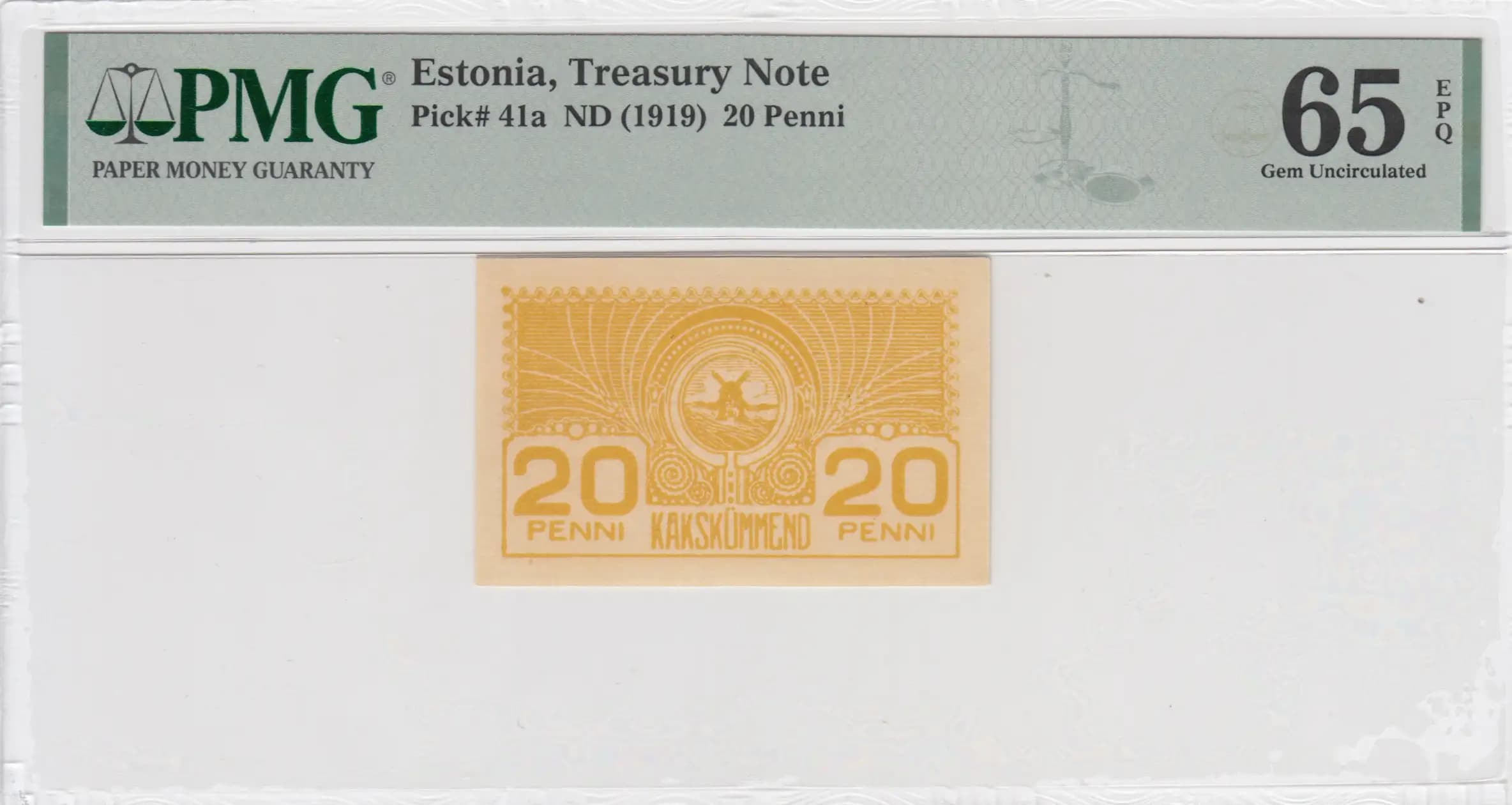
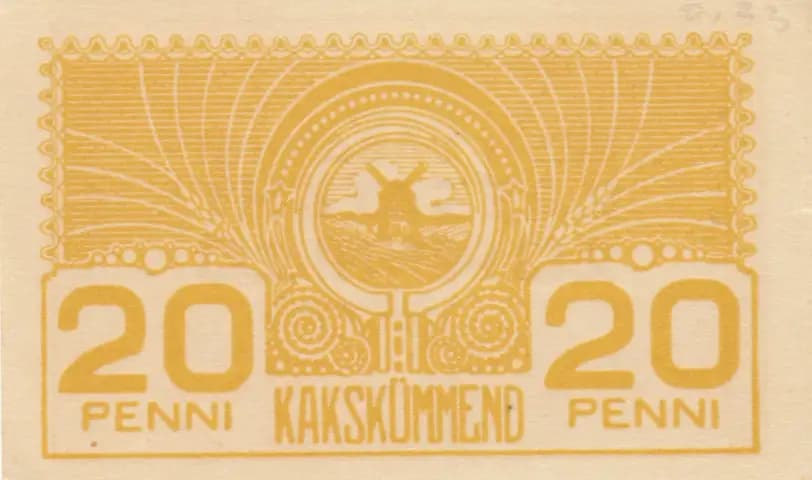
This is an uncirculated 1919 Estonian Treasury note featuring an exceptional design centered on a detailed eagle medallion surrounded by radiating sunburst patterns rendered in warm golden tones. The pristine condition with no visible wear, creases, or damage, combined with the intricate fine-line security printing throughout, makes this a desirable specimen from Estonia's early independent period. The note's scarcity in high grades and historical significance as an early emission of the newly-formed Estonian Republic enhance its collector appeal.
Common. Despite being from the early 1919 period of Estonian independence, this note trades regularly on eBay with multiple sales documented across various grades. Historical auction data shows even UNC specimens selling for $26.88 (2020) and professionally-graded PMG 65 examples reaching $82 (2020), with catalog values (2016) listing UNC at $35. The consistent supply and moderate price points indicate adequate print quantities were distributed. Notes of this era with such regular market activity and affordable pricing across grades are classified as common within the numismatic hobby.
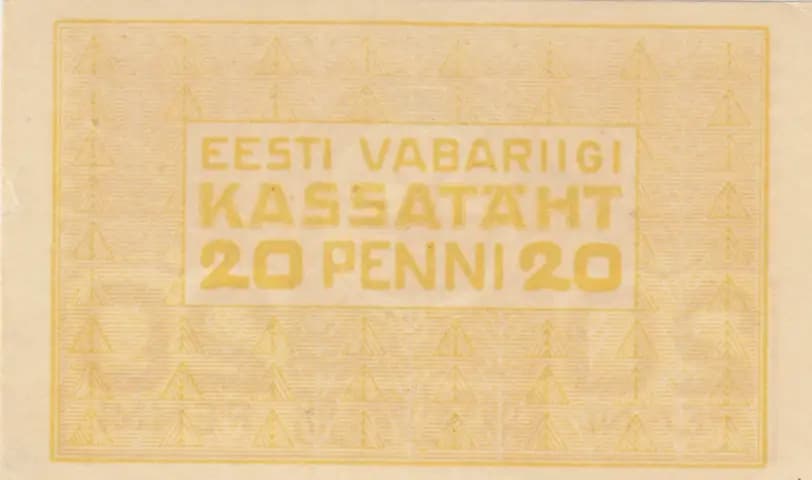
This 20 Penni note was issued in 1919 by the Treasury of Estonia (Eesti Vabariigi Kassataht) during the nation's first years of independence following the Russian Revolution and World War I. The prominent eagle motif on the obverse symbolizes national sovereignty and strength, while the geometric tree-like pattern on the reverse reflects the nation's forested landscape and agrarian character. The note's simple but dignified design exemplifies the graphic identity adopted by the young Estonian state to establish monetary independence.
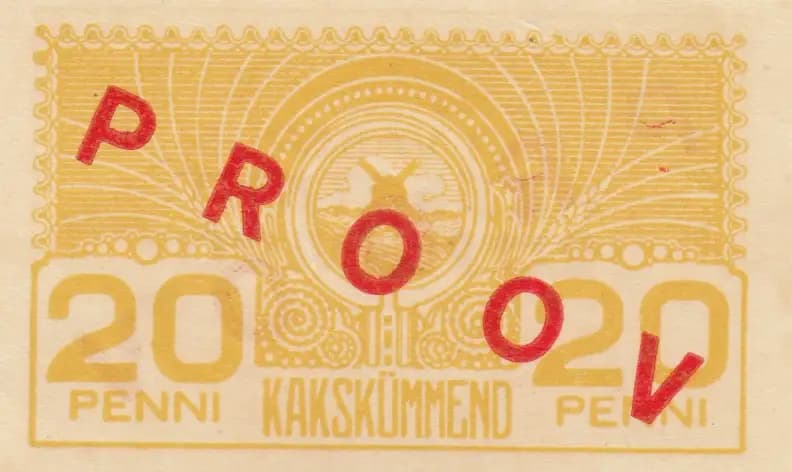
The obverse features a meticulously detailed circular medallion containing an eagle (national emblem) facing left, at the center of a sunburst design created by fine radiating lines and concentric circles. Ornamental spiral and rosette patterns appear below the medallion, providing visual balance. The denomination appears in two locations (left and right) in a white rectangular band. The reverse displays a geometric repeating pattern of stylized triangular or tree-like shapes arranged in a regular grid across the field, enclosed by a decorative rectangular border. A central white panel contains the issuer information 'EESTI VABARIIGI KASSATAHT' and denomination '20 PENNI 20' in serif typeface. The entire note is rendered in golden-yellow tones with cream/off-white highlights.
Front: '20' and 'PENNI' appear on either side of the central medallion; 'KAKSKUMMEND' (Twenty) is inscribed above. Back: 'EESTI VABARIIGI' (Estonian Republic) and 'KASSATAHT' (Treasury Note) appear in the upper portion; '20 PENNI 20' is displayed in the central white panel. All inscriptions appear in Estonian, the official language of the newly-independent state.
Intaglio (engraved) printing, evidenced by the fine line work, detailed concentric circle patterns, and intricate security design elements visible throughout both sides. The precision of the radiating sunburst pattern and repeating geometric background design demonstrates high-quality engraving characteristic of security banknote production. The specific printer for this Estonian Treasury issue is likely the State Printing House (Riigi Trükikoda), though attribution would require additional research into Estonian monetary printing contracts of 1919.
Per PMG cataloging, this Pick-41 base number has one recognized variant (P-41a). Without visible serial numbers, signatures, or date variations discernible in the provided images, the specific variety designation cannot be confirmed from visual inspection alone. Further examination of serial number format and any printer marks would be required to definitively identify the variant.