20 kopikat 1860
About This Note
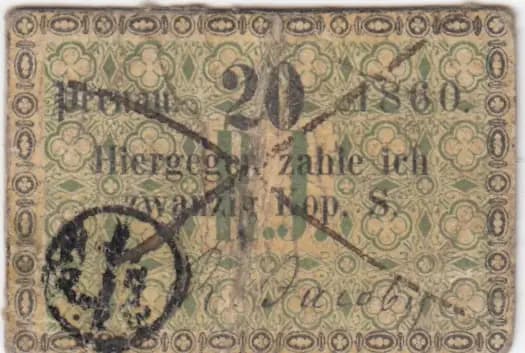
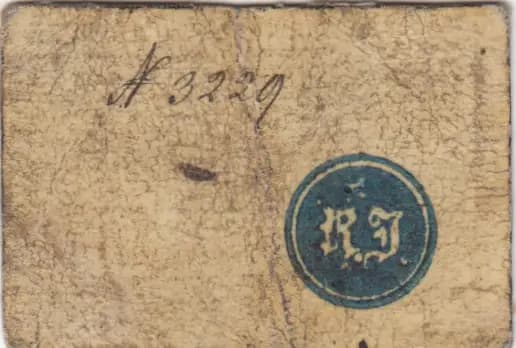
A scarce 1860 Estonian 20 kopeck note from Pärnu featuring an ornate repeating quatrefoil pattern background in pale yellow-green with dark overprinted text. The note exhibits heavy circulation wear with significant foxing, creasing, and age-related deterioration throughout, along with multiple official stamps and handwritten annotations on the reverse. This unlisted Pick variety represents an important transitional document from Estonia's early monetary period under Imperial Russian administration.
scarce. This Pick-unlisted variety from 1860 represents an early transitional banknote from a regional Pärnu issuer during the Russian Imperial period. The unlisted status in standard catalogs, combined with the observed condition showing heavy circulation and institutional handling (evidenced by multiple official stamps and handwritten annotations), indicates limited surviving examples. The specific issuer attribution remains uncertain (marked as '?' in catalog data), suggesting incomplete historical documentation and a restricted print run. However, without documented print quantity data or strong market evidence, the rarity assessment is conservative; similar regional Russian Imperial notes from this era typically appear in the scarce range rather than very rare.
This 1860 banknote was issued during the period when Estonia was part of the Russian Empire, as evidenced by the mixed German-Russian inscription language and the Imperial authority markings visible on the front. The Pärnu issuer and the use of Russian kopeck denomination reflect the economic integration of the Baltic territories into the broader Russian monetary system. The circular official seals and stamps on both sides indicate the administrative oversight and authentication procedures employed by Imperial Russian banking authorities over local financial institutions.
The note features a sophisticated security background consisting of a repeating circular quatrefoil (four-lobed) ornamental pattern in dark ink covering the entire front surface, a common anti-counterfeiting technique of the 1860s period. The denomination '20' and year '1860' are prominently overprinted in dark ink over this patterned background. A circular seal or stamp impression appears on the left side of the front, while the reverse shows a largely plain aged cream-colored paper surface with minimal ornamentation. A blue circular official stamp impression is positioned on the right side of the reverse, featuring Cyrillic inscriptions consistent with Imperial Russian banking authority markings. The handwritten annotation 'Koop.' in the upper left of the reverse suggests this note passed through commercial banking transactions before official archiving.
Front side: '20' (denomination in Arabic numerals), '1860' (year of issue), 'Imperatoris Zahlre ich' (German/mixed language reference to Imperial Authority), 'Kop. S.' (abbreviation for Kopecks). Back side: 'Koop.' (handwritten abbreviation, likely Russian 'Покупка' meaning Purchase or Buying), and Cyrillic characters within the circular official stamp (text unclear due to image quality but consistent with Imperial authentication marks).
The note was produced using relief letterpress printing for the text and denomination overprints, combined with an intaglio or engraved security background pattern featuring the repeating quatrefoil design. The official stamps on both sides appear to have been applied post-printing using circular stamp impressions, with the reverse stamp executed in blue ink typical of official authorization marks. The mixed printing techniques reflect the dual-authority nature of local Pärnu banking under Imperial Russian oversight during this period.
As a Pick-unlisted variety, this note represents an undocumented or inadequately cataloged issue from the Pärnu banking authority in 1860. No standard varieties (by signature, serial number prefix, or known overprint states) can be definitively identified from the visual analysis provided. The presence of multiple official stamps and the handwritten notation suggest this may be a bank-marked or authenticated example, possibly from a bank collection or institutional archive. The specific circular seal impressions visible on both front and reverse may represent identifying marks of particular banking institutions or regional authorities, but their exact significance requires specialist numismatic research into Estonian and Russian Imperial monetary records from this period.