2 kopikat 1918
About This Note
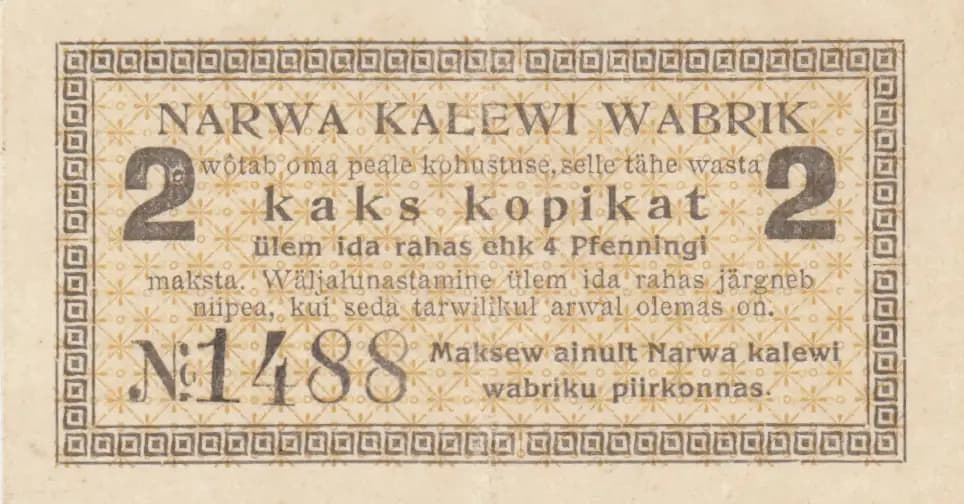
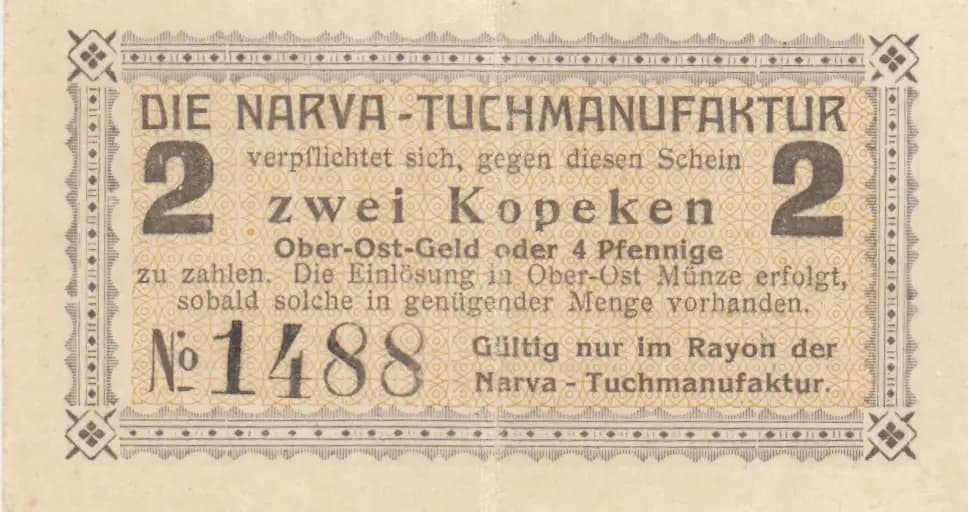
This is a bilingual 2 kopikat emergency banknote issued by the Narva Kalevivabrik (Narva Textile Factory) in 1918, a scarce example of Estonian private emergency currency from the immediate post-war period. The note displays well-preserved Greek key and decorative geometric border patterns in brown and dark gray on beige paper, with matching serial number N°1488 on both sides. In VF condition, it shows expected age-related foxing and discoloration consistent with a century-old paper note, making it an attractive example of early 20th-century Estonian industrial scrip.
Scarce. While not extreme rarities, Estonian private banknotes from 1918, particularly those issued by specific factories like Narva Kalevivabrik and listed as 'unlisted' in Pick catalog (indicating limited documentation and likely small print runs), are substantially less common than official state issues. The lack of catalog listing suggests limited scholarly attention and relatively modest distribution. Notes from this emergency period and issuer typically command moderate collector interest and appear infrequently in the market, making this a worthwhile acquisition for Estonian numismatists despite the Pick number being unlisted.
Issued during the tumultuous period of Estonia's independence struggle and the collapse of German occupation (Ober-Ost), this factory-backed note represents the emergency currency measures adopted by Estonian enterprises when official currency was in short supply. The bilingual format (Estonian and German) reflects the transitional political situation, with German text referencing 'Ober-Ost-Geld' (occupation currency), while the redemption terms note the factory's willingness to convert the scrip into official money once the new Estonian state stabilized. Such private banknotes were typically issued for a limited period and in small quantities, serving as local medium of exchange within the factory district.
A bilingual (Estonian/German) industrial scrip note featuring symmetrical design elements typical of early 20th-century commercial banknotes. The front and reverse both display large denomination numerals '2' positioned in opposing corners, framed by classical Greek key pattern borders rendered in dark brown/gray on a cream-colored background. The reverse side incorporates cross-hatched corner ornaments and double-line geometric border patterns, adding visual sophistication to what was functionally an emergency promissory note. The absence of portraiture or national symbols reflects its purely commercial purpose as factory-issued scrip rather than state-authorized currency. The typography is printed in legible serif fonts appropriate to the period, with the dual-language text emphasizing the transitional political circumstances of 1918 Estonia.
FRONT SIDE: The Narva Textile Factory (Estonian: 'NARWA KALEWEI WABRIK') takes upon itself the obligation to exchange this note for two kopeks in that currency or 4 Pfennigs. Redemption in that currency will follow as soon as it is available in sufficient quantity. Valid only in the Narva textile factory district. Serial number N°1488. BACK SIDE: The Narva Textile Manufactory (German: 'DIE NARVA-TUCHMANUFAKTUR') undertakes to exchange for this note two kopeks in Ober-Ost currency or 4 Pfennigs to pay. Redemption in Ober-Ost currency will take place as soon as sufficient quantities are available. Valid only in the Narva Textile Manufactory district. Serial number N° 1488.
Letterpress printing, evidenced by the crisp, uniform impression of text and decorative borders visible in both the front and reverse sides. The consistent baseline alignment, sharp serifs, and the characteristic embossed appearance of the paper indicate use of movable type and metal ornamental cuts for the border designs. The bilingual composition suggests separate plates or careful typesetting for Estonian and German versions. No security features (watermarks, security threads, intaglio elements) are evident, consistent with emergency industrial scrip of the period.
Serial number N°1488 is the only variety marker visible on this specimen. As a Pick-unlisted note with individual factory issuance, varieties may exist based on different serial number ranges, though documentation is limited. No overprints, date variants, or signature variations are apparent on this note. The bilingual presentation (Estonian obverse / German reverse) appears to be the standard format for this issue rather than a variety marker.