100 marka 1919
About This Note
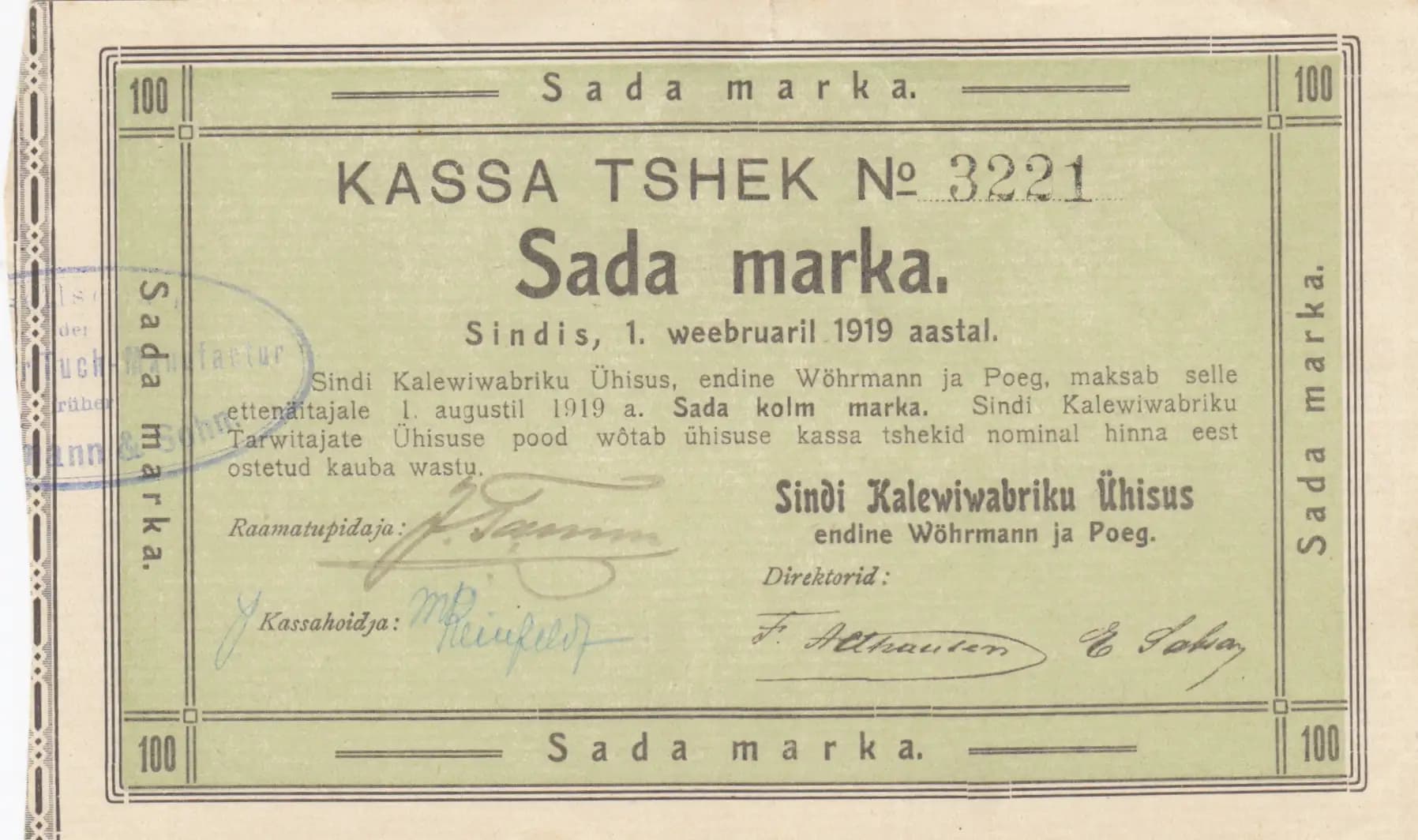
This is a remarkable 100 Marka cash check issued by the Sindi Kaleviwabriku Union (formerly Wöhrmann and Poeg) dated February 1, 1919, representing an unlisted and historically significant piece of early Estonian currency. The note features a cream/beige colored document with formal decorative borders, handwritten signatures from multiple officials (accountant, cashier, and management), and is graded in AU condition despite showing expected age-related patina. This is an exceptionally rare example of a corporate/cooperative emergency currency from Estonia's critical independence period, when such provisional notes were essential during the transition from Tsarist to independent governance.
Very Rare. This Pick-unlisted note represents an early Estonian emergency currency issued by a specific cooperative for a limited duration (redeemable August 1, 1919). The Sindi Kaleviwabriku was a regional factory consumer union, not a national or major bank, meaning print runs would have been modest and primarily circulated within the local Sindi community. As an unlisted variety not catalogued in standard Pick references, and given its early independence-period origin with specific limited redemption terms, this represents a scarce piece of Estonian numismatic history. The AU condition grade also enhances its desirability, as most surviving examples of such emergency notes would show significantly more wear.
This cash check was issued during the tumultuous early months of Estonian independence in 1919, when the newly declared nation faced severe currency shortages and economic disruption. The Sindi Kaleviwabriku (Sindi Kaleviwabriku Consumers' Union) issued this note as an emergency financial instrument, payable on August 1, 1919, redeemable both as currency and for goods at the union store. This document exemplifies how local factories, cooperatives, and consumer unions filled the monetary vacuum created by the collapse of the Russian Imperial system and before Estonia's own official currency could be fully established.
This is a formal business document-style emergency currency note measuring standard letter proportions. The front features a classical decorative border frame with corner ornaments containing the denomination '100' in each corner square. The design employs a minimal aesthetic typical of wartime and emergency currency production, relying on typography and official-looking layout rather than elaborate engraving. The cream/beige background provides contrast for the black printed text in Estonian (using the older German-influenced orthography common to the period, such as 'w' for 'v' and 'ü' for 'ü'). Multiple handwritten signature lines in three distinct positions (accountant, cashier, and directors) authenticate the document. A library or archival stamp visible in the upper left indicates this note has museum/archival provenance. No portraits, allegorical figures, or recognizable landmarks are depicted; instead, the document's authority derives from the institutional letterhead and the signatures of responsible officials.
FRONT SIDE: Principal inscription: 'Sada marka' (One Hundred Marks). Document type and serial: 'KASSA TSHEK N° 3221' (CASH CHECK No. 3221). Date and location: 'Sindis, 1. weebruaril 1919 aastal.' (In Sindi, 1st February 1919). Main body text: 'Sindi Kalewiwabriku Ühisus, endine Wöhrmann ja Poeg, maksab selle ettenäittajale 1. augustil 1919 a. Sada kolm marka. Sindi Kalewiwabriku Tarwitajate Ühisuse pood wõtab ühisuse kassa tshekid nominal hinna eest ostetud kauba wastu.' (Sindi Kalewiwabriku Union, formerly Wöhrmann and Poeg, pays the bearer one hundred marks on August 1st, 1919. The Sindi Kalewiwabriku Consumer Union store accepts union cash checks at nominal price for purchased goods.) Issuer identification: 'Sindi Kalewiwabriku Ühisus / endine Wöhrmann ja Poeg.' (Sindi Kalewiwabriku Union / formerly Wöhrmann and Poeg). Signature lines: 'Raamatupidaja:' (Accountant:), 'Kassahoidja:' (Cashier:), 'Direktooria:' (Management/Directors:). BACK SIDE: Blank or heavily faded with no legible inscriptions.
This note was produced using letterpress (relief) printing for the primary text and border design, combined with manual handwritten signatures and official stamps. The crisp black text against the cream paper, the consistent letterforms, and the decorative border ornaments all indicate professional commercial printing equipment typical of Estonian printeries in 1919. No security printing features, watermarks, or advanced security measures are evident—reflecting both the emergency nature of the issue and the technological capabilities of Estonian printers during this period. The printer is not identified on the note itself, though it would have been a local Sindi or Estonian-based printing establishment.
This specific note is Cash Check No. 3221, dated February 1, 1919, with a redemption date of August 1, 1919. Multiple handwritten signatures appear on the note, suggesting this variety may be identifiable by the specific officials who signed it. The use of older Estonian orthography (German-influenced spelling conventions) and the February 1919 date place it among the very earliest Estonian independence-period issues. As an unlisted Pick variety, additional examples with different check numbers or signature combinations may exist, constituting distinct sub-varieties. The presence of an archival stamp suggests institutional documentation of this issue's rarity and historical importance.