100 marka 1920
About This Note
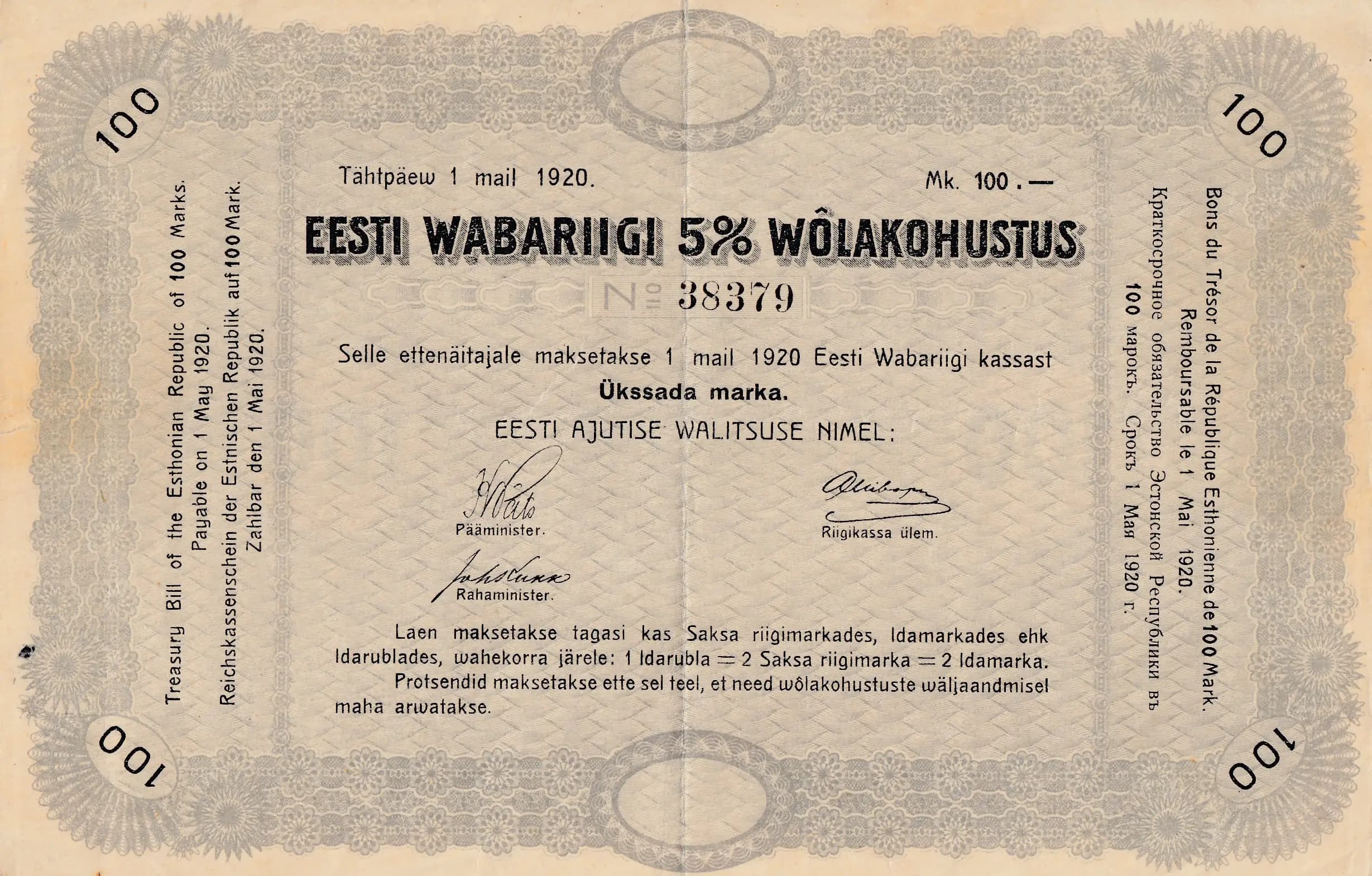
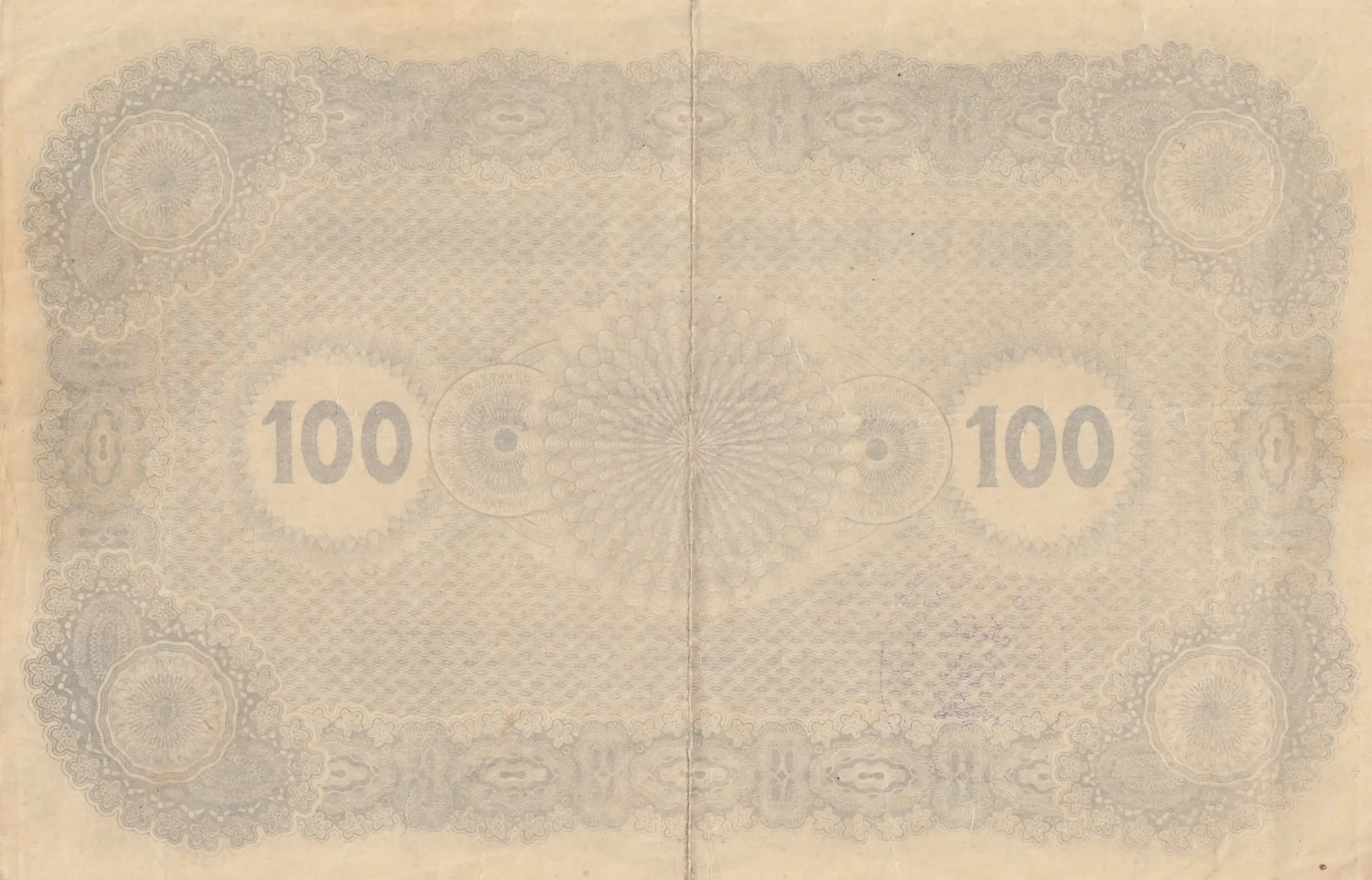
This 100 Marka banknote from Estonia dated 1 May 1920 represents an important early issue of the newly independent Estonian Republic's provisional government debt obligations. The note displays excellent preservation in VF condition with clear ornate decorative borders, visible security features including watermarked corner medallions and central '100' denominations, and a characteristic vertical center fold typical of period handling. The multilingual inscriptions in Estonian, German, and French reflect Estonia's complex post-WWI position and make this an interesting artifact of the nation's transition to independence.
Common. This is an early issue of the Estonian Provisional Government from 1920, and while historically significant, it was issued in substantial quantities as a debt obligation. No indicators of limited print runs, special varieties, or recall status are evident. The denomination (100 Marka) was a standard high-value denomination likely produced in volume to finance government operations during the transition period. The condition, while fine, is not exceptional enough to warrant a rarity premium, and examples appear with reasonable regularity in the market.
Issued by the Estonian Provisional Government on 1 May 1920, this 5% debt obligation represents the newly independent Estonian Republic's early financial instruments following independence from the Russian Empire (declared 24 February 1920). The multilingual text in Estonian, German, and French on both sides reflects the geopolitical tensions and currency exchange complexities of the immediate post-war period, with specific provisions for redemption in German state marks, Eastern marks, or Eastern rubles—demonstrating the unstable monetary landscape of early 1920s Eastern Europe. The formal signatures of the Prime Minister, Finance Minister, and State Treasurer underscore the legitimacy the provisional government sought to establish for these obligations.
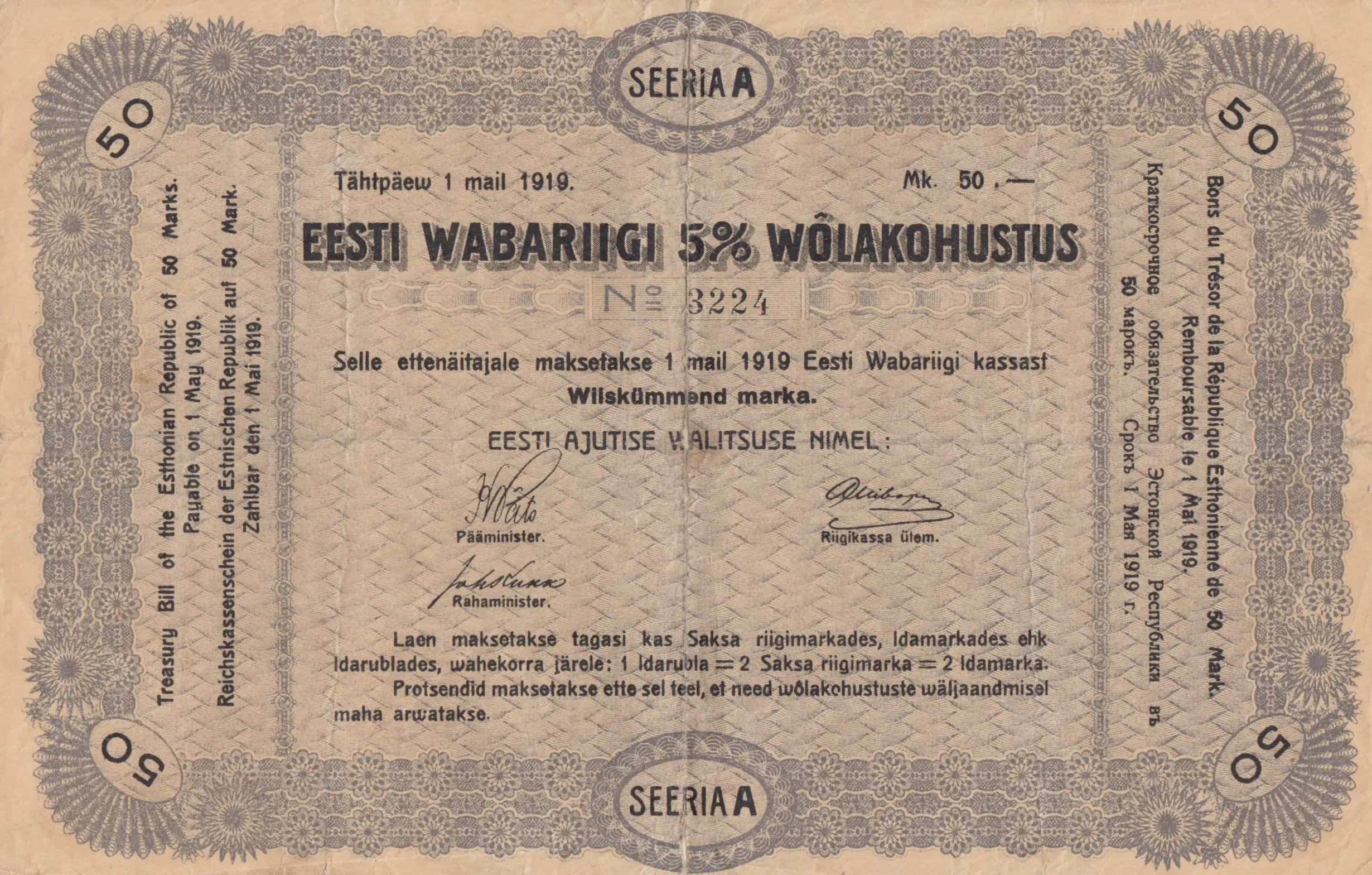
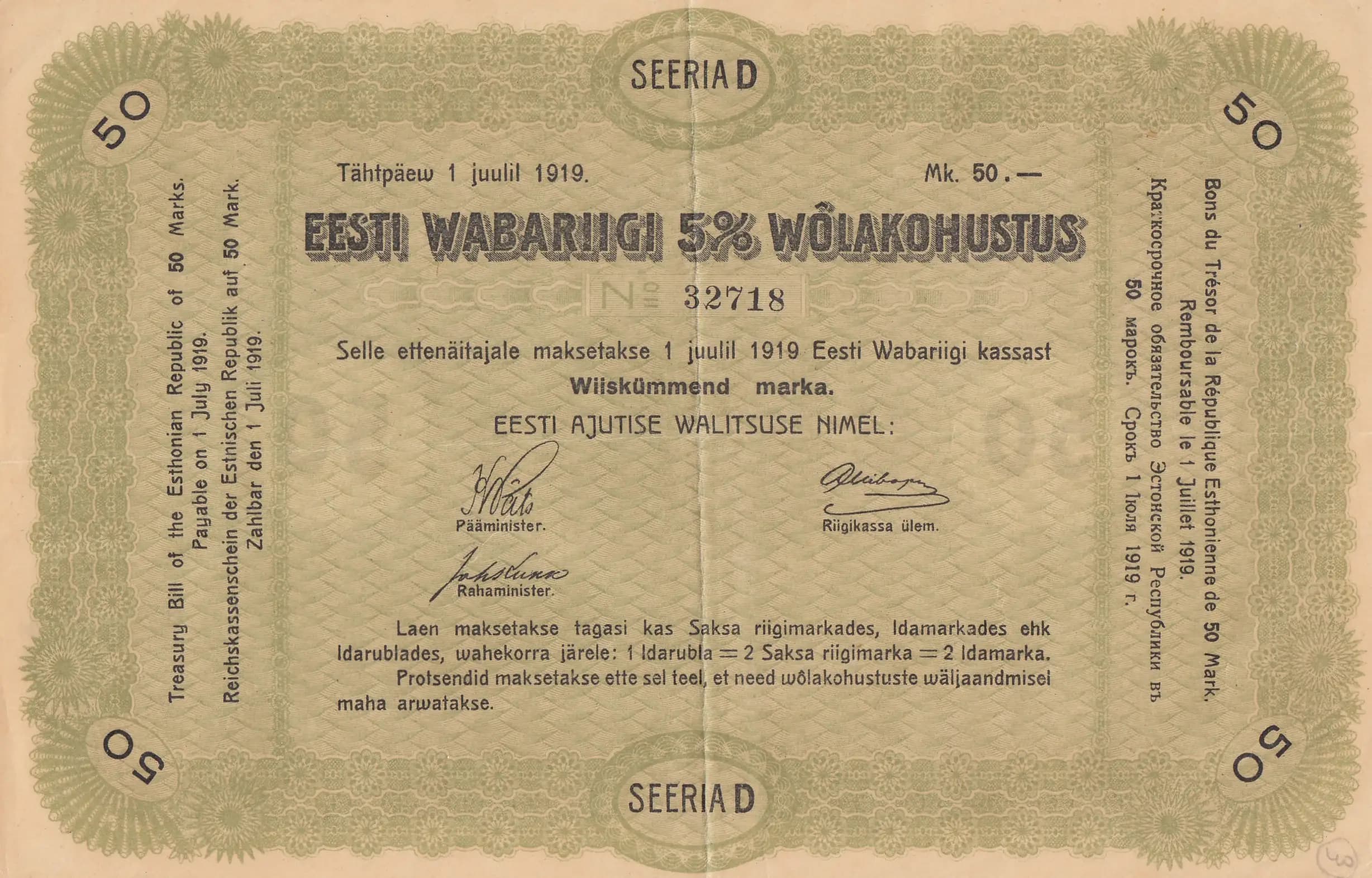
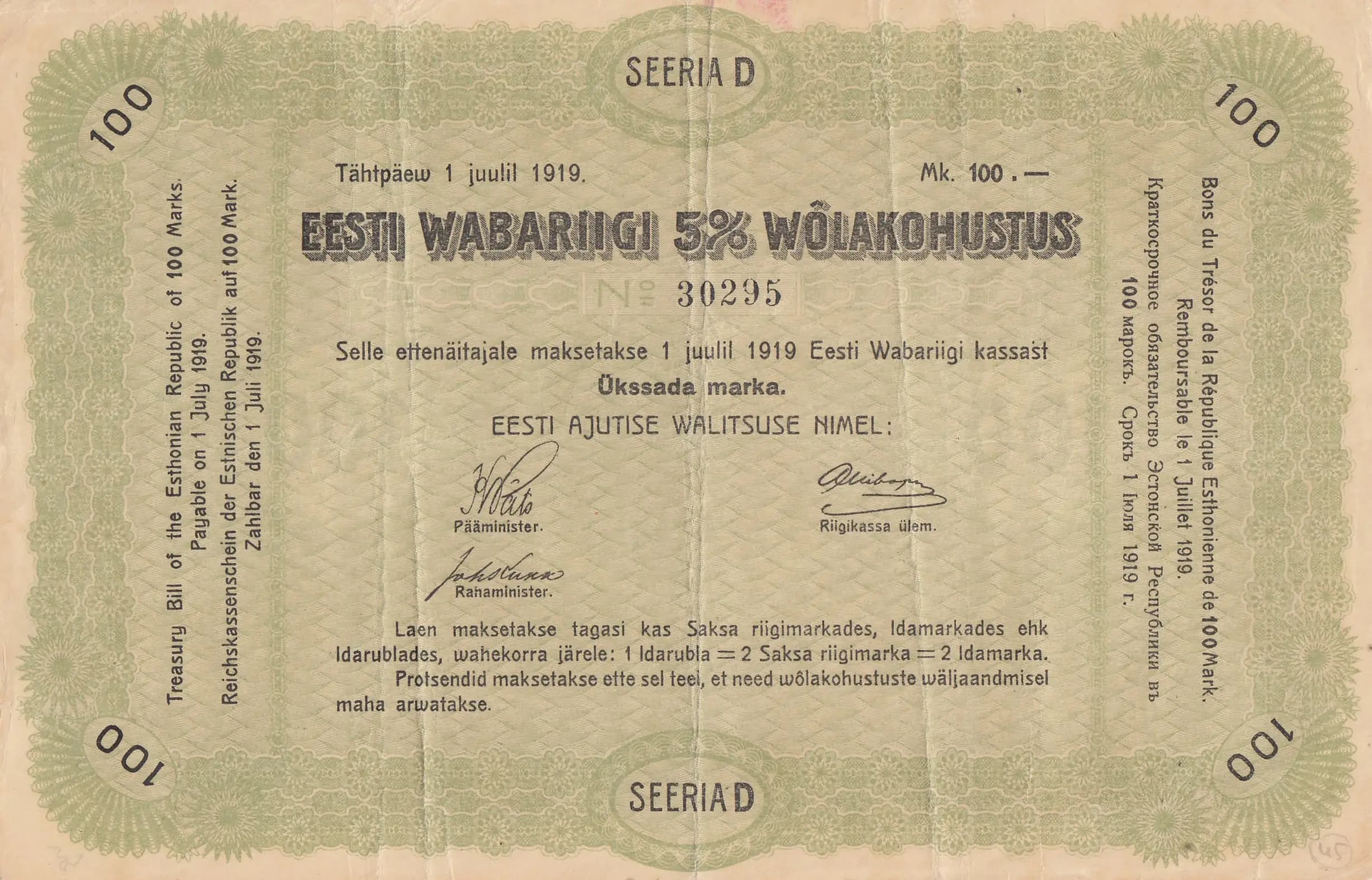
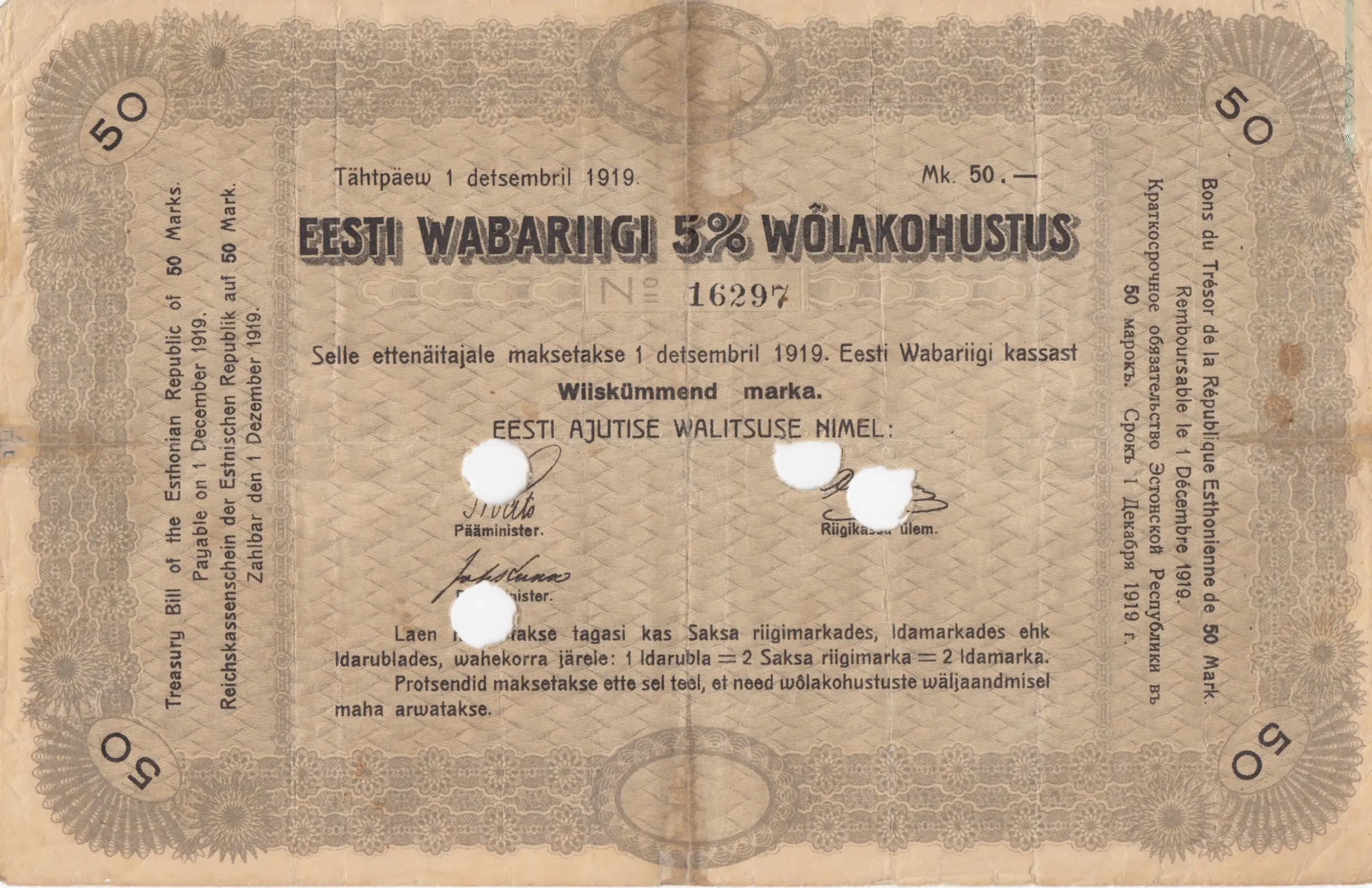
This is a debt obligation certificate rather than traditional currency, reflecting Estonia's financial situation in 1920. The front features an elaborate ornamental border with intricate floral and geometric patterns in black ink on a tan/beige field, with corner numerals '100' in all four positions for easy denomination identification. Two oval seal medallions appear at top and bottom center, likely representing official government seals. The design emphasizes security through detailed fine-line border work and multiple decorative fan-like corner patterns. The back presents a more austere design with circular watermark medallions in each corner and a symmetric ornamental frame, featuring prominent watermarked '100' denominations visible from both sides—a key security feature of the period. The overall layout suggests this was intended as a negotiable instrument of significant value requiring multiple authenticity markers.
FRONT SIDE: Principal text reads 'EESTI WABARIIGI 5% WÕLAKOHUSTUS' (Estonian Republic 5% Debt Obligation) with denomination 'Ükssada marka' (One hundred marks) and 'Mk. 100.—'. The redemption clause states: 'Selle ettenäitajale maksetakse 1 mail 1920 Eesti Wabariigi kassast' (This will be paid to the bearer on 1 May 1920 from the Estonian Republic treasury). Authority is given as 'EESTI AJUTISE WALITSUSE NIMEL' (In the name of the Estonian Provisional Government) with signature lines for 'Pääminister' (Prime Minister), 'Rahaminister' (Finance Minister), and 'Riigikassa ülsem' (State Treasurer). Exchange provisions state: 'Laen maksetakse tagasi kas Saksa riigimärkades, Idamärkades ehk Idarublades, wahekorra järele: 1 Idarubla = 2 Saksa riigimarka = 2 Idamarka' (Loan repaid in German state marks, Eastern marks or Eastern rubles, according to the rate: 1 Eastern ruble = 2 German state marks = 2 Eastern marks). Interest note: 'Protsendid maksetakse ette sel teel, et need wõlakohustuste wäljäandmisel maha arwaitakse' (Interest is paid in advance by deducting it from the issuance of these debt obligations). Multilingual headers in English ('Treasury Bill of the Patuate on May 1 1920'), German ('Reichskassenschein der Estinischen Republik au/1 1920'), and French ('Bons de Trésor de la République Estonienne de 1 Mai 1920'). Serial number 'N° 38379' appears on front. BACK SIDE: Only denominations '100' visible in watermark positions on left and right sides.
The note exhibits characteristics of intaglio (engraved) printing, evidenced by the fine, crisp line work throughout the ornate borders and the sharp definition of the decorative patterns. The depth of the black ink impression and the precise detail in the corner medallions and fan patterns are consistent with engraving. The watermarks visible on the back (particularly the '100' denominations and corner medallions) indicate paper watermarking as an integrated security feature. The quality and consistency of the printing suggest production by an established security printer familiar with bond and currency work, likely a European firm with expertise in government financial instruments. No specific printer attribution is visible in the inscriptions.
This specific note is serial number 38379, issued under the Estonian Provisional Government on 1 May 1920. Known varieties of this Pick number may include different serial number ranges or signature combinations corresponding to different government officials serving as Prime Minister, Finance Minister, and State Treasurer during 1920. The date of issue (1 May 1920) appears fixed on this denomination, though other dated variants may exist. No overprints or corrections are evident on this specimen.