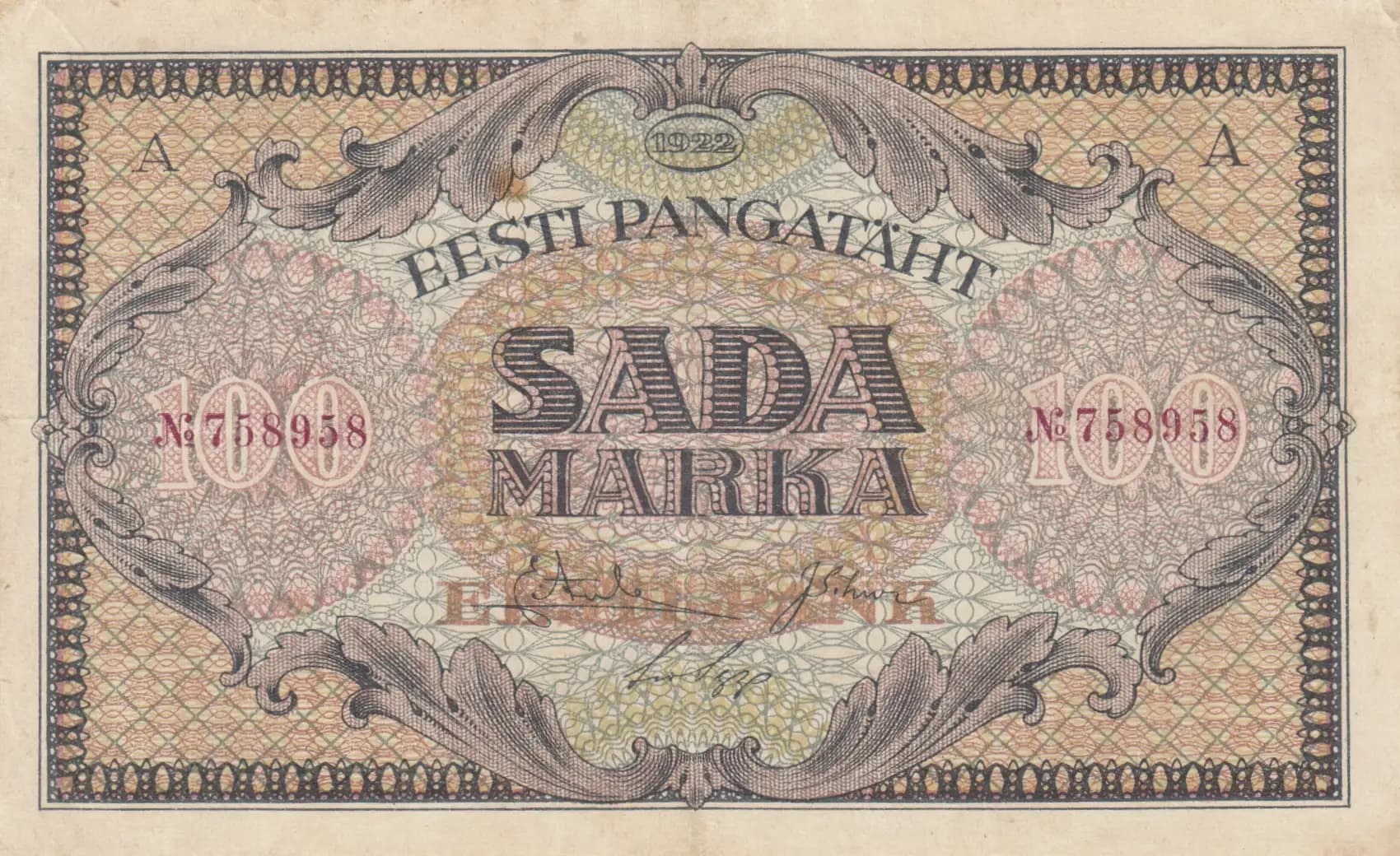
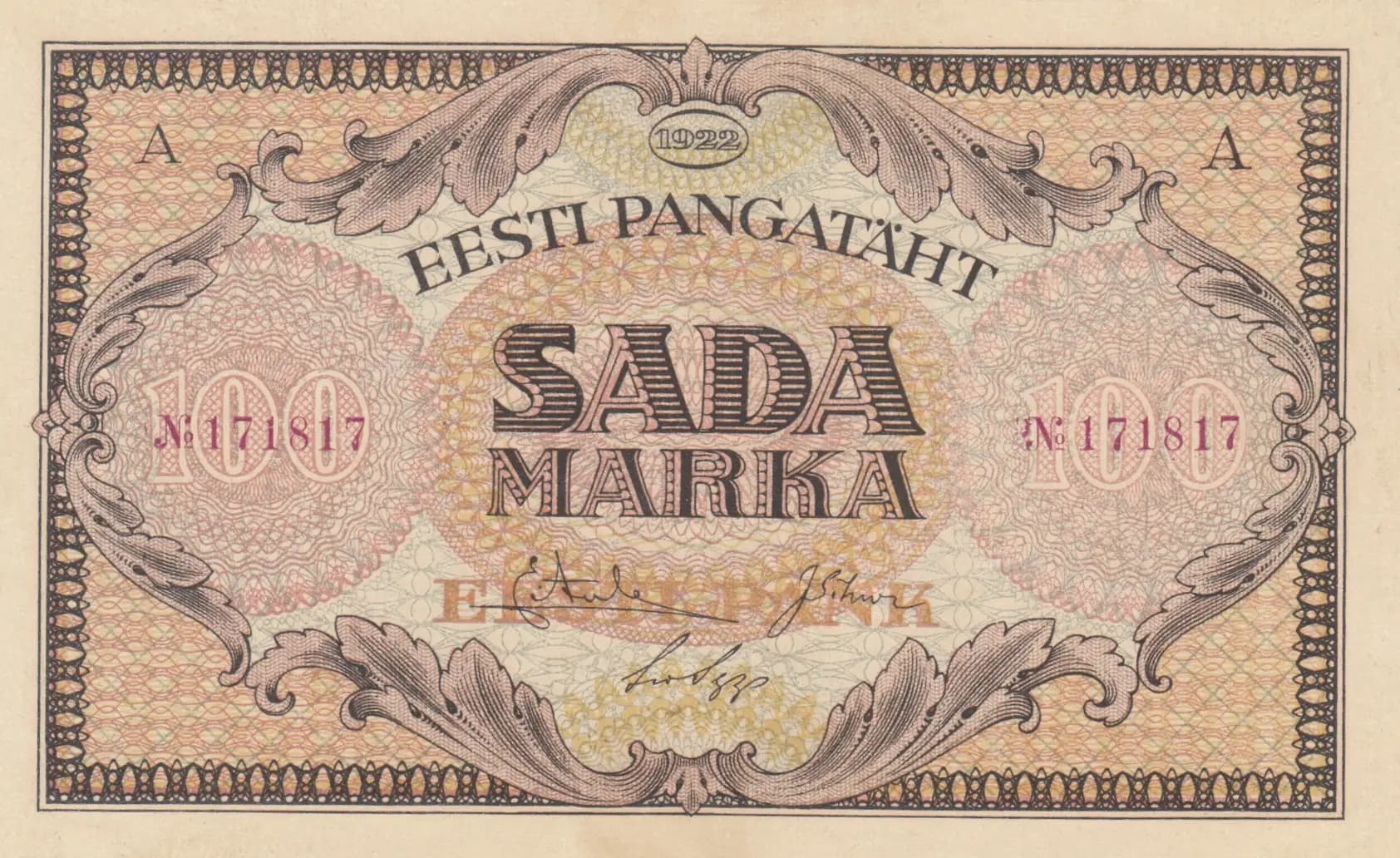
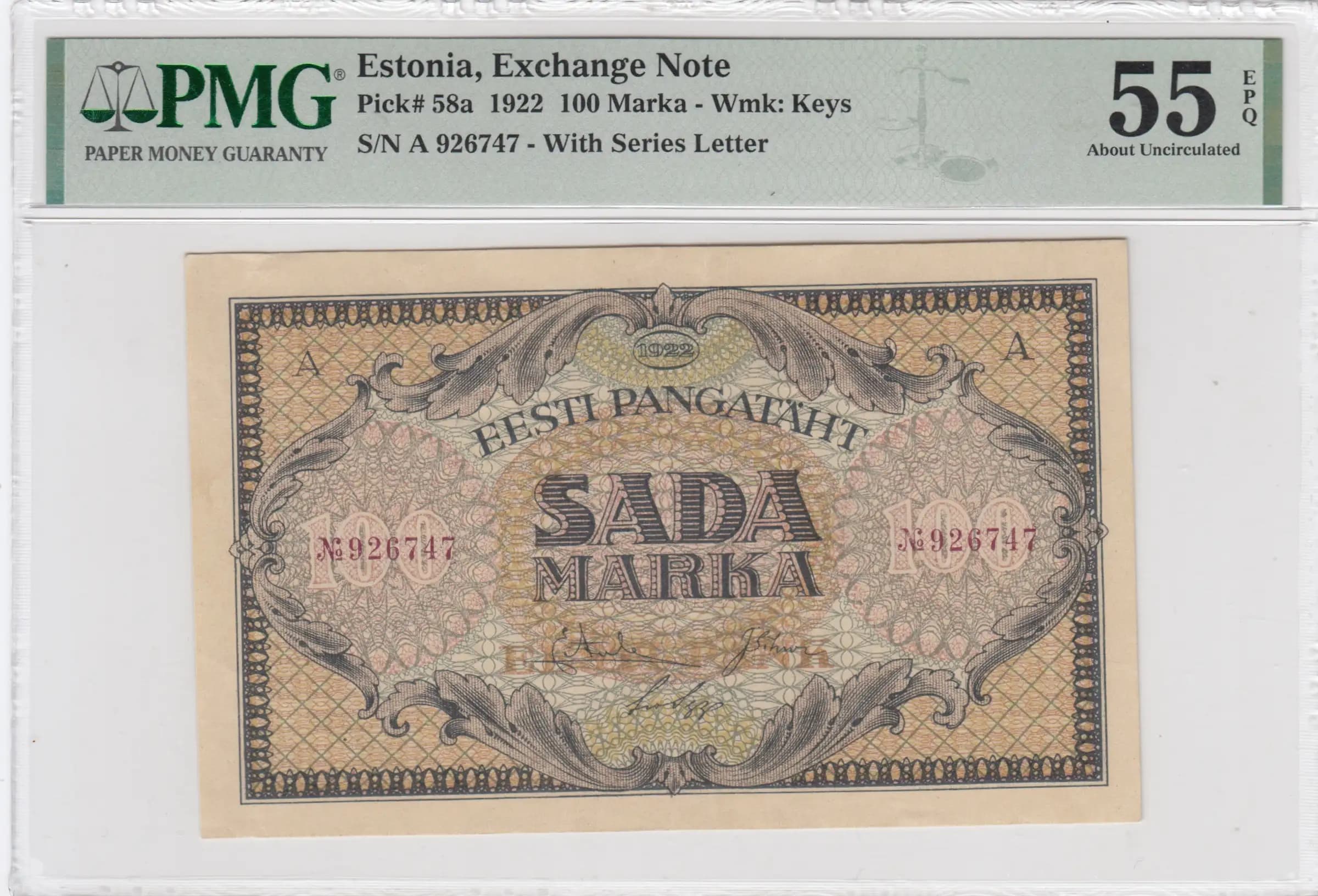
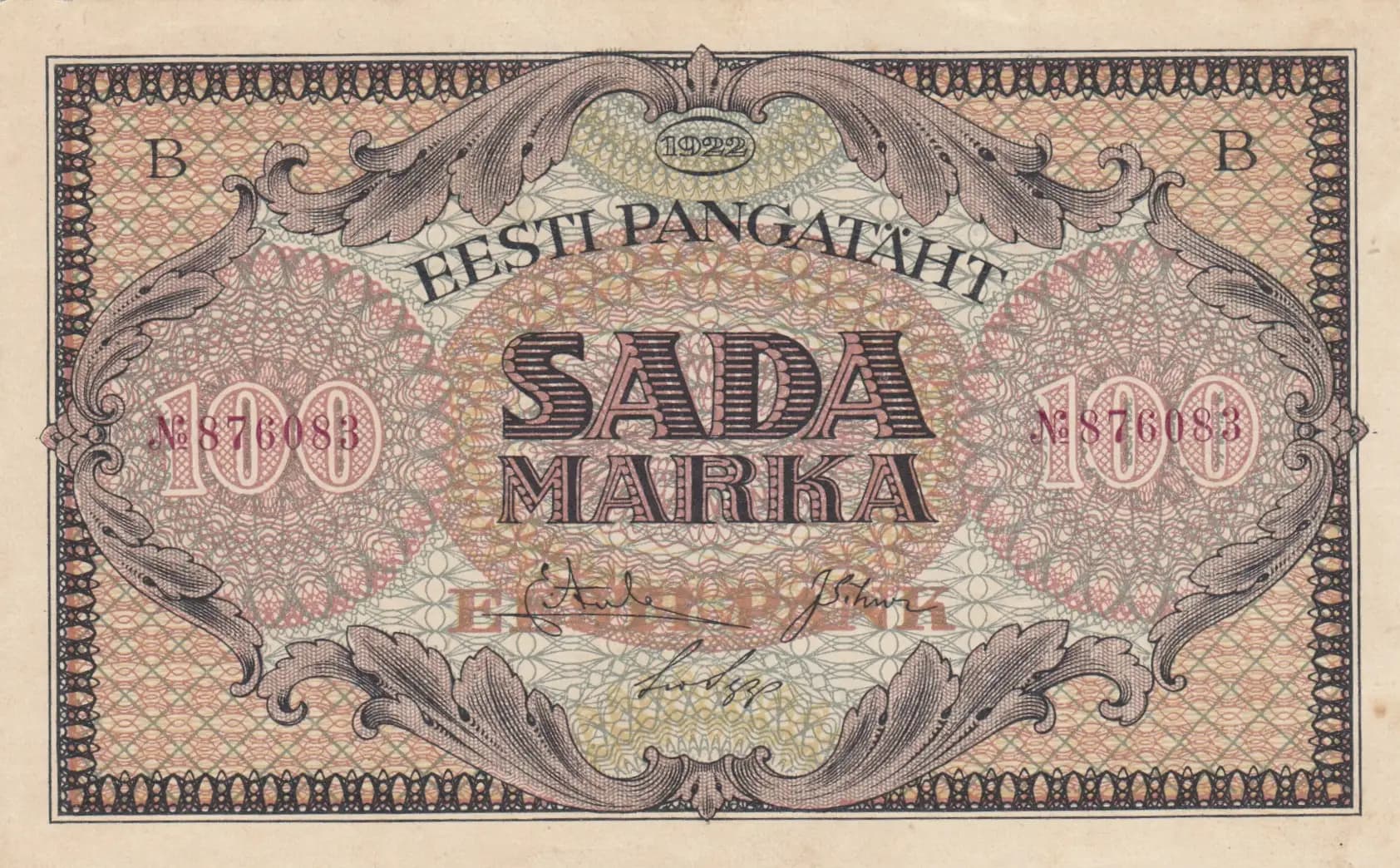
100 marka 1922
“serie E”
Market Prices
2 salesAbout This Note
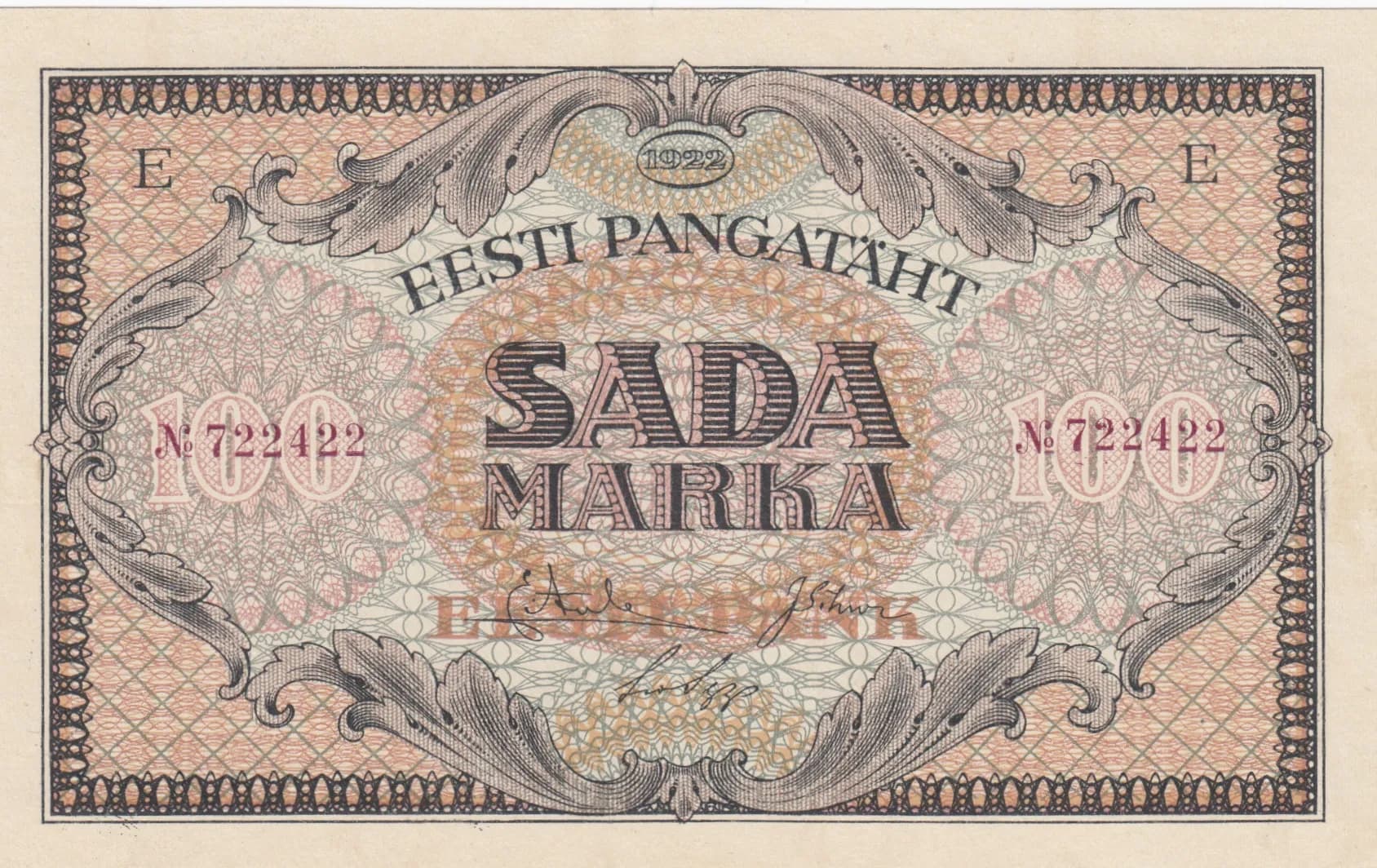
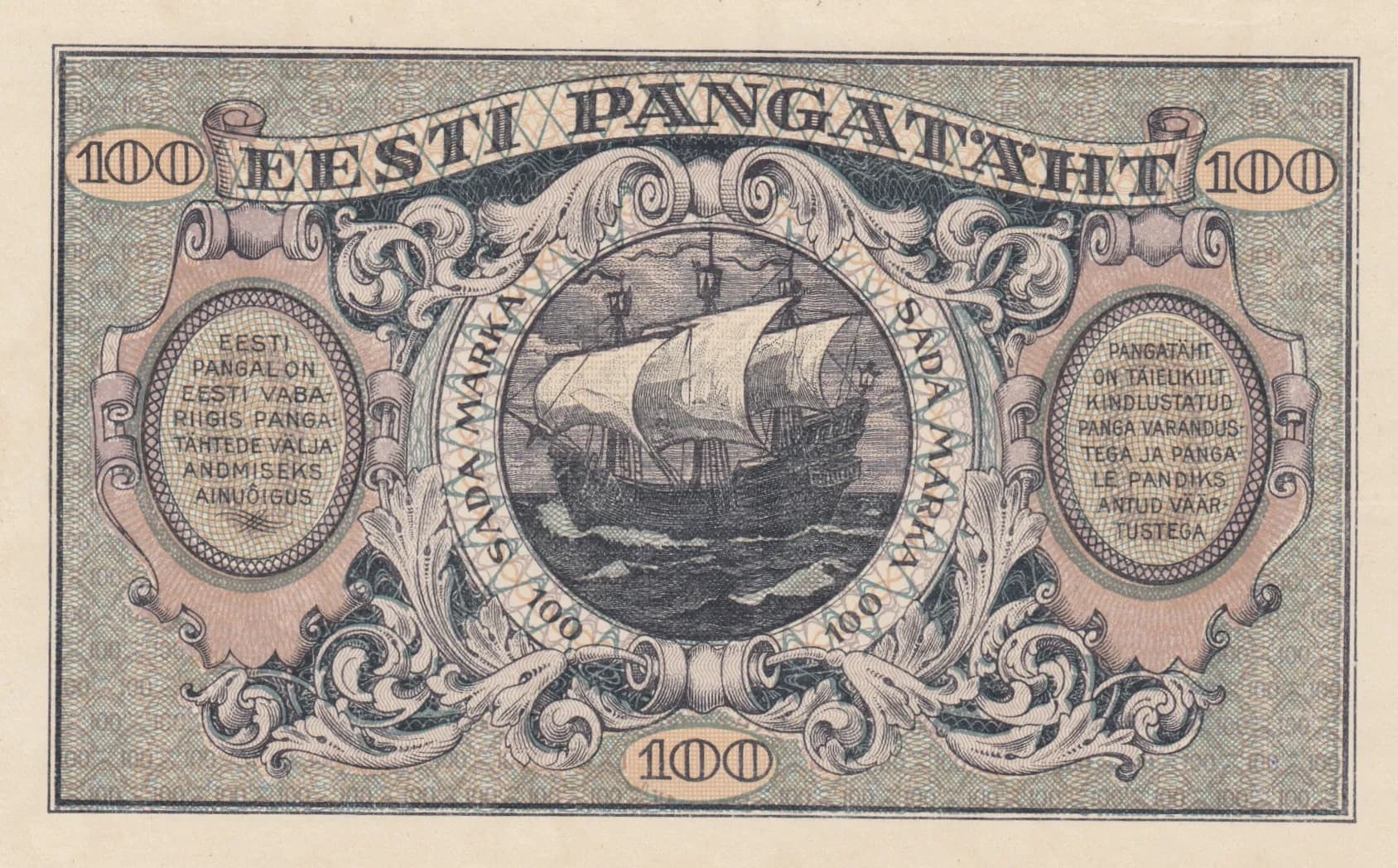
This is a stunning example of an Estonian 100 Marka note from 1922 (Pick-58), issued by the Treasury of Estonia during the nation's early independence period. The note is in uncirculated condition with pristine paper, sharp impressions, and no visible wear, displaying the characteristic peachy-tan color palette and intricate engraving work typical of early Estonian currency. The front features an impressive spread-winged eagle centerpiece with elaborate baroque scrollwork, while the reverse showcases a detailed three-masted sailing ship within an ornamental circular vignette—powerful national symbols reflecting Estonia's maritime heritage and newly-won sovereignty.
Common. The 100 Marka denomination from 1922 was part of the initial currency issue for the newly independent Estonian state and saw substantial circulation during the 1920s before currency reforms. While early Estonian banknotes have collector interest, this denomination and Pick number are regularly encountered in international banknote markets, particularly in uncirculated condition. Series E notes are among the more commonly seen series designations for this issue, indicating normal production quantities for the period.
This note was issued in 1922, just four years after Estonia declared independence from Russia in 1918, during the critical period of establishing national institutions and currency. The sailing ship depicted on the reverse represents Estonia's historical maritime traditions and economic aspirations, while the eagle on the front symbolizes national sovereignty and strength. The ornate baroque design aesthetic reflects both European banknote traditions and Estonia's desire to establish itself as a modern, culturally sophisticated European nation following the upheaval of World War I and Russian Revolution.
The front of this note features a symmetrical design dominated by an imperial eagle with spread wings positioned at the top center, flanked by elaborate baroque scrollwork and geometric ornamental borders. The background employs fine geometric patterns throughout, with the primary text 'SADA MARKA' and 'EESTI PANGATAHT' prominently displayed in the center field. The reverse is anchored by a detailed circular vignette containing a three-masted sailing ship (clipper or merchant vessel) rendered in fine engraving, depicted on water with full sail configuration. This central maritime vignette is surrounded by baroque flourishes and flanked by two oval cartouches containing the legal backing text. The denomination '100' appears in three decorative ovals positioned at top-left, top-right, and bottom-center. The overall color scheme combines tan/beige backgrounds with black and dark brown engraving, creating strong contrast and visual impact characteristic of early 20th-century currency design.
FRONT: 'EESTI PANGATAHT' (Estonian Bank Note) / 'SADA MARKA' (One Hundred Marks) / Serial number 'N°722422' / Series letter 'E'. BACK: 'EESTI PANGATAHT' (Estonian Bank Note) / '100' (denomination in decorative numerals, appearing three times) / 'SADA MARKA' (One Hundred Marks, in circular banner) / Left cartouche: 'EESTI PANGAL ON EESTI VABA RIIGIS PANGA ANTIIS VALLA HULKA KUULUMISED AINUOIGUS' (The Estonian Bank has exclusive rights to issue bank notes in the free Estonian state) / Right cartouche: 'PANGATAHT ON TAIELIKULT KINDLUSTATUD PANGA VARANDUSE TEGA JA PANGA LE PANDIKS ANTIUD WAAR TUSTEGA' (The bank note is fully secured by the Bank's assets and goods pledged to the Bank).
This note was produced using intaglio (steel engraving) printing, evidenced by the extremely fine line work, detailed geometric patterns, elaborate baroque ornamentation, and the crisp, sharp impressions visible throughout both sides. The precise rendering of the three-masted sailing ship and the eagle with delicate wing feather details are hallmarks of intaglio printing. For Estonian currency of this period, the note was likely printed by a major European security printer; the Reichsdruckerei (German State Printing Office) printed early Estonian banknotes, though confirmation for this specific Pick number would require archival documentation. The fine-line background patterns and complex ornamental design served as contemporary anti-counterfeiting measures.
This note is identified as Series E based on the series letter visible in the upper left portion of the front. Early Estonian banknotes from 1922 were issued in multiple series (A through E and possibly beyond), with different series designations reflecting sequential printing runs. The serial number 722422 is within the range typical for Series E notes. No major over-prints, date variations, or signature varieties are apparent on this particular example, making it a standard variety of the Pick-58 type.