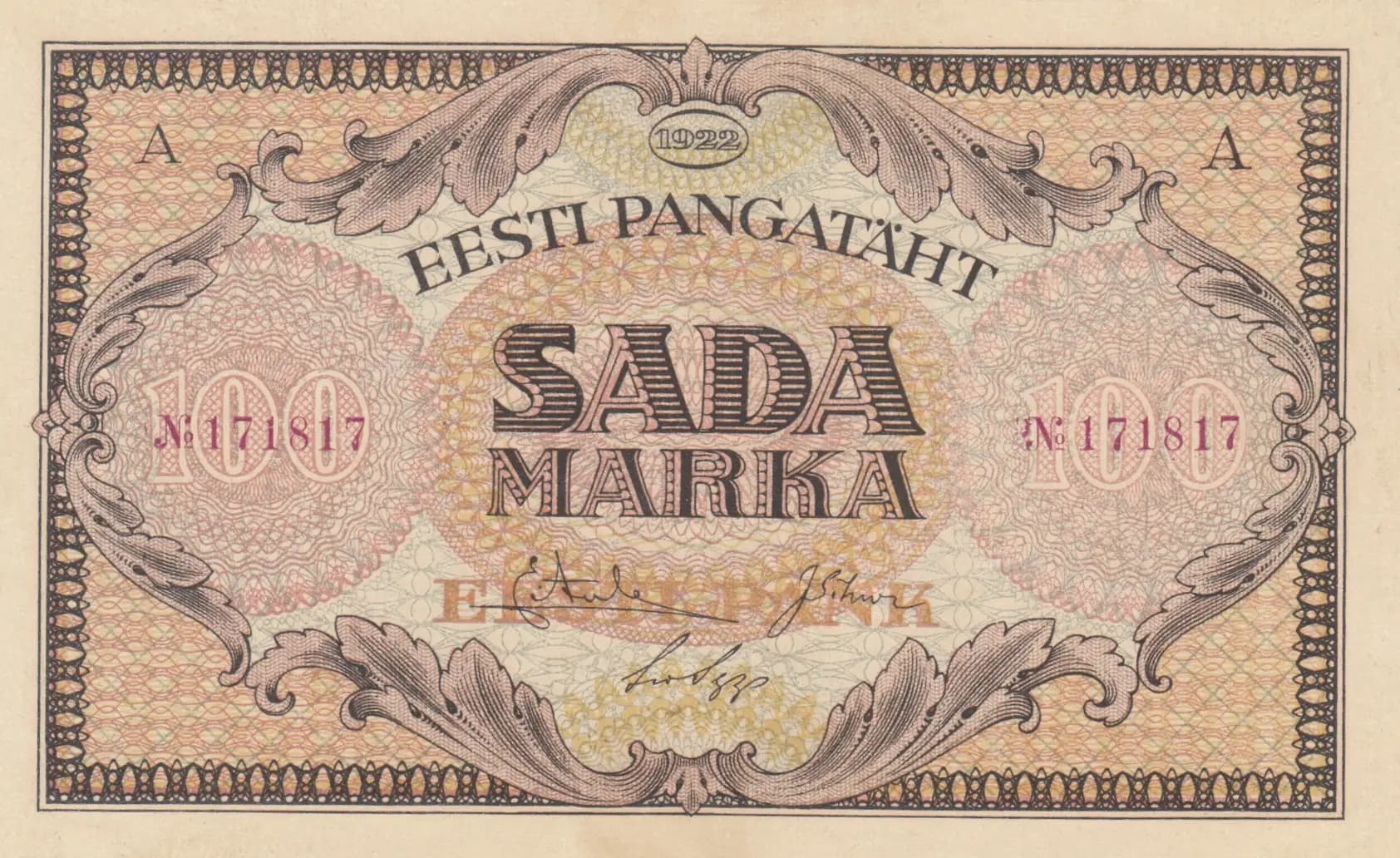
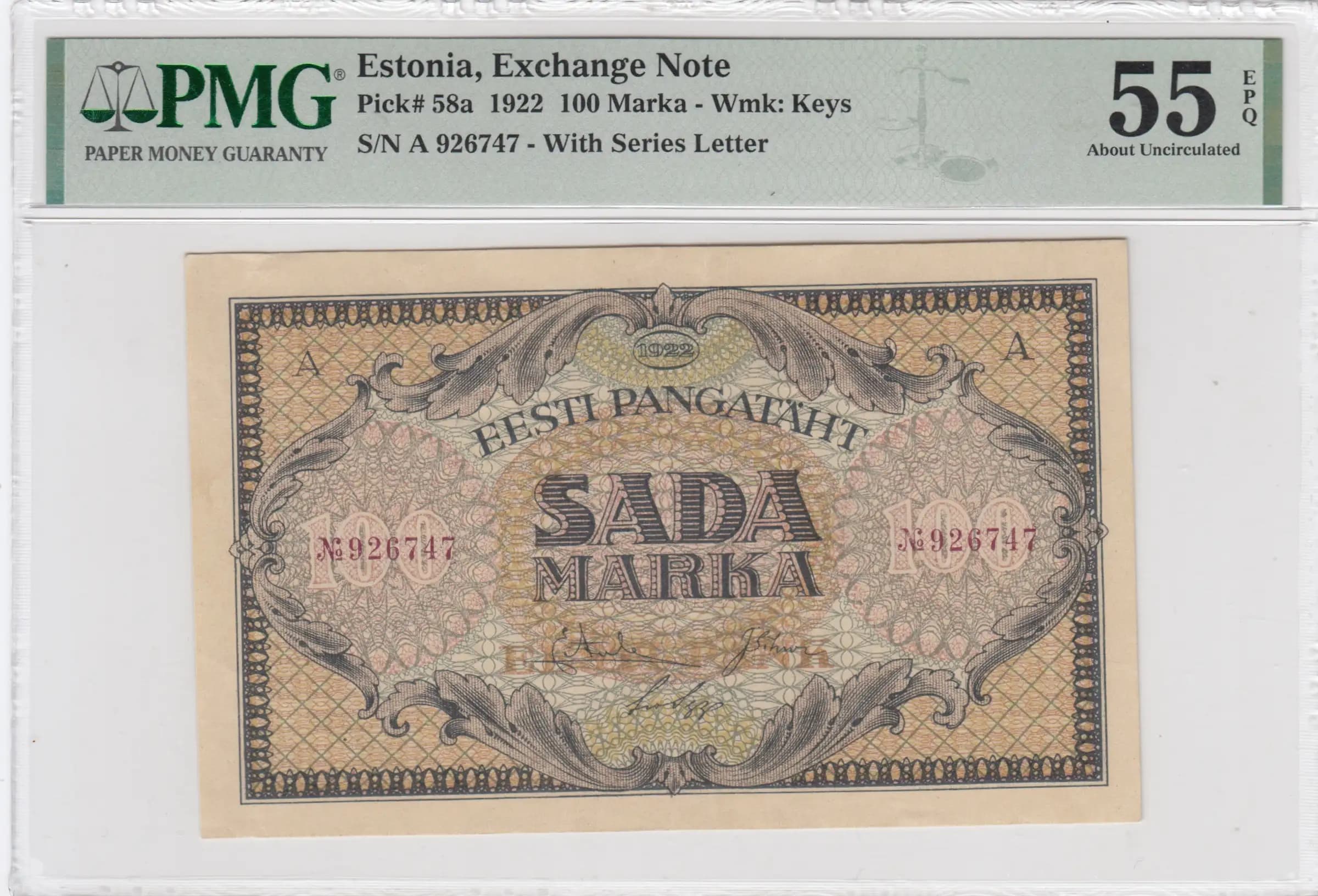
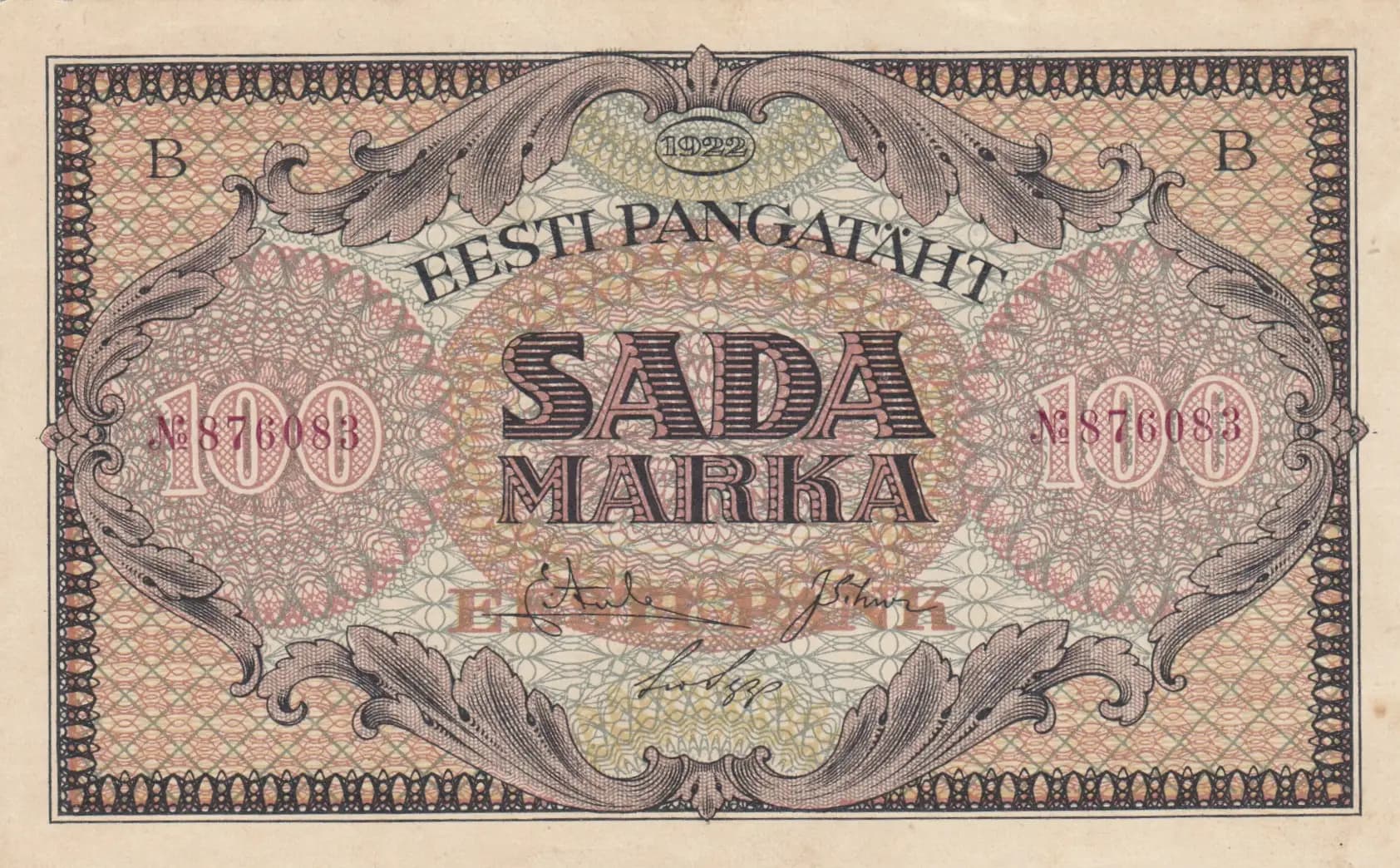
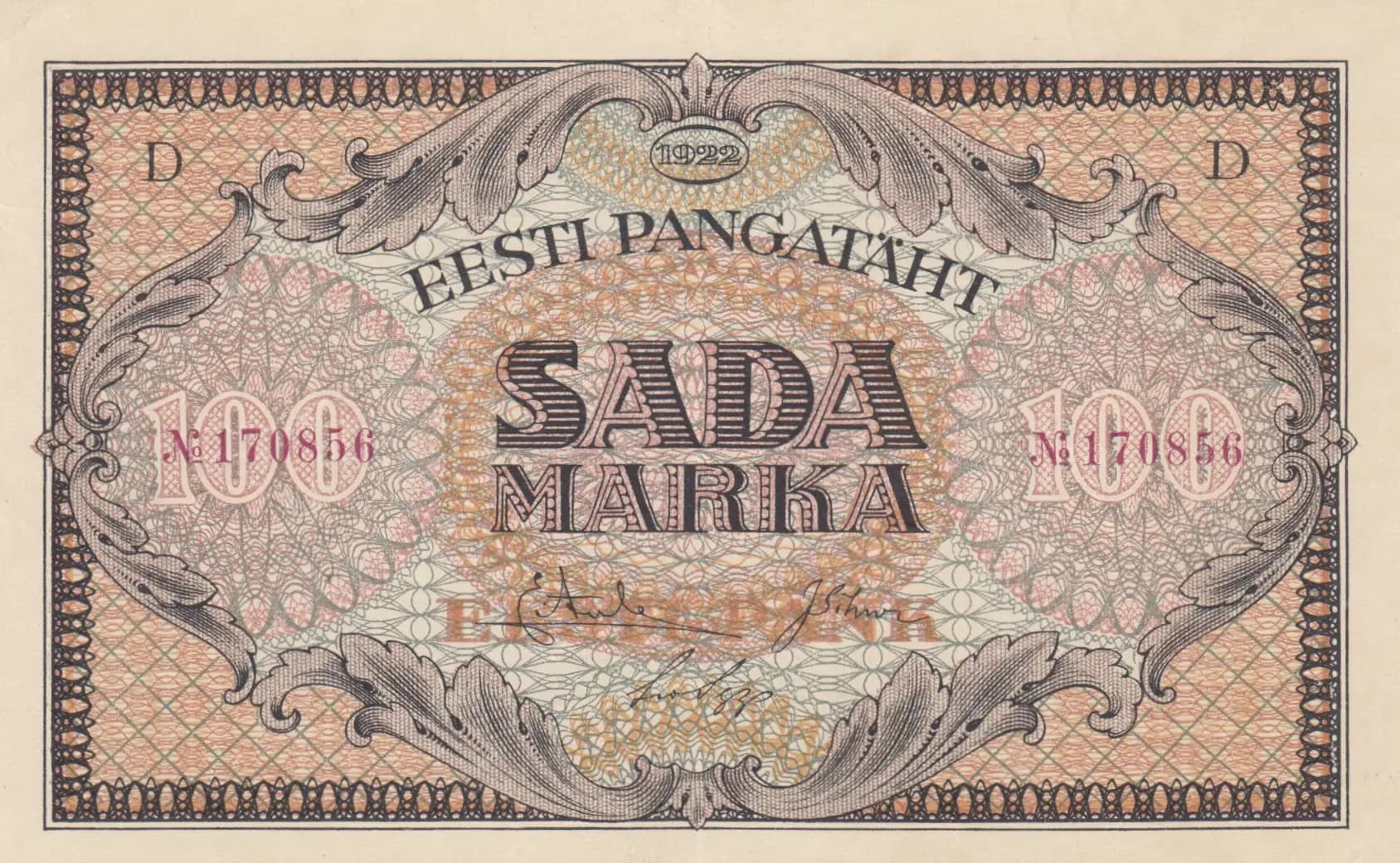
100 marka 1922
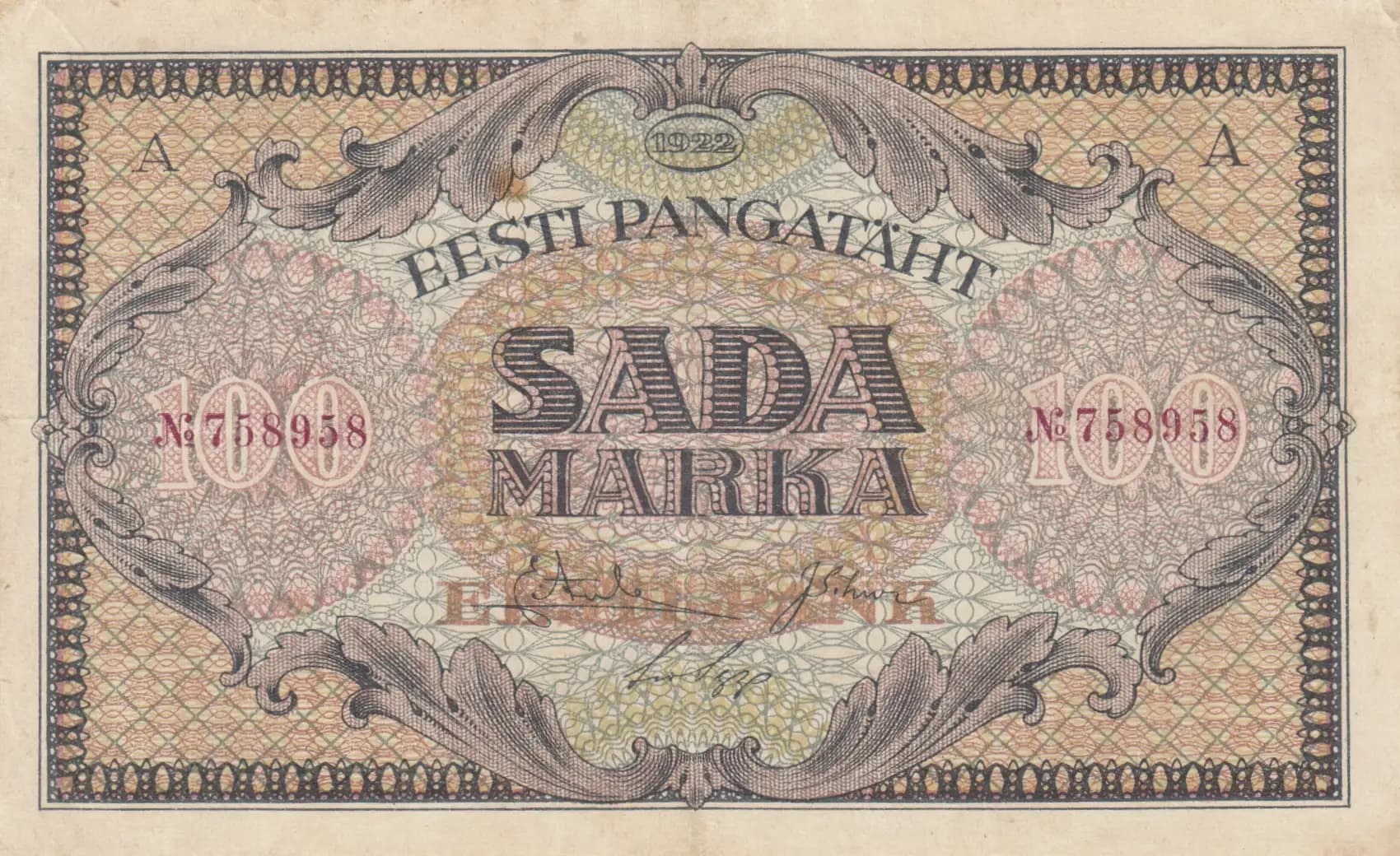
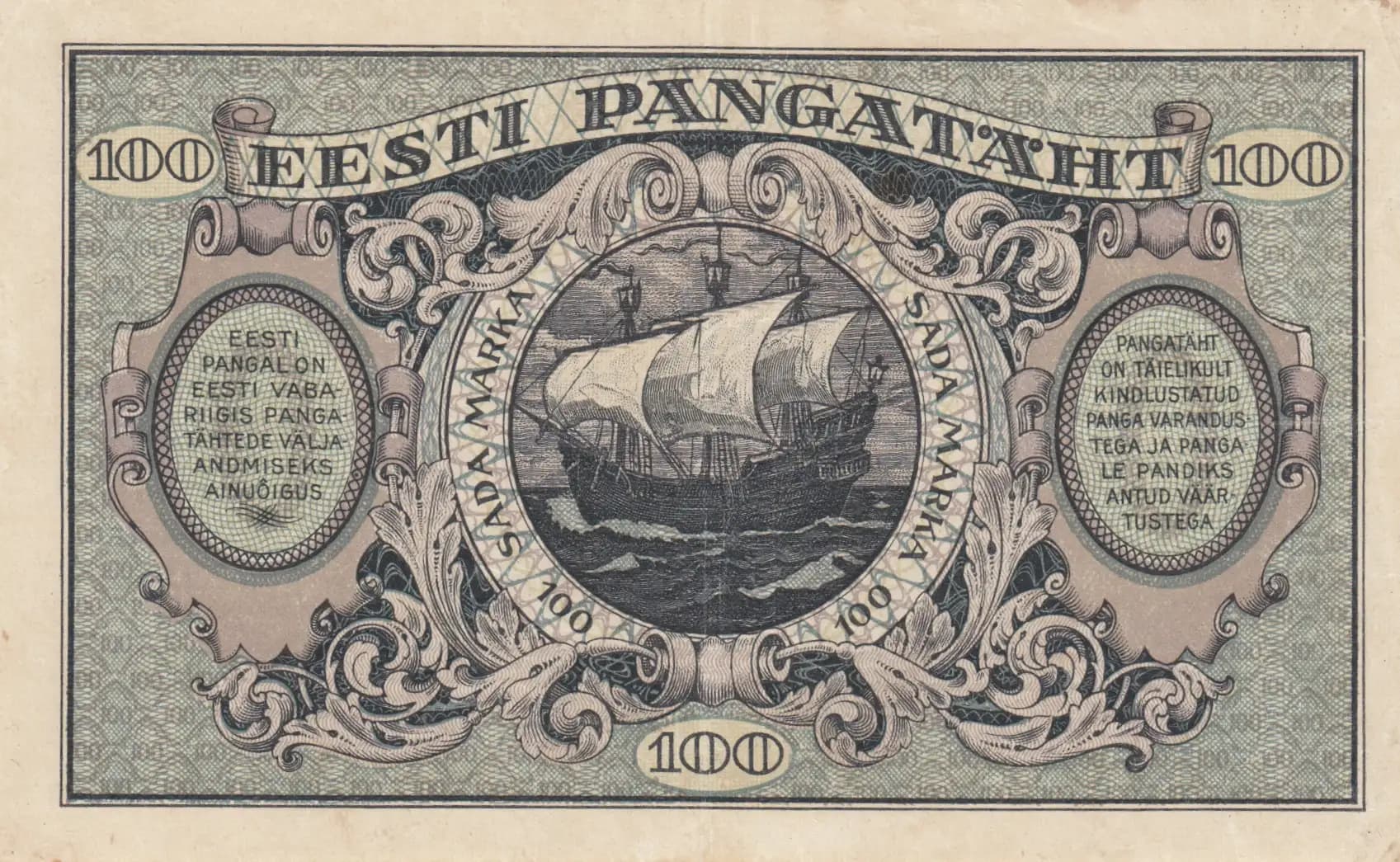
“serie A”
Market Prices
2 salesAbout This Note
This Estonia 100 Marka from 1922 presents in VF condition with the characteristic aging patina of early twentieth-century Estonian currency. The note displays the distinctive lilac, brown, and green underprint on the obverse with bold 'SADA MARKA' denomination text, while the reverse showcases a detailed Hanseatic galleon vignette within ornate baroque scrollwork—a powerful symbol of Estonia's mercantile heritage and independence aspirations. Visible foxing and creasing throughout reflect authentic circulation history, with the intricate line engraving remaining sharp and well-preserved despite the note's age.
Common. The eBay pricing data indicates relatively consistent market availability with F-grade examples selling for approximately $160 and VF examples estimated at $500 (2016 catalog values). This range reflects steady collector demand without significant scarcity premiums. As a regular-issue banknote from a sovereign state with substantial print runs during the early independence period (1922), this Pick 58 represents standard circulation stock rather than a limited or recalled issue. The availability of multiple graded examples and consistent eBay transaction history confirm common-grade classification.
Issued in 1922 during Estonia's early years as an independent nation following the Russian Revolution and Estonian War of Independence, this banknote embodies the young republic's cultural and commercial identity through its choice of maritime imagery. The three-masted Hanseatic galleon depicted on the reverse references Estonia's historical role in Baltic trade networks and Hanseatic League commerce, while the Estonian-language inscriptions ('EESTI PANGATAHIT') assert the nation's sovereignty and distinct financial authority separate from its former Russian imperial overlords.
The obverse features the formal heading 'EESTI PANGATAHIT' within an oval cartouche at top center, crowned by an ornate winged emblem representing state authority. The denomination '100' appears in decorative circular frames on both left and right margins. The central text 'SADA MARKA' dominates in bold letters, with the entire field secured by complex geometric cross-hatch background patterning typical of early security printing. The reverse showcases a three-masted Hanseatic merchant galleon as the central vignette, positioned within an ornate baroque medallion frame, flanked by circular cartouches containing Estonian-language legal text guaranteeing the note's backing. Decorative scrollwork, flourishes, and baroque flourishes frame all design elements. No portraits appear on either side; instead, the design emphasizes national symbols and maritime heritage.
FRONT: 'EESTI PANGATAHIT' (Estonian Bank Note) / 'SADA MARKA' (One Hundred Mark) / '1922' (date of issue) / Serial number '№768958' / Denomination '100'. BACK: 'EEESTI PANGATAHIT' (Estonian Bank Note) / '100' (denomination markers) / 'EESTI PANGAL ON ÕIGUS PAIGUTADA KÄENDATUSE VASTAVALT MUULE PANGALE PANDUST JA PANGALE PANDUSE ANTUD VAAR-TUSTEGA' (The Estonian Bank has the right to place collateral according to pledges made to another bank and valuables pledged to the bank) / 'PANGATAHIT ON TAIELIKULT KINDLUSTATUD PANGAVARA NDUS-TEGA JA PANGA PANDUSE ANTUD VAAR-TUSTEGA' (This bank note is fully secured by banking assets and valuables pledged to the bank)—standard banking guarantee and backing clauses establishing legal tender status.
Intaglio line engraving on security paper, employing multiple passes of colored inks (black primary printing with brown, pink/red, and green underprinting visible in the original specification). The complex geometric cross-hatch background patterns and fine line detail throughout are characteristic of deep intaglio security printing techniques standard for Central European banknotes of the 1920s period. The printer is not identified in the catalog data, but Estonian State Bank notes of this era were typically produced by established European security printers.
PMG cataloging indicates P-58a as the sole variant for this base Pick number, identified by the watermark type (Light and dark keys). The serial number visible in this example ('№768958') with series designation 'A' represents standard production sequencing. No signature varieties, overprints, or emergency printings are noted for this issue. The specific series 'A' prefix is consistent with early production runs from the 1922 issue.