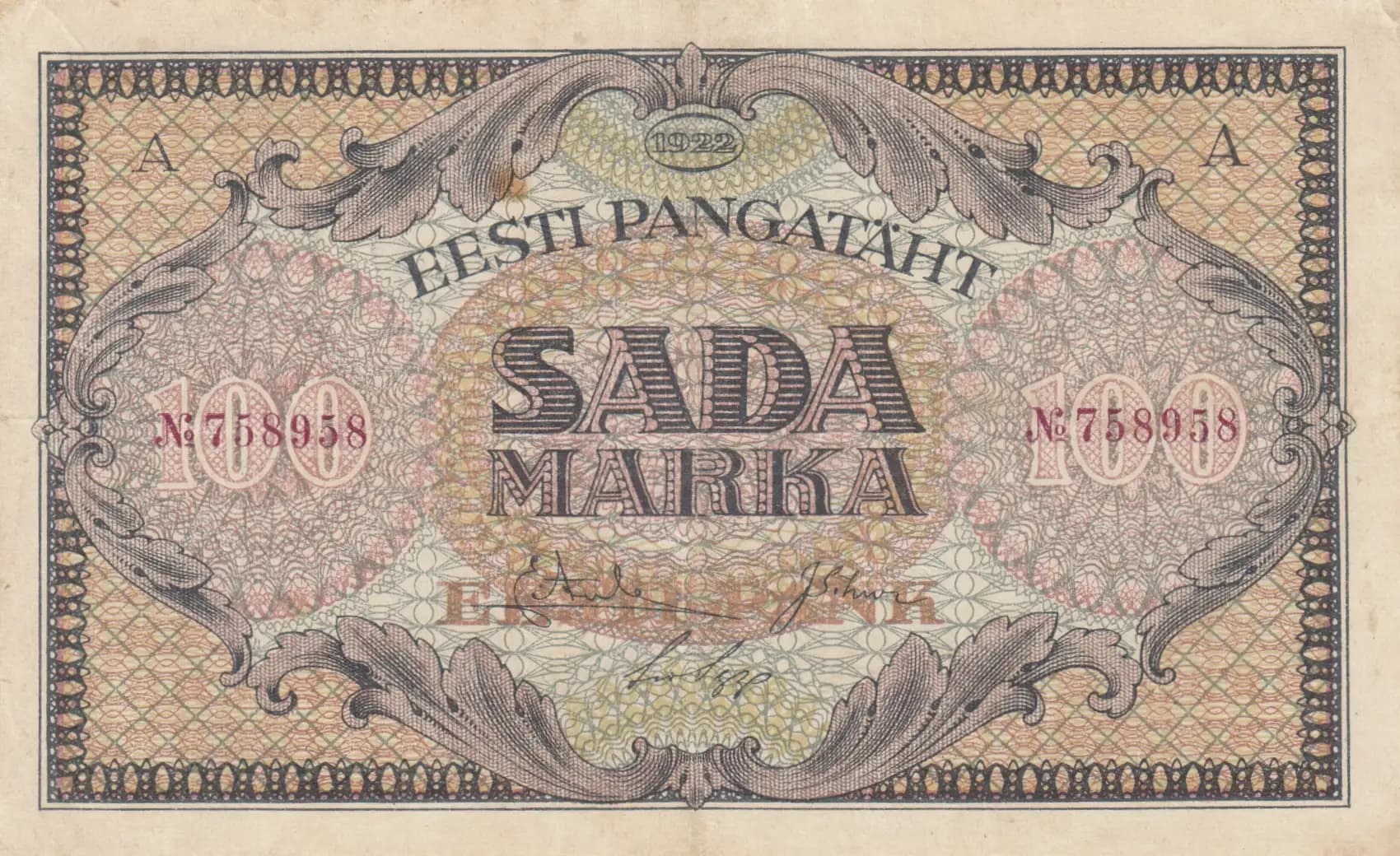
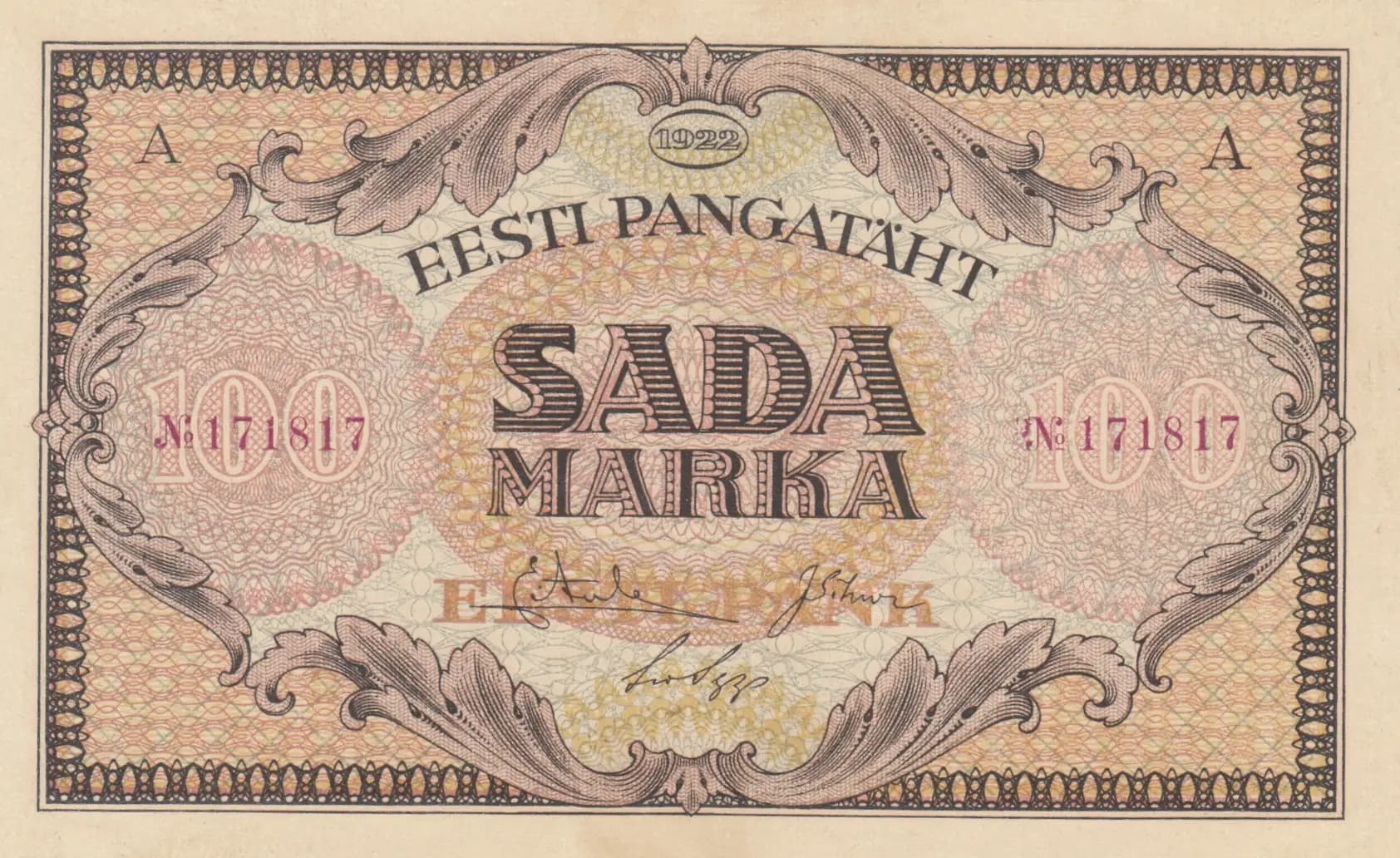
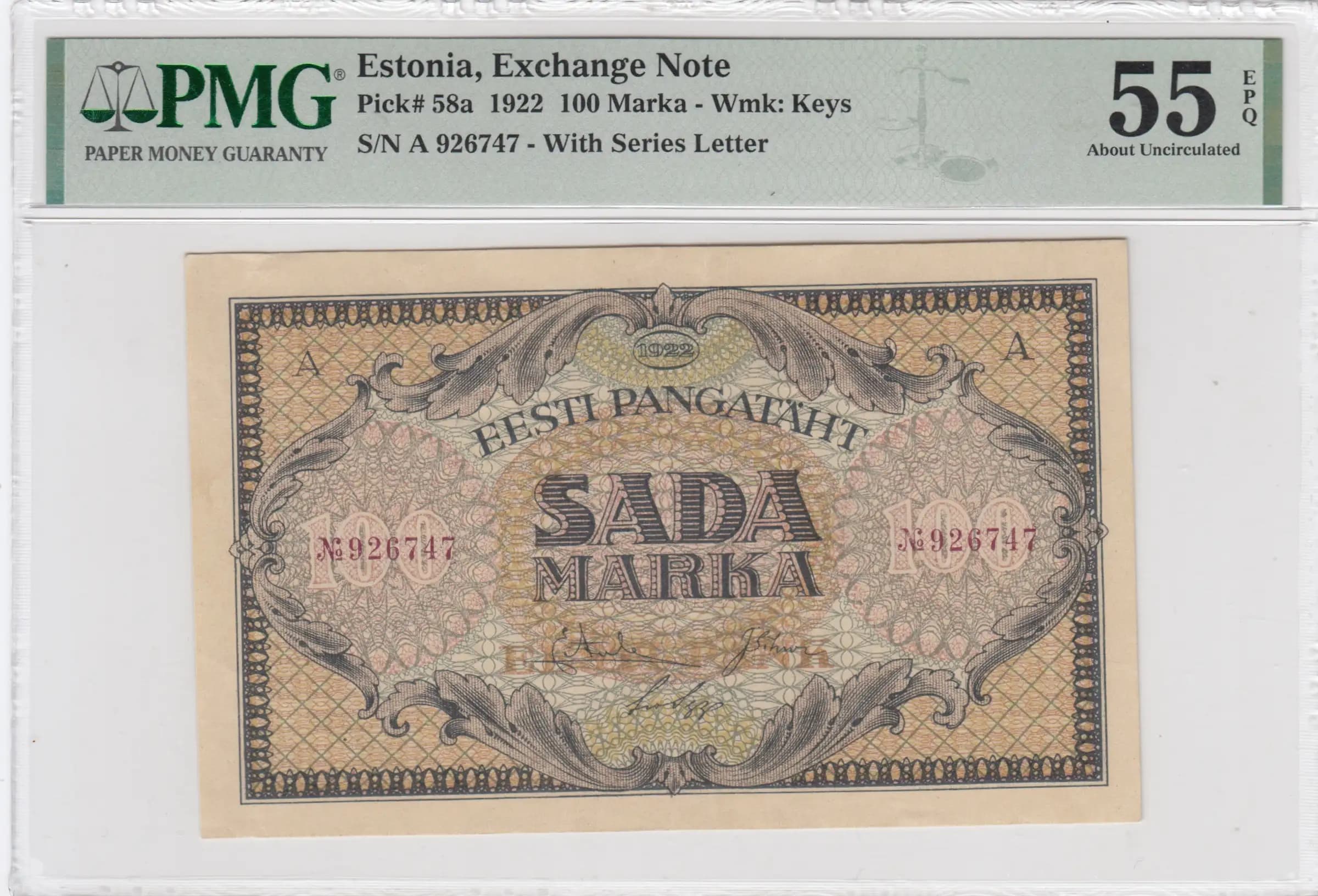
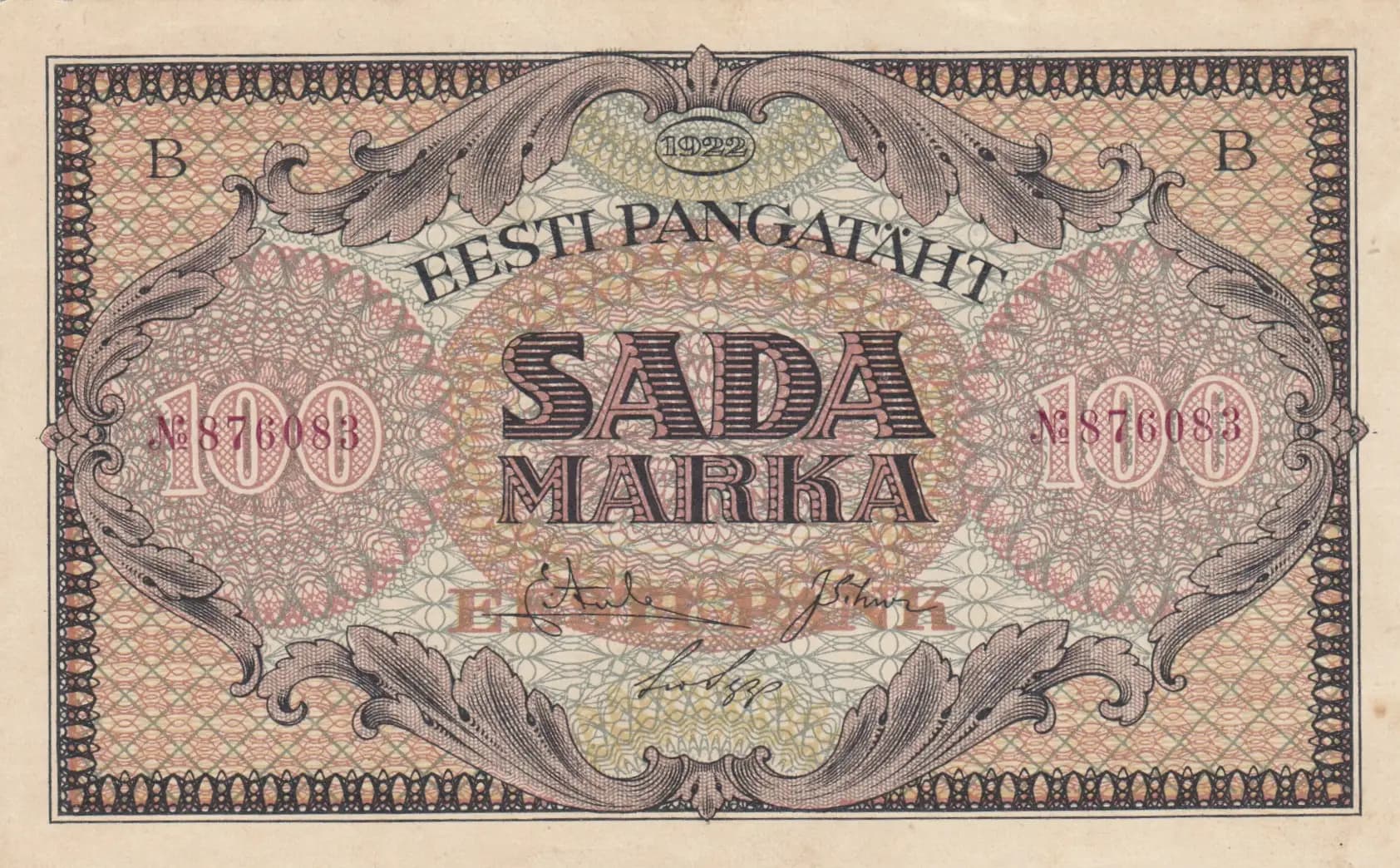
100 marka 1922
“serie D”
Market Prices
2 salesAbout This Note
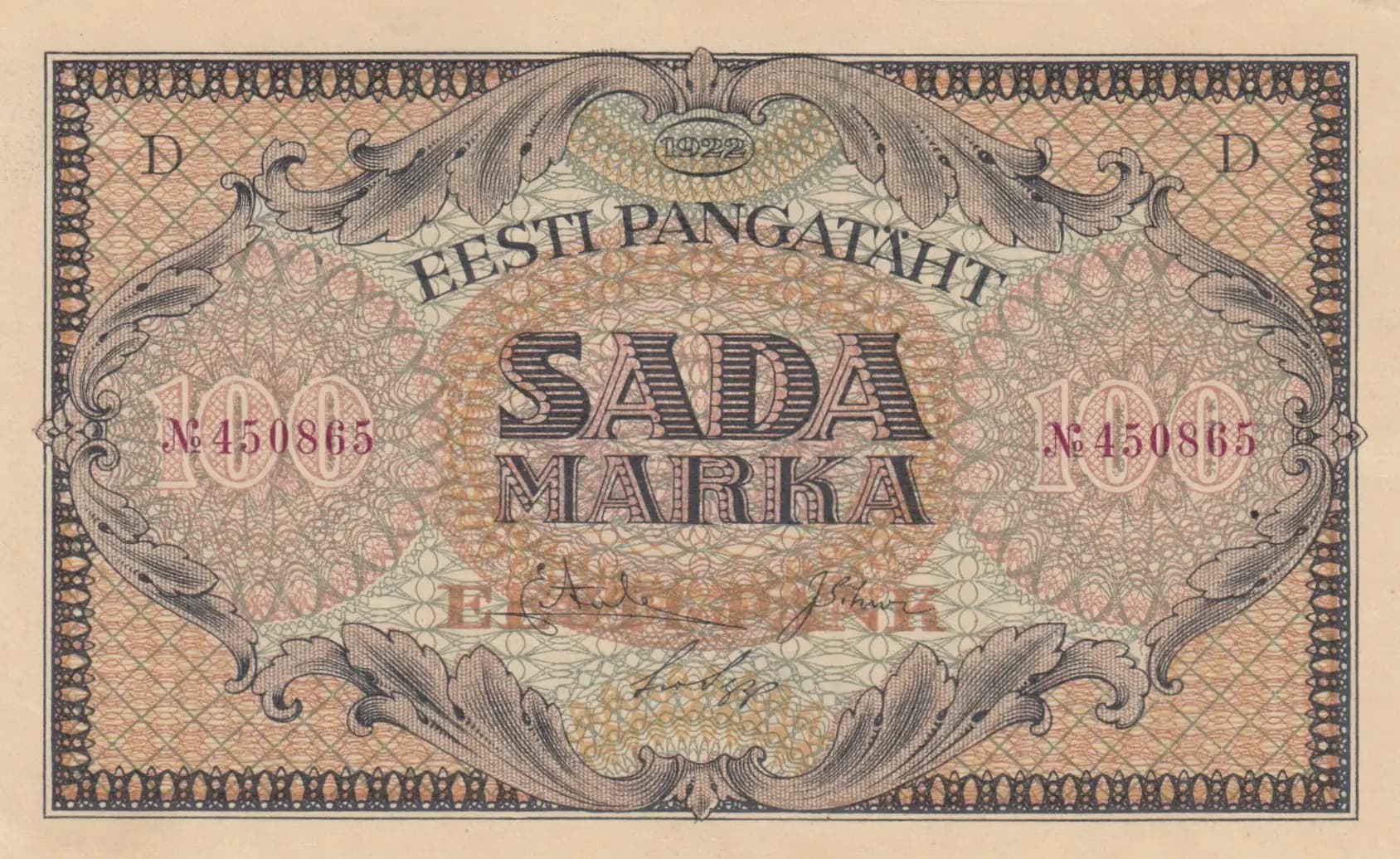
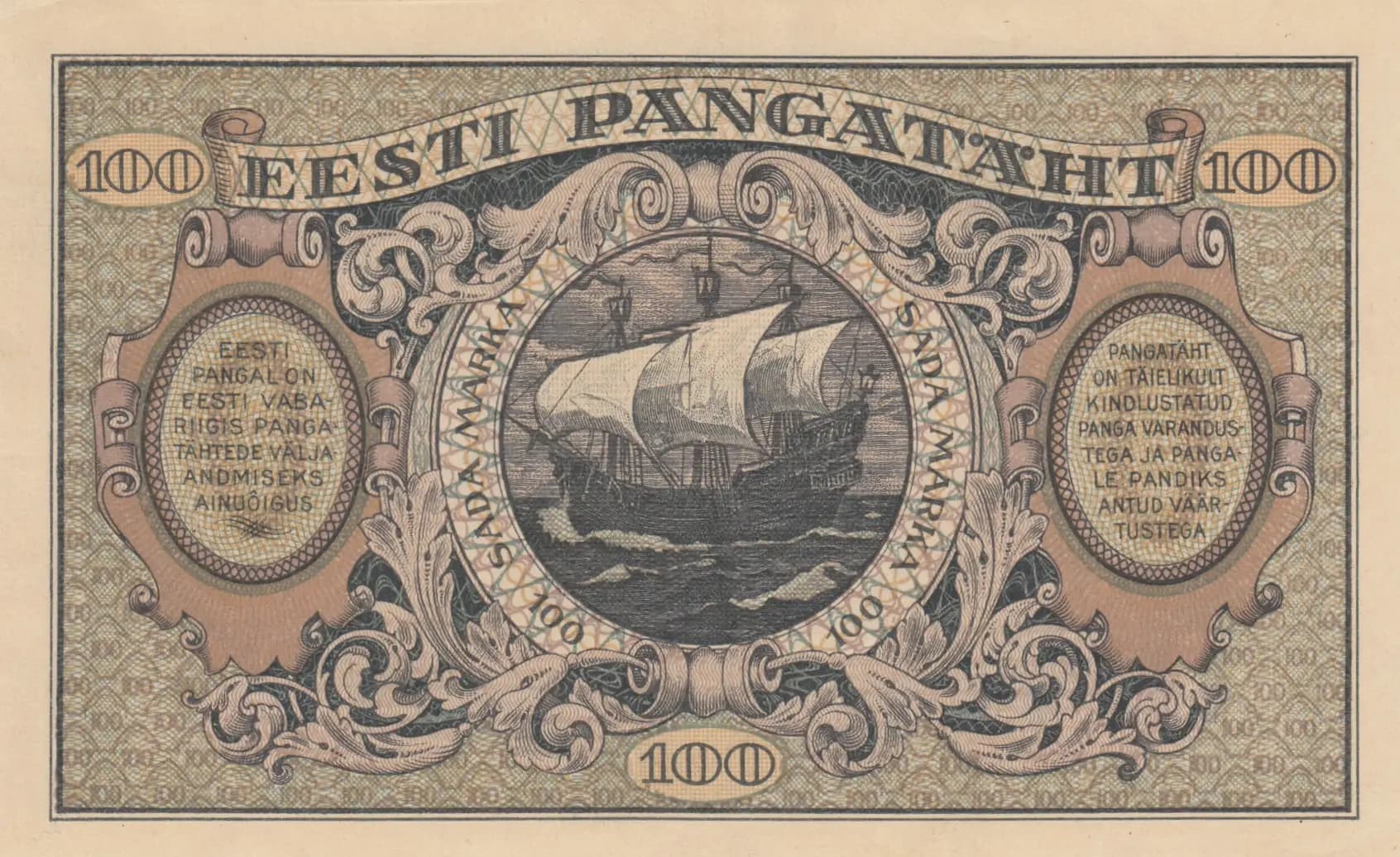
This is an exceptionally well-preserved example of Estonia's first banknote series, the 100 Marka from 1922, graded UNC with minimal handling marks. The note features intricate baroque-style ornamentation and a striking central vignette of a sailing ship on the reverse, symbolizing Estonia's maritime heritage and independence. The crisp printing, clear serial numbers, and vibrant beige/tan color scheme with sharp detail preservation make this an attractive example of early Estonian currency from the Republic's first years.
Common. While this represents an early issue from Estonia's first independent republic (historically significant), the 100 Marka denomination from 1922 was produced in substantial quantities to meet circulation demands during the establishment of the new Estonian monetary system. The UNC condition grade is not unusually difficult to find for this note type, as many examples were preserved in bank stocks. No evidence of limited print runs, recalls, or scarcity exists for Pick-58.
This note was issued during Estonia's early period as an independent republic following the 1918 declaration of independence from Russia. The prominent sailing ship depicted on the reverse reflects Estonia's strong maritime traditions and economic significance as a Baltic trading nation. The inscriptions emphasizing the Estonian Bank's exclusive right to issue banknotes underscore the new nation's sovereignty and establishment of its own monetary system during the 1920s stabilization period.
This banknote exemplifies the artistic standards of early 20th-century Estonian currency design. The front features ornamental baroque-style scrollwork and floral designs concentrated in the corners and margins, with a central coat of arms or state emblem positioned at the top, reinforcing national identity. The reverse presents a detailed circular vignette of a fully-rigged sailing vessel with multiple masts and billowing sails, depicted on water and surrounded by elaborate ornamental medallions and baroque flourishes. The consistent use of decorative borders with fine parallel line patterns on both sides demonstrates sophisticated security printing practices for the period. The beige/tan base color with brown and black printing creates effective contrast for legibility while maintaining aesthetic refinement characteristic of interwar European banknote design.
FRONT SIDE: 'EESTI PANGATAHT' (Estonian Banknote) — 'SADA MARKA' (100 Marks) — '1922' (date of issue) — '№450865' (serial number, printed on both left and right sides). BACK SIDE: 'EESTI PANGATAHT' (Estonian Banknote) — '100' (denomination, appears in corners) — 'EESTI PANGAL ON EESTI VABA RIIGIS PANGA TAHTEDE VALJA ANDMISEKS AINUOIGUS' (The Estonian Bank has the exclusive right to issue banknotes in the free Estonian state) — 'PANGATAHT ON TAIELIKULT KINDLUSTATUD PANGA VARANDUS-TEGA JA PANGA-LE PANDIKS ANTUD TUSTEGA' (The banknote is fully secured by the bank's assets and pledged securities).
This note was produced using intaglio engraving (deep-plate printing), evidenced by the crisp, finely-detailed line work visible in the ornamental borders, baroque scrollwork, and the detailed ship vignette. The sharp impression of serifs on text and the dimensional quality of the decorative elements confirm professional security printing. The note was likely produced by Göggingen or another established European security printer contracted by the Estonian Treasury, employing multiple engraved plates for the complex designs.
This example is identified as Serie D based on catalog notation. The serial number 450865 visible on both sides indicates mid-range production. Early Estonian notes of this series exist with various serial number prefixes and letter designations (A through D known). No major overprints, significant signature variations, or dating variants are documented for this Pick number, making it a straightforward single-variety issue.