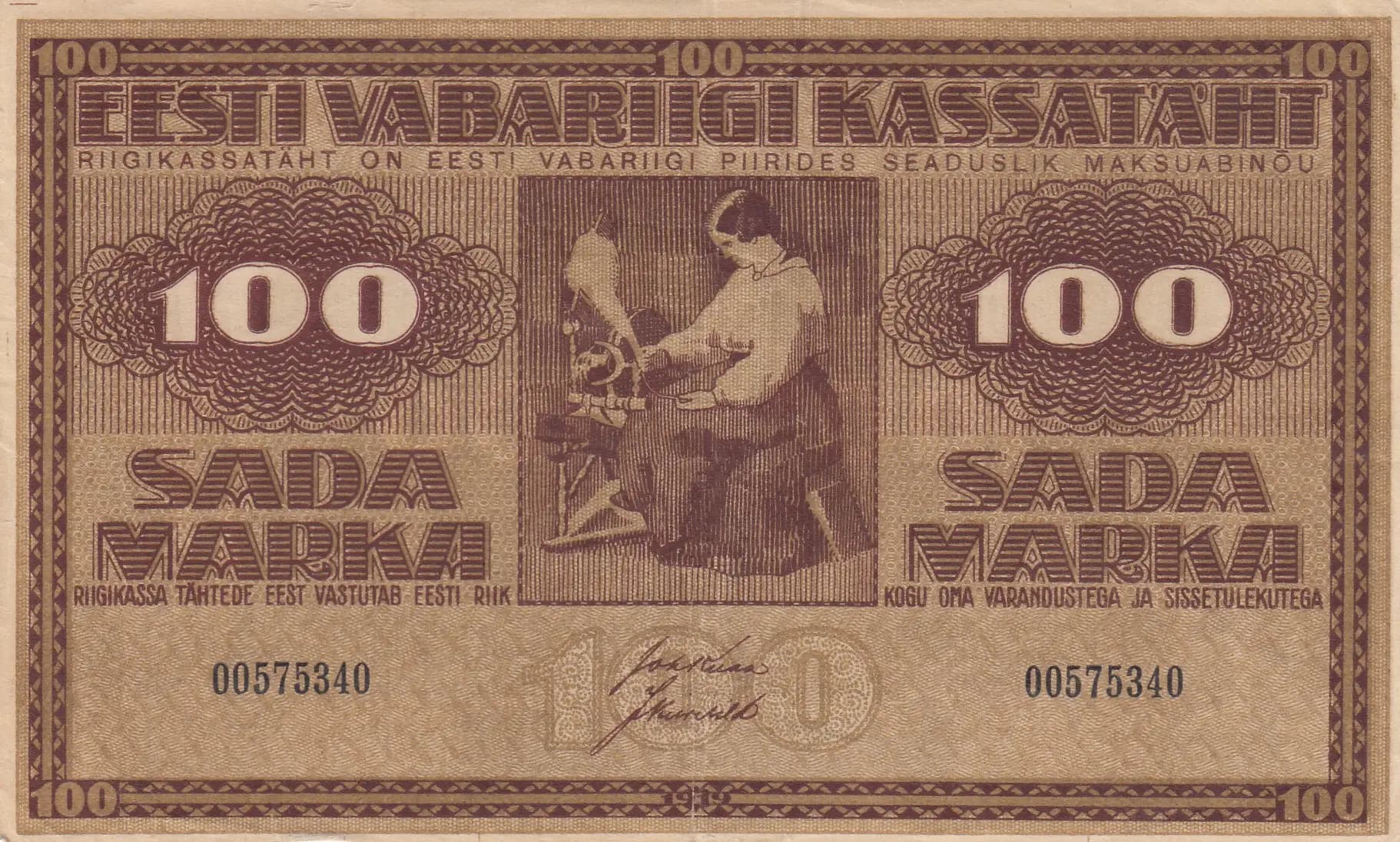
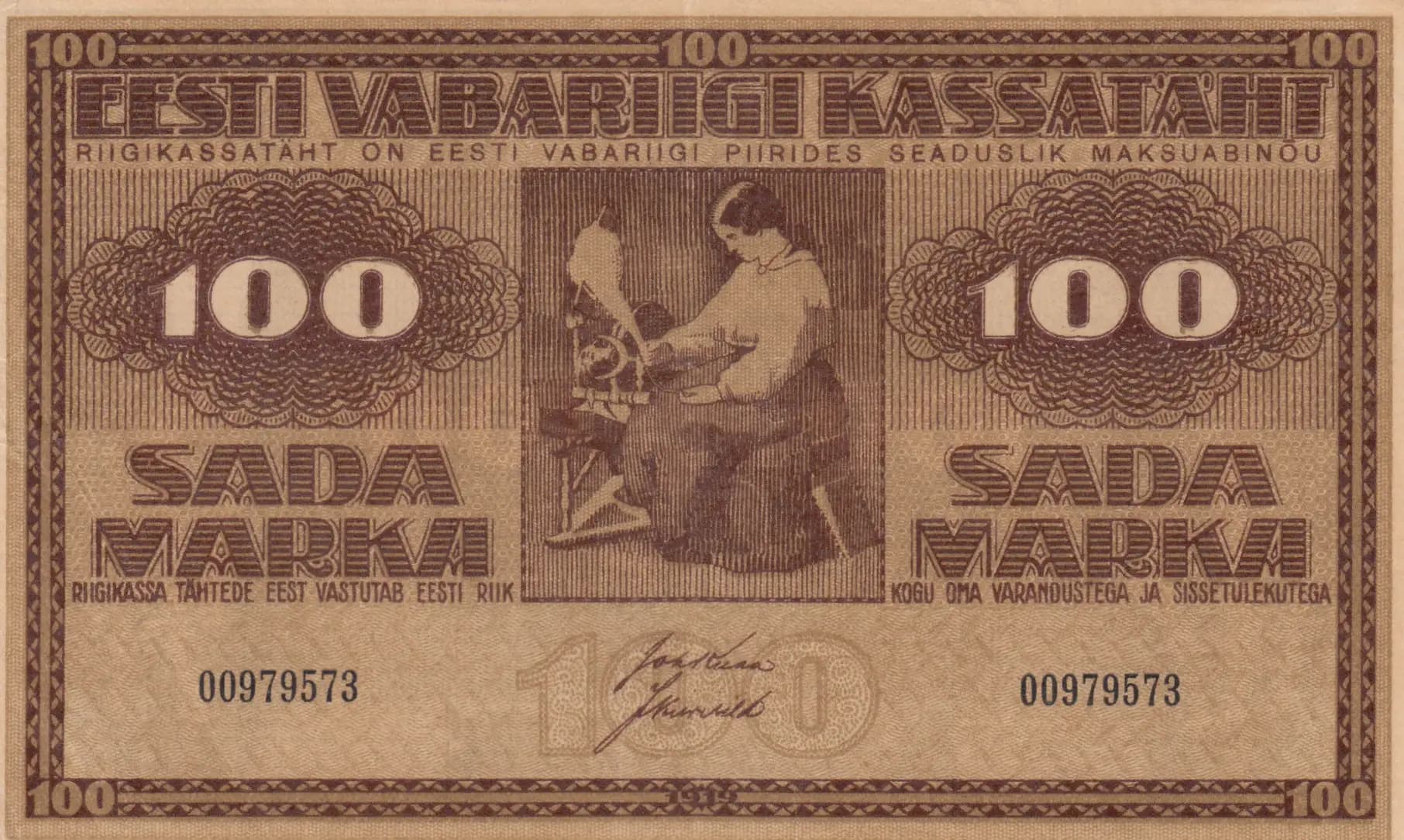
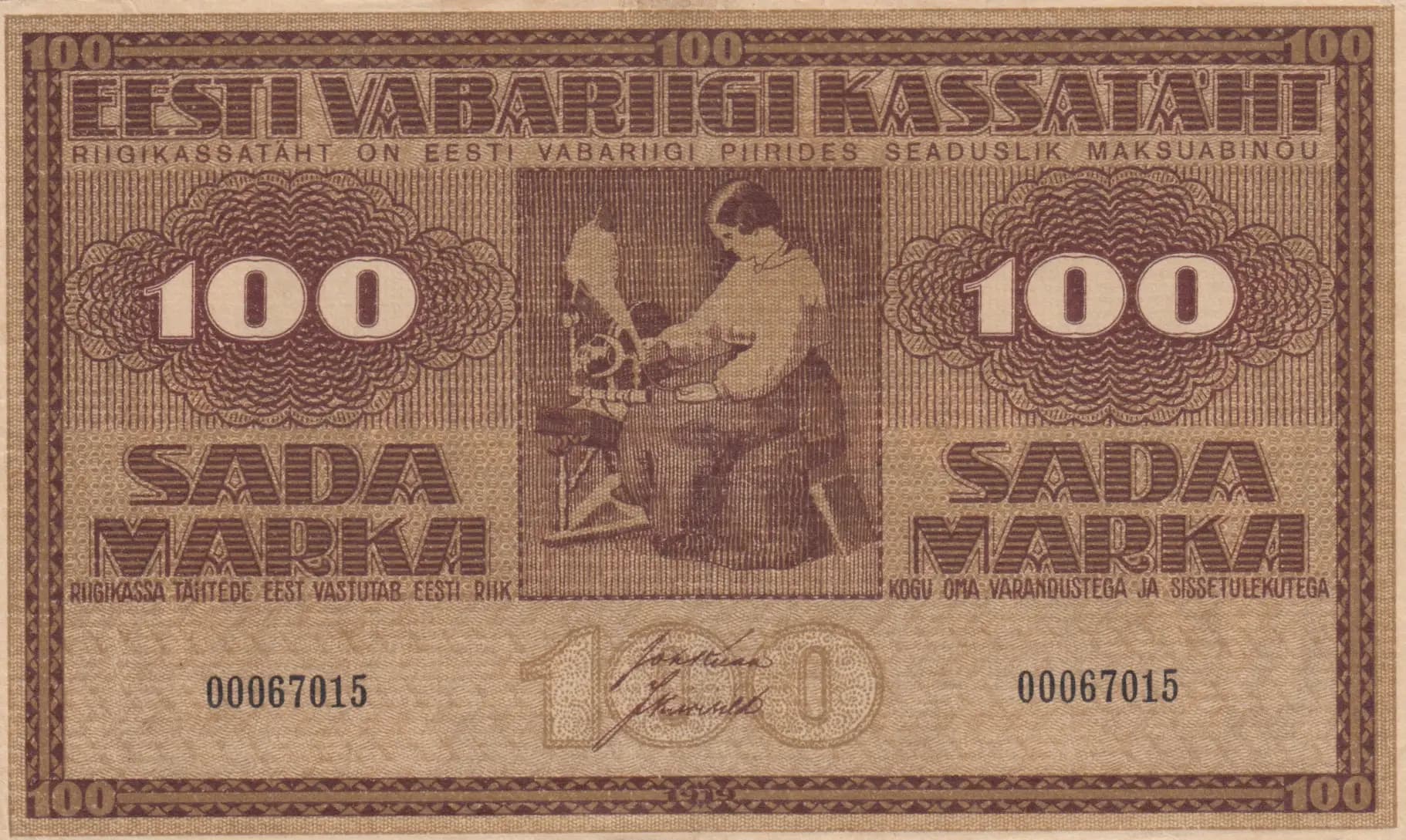
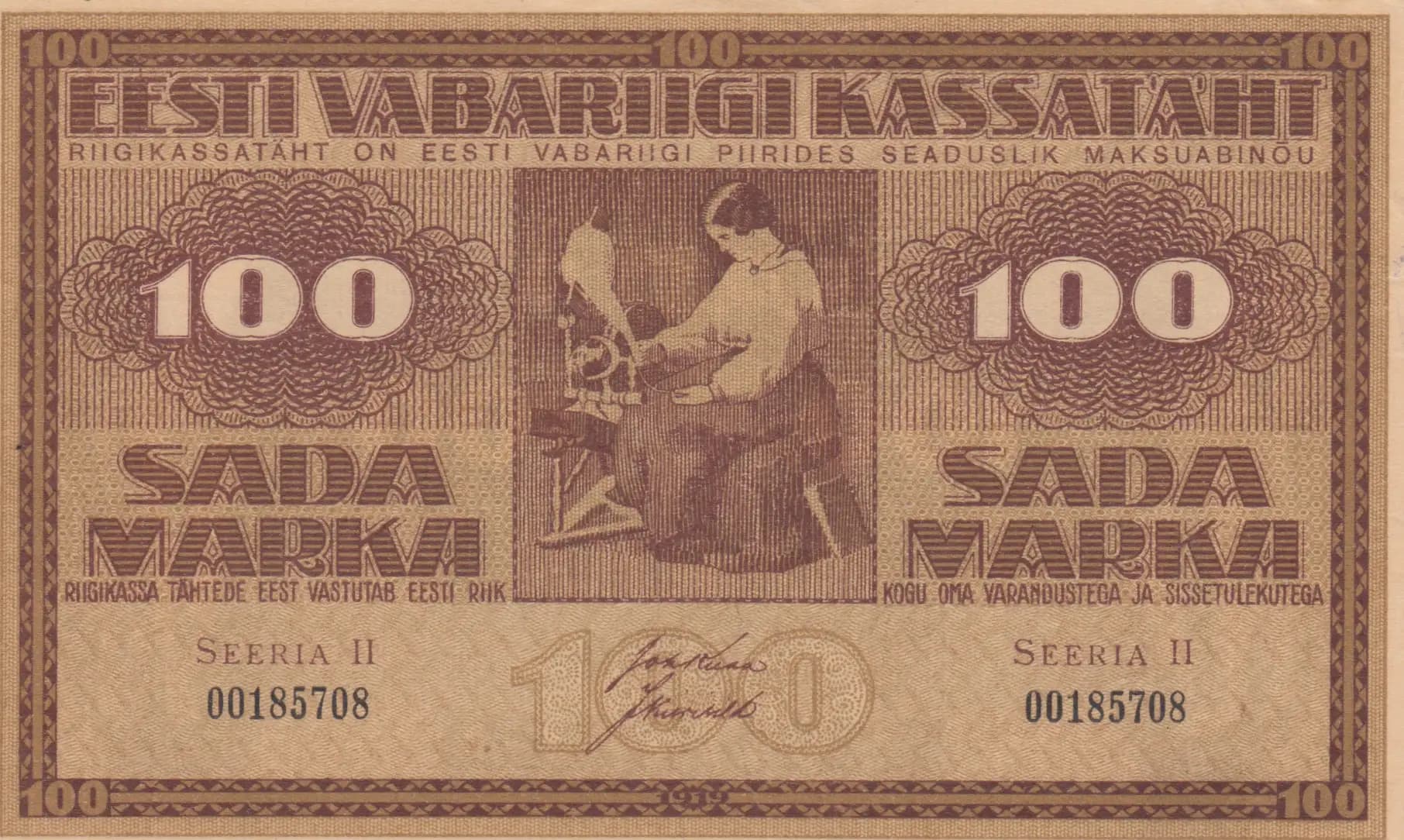
100 marka 1919
“w/m vert lines”
Market Prices
1 saleAbout This Note
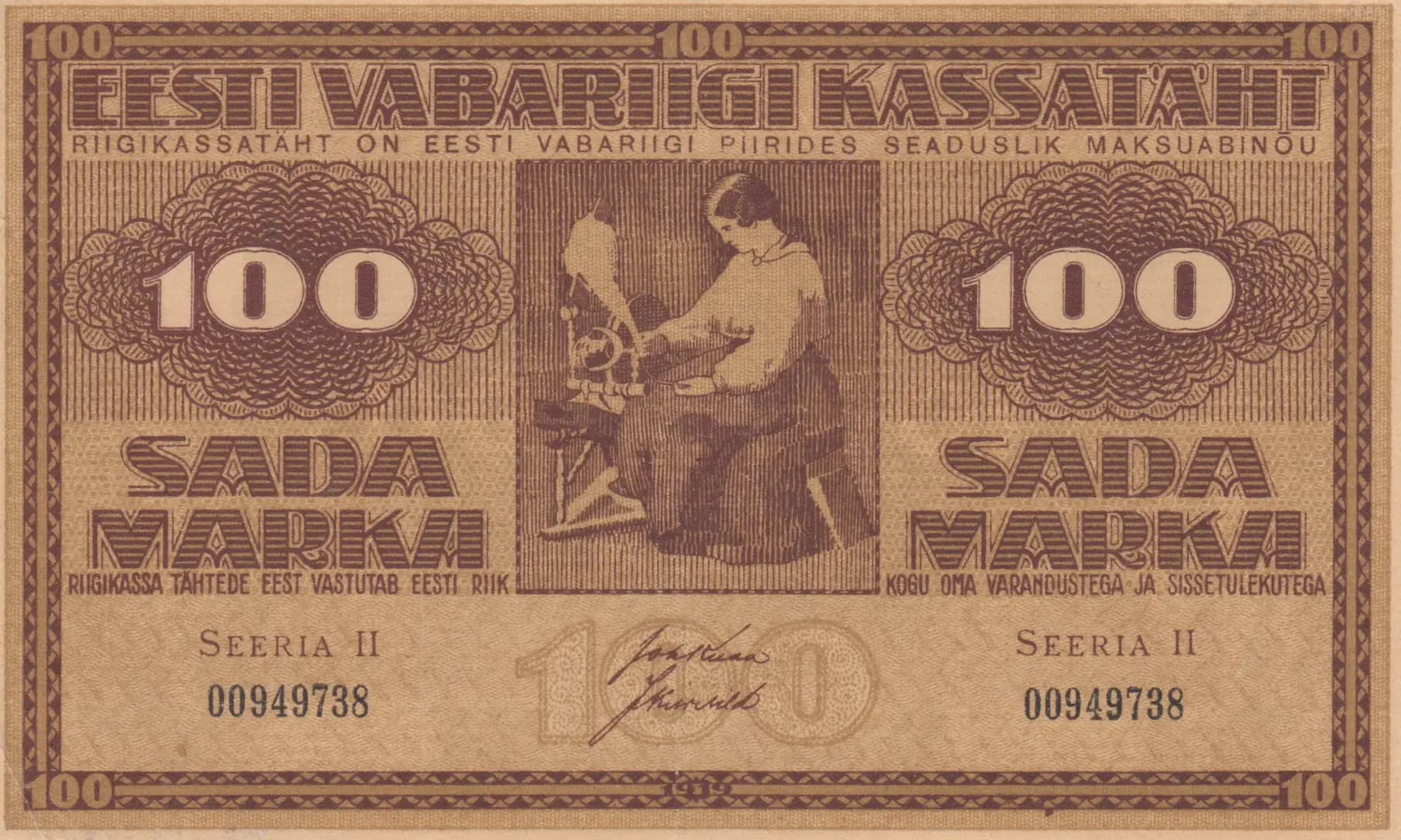
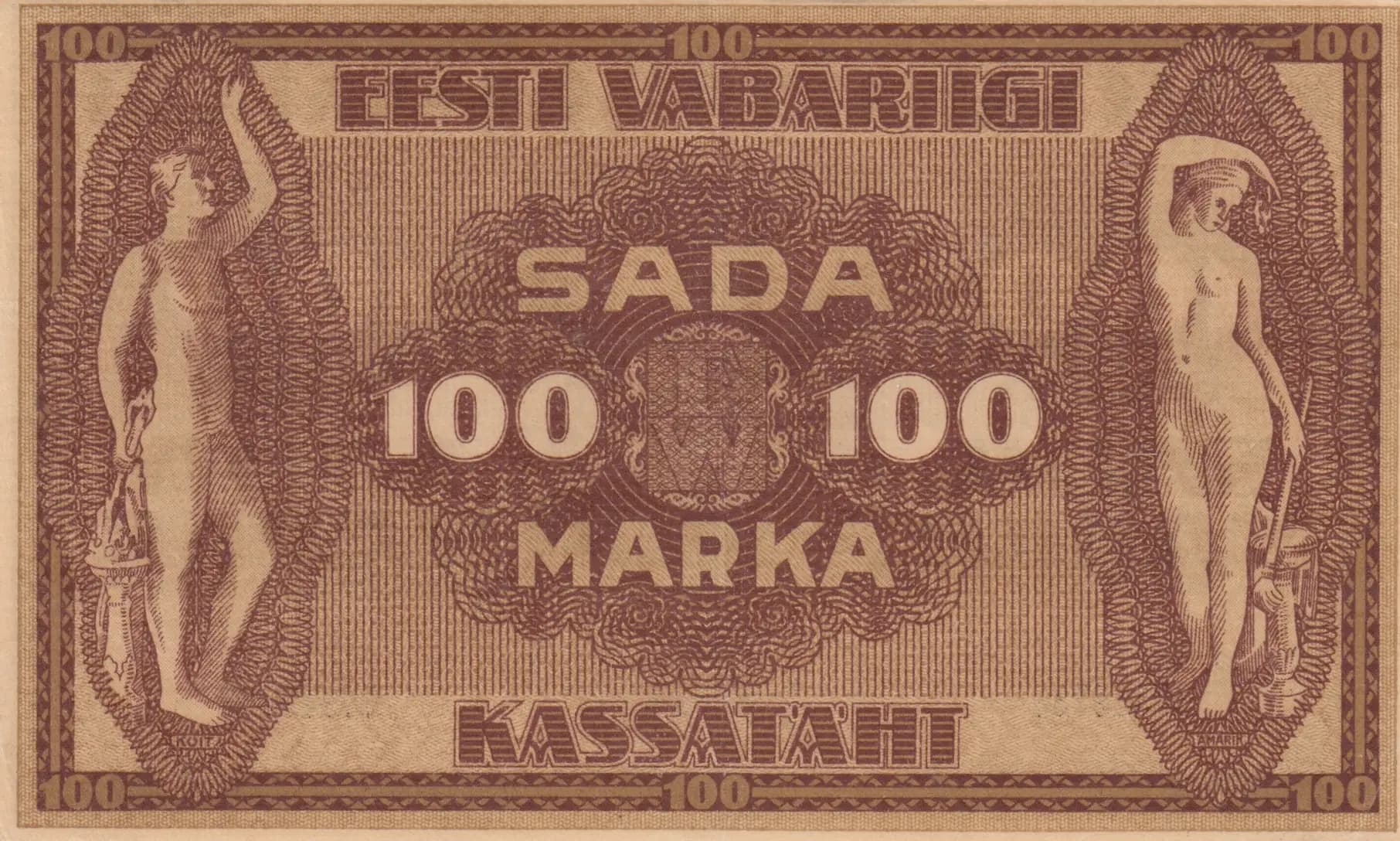
This is a beautiful example of Estonia's early treasury note from 1919, featuring the distinctive brown and tan color scheme and fine engraving characteristic of the period. The note displays excellent preservation with sharp, crisp printing throughout and no visible wear, placing it solidly in the AU (About Uncirculated) grade range. The design showcases the new Estonian Republic's commitment to national identity through allegorical imagery and textile craftsmanship symbolism, making it a significant piece of early 20th-century Baltic numismatic history.
Common. The 1919 Estonian 100 marka (P-48b) appears regularly in the collector market, with auction and eBay sales data indicating typical circulated examples sell in the $40-100 range. The catalog value of $200 for UNC specimens reflects modest appreciation potential but not scarcity. No evidence in the PMG population data suggests this is a scarce variety, and the catalog notation of P-48c as an alternative variant (rather than an extremely rare type) indicates a straightforward, standard issue. While Estonian currency from this brief independent period (1919-1940) holds historical significance, this denomination was issued in quantities sufficient to be considered common today.
Issued in 1919 by the newly independent Estonian Republic following independence from Imperial Russia, this 100 marka note represents the nation's first treasury currency. The imagery—a woman at a spinning wheel on the obverse and allegorical female figures on the reverse—reflects Estonia's historical emphasis on textile production and craftwork, while also embodying the classical allegory of national prosperity and virtue that characterized post-WWI European currency design during the brief period before Estonia's transition to the kroon.
The obverse features a woman depicted in profile/three-quarter view engaged in textile work at a spinning wheel, rendered as a skillfully engraved central vignette. This allegorical representation of productive labor and domestic craftsmanship was a common motif in early Estonian nationalist iconography, celebrating the nation's textile heritage. Two large decorative rosette patterns flank the denomination markers, with ornamental borders featuring geometric patterns and cornucopias in the corners. The reverse presents two female allegorical figures in classical poses—one on each side—flanking a central large decorative rosette pattern. These figures represent abstract concepts such as prosperity, justice, or national virtue. Both sides employ fine line engraving with intricate border work and medallion frames, characteristic of high-security early 20th-century currency design. The color scheme of brown on tan/cream underprint provides strong visual distinction and circulation durability.
FRONT SIDE: 'EESTI VABARIIGI KASSATAHT' (Estonian State Treasury Note) — top inscription establishing the issuer. 'RIIGIKASSATAHT ON EESTI VABARIIGI PIIRDES SEADUSLIK MAKSUABINÕU' (The state treasury note is a legal means of payment within the boundaries of the Estonian Republic) — legal validity statement. '100' and 'SADA MARKA' (One hundred marks) — denomination. 'RIIGIKASSA TAHTEDE EEST VASTUTUAB EESTI RIIK KOGU OMA VARANDUSTEGA JA SISSETULEBUKUTEGA' (The Estonian State is responsible for the state treasury notes with all its property and income) — government guarantee. 'SEERIA II' (Series II) — series designation. Serial number: 00949738. REVERSE SIDE: 'EESTI VABARIIGI' (Estonian Republic). 'SADA 100 MARKA 100' (One hundred marks) — denomination displayed centrally. 'KASSATAHT' (Treasury note).
Intaglio engraving (line engraving), the standard security printing method for currency in 1919. The fine detail visible throughout the design, sharp line work, and the three-dimensional quality of the engraved portraits and decorative elements are characteristic of intaglio/engraved plate printing. The uniform aging of the paper and crisp impression quality suggest professional currency production by Estonia's designated state security printer of the period.
This example is cataloged as P-48b (the primary variety of the 100 marka 1919 issue). The collector note indicates 'w/m vert lines' (watermark with vertical lines), which is a documented feature of this issue. The observed 'SEERIA II' (Series II) designation on both obverse and reverse confirms this is a Series II printing. Serial number 00949738 places this in the standard numbering sequence. The Pick catalog notes P-48c as an alternative variant; confirmation of whether this note is P-48b or P-48c would require expert comparison of subtle design or printing differences, though the visual characteristics shown are consistent with P-48b as the primary listed variety.