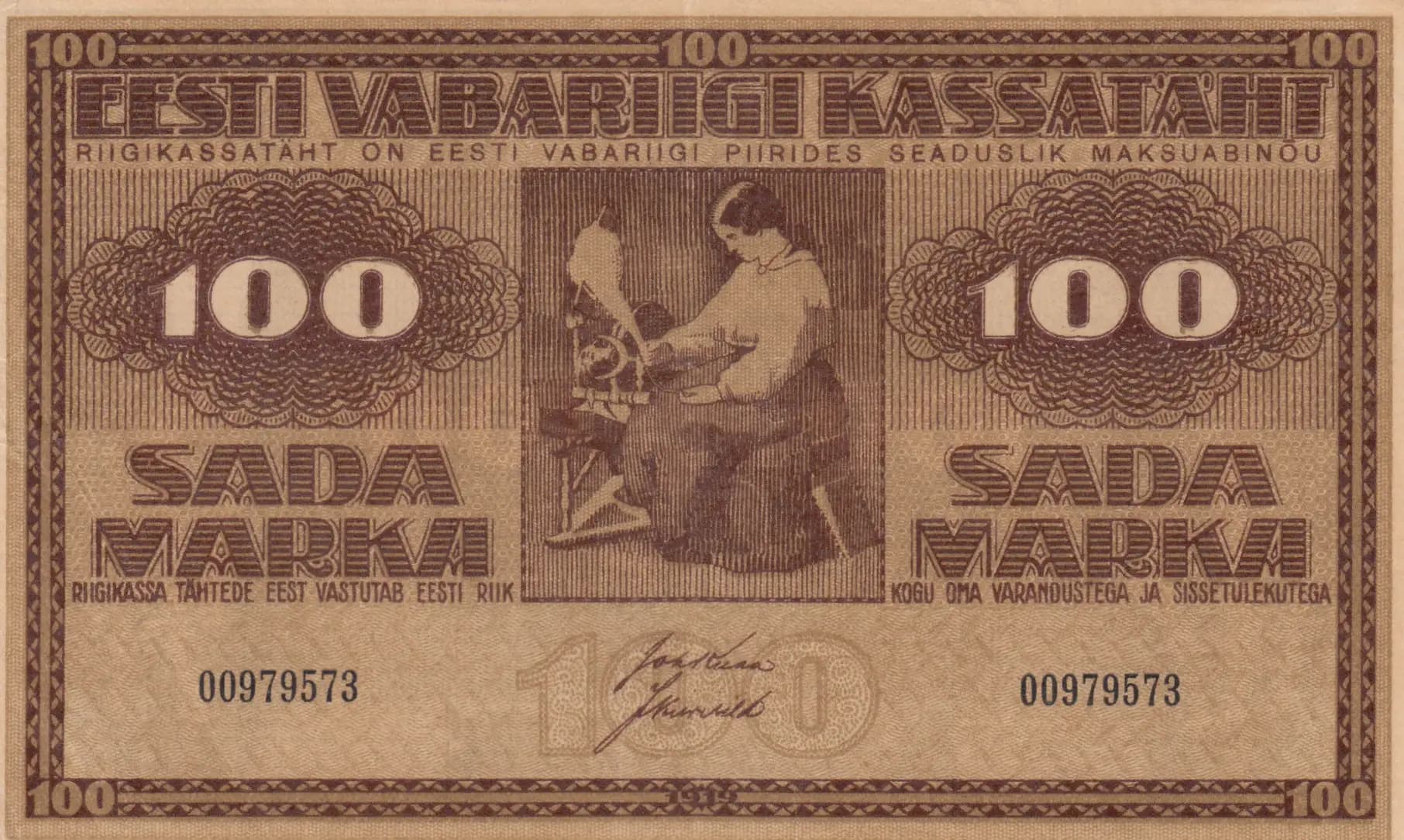
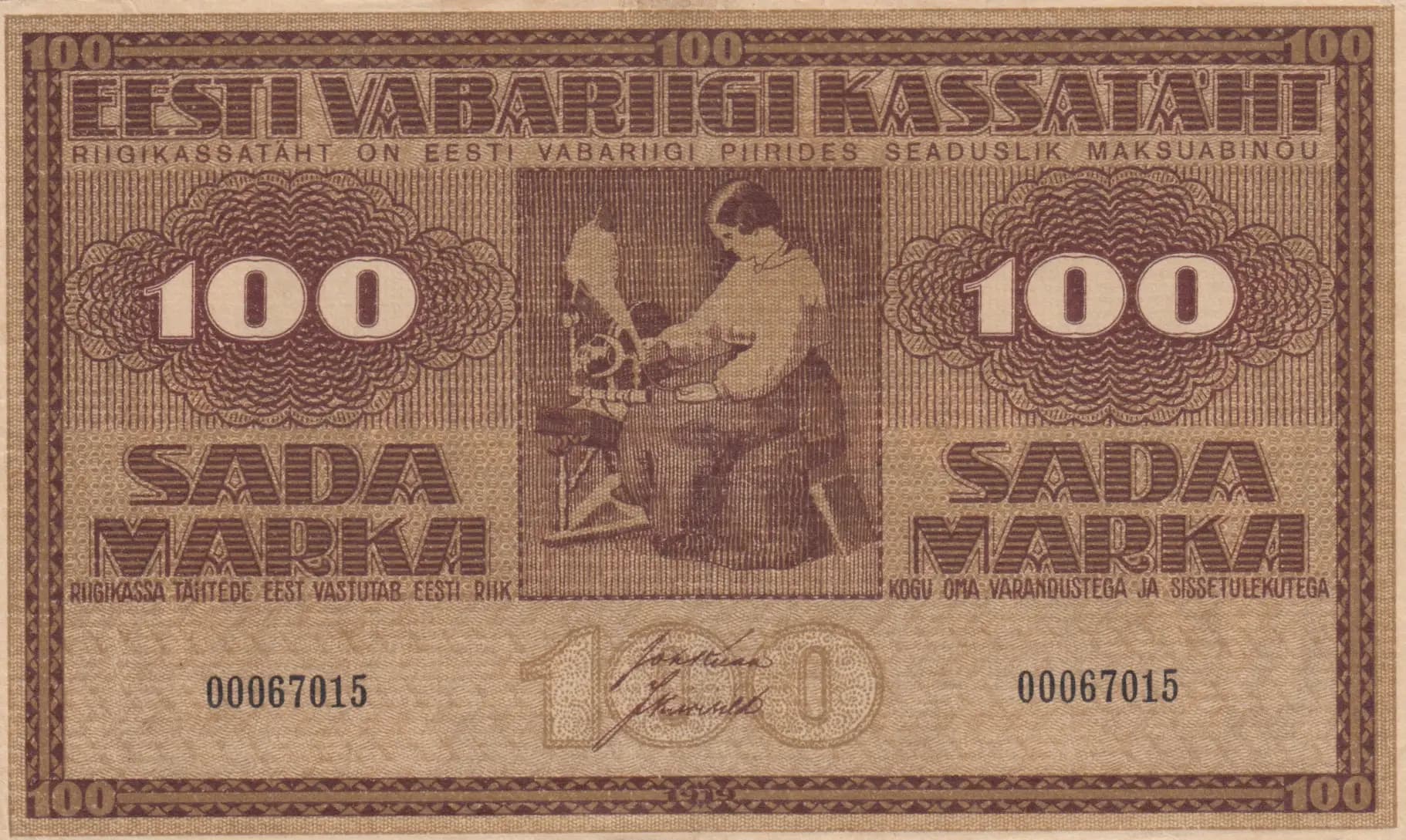
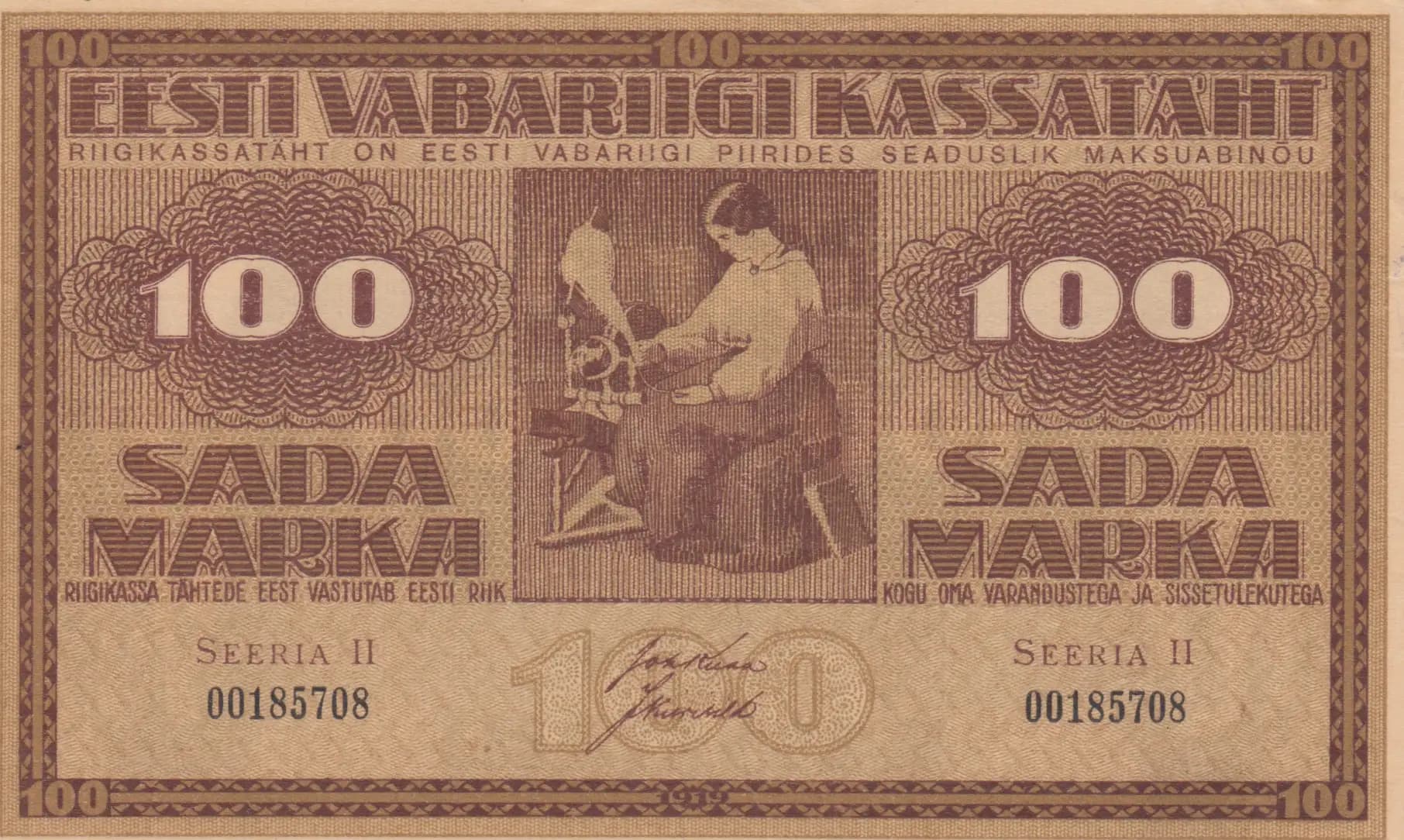
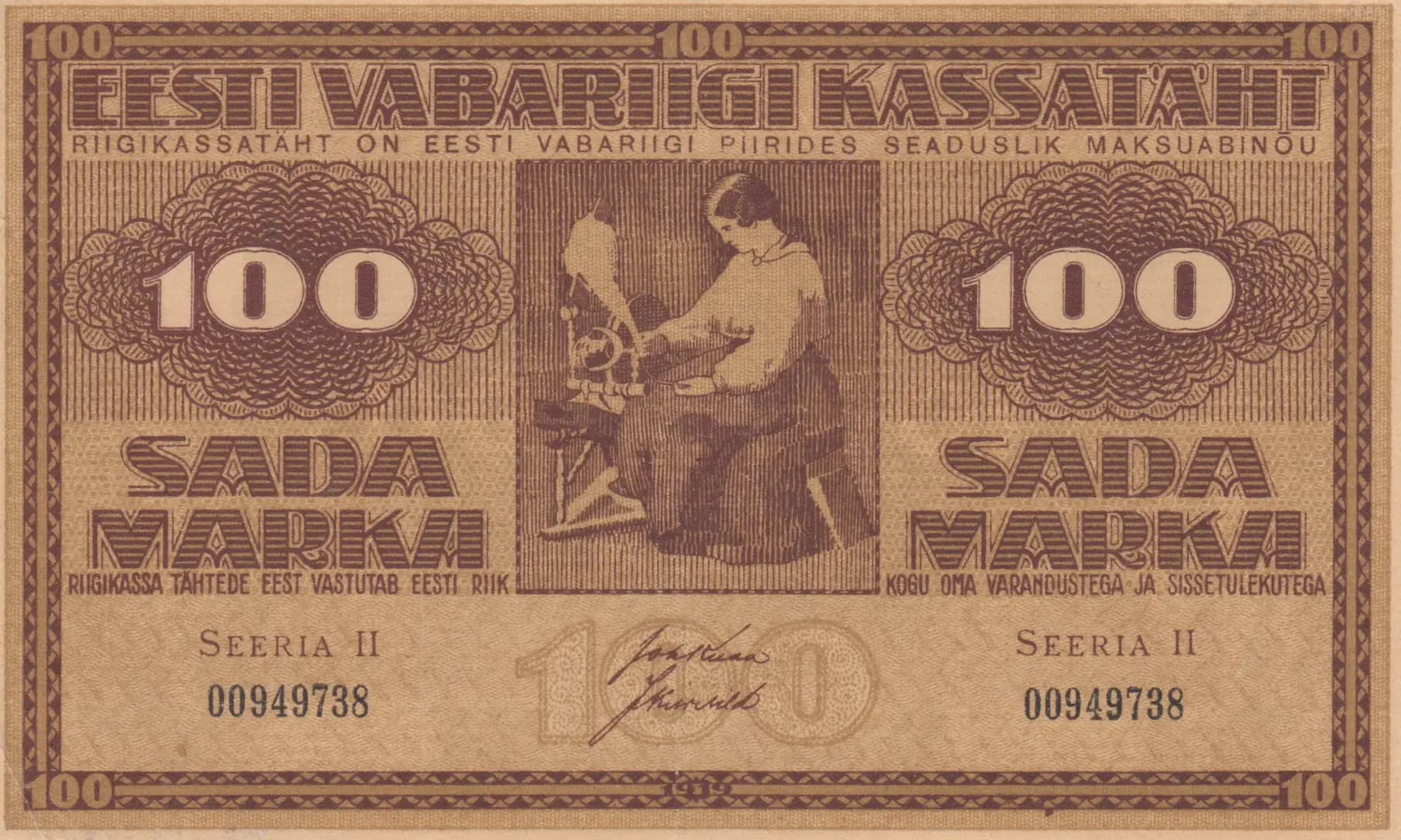
100 marka 1919
“w/m hor lines”
Market Prices
About This Note
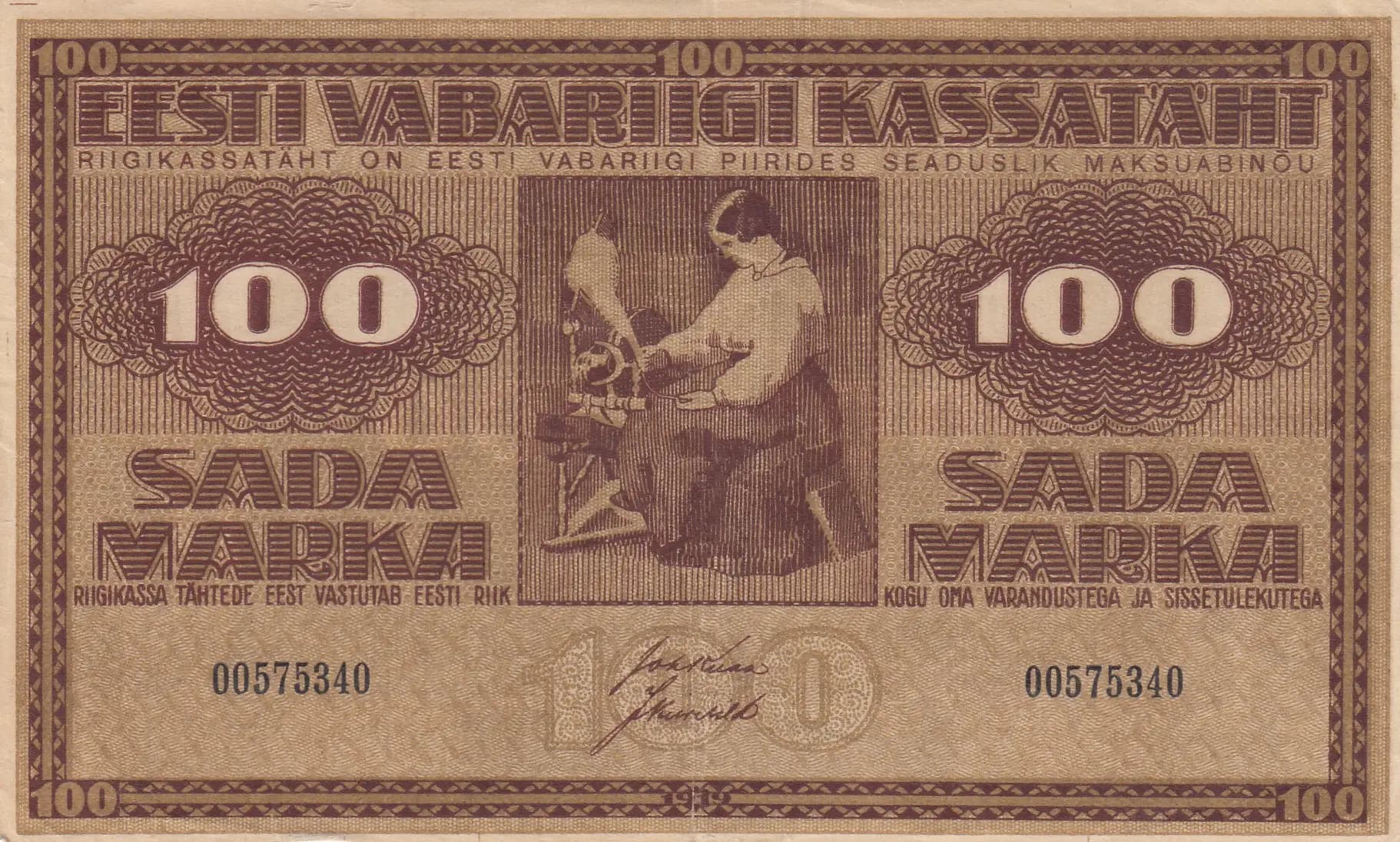
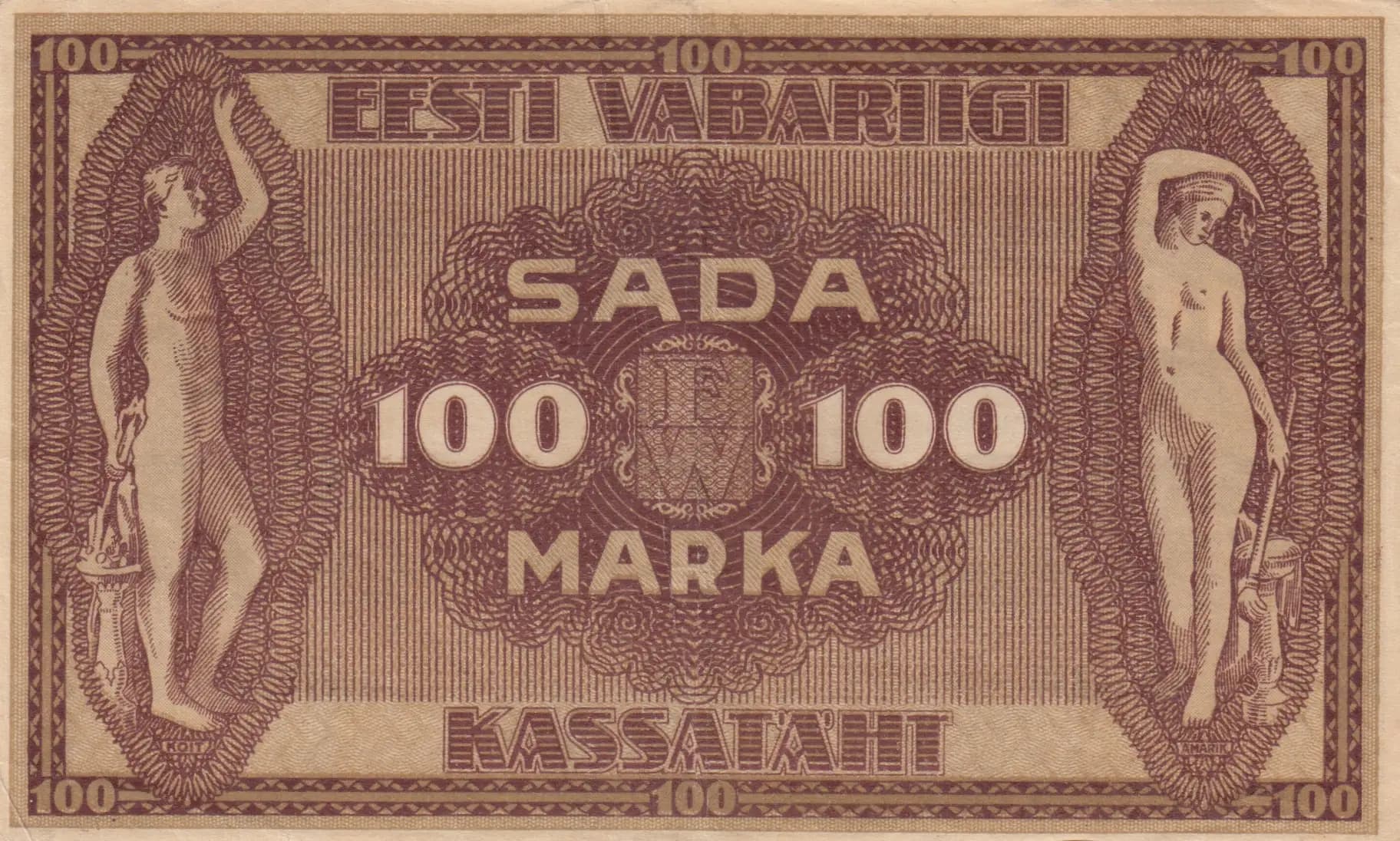
This is a VF-grade 100 Marka banknote from Estonia's 1919 Treasury issue, featuring exceptional Art Deco engraving with brown and tan coloring. The obverse depicts a craftsman at work in classical style, while the reverse displays allegorical female figures flanking the central coat of arms—both sides demonstrating the sophisticated fine-line engraving technique characteristic of early Estonian currency. The note exhibits crisp impression quality and clean paper stock consistent with its VF condition grade, making it a solid representative example of this important nationalist-era emission.
Common. The eBay market data shows consistent trading in the $45-$275 USD range across various condition grades, with VF examples (matching the subject note) catalogued at $100 in the 2016 reference and appearing regularly at $54.90-$245.00 USD in recent sales. The 100 Marka from the 1919 Treasury issue was a regular circulation denomination from Estonia's new republic with substantial print runs, and examples remain readily available to collectors at modest prices.
Issued during Estonia's first year of independence following the Russian Revolution, the 100 Marka represents the new Estonian Republic's assertion of monetary sovereignty through the Treasury (Riigikassa). The allegorical imagery on the reverse—classical female figures representing virtue and national ideals—reflects the design philosophy of newly independent European nations seeking to legitimize their authority through classical artistic references and nationalist symbolism.
The obverse features a male craftsman or laborer depicted in classical engraving style, seated at an industrial lathe or similar machinery, positioned centrally within an ornate Art Deco frame. Large decorative rosette medallions containing the numeral '100' are positioned on both left and right sides. The reverse presents an allegorical composition with two classical nude female figures—likely representing virtues or national concepts such as prosperity and justice—flanking an ornate central shield containing the Estonian coat of arms within an elaborate medallion. Both sides employ extensive geometric borders and fine parallel line work creating tonal depth, reflecting the design principles of early 20th-century European currency design emphasizing both artistic merit and security through engraving complexity.
FRONT SIDE: 'EESTI VABARIIGI KASSATÄHT' (Estonian Republic Banknote); 'SADA MARKA' (One Hundred Marks); '100' (denomination); 'RIIGIKASSA JÄRGI EEST VASTUAB EESTI RIIK' (The Estonian State guarantees according to state treasury law); 'KOGU OMA VARANDUSFEGA JA SISSETUEKUTEGA' (With all its property and resources); 'BUGIKASSA JÄRGI ON EESTI VABARIIGI PIIRIDE SEADUSED MAKSUS' (According to state treasury law, valid within Estonian borders); Serial numbers '00575340'. BACK SIDE: 'EESTI VABARIIGI' (Estonian Republic); 'SADA MARKA' (One Hundred Marks); '100' (denomination); 'KASSATÄHT' (Banknote).
Engraved intaglio printing on banknote paper, with fine-line engraving throughout providing both aesthetic detail and anti-counterfeiting protection. The crisp impression and clear reproduction of the intricate parallel line work, geometric patterns, and portrait details indicate high-quality intaglio production standards typical of major European security printers of the 1919 period.
The note is catalogued as Pick P-48a. The visual serial number '00575340' and the horizontal wavy line watermark (indicated in collector notes as 'w/m hor lines') are consistent with the standard P-48a variety. PMG records indicate a P-48c variant exists within this Pick number base, though the present note's features align with the P-48a classification. No overprints, date variations, or signature variants are apparent in the observed imagery.