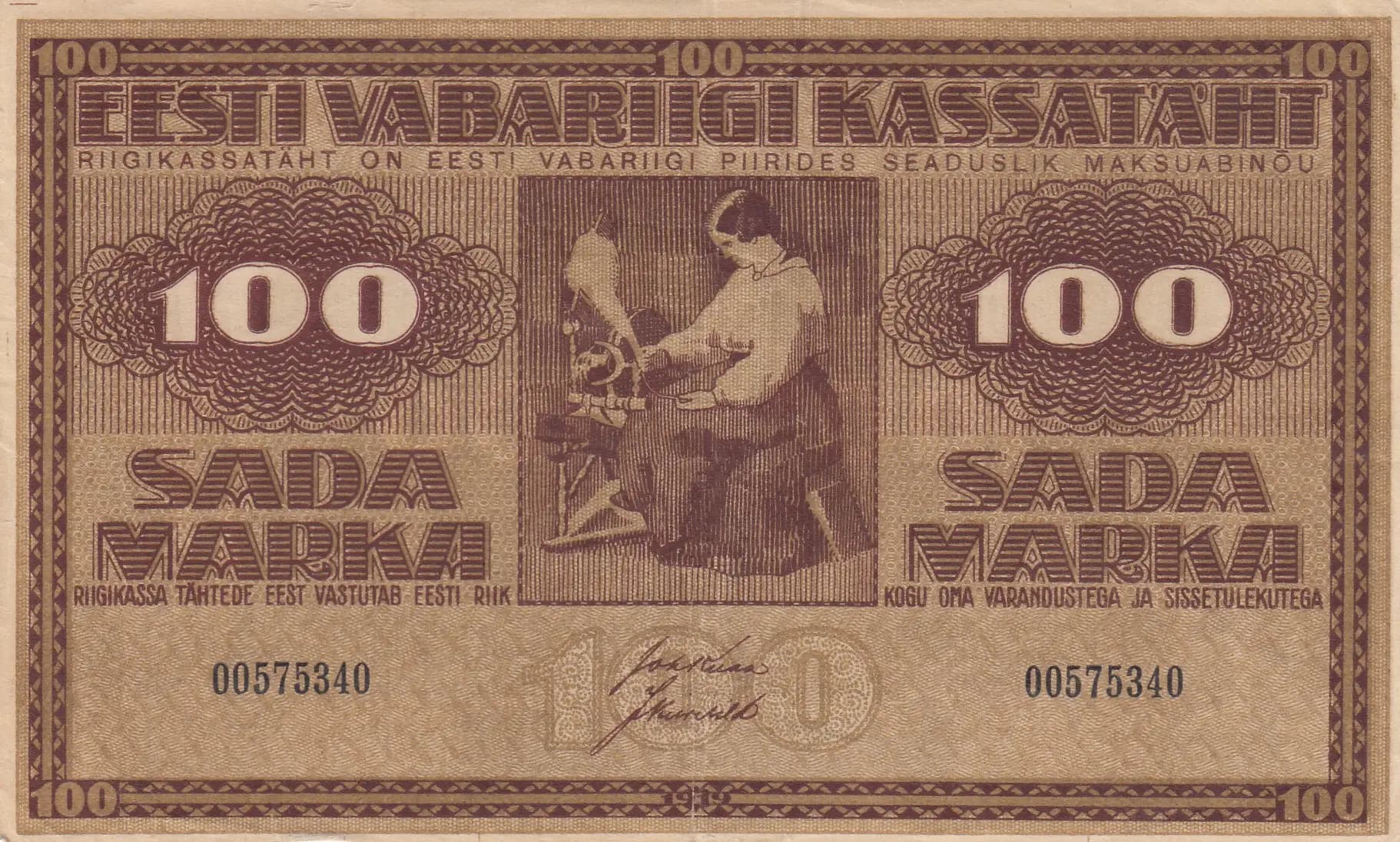
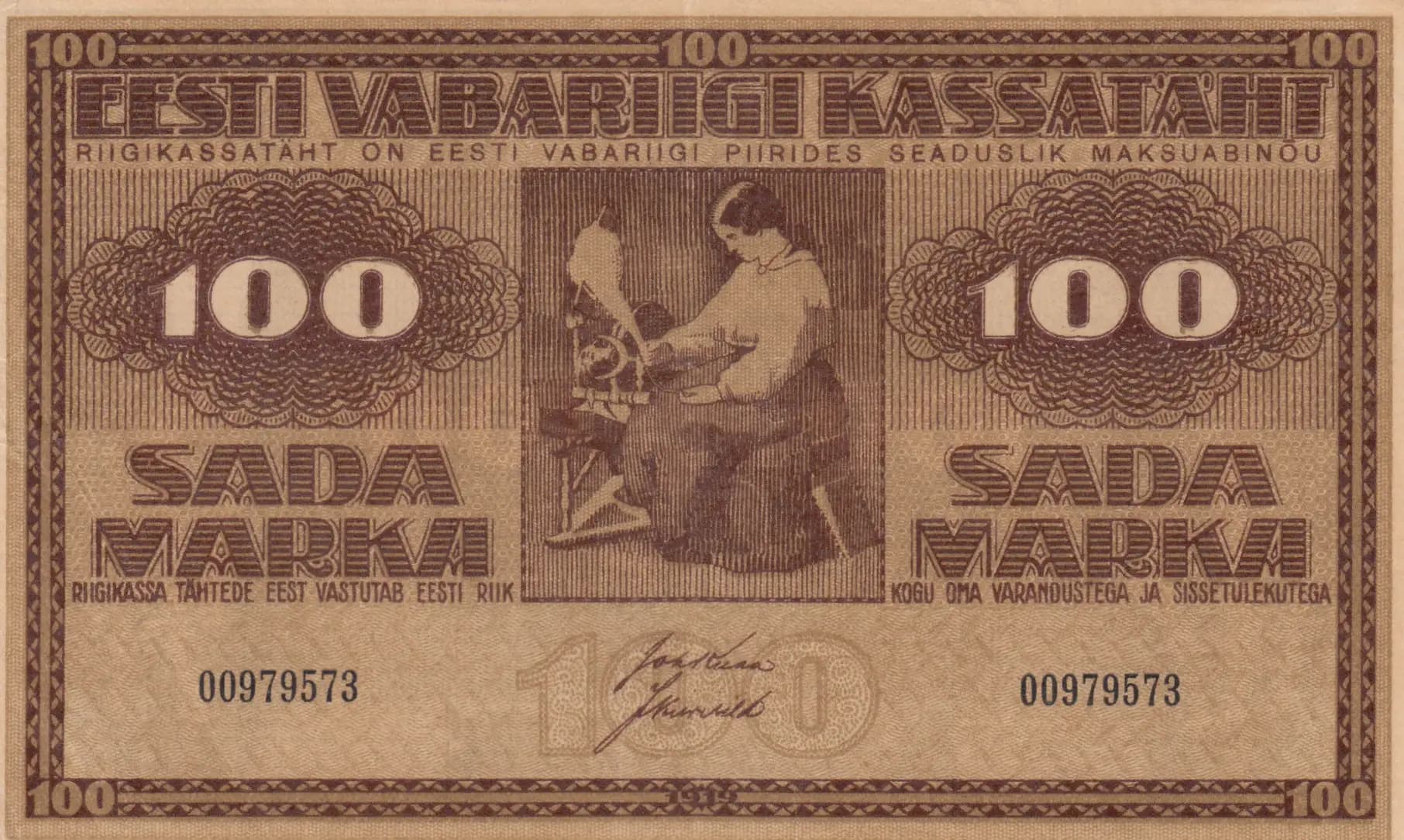
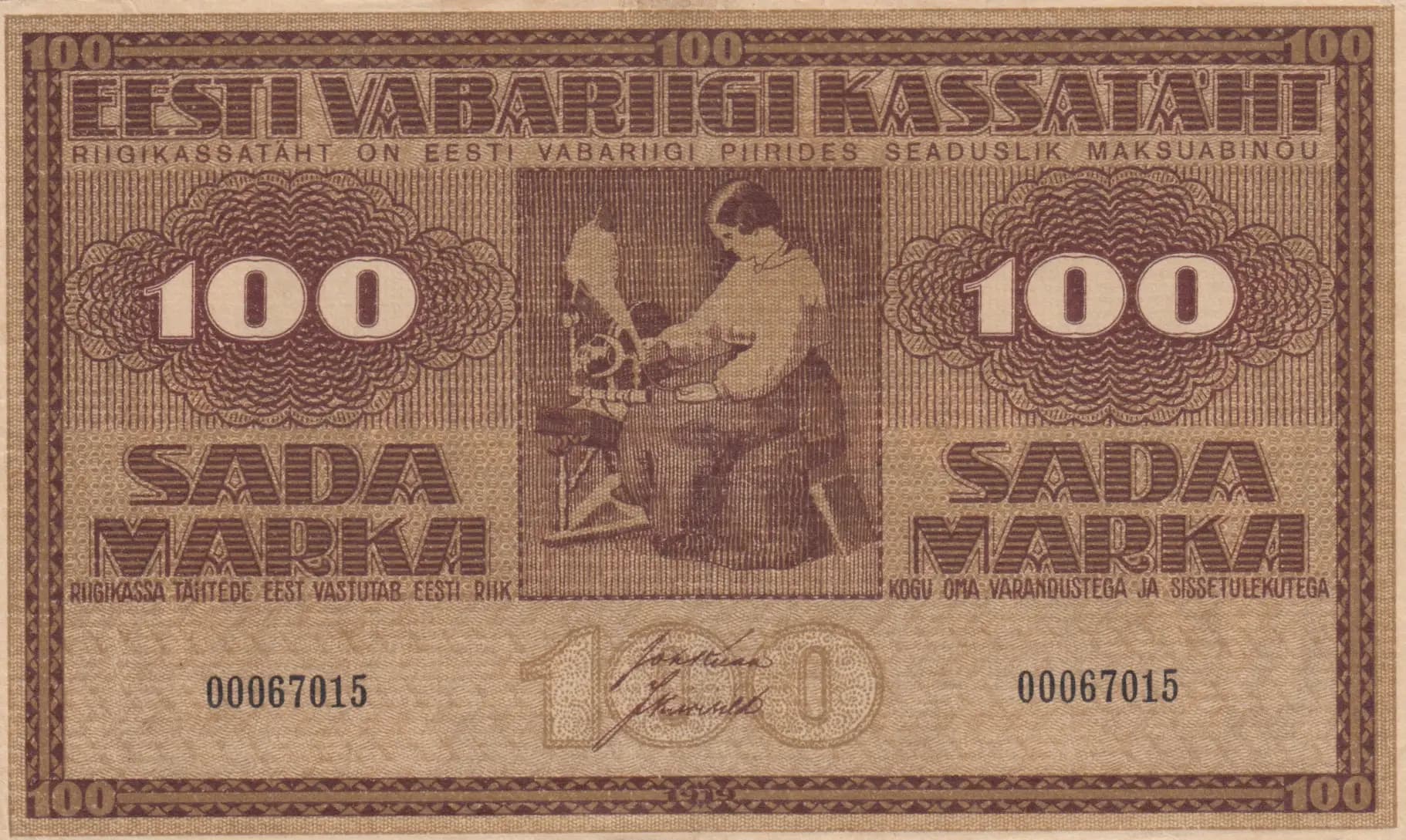
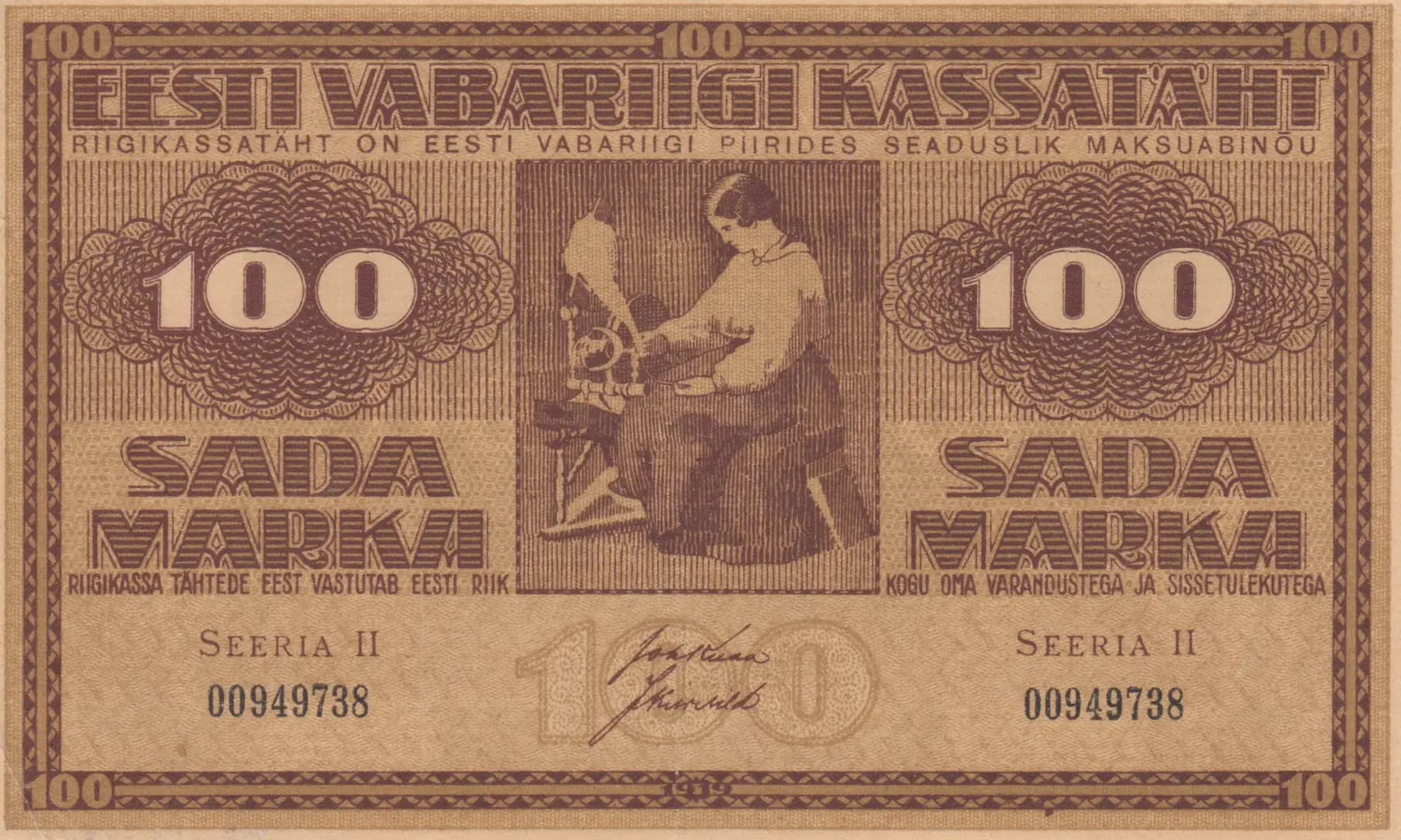
100 marka 1919
“w/m hor lines”
Market Prices
1 saleAbout This Note
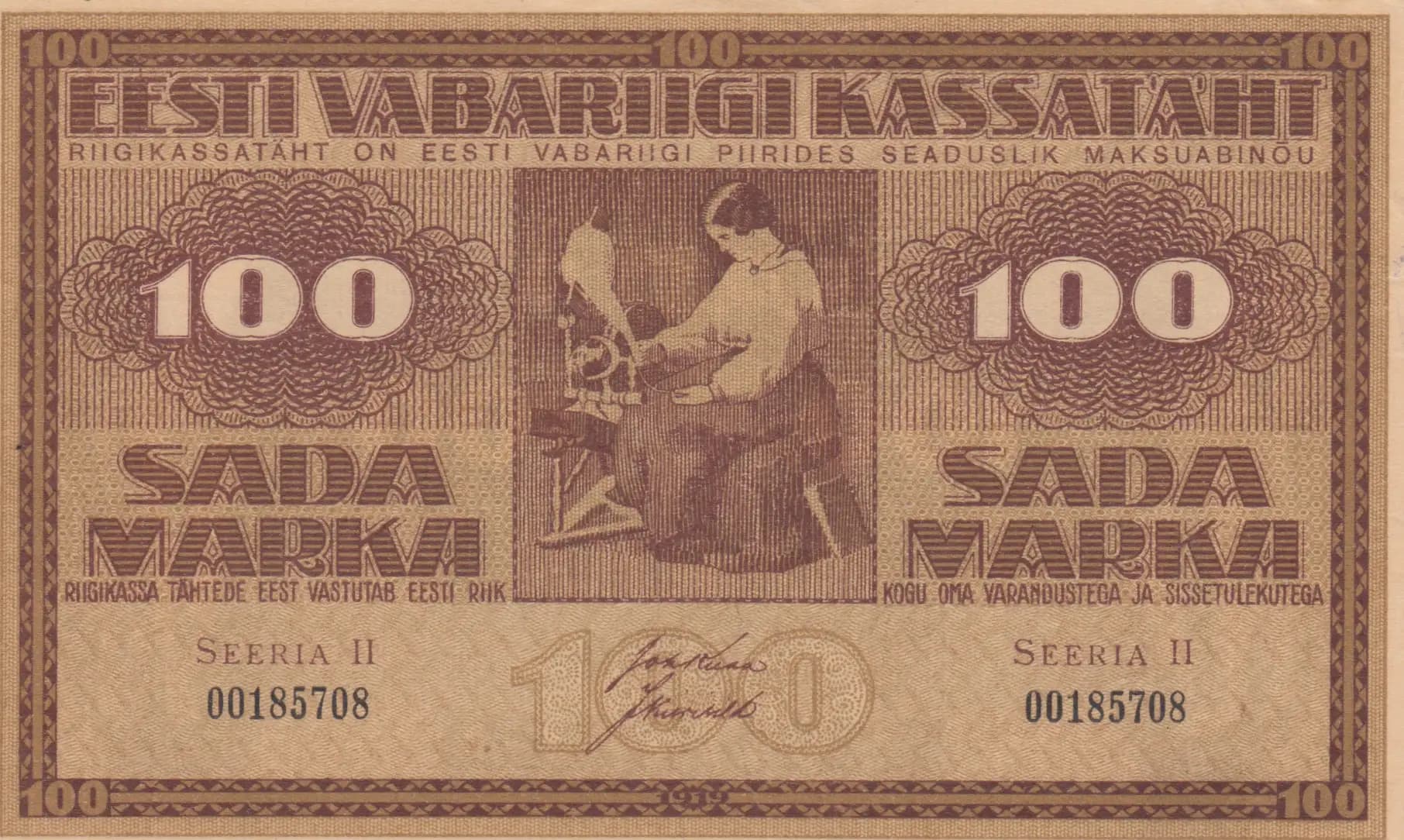
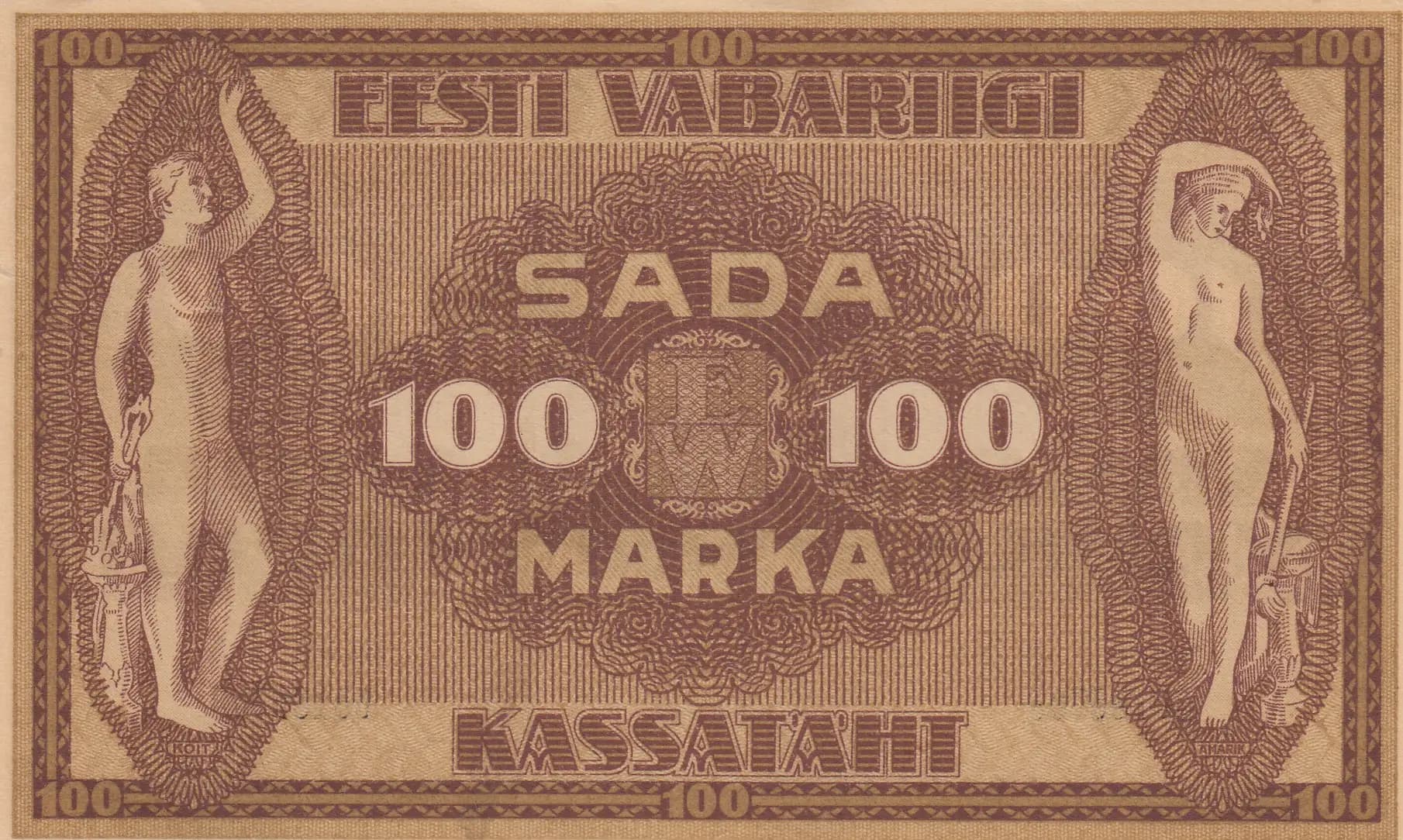
This Estonia 100 Marka from 1919 presents an exceptional example of early Estonian Republic currency in EF condition, featuring the characteristic brown and tan palette with intricate engraving throughout. The obverse displays a woman engaged in textile work at a spinning wheel, centered between decorative cloud-like denomination medallions, while the reverse showcases allegorical classical female figures in an ornate symmetrical composition. The note exhibits crisp, clean printing with no visible wear or circulation marks, making it a desirable specimen for collectors of early Baltic currency.
Common. The eBay market data showing VG condition selling for $41 (2016 catalog values: VG $60, VF $100, UNC $200) indicates this is a readily available note in the collector market. Series II of the 1919 Estonian 100 Marka was issued in significant quantities as part of the new nation's standard circulation currency. The EF condition grade places this note above typical circulated examples but does not represent an exceptional rarity. Early Estonian banknotes, while historically significant, were produced in sufficient volume that high-grade examples remain accessible to collectors at moderate price points.
Issued during Estonia's nascent period as an independent republic following the Russian Revolution and World War I, this 1919 banknote reflects the nation's urgent need to establish its own currency separate from Russian rubles. The imagery deliberately emphasizes Estonian cultural identity through the depiction of traditional textile work—a historically significant craft in Estonian society—while the allegorical figures on the reverse evoke classical themes of prosperity and national strength. The explicit Estonian text and the Treasury's declaration of state responsibility for the currency underscore the new nation's assertion of economic sovereignty during a period of profound political transformation in Eastern Europe.
The obverse features a finely engraved vignette of an Estonian woman in profile, seated and actively engaged in traditional textile craftsmanship, likely spinning or weaving—imagery chosen to represent Estonian cultural heritage and labor. This central portrait is framed by elaborate decorative elements including large cloud-shaped medallions bearing the denomination '100' positioned at left and right, with ornamental borders featuring geometric patterns and fine repeating vertical line work throughout the background. The reverse presents a symmetrical allegorical design depicting two classical female nymphs or figures representing prosperity and national virtue, each positioned within ornate oval frames on either side of a prominent central medallion containing the denomination. The entire composition employs sophisticated engraving with rosette designs, complex geometric borders, and intricate background detailing characteristic of high-security currency production. The consistent brown and tan color scheme, applied to cream and beige base stock, creates visual harmony while the fine line work serves both aesthetic and anti-counterfeiting purposes.
FRONT SIDE: 'EESTI VABARIIGI KASSATÄHT' (Estonian Republic Banknote); '100' and 'SADA MARKI' (One Hundred Marks); 'SEERIA II' (Series II); Serial number '00185708'; 'RIIGIKASSATÄHT ON EESTI VABARIIGI PIIRIES SEADUSLIK MAKSUABINÕU' (State banknote is a legal means of payment within the borders of the Estonian Republic); 'RIIGIKASSA TAHTEDE EEST VASTUAB EESTI RIIK KOGU OMA VARANDUSEGA JA SISSETULEKUTEGA' (The Estonian State is responsible for state banknotes with all its property and revenues). BACK SIDE: 'EESTI VABARIIGI' (Estonian Republic); '100' and 'SADA MARKA' (One Hundred Marks); 'KASSATÄHT' (Banknote).
Intaglio engraving (copperplate printing), the standard security printing method for Estonian banknotes of this period. The visual evidence of fine line work, complex geometric patterns, delicate background details, and the dimensional quality of the engraved portraits are characteristic of intaglio production. The printer for this series was likely one of the established European security printers contracted by the Estonian Treasury, though specific attribution would require additional documentation. The security features incorporated through intricate engraving patterns and fine-line background work were state-of-the-art anti-counterfeiting measures for 1919.
This note is cataloged as Pick P-48b (Series II variant). The catalog data indicates 'w/m hor lines' (watermark horizontal lines), a distinguishing feature of this particular variety. The visual analysis confirms the presence of 'SEERIA II' (Series II) text on the obverse, confirming this is the Series II printing. PMG records indicate variant P-48c exists for this Pick number base, suggesting multiple printings or security feature variations were produced. The specific serial number '00185708' visible on this specimen would be unique to this individual note. Collectors should note that different series and watermark variations of this denomination exist and should be distinguished in catalog documentation.