100 krooni 1935 specimen
Market Prices
3 salesAbout This Note
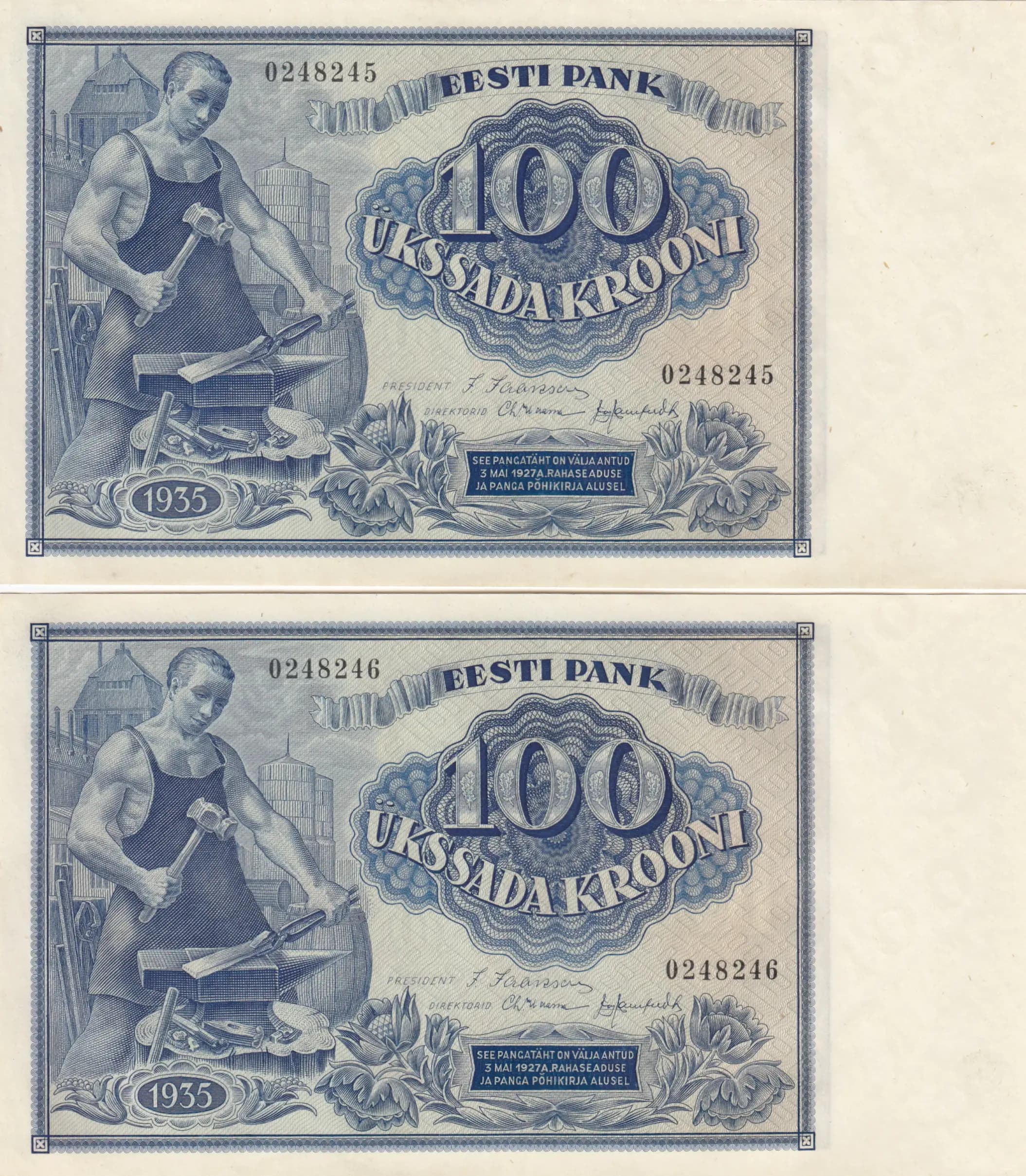
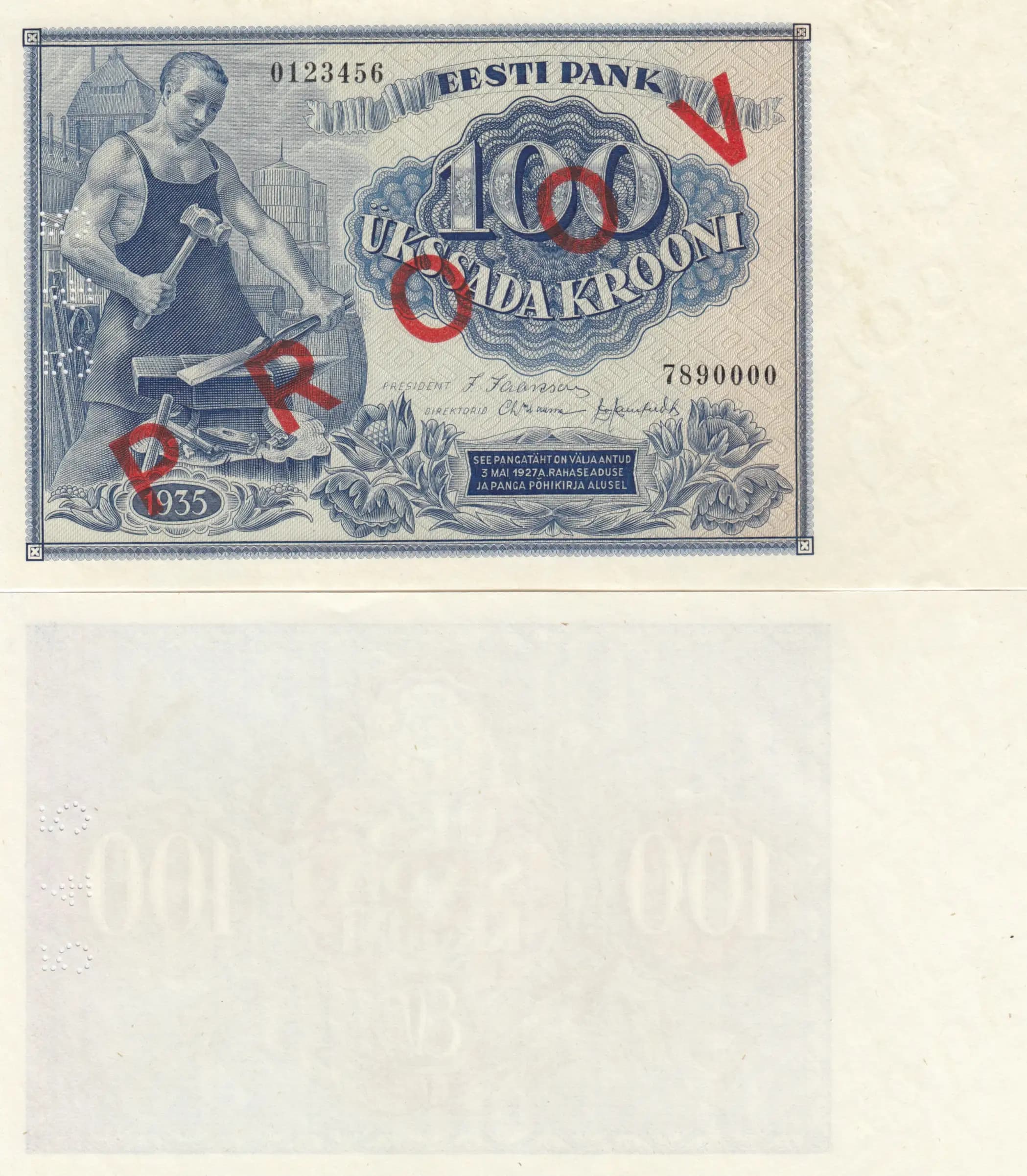
This is an exceptional 1935 Estonian 100 krooni specimen note issued by Eesti Pank, graded UNC. The note features a striking blue-toned obverse depicting a muscular blacksmith at work on the left, symbolizing Estonia's industrial development during the interwar period. Both sides display prominent red 'PROOV' (specimen) markings with official stamps, and the note remains in pristine condition with no circulation wear, making it a desirable example of Estonian numismatic history and early 20th-century security printing craftsmanship.
Common. While specimen notes command a modest premium over issued circulation notes, this particular denomination and date have been produced in sufficient quantities that specimen examples remain readily available in the collector market. eBay sales data confirms moderate pricing ($11-$150 depending on condition across various years), with UNC specimens selling in the $140-150 range — indicating steady but not exceptional collector demand. The note was not recalled, the issuer remained stable, and print runs were substantial, all factors contributing to its classification as a common variety despite its specimen status.
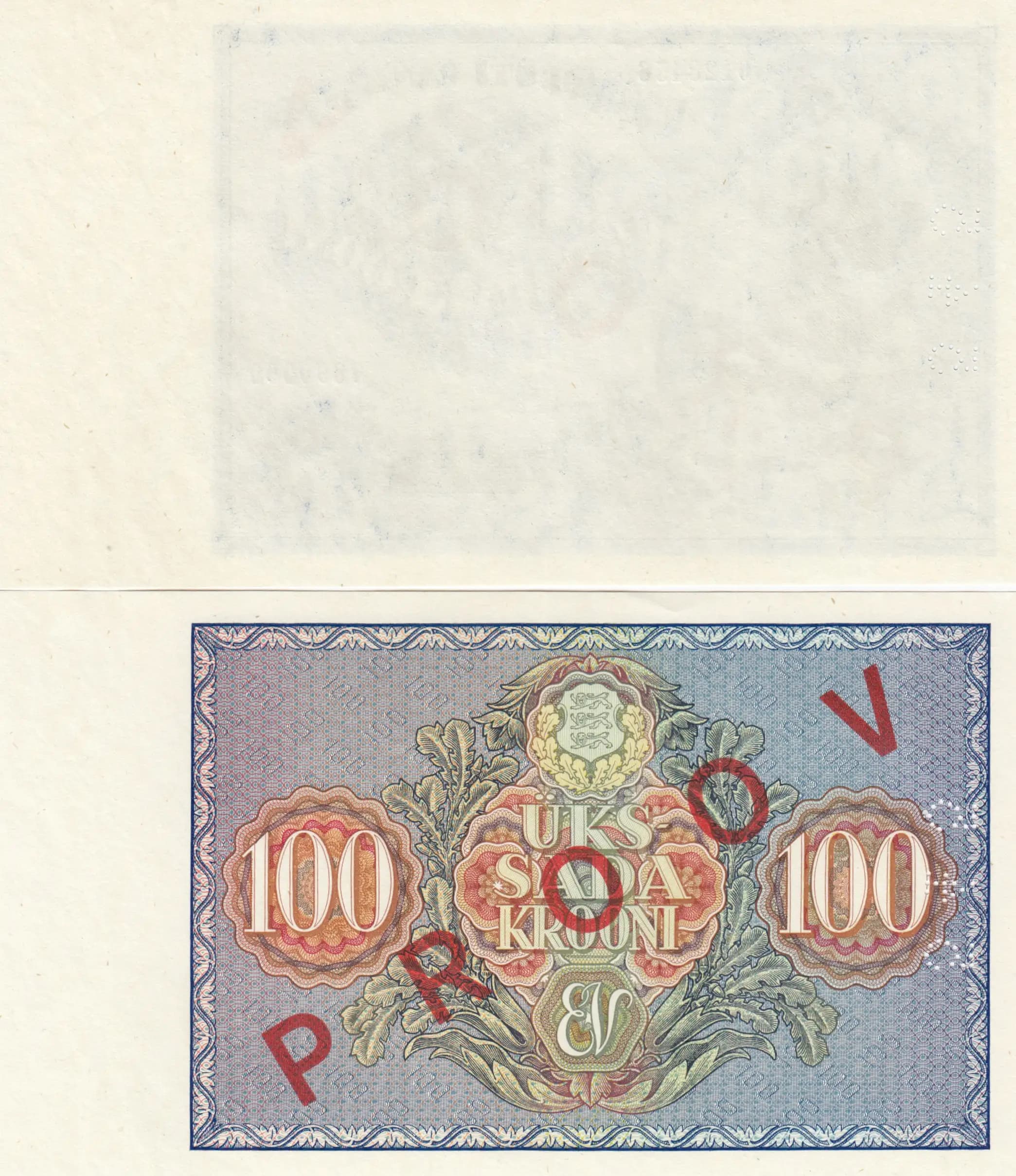
This 100 krooni note was issued during Estonia's first period of independence (1920-1940), specifically in 1935, reflecting the nation's economic development and modernization efforts. The blacksmith depicted on the obverse symbolizes Estonia's industrial capacity and labor-based economy during the interwar years, while the reverse's elaborate heraldic design centered on the Estonian coat of arms (EV - Eesti Vabariik) emphasizes national sovereignty. The specimen marking itself indicates this was a presentation or security printer's proof, part of the quality control and demonstration process for Estonia's currency production.
The obverse features a classical male figure depicted as a blacksmith or craftsman in muscular, heroic style, shown in profile facing left while holding hammer and tools. Behind the figure are architectural elements representing industrial or institutional buildings, symbolizing Estonian urban development and economic progress. The denomination '100' is prominently displayed in an ornate oval cartouche in the center, flanked by decorative corner ornaments and floral elements at the base. The reverse presents an elaborate heraldic composition centered on a large oval cartouche containing the Estonian coat of arms (the lion rampant of Estonia), surrounded by baroque-style floral scrollwork and symmetrical decorative flourishes. The denomination '100' appears prominently on both left and right sides of the reverse. The overall color scheme combines blue, red, green, yellow/gold, and purple tones typical of the period's security printing standards.
Front side: 'EESTI PANK' (Estonian Bank); '100' and 'ÜÜDA KROONI' (One Hundred Krooni); '1935' (year of issue); 'PRESIDENT' and 'DIREKTOR' (signature titles); 'SEE PANGA TICKET ON VALIA ANTUD 2 MAI 1927.A, RAHASE ADUSE JA PANGA PÖHIKIRJA ALUSEEL' (This bank note was validly issued on May 2, 1927, on the basis of the currency law and the bank's charter). Back side: '100' (denomination, repeated left and right); 'UKS SADA KROONI' (One Hundred Krooni); 'EV' (Eesti Vabariik - Estonian Republic). Both sides bear red 'PROOV' (Specimen) overprints with official validation stamps.
Intaglio engraving (copperplate/steel engraving), the standard security printing technique for high-value banknotes of the period. The detailed line work, intricate decorative borders, fine background patterns, and complex heraldic detailing are characteristic of professional intaglio production. The specimen note likely was produced by a specialized European security printer contracted by Eesti Pank, as was standard practice for the Estonian central bank during the interwar period.
This is cataloged as P-66s (the 's' denoting specimen status), with Pick records indicating P-66a as an alternative variant designation. The specimen markings ('PROOV' overprints with 'V' and 'P' stamps) confirm this as an official specimen issue rather than a circulation note. The visible serial numbers in the images (0123456 and 7890000 ranges) are consistent with specimen note numbering practices, though specimen notes typically use sequential or placeholder series rather than standard circulation serial ranges. No significant printing varieties beyond specimen/issued distinction are noted for this denomination.