10 rubla 1941
“blank w #”
About This Note
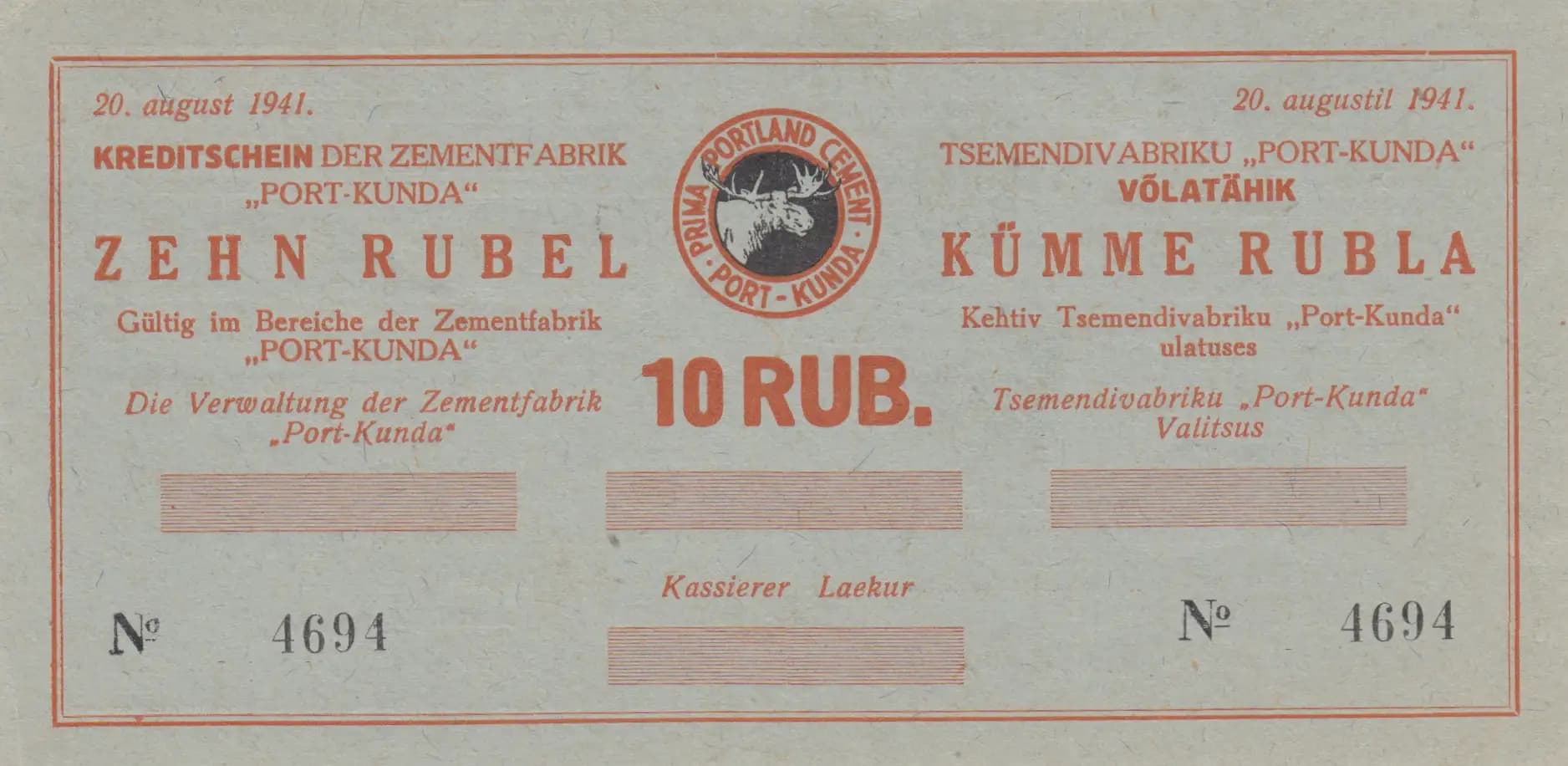
This is a 10 Rubla credit note (Kreditschein) issued by the Port-Kunda cement factory on August 20, 1941, during the German occupation of Estonia in World War II. The note is printed in red and black on light gray paper and remains in AU condition with minimal wear, clear printing, and well-preserved paper showing only light aging. The bilingual German-Estonian presentation and circular factory seal featuring a reindeer emblem make this an interesting example of wartime industrial scrip that documents the economic adaptation of occupied territories.
Common. Port-Kunda industrial credit notes from 1941 are relatively common in the numismatic market, as the factory issued multiple denominations and serial numbers across several months of validity extensions. The AU condition grade is not uncommon for surviving examples, as these notes were issued in a controlled industrial setting and many were preserved rather than circulated intensively. While these notes represent an important historical document of World War II occupation economics, they were issued in sufficient quantity that they do not command premium prices typical of rare currency. Serial number 4694 indicates this is from a substantial print run.
This note represents a fascinating artifact of the German occupation period (1941-1944) when Estonia was incorporated into the Reichskommissariat Ostland. The Port-Kunda cement factory, a major industrial concern, issued this credit note as a substitute currency valid only within the factory's operations, reflecting wartime economic fragmentation and the German administrative apparatus's attempt to maintain industrial production. The bilingual German-Estonian text and the reference to Soviet ruble equivalency (despite Nazi occupation) illustrate the complex economic and political dynamics of occupied territory, where German management structures coexisted with local administrative participation.
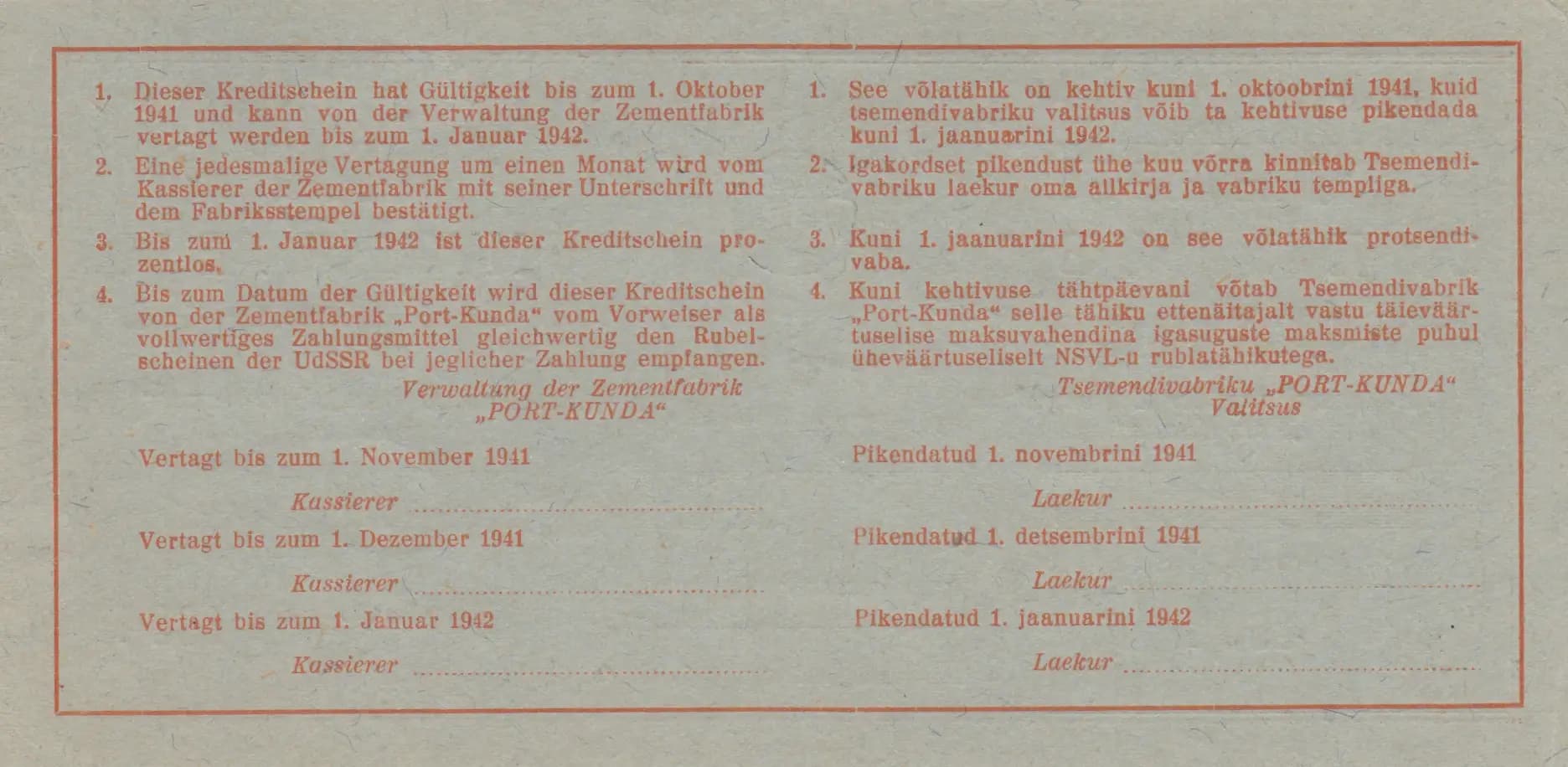
The note features a symmetrical bilingual layout reflecting the dual German occupation authority and Estonian local administration. The front displays a circular emblem/seal at the center showing a reindeer or similar horned animal with the text 'PORTLAND CEMENT PORT-KUNDA' around the circumference—this seal served both as a corporate identifier and security feature. The denomination '10 RUB.' is prominently positioned in the center in large numerals. German text appears on the left side and Estonian equivalents on the right, creating a mirror-image layout typical of bilingual occupation-era documents. The back contains four numbered terms and conditions in the same bilingual format, with multiple blank lines for dated signatures and factory stamps to authenticate monthly extensions of validity. The overall design is formal and official in appearance, emphasizing the note's nature as an administrative currency substitute rather than decorative banknote artwork.
FRONT: 'Credit note of the cement factory Port-Kunda' (German: Kreditschein der Zementfabrik "Port-Kunda") / '10 RUB.' (denomination) / 'Ten rubles' (German: Zehn Rubel; Estonian: Kümme Rubla) / 'Valid in the area of the cement factory Port-Kunda' (German: Gültig im Bereiche der Zementfabrik "PORT-KUNDA"; Estonian: Kehtiv Tsemendivabriku "Port-Kunda" ulatuses) / 'The administration of the cement factory Port-Kunda' (German: Die Verwaltung der Zementfabrik "Port-Kunda"; Estonian: Tsemendivabriku "Port-Kunda" Valitsus) / 'August 20, 1941' (Estonian: 20. augustil 1941) / Serial number: N° 4694 / Signature lines for Cashier/Accountant (German: Kassierer; Estonian: Laekur). BACK: Terms and conditions in four numbered points: '(1) This credit note is valid until October 1, 1941 and can be extended by the cement factory administration until January 1, 1942' / '(2) Each extension by one month will be confirmed by the cement factory cashier with his signature and factory stamp' / '(3) Until January 1, 1942, this credit note is interest-free' / '(4) Until the date of validity, this credit note will be accepted by the Port-Kunda cement factory as full-value payment equivalent to Soviet ruble notes for any payment' / Extension dates for validity periods: 'Extended until November 1, 1941' / 'Extended until December 1, 1941' / 'Extended until January 1, 1942' (each with bilingual German-Estonian text).
The note was produced using letterpress printing in two colors (red/orange and black) on a light gray or beige paper stock. The clarity of the bilateral text and the crisp impression of the circular seal suggest professional printing by a dedicated security printer, likely under German occupation administration. The symmetric bilingual layout and formal typographical arrangement indicate careful pre-planning and execution typical of official occupation-era financial instruments. The paper quality and printing precision suggest production by an established printing facility operating under German military administration, though specific printer attribution is not documented in available catalogs.
This note represents variety with serial number 4694 and shows evidence of the extension system documented on the back—blank lines for November 1, December 1, and January 1, 1942 extensions, though these appear unsigned on the example shown. Varieties of this note exist based on: (1) Serial number ranges and prefixes, (2) Presence or absence of handwritten extension dates and signatures, and (3) Factory stamp impressions on extension lines. The August 20, 1941 issue date marks this as from the initial issuance period. Notes showing all three extension periods stamped and signed represent completed validity cycles and may be considered more interesting from a historical perspective, documenting the full operational period of the credit note system.