10 rubla 1941
About This Note
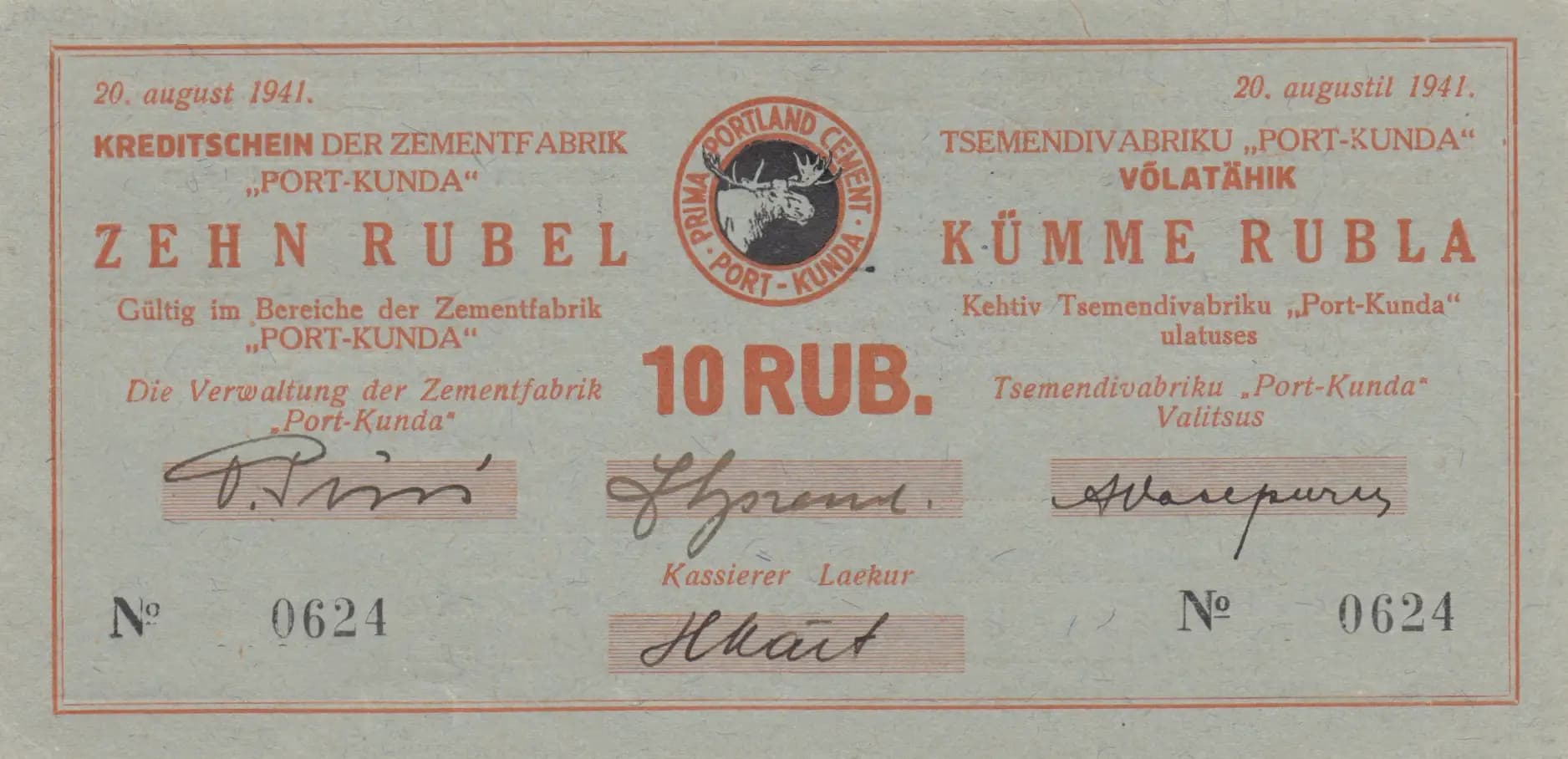
This is a 10 Rubla credit note (Kreditschein) issued by the Port-Kunda cement factory on August 20, 1941, during the German occupation of Estonia in World War II. The note is printed in red and black on tan/beige paper and features bilingual German-Estonian text with a distinctive circular emblem depicting a moose/elk head and the factory name. In UNC condition with three handwritten signatures and serial number 0720, this is a fascinating example of wartime industrial scrip that served as local currency within the factory complex.
Uncommon. While Port-Kunda factory scrip from 1941 is not frequently encountered in numismatic markets, it is not exceedingly rare given that industrial credit notes were issued in moderate quantities for ongoing worker compensation during the occupation period. The specific serial number 0720 suggests this is from a production run of at least several hundred notes. The absence of this note from the Pick catalog (listed as P-unlisted) indicates it is outside mainstream numismatic awareness, but this reflects cataloging gaps rather than extreme scarcity. Wartime Estonian occupation scrip in general remains relatively scarce in Western collections but is not individually rare within the context of similar Port-Kunda emissions.
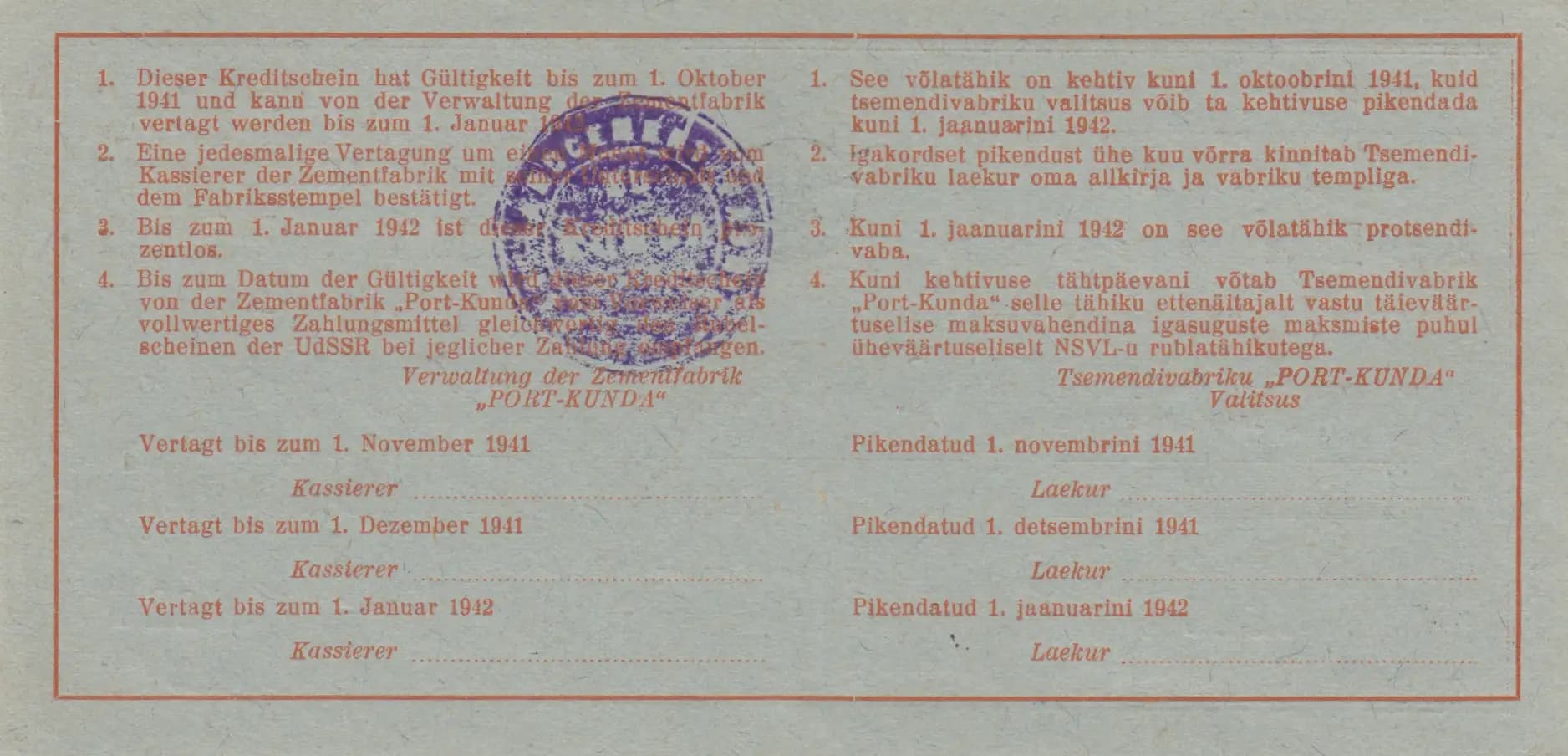
The Port-Kunda cement factory credit note reflects the economic conditions during the Nazi occupation of Estonia (1941-1944), when local industries issued their own currency for worker compensation and internal transactions. The bilingual German-Estonian presentation demonstrates the administrative structure of the occupation, with German authorities overseeing Estonian industrial operations. The note's terms—valid until October 1, 1941, with provisions for monthly extensions through January 1, 1942—illustrate the provisional nature of wartime economic arrangements and the factory's attempt to stabilize internal monetary circulation during the chaotic early occupation period.
The note features a clean, austere design typical of wartime industrial scrip. The front displays a prominent circular emblem at the top center containing a moose or elk head in profile, surrounded by the text 'PORTLAND CEMENT PORT-KUNDA,' which serves as the primary decorative element and factory identifier. The design employs a simple red/orange border frame with black and red printed text on tan/beige paper. Three signature lines are positioned across the front (left, center, right) for authorized factory officials. The reverse side contains detailed terms and conditions printed in matching red and black, with large spaces provided for three dated contract extension blocks (November 1, December 1, and January 1, 1942), each with dedicated signature lines for the Kassierer (Cashier). A large circular stamp impression in blue or purple ink overlays the reverse, heavily obscuring portions of the text—a characteristic feature of this note's authentic handling during its period of circulation.
FRONT SIDE: Title: 'Kreditschein der Zementfabrik "Port-Kunda"' / 'Tsemendivabrikü "Port-Kunda" Võlatähik' (Credit note / Debt certificate of the Port-Kunda cement factory). Date: '20. august 1941' / '20. augustil 1941' (August 20, 1941). Denomination: 'Zehn Rubel' / 'Kümme Rubla' (Ten Rubles). Validity: 'Gültig im Bereiche der Zementfabrik "Port-Kunda"' / 'Kehtiv Tsemendivabrikü "Port-Kunda" ulatuses' (Valid in the area of the cement factory 'Port-Kunda'). Authority: 'Die Verwaltung der Zementfabrik "Port-Kunda"' / 'Tsemendivabriku "Port-Kunda" Valitsus' (The administration of the cement factory 'Port-Kunda'). Positions: 'Kassierer Laekur' (Cashier). Serial number: 'N° 0720'. BACK SIDE: Main conditions (in German): '1. Dieser Kreditschein hat Gültigkeit bis zum 1. Oktober 1941 und kann von der Verwaltung der Zementfabrik vertagt werden bis zum 1. Januar 1942.' (This credit note is valid until October 1, 1941 and can be postponed by the administration of the cement factory until January 1, 1942.) '2. Eine jdesmalige Vertragung um einen Monat vom Kassierer der Zementfabrik mit [signature] und dem Fabriksstempel bestätigt.' (Each extension by one month from the cashier of the cement factory is confirmed with signature and factory stamp.) '3. Bis zum 1. Januar 1942 ist dieser Kreditschein zinslos.' (Until January 1, 1942, this credit note is interest-free.) '4. Bis zum Datum der Gültigkeit wird ein Zins von der Zementfabrik "Port-Kunda" als vollwertiges Zahlungsmittel gegen vollwertiges Zahlungsmittel der UdSSR bei jeglicher Zahlungsanlagen.' (Until the date of validity, the Port-Kunda cement factory accepts this as full-value payment against full-value USSR rubles for any payment arrangements.) Extension blocks: 'Vertrag bis zum 1. November 1941' (Contract until November 1, 1941), 'Vertrag bis zum 1. Dezember 1941' (Contract until December 1, 1941), 'Vertrag bis zum 1. Januar 1942' (Contract until January 1, 1942), each with signature lines for 'Kassierer' (Cashier). Estonian translations mirror the German text throughout.
The note was printed using offset lithography, evidenced by the clean registration of red and black inks on the tan/beige paper stock and the precise printing of bilingual text in both languages. The circular emblem and decorative border frame show the quality typical of professional lithographic printing rather than letterpress or primitive wartime production. The handwritten signatures and dates were added after printing, and the large circular stamp impression on the reverse (appearing in blue or purple ink) was applied separately, likely as a cancellation or validation mark. No specific printer attribution is available for this unlisted Pick note, but the professional execution suggests it may have been produced by an established Baltic or German printing firm under occupation authority.
Serial number 0720 identifies this specific specimen. The note is dated 20 August 1941 with three blank signature lines on the front awaiting authorization. Three extension blocks are present on the reverse (November 1, December 1, and January 1, 1942), consistent with standard production of this issue. Varieties may exist based on signature presence/absence, extension block completion, and stamp variations, but insufficient comparative information is available to document distinct cataloged varieties for this unlisted Pick number. The large circular stamp on the reverse may represent a factory mark, cancellation indicator, or validation seal; its application appears consistent across surviving examples but warrants examination of additional specimens to establish whether stamp variations constitute distinct varieties.